2. Roots
+ Customize lesson
0
0
Sign In
This lesson focuses on the foundational concepts of square roots and cube roots, as well as the properties of irrational numbers. It explains how to calculate roots and what radicands and indices are in this context. The lesson is particularly useful for students who are looking to deepen their understanding of these mathematical concepts. For example, knowing how to work with roots can help in solving real-world problems like calculating areas and volumes. Understanding irrational numbers can also be beneficial for various scientific applications. The teaching approach combines theoretical knowledge with practical examples, making it easier to grasp these complex topics.
| Student Learning Objectives: |
|---|
|
| | 16 Theory slides |
| | 10 Exercises - Grade E - A |
| | Each lesson is meant to take 1-2 classroom sessions |
A backyard garden has square vegetable patches of tomatoes, broccoli, and corn.

The tomato patch has an area of 9 square yards. Find the side length of the tomato patch.
The broccoli patch has an area of 36 square yards. Find the length of the side of the broccoli patch.
The corn field has an area of 121 square yards. Find the side length of the corn field.
What are the common characteristics between all the squares?
The n^(th) root of a real number a expresses another real number that, when multiplied by itself n times, will result in a. The notation is made up of a radical symbol, radicand a, and index n.

For example, the radical expression sqrt(16) is the fourth root
of 16. Notice that sqrt(16) simplifies to 2 because 2 multiplied by itself 4 times equals 16.
Even n^\text{th} roots are defined only for non-negative real numbers. When n is even and the radicand is positive, two real roots exist; the positive one is known as the principal root. For example, the number 16 has two square roots. ccc & &sqrt(16)=± 4& & &⇕& &4^2=16 &and& (-4)^2=16 The principal root of 16 is 4. In contrast, when considering odd roots, such as cube roots, there is only one real root, which then is the principal root. sqrt(27)=3 ⇔ 3^3=27 Since odd roots are defined for all real numbers, the principal root can be either negative or positive. Suppose that n is an integer greater than 1 and a is a real number.
| n is even | n is odd | |
|---|---|---|
| a> 0 | Two square roots: one positive and one negative. The principal root is the positive one. | One positive root, which is the principal root. |
| a= 0 | The only root is zero. | The only root is zero. |
| a< 0 | No real roots. | One negative root, which is the principal root. |
The most common roots have an index of 2 or 3. These common roots have special names: square roots and cube roots, respectively.
A square root of a number a is a number that, when multiplied by itself, equals a. For example, 4 and - 4 are the square roots of 16. 4* 4 &= 16 [0.5em]
-4 * (-4)&=16
All positive numbers have two square roots, one positive and one negative. To avoid ambiguity, when talking about the square root of a number, only the positive root, also known as its principal root, is considered. The radical symbol sqrt()
is used to indicate the square root of a number. For example, the square root of 16 is written as sqrt(16).
sqrt(16) = 4
The principal root of 16 is 4 because 4 multiplied by itself equals 16 and 4 is positive. When a number is a perfect square, its square roots are integers.
| Principal Root of Perfect Squares | Principal Root of Non-Perfect Squares | ||
|---|---|---|---|
| Perfect Square | Principal Root (Integer Number) |
Non-Perfect Square | Principal Root (Irrational Number) |
| 1 | sqrt(1)=1 | 2 | sqrt(2)≈ 1.414213... |
| 4 | sqrt(4)=2 | 3 | sqrt(3)≈ 1.732050... |
| 9 | sqrt(9)=3 | 5 | sqrt(5)≈ 2.236067... |
| 16 | sqrt(16)=4 | 10 | sqrt(10)≈ 3.162277... |
| 25 | sqrt(25)=5 | 20 | sqrt(20)≈ 4.472135... |
The square root of a negative number is not a real number because there is no real number that, when multiplied by itself, results in a negative number. a * a ≥ 0, for any real numbera
The cube root of a number a is a number that, when multiplied by itself three times, equals a. For example, 2 is the cube root of 8. 2 * 2 * 2 = 8 ⇒ sqrt(8) = 2 Cube roots and raising a number to the third power are operations that undo each other.
sqrt(a^3) = a and (sqrt(a))^3=a
Unlike square roots, cube roots can yield negative results. This is because the product of three negative factors is negative. ( - 2)( - 2)( - 2)=- 8 ⇒ sqrt(-8) = -2
Calculate the exact square and cube roots.

The set of irrational numbers is formed by all numbers that cannot be expressed as the ratio between two integers. sqrt(2), sqrt(3), sqrt(5), e, π ... Irrational numbers are real numbers, but they cannot be expressed as fractions. The decimal expansion of irrational numbers is not repeating and non-terminating. sqrt(2) &= 1.41421356237... π &= 3.14159265359 ... In other words, a number is irrational if it is not rational. Although this number set does not have its own symbol, it is sometimes represented with a combination of other symbols.
R-Q or R \ QThe square root of a whole number that is not a perfect square is irrational. The cube root of an integer that is not a perfect cube is also irrational. For other roots, check whether the radicand is a perfect power that matches the index of the root.
| Radical Number | Rewrite | Result |
|---|---|---|
| sqrt(25) | sqrt(5^2) | Rational Number |
| sqrt(18) | sqrt(3^2* 2) | Irrational Number |
| sqrt(27) | sqrt(3^3) | Rational Number |
| sqrt(25) | sqrt(5^2) | Irrational Number |
Determine whether the given number is rational or irrational.

Consider taking the square root of a number. If the radicand is a perfect square, then it is a rational number. If the radicand is not a perfect square, then it is an irrational number. The radicand of sqrt(2) is 2. 2 is not a perfect square ⇓ sqrt(2) is an irrational number We can use a calculator to find the exact value of sqrt(2). To write the square root sign sqrt(), push 2ND and x^2. Then, press the 2 and ENTER buttons.

Although a finite number of decimals is displayed on the calculator screen, the truth is that this value does not terminate. As such, its exact form is sqrt(2). The values of irrational numbers are often rounded to one or two decimal places to easily locate them on a number line. 1.414213562 ... ≈ 1.4 The value of sqrt()2 is less than 2 and greater than 1. Since 1.4 is close to 1.5, the value is located around 1.5 on the number line.

A park has five walking trails. Their lengths, in kilometers, are represented by the following irrational numbers.
| Trail | Length (km) |
|---|---|
| Robin Trail | sqrt(5) |
| Meadowlark Trail | sqrt(5) |
| Cardinal Trail | sqrt(14) |
| Hummingbird Trail | sqrt(20) |
| Owl Trail | sqrt(34) |
Use a calculator to find the approximate length of each trail. Then, order these lengths from least to greatest.

The Meadowlark Trail has a length of sqrt(5) kilometers. Since this is a cube root, we push the MATH button first, then select the fourth option sqrt()(.
We enter the value of the radicand, 5, and push the ENTER button to see the result.


We use the same process to find the values of the remaining radicals.

Next, we round each radical to two decimal places.
| Trail | Length (km) | Rounding |
|---|---|---|
| Robin Trail | sqrt(5) = 2.236067977 ... | 2.24 |
| Meadowlark Trail | sqrt(5) = 1.709975946 ... | 1.71 |
| Cardinal Trail | sqrt(14) = 2.410142264 ... | 2.41 |
| Hummingbird Trail | sqrt(20) = 4.472135955 ... | 4.47 |
| Owl Trail | sqrt(34) = 3.239611801 ... | 3.24 |
Finally, let's sort these numbers from least to greatest using a number line.

To finish, we can write the lengths of the walking trails in order from shortest to longest in the table.
| Trail | Exact Length (km) | Estimated Length (km) |
|---|---|---|
| Meadowlark Trail | sqrt(5) | 1.71 |
| Robin Trail | sqrt(5) | 2.24 |
| Cardinal Trail | sqrt(14) | 2.41 |
| Owl Trail | sqrt(34) | 3.24 |
| Hummingbird Trail | sqrt(20) | 4.47 |
A square root can be rounded to its nearest whole number without calculating its exact value. To do so, start by finding the closest perfect squares to the radicand and calculate their square roots. The initial square root will be located between the two consecutive whole numbers. For example, consider sqrt(40) and several perfect squares close to 40. 25 , 36 , 49 , 64 Since 40 is greater than 36 and less than 49, sqrt(40) is between the square roots of these two values. c 36 & < & 40 & < & 49 sqrt(36) & < & sqrt(40) & < & sqrt(49) Now calculate the square roots of the two perfect squares. c sqrt(36) & < & sqrt(40) & < & sqrt(49) 6 & < & sqrt(40) & < & 7 It can be concluded that the exact value of sqrt(40) is between 6 and 7. Next, we will round the value to one of these numbers. Which number is closer to sqrt(40), 6 or 7? 40- 36=4 & 49-40=9 ⇓ 4 < 9 Since 40 is closer to 36 than to 49, sqrt(40) is closer to sqrt(36) than it is to sqrt(49). Because of this, sqrt(40) rounds to sqrt(36), or 6.
sqrt(40) ≈ 6A cube root can be rounded to the nearest integer without using a calculator. For example, consider sqrt(100). sqrt(100) First, find the perfect cubes closest to 100. The greatest perfect cube less than 100 is 64, and the least perfect cube greater than 100 is 125. 64 & < & 100 & < & 125 The inequality means that the cube root of 100 is between the cube roots of 64 and 125. sqrt(64) < sqrt(100) < sqrt(125) Next, calculate the cube roots of the two perfect cubes. 4 & < & sqrt(100) & < & 5 The exact value of sqrt(100) is somewhere between 4 and 5. Next, determine which number is closer to sqrt(100). 100- 64 = 36 & 125-100=25 ⇓ 36 > 25 Since 100 is closer to 125 than it is to 64, sqrt(100) is closer to sqrt(125) than to sqrt(64). Therefore, we round it to the integer 5.
sqrt(100) ≈ 5Without a calculator, estimate the given square root or cube root to its nearest integer.

At the beginning of the lesson, we heard about a backyard garden's vegetable patches.

The tomato patch has an area of 9 square yards. Find the side length of the tomato patch.
The broccoli patch has an area of 36 square yards. Find the length of the side of the broccoli patch.
The corn field has an area of 121 square yards. Find the side length of the corn field.
What are the common characteristics between all the squares?
The area of a square is the square of a side length. Squaring a number and taking the square root of the number are inverse operations.
The area of a square is the square of a side length. Squaring a number and taking the square root of the number are inverse operations.
The area of a square is the square of a side length. Squaring a number and taking the square root of the number are inverse operations.
Check each side length and area based on the given characteristics.
A square is a rectangle with four equal side lengths. We can find the area of a square by squaring the length of a side.
c Side Length & Area a & a^2 The tomato patch is a square, so we can use the inverse operation to find its side length. We take the square root of the area. c Area & Side Length a^2 & sqrt(a^2)=a We know that 9 is a perfect square because it can be written as the square of 3. Let's take the square root of 9 to find the side length of the tomato patch. c Area & Side Length 9 & sqrt(3^2)=3 The side length of the tomato patch is 3 yards.
To find the side length of the broccoli patch, we use the same method as in Part A. We take the square root of 36 to undo the squaring.
c Area & Side Length [0.5em] a^2 & sqrt(a^2)=a [0.5em] 36 & sqrt(6^2)=6 The side length of the broccoli patch is 6 yards. This also means that 36 is a perfect square.
We continue with the last field. This time, we take the square root of 121. Because 11^2 = 121, 121 is also a perfect square.
c Area & Side Length [0.5em] a^2 & sqrt(a^2)=a [0.5em] 121 & sqrt(11^2)=11 The side length of the corn field is 11 yards.
Lastly, we need to find what the areas and side lengths have in common. In the previous parts, we found that all the areas are perfect squares. This also tells us that all the side lengths are integers.
| Perfect Square? | Area | Side Length | Integer? |
|---|---|---|---|
| ✓ | 9yd | 3yd^2 | ✓ |
| ✓ | 36yd | 6yd^2 | ✓ |
| ✓ | 121yd | 11yd^2 | ✓ |
Since every integer is a rational number, each side length is also a rational number, not an irrational number. Let's check whether the side lengths are multiples of 3.
| Multiple of 3 | |
|---|---|
| 3 | ✓ |
| 6 | ✓ |
| 11 | * |
We found that three of the given characteristics are common to all the vegetable patches.
| All the side lengths are integers. | ✓ |
| All the side lengths are rational numbers. | ✓ |
| All the areas are perfect squares. | ✓ |
Ignacio wants to buy a huge mirror to tie the decorations in his living room together. He examines the following mirror online. The height of the mirror is given as sqrt(20) feet on the website.
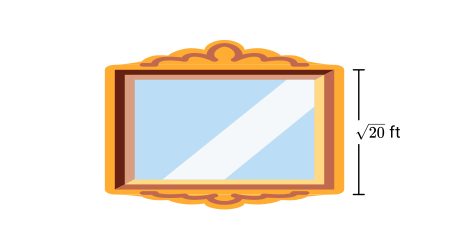
To determine whether the mirror fits on the living room wall, he needs to know the exact value of the height of the mirror before ordering. Use a calculator to help him to calculate the value of sqrt(20). Round the result to one decimal place.
To find the exact value of a square root on a calculator, we push the 2ND button, then x^2, to get the square root sign.
Then we enter the value of the radicand, which in this case is 20. Finally, we push the ENTER button to see the result.
Let's now round the value to one decimal place. 4.472135955 ... ≈ 4.5 This means that the height of the mirror is about 4.5 feet. It sounds like a huge mirror!
Ignacio and his three friends are playing a game. Each person secretly writes an irrational number on a piece of paper.
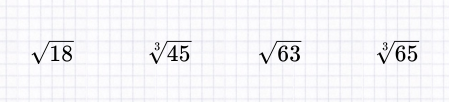
The one who writes the greatest number wins the game. To decide the winner, order the numbers from greatest to least.
Let's find the exact values of the numbers in decimal notation first, starting with sqrt(18). Since it is a square root, we will push 2ND and x^2 to have the square root sign. Then, we will enter the value of the radicand which is 18 and push the ENTER button.
Let's now round the obtained number to two decimal places. 4.242640687 ... ≈ 4.24 Next, we will find the exact value of sqrt(45). Notice that it is a cube root, not a square root. This time we will push the MATH button first, push the number 4 to get a cube root sign. After that, we will enter the value of the radicand, 45, and push the ENTER button to see the result.
Great! We will now round this value to two decimal places. 3.556893304 ... ≈ 3.56 Let's follow the same procedure for the remaining numbers sqrt(65) and sqrt(63).
Let's round the the new values to two decimal places. 7.937253933 ... ≈ 7.94 4.020725759 ... ≈ 4.02 Now that we have the decimal notations of all numbers, we can order them. Let's do it! 3.56 < 4.02 < 4.24 < 7.94 sqrt(45) < sqrt(65) < sqrt(18) < sqrt(63) We have that sqrt(63) is the greatest irrational number in this list. This means that the one who wrote down this number wins the game!
We will start by finding consecutive perfect squares around the radicand to estimate sqrt(15). Let's recall the first ten perfect squares.
| Exponent | 1^2 | 2^2 | 3^2 | 4^2 | 5^2 | 6^2 | 7^2 | 8^2 | 9^2 | 10^2 |
|---|---|---|---|---|---|---|---|---|---|---|
| Perfect Square | 1 | 4 | 9 | 16 | 25 | 36 | 49 | 64 | 81 | 100 |
Notice that the greatest perfect square less than 15 is 9. The smallest perfect square greater than 15 is 16.
We found that sqrt(15) is in between 3 and 4. Since 15 is closer to 16 than to 9, sqrt(15) is also closer to sqrt(16) than to sqrt(9). Let's see these values on a number line.
Therefore, we have to round up sqrt(15) to 4. sqrt(15) ≈ 4
This time we will estimate sqrt(150) to the nearest integer. Since it is a cube root, we will find the closest perfect cubes to 150. Let's first recall the first ten perfect cubes.
| Exponent | 1^3 | 2^3 | 3^3 | 4^3 | 5^3 | 6^3 | 7^3 | 8^3 | 9^3 | 10^3 |
|---|---|---|---|---|---|---|---|---|---|---|
| Perfect Cube | 1 | 8 | 27 | 64 | 125 | 216 | 343 | 512 | 729 | 1000 |
Notice that the greatest perfect cube less than 150 is 125, and the smallest perfect cube greater than 150 is 216.
We found that sqrt(150) is less than 6 and greater than 5. Let's see which perfect cube is closer to 150. 216-150=66 & 150- 125=25 66 > 25 Since 150 is closer to 125 than it is to 216, sqrt(150) is closer to sqrt(125) than it is to sqrt(216). Let's see these values on a number line.
This means that we can estimate sqrt(150) to 5. sqrt(150) ≈ 5
