1. Powers
+ Customize lesson
0
0
Sign In
This lesson delves into the mathematical concepts of perfect squares, perfect cubes, and powers. It focuses on understanding the base and exponent in power expressions. The lesson is designed to help individuals like Tearrik, who wants to improve his understanding of these topics after failing to answer trivia questions about them. The concepts are explained through practical examples, such as calculating bonus points in a trivia game. Understanding these principles is crucial for various real-world applications, including geometry and advanced algebra.
| Student Learning Objectives: |
|---|
|
| | 11 Theory slides |
| | 10 Exercises - Grade E - A |
| | Each lesson is meant to take 1-2 classroom sessions |
When a specific number is added to itself multiple times, the result is the same as multiplication.


A power is the product of a repeated factor. A power expression consists of two parts. The base is the repeated factor and the exponent indicates how many times the base is used as a factor. Consider the power expression with base 7 and exponent 4.

In this example, 7 appears as a factor 4 times.
7^4 = 7 * 7 * 7 * 7_4Most powers are read in the same way.
| Expression | Example 1 | Example 2 |
|---|---|---|
| 2^2 | 2 to the second power |
2 squared |
| 7^3 | 7 to the third power |
7 cubed |
| 5^4 | 5 raised to the power of 4 |
5 raised to the fourth power |
Tearrik is in a trivia contest at school.

The table below shows the bonus points Tearrik will earn if he answers 1, 2, or 3 questions correctly.
| Questions Answered Correctly | Points | Simplify |
|---|---|---|
| 1 | 2 | 2 |
| 2 | 2* 2 | 4 |
| 3 | 2* 2 * 2 | 8 |
Select the power that represents how many points Tearrik will get if he answers three questions correctly.
Tearrik manages to answer five questions correctly. How many bonus points does he win?
How many times is the number 2 used as a factor?
What does the exponent indicate?
Do the smaller multiplications one at a time.
Looking at the table, answering three questions correctly means the number two is multiplied by itself three times.
2* 2 * 2_3 To write this product as a power, we have to identify the base and the exponent. The base is the number being multiplied, and the exponent tells us how many times it is used as a factor. Base: & 2 Exponent: & 3 The power expression equal to 2 * 2 * 2 is 2^3.
To rewrite the 2^4 bonus points Tearrik earns for answering four questions correctly, we start by identifying the base and exponent.

Here, the base is 2 and the exponent is 4. This means we multiply 2 by itself 4 times. 2* 2 * 2* 2_4
For answering three questions correctly, Tearrik gets 2^3 bonus points, and for four questions, he gets 2^4 bonus points. We can use this pattern to find the bonus points for five questions.
| Questions Answered Correctly | Bonus Points |
|---|---|
| 3 | 2^3 |
| 4 | 2^4 |
| 5 | 2^5 |
Since the base is 2 and the exponent is 5, we multiply 2 by itself 5 times. 2* 2 * 2* 2 * 2_5 To find this product, we can multiply the numbers one by one. Let's do it!
Associative Property of Multiplication
Multiply
Associative Property of Multiplication
Multiply
Multiply
Tearrik will get 32 bonus points if he answers five questions correctly.
Find the value of the given power.

The numbers that result from raising an integer to the power of 2 appear frequently in math. These numbers are called perfect squares.
| Example | Rewrite as a Product | Perfect Square? | Explanation |
|---|---|---|---|
| 25 | 5 * 5 =5^2 | Yes ✓ | 5 is an integer. |
| 30.25 | 5.5 * 5.5 = 5.5^2 | No * | 5.5 is not an integer. |
| 32 | 5.656... * 5.656... = (5.656...)^2 | No * | 5.656... is not an integer. |
| 64 | 8 * 8 =8^2 | Yes ✓ | 8 is an integer. |
Similar to perfect squares, some numbers are called perfect cubes.
| Example | Rewrite as a Product | Perfect Cube? | Explanation |
|---|---|---|---|
| 125 | 5 * 5 * 5=5^3 | Yes ✓ | 5 is an integer. |
| 166.375 | 5.5 * 5.5 * 5.5 = 5.5^3 | No * | 5.5 is not an integer. |
| 64 | 4 * 4 * 4=4^3 | Yes ✓ | 4 is an integer. |
| 270 | 6.463... * 6.463... * 6.463... = (6.463...)^3 | No * | 6.463... is not an integer. |
Which of the following numbers are perfect squares? Select all that apply.
Which of the following numbers are perfect cubes? Select all that apply.
Numbers between the squares of two consecutive integers cannot be perfect squares.
Numbers between the cubes of two consecutive integers cannot be perfect cubes.
A perfect square is a number that can be written as the square of an integer. For example, 64 is a perfect square because it is the square of 8.
8^2 = 64 To identify the numbers that are not perfect squares, let's look at the squares of 5 and 6. 5^2 = 25 6^2 = 36 Since 5 and 6 are integers, 25 and 36 are perfect squares. There are no integers between 5 and 6, so there are no perfect squares between 25 and 36.

This is why we know that 27 is not a perfect square. To determine whether 136 is a perfect square, let's look at the consecutive perfect squares in the table below.
| Number | Square | Less Than, Greater Than, or Equal to 136? |
|---|---|---|
| 10 | 10^2 = 100 | 100 < 136 |
| 11 | 11^2 = 121 | 121 < 136 |
| 12 | 12^2 = 144 | 144 > 136 |
The table shows that 136 is greater than 121 but less than 144. Since 136 lies between two consecutive perfect squares, it cannot be a perfect square. Let's continue the table to check whether 225 is a perfect square.
| Number | Square | Less Than, Greater Than, or Equal to 225? |
|---|---|---|
| 13 | 13^2 = 169 | 169 < 225 |
| 14 | 14^2 = 196 | 196 < 225 |
| 15 | 15^2 = 225 | 225 = 225 |
We know that 225 is a perfect square because 15 is an integer and 15^2 = 225. The final number to check is 729. The square of 20 is 400, and the square of 30 is 900. Because 729 is closer to 900 than to 400, it is easier to start with 30 and work down through the perfect squares.
| Number | Square | Less Than, Greater Than, or Equal to 729? |
|---|---|---|
| 30 | 30^2 = 900 | 900 > 729 |
| 29 | 29^2 = 841 | 841 > 729 |
| 28 | 28^2 = 784 | 784 > 729 |
| 27 | 27^2 = 729 | 729 = 729 |
We found that 729 is a perfect square. Now we can summarize our results in another table.
| Number | Perfect Square? |
|---|---|
| 64 | Yes |
| 27 | No |
| 136 | No |
| 225 | Yes |
| 729 | Yes |
A perfect cube is a number that can be expressed as the cube of an integer. For example, the cube of 10 is 1000, so 1000 is a perfect cube.
10^3 = 1000 Since all the given numbers are less than 1000, any perfect cubes among them must be the cube of an integer from 1 to 9. Let's make a table of these cubes and look for the given numbers.
| Number | Cube |
|---|---|
| 1 | 1^3 = 1 |
| 2 | 2^3 = 8 |
| 3 | 3^3 = 27 |
| 4 | 4^3 = 64 |
| 5 | 5^3 = 125 |
| 6 | 6^3 = 216 |
| 7 | 7^3 = 343 |
| 8 | 8^3 = 512 |
| 9 | 9^3 = 729 |
We can summarize our findings in another table.
| Number | Perfect Cube? |
|---|---|
| 64 | Yes |
| 27 | Yes |
| 136 | No |
| 225 | No |
| 729 | Yes |
See that a number can be both a perfect cube and a perfect square! For example, 64 = 4^3 = 8^2.
Determine whether the given number is a perfect square, a perfect cube, both, or neither.

What happens when a negative number is raised to a power? For example, when -2 is squared, the result is positive! (-2) ^2 &= (-2)(-2) &⇕ (-2) ^2 &= 4 When a negative number has an exponent that is an even number, the result is positive. This happens because the negative factors can be grouped in pairs, each of which results in a positive number. Let's consider (-2)^4.
Write power as a product
Associative Property of Multiplication
Multiply
| Base | Even Exponent | Odd Exponent |
|---|---|---|
| Positive | Positive | Positive |
| Negative | Positive | Negative |
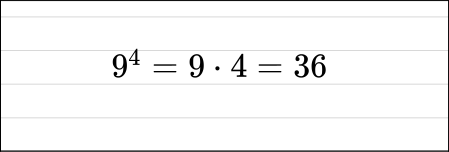
We are asked to determine whether Davontay found the correct value of 9^4. Let's see the procedure he followed!
A power is the product of repeated factors. The base of a power is the repeated factor. The exponent indicates the number of times the base is used as a factor.
Notice that Davontay did not rewrite the power as the product of repeated factors. Instead of multiplying 9 by itself 4 times, Davontay multiplied 9 by 4. This means that his answer is not correct.
To find the correct value of the given power, let's start by rewriting it as the product of repeated factors. The base is 9 and the power is 4. This means that 9 will be used as a factor 4 times.
9^4= 9 * 9 * 9 * 9 ⇕
9^4=6561
Therefore, the correct value of the given power is 6561.
Diego likes to collect model cars. He has four different sizes of his favorite sports car on display, from smallest to largest. The smallest is 2 centimeters tall. Each car is twice as tall as the previous car.

What is the height of the largest car?
Let's picture Diego's display of his favorite model cars.
We want to find the height of the fourth car. The smallest car is 2 centimeters tall. We know that the height of each successive car is twice the height of the previous one. Let's use this information to find how tall the second car is. 2 * 2 = 4 centimeters Notice that this is a product of repeated factors. We can rewrite the repeated factors as a power. The base of the power will be the repeated factor and the exponent will indicate the number of times the base is used as a factor. Let's see an example!
In our case, the base is 2 and the exponent is 2. 2 * 2 = 2^2 We can follow the same procedure for the next model cars, but remember that the height of each car is twice the height of the previous car. This means that we can multiply the previous height by 2. Let's make a table with the results!
| No. of Model | Twice the Previous Height | Power | Height of Next Model |
|---|---|---|---|
| 2 | 2* 2 | 2^2 | 4 |
| 3 | 2* 2 * 2 | 2^3 | 8 |
| 4 | 2* 2 * 2 * 2 | 2^4 | 16 |
We see that the largest model car has a height of 16 centimeters.
| Power | 7^5 | 7^4 | 7^3 | 7^2 | 7^1 | 7^0 |
|---|---|---|---|---|---|---|
| Value | 16 807 | 2401 |
Let's start by remembering the definition of a power. A power is the product of repeated factors. The base of the power is the repeated factor, and the exponent indicates the number of times the base is used as a factor.
We are asked to find the remaining values of the given table.
| Power | 7^5 | 7^4 | 7^3 | 7^2 | 7^1 | 7^0 |
|---|---|---|---|---|---|---|
| Value | 16 807 | 2401 |
It is a good thing that we reviewed how powers work! We can use the definition to write each power as a product of repeated factors. Then we can find the value of each one. Let's do it!
| Power | Repeated Factor | Value |
|---|---|---|
| 7^5 | 7* 7 * 7 * 7 * 7 | 16 807 |
| 7^4 | 7 * 7 * 7 * 7 | 2401 |
| 7^3 | 7 * 7 * 7 | 343 |
| 7^2 | 7 * 7 | 49 |
| 7^1 | 7 | 7 |
But what should we do about 7^0? First, notice that as the exponent decreases, the number of times the base is multiplied also decreases. This means that we can also say that the value of each power can be found by removing a factor from the previous power. This is equivalent to dividing the value of the previous power by 7.
| 7^n | 7^(n+1)/7 | Value |
|---|---|---|
| 7^5 | 7^6/7 | 16 807 |
| 7^4 | 7^5/7 | 2401 |
| 7^3 | 7^4/7 | 343 |
| 7^2 | 7^3/7 | 49 |
| 7^1 | 7^2/7 | 7 |
Following this pattern, we can find the value of 7^0 by dividing the value of 7^1 by 7. 7^0 = 7^1/7 ⇔ 7^0 = 1 Finally, let's complete the given table with the information we found.
| Power | 7^5 | 7^4 | 7^3 | 7^2 | 7^1 | 7^0 |
|---|---|---|---|---|---|---|
| Value | 16 807 | 2401 | 343 | 49 | 7 | 1 |
In general, when we raise any number to the power of zero, the result is 1.
To find the value of 7^(-1), we can continue the pattern that we found in Part A by dividing 7^0 by 7.
7^(-1) = 7^0/7 ⇔ 7^(-1) = 1/7
We can see that the value of 7^(-1) is 17. In general, when we raise any number to the power of -1, the result is the multiplicative inverse of the base.
