6. Multiply and Divide Integers
Sign In
An error ocurred, try again later!
Chapter 1
6.
Multiply and Divide Integers
Understanding integers, especially in the context of multiplication and division, is essential for various real-world applications. For instance, negative numbers often appear in financial calculations, such as debt or temperature measurements like below-zero weather conditions. Multiplication and division of integers are not just academic exercises; they are tools that can help in planning budgets, analyzing data, and even in coding algorithms for computer programs. The lesson explains these concepts in a straightforward manner, making it easier to grasp the logic behind the operations and their practical uses.
Show less Show more expand_more 


Lesson Settings & Tools
| | 12 Theory slides |
| | 10 Exercises - Grade E - A |
| | Each lesson is meant to take 1-2 classroom sessions |
Multiply and Divide Integers
Slide of 12
If an ice cream cone costs $3, how many ice cream cones could be bought with $12? How much money is needed to buy ten milkshakes that cost $4 each? The answers to these questions can be found by using division and multiplication, respectively. Throughout this lesson, examples will be provided to show how these operations are useful for finding the answers to many similar daily situations.
Catch-Up and Review
Here are a few recommended readings before getting started with this lesson.
Explore
Share
Report error
What is Multiplication?
Multiplying a positive integer a by a positive integer b is the same as adding b to itself a times. 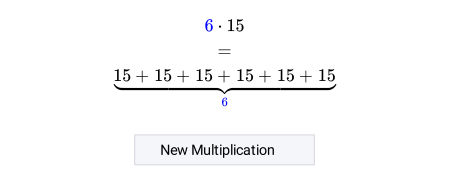 Consider the following questions!
- What happens if b is negative?
- What happens if both a and b are negative?
Discussion
Share
Report error
Multiplying Integer Numbers
Multiplication is the same as repeated addition. However, when multiplying integers, the signs of the factors determine whether the product is positive or negative.
Method
Share
Report error
Multiplying Integers With the Same Sign
The product of two integers is always positive if and only if the factors have the same sign. This means that when the factors are both positive or both negative, ignore the signs and multiply them as if they were whole numbers. To illustrate this process, consider the following multiplication of integers.
-3*(-4)
There are two steps to follow when the factors have the same sign.
1
Verify the Signs of the Factors
expand_more If both factors are positive, keep the numbers as they are. On the other hand, if the factors are both negative, ignore the signs of the factors to reduce the multiplication to a multiplication of two positive integers. In this example, the signs of the integers will be removed because both are negative. -3*(-4) ⇕ 3*4 The expression is now a multiplication of two whole numbers.
2
Find the Product Using a Number Line
expand_more The first factor indicates how many intervals will be needed to find the product. The second factor indicates the size of each interval. The intervals are drawn on a number line starting from zero. In this case, 3* 4 indicates that three equal intervals of length 4 are needed. 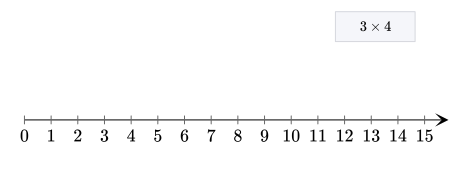 The endpoint represents the product of the given multiplication of integers with the same sign.
3*4=12 ⇔ -3*(-4)=12
The result of multiplication of integers with the same sign is always positive.
The endpoint represents the product of the given multiplication of integers with the same sign.
3*4=12 ⇔ -3*(-4)=12
The result of multiplication of integers with the same sign is always positive.
Discussion
Share
Report error
Multiplying Integers With Different Sings
The product of two integers is always negative if and only if one factor is negative and the other is positive. Change the negative factor to its opposite and perform the multiplication as if both were whole numbers. Next, change the result to its opposite to get the final product. Consider the following multiplication of integers.
-7*2
Follow these three steps to find the product of two integers with different signs.
1
Check the Signs of the Factors
expand_more Verify that one factor is positive and the other is negative. Change the negative factor to its opposite. The result is a multiplication of two positive integers. For the given example, the first factor is negative 7, so change it to its opposite 7. -7*2 ⇒ 7*2
2
Find the Product of the Resulting Multiplication
expand_more Next, find the product of the multiplication of two whole numbers. In this case, 7*2 means that seven equal intervals of length 2 are needed. Use a number line to find this product. 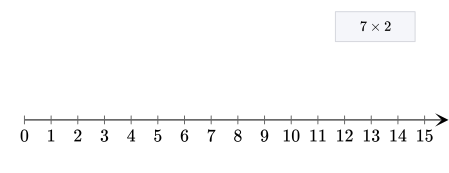 The endpoint is the product of the resulting multiplication. This means that 7*2=14.
3
Change the Product to Its Opposite
expand_more Change the product from the previous step to its opposite to get the product of the initial multiplication of integers with different signs. For the given example, the product of whole numbers is 14. Its opposite is -14. 7*2= 14 ⇒ -7*2= -14 In summary, multiply two integers with different signs as if they were whole numbers and change the result to its opposite to get the final product.
Example
Share
Report error
The Piano Girl
LaShay is a brilliant pianist. One day, she is asked to play at her school concert. She is excited to showcase her talent in front of her peers. She now wants to calculate how long it would take her to play her piece.

{"type":"text","form":{"type":"math","options":{"comparison":"1","nofractofloat":false,"keypad":{"simple":true,"useShortLog":false,"variables":[],"constants":[]},"rendered":false},"text":" "},"formTextBefore":null,"formTextAfter":"minutes","answer":{"text":["24"]}}
Hint
Multiply the number of songs by the average length of a song to find the total time.
Solution
Multiplying the number of songs and the duration of each song gives the total time it will take LaShay to play all songs. Total Time=Number of Songs*Length of Song
In this case, LaShay has a total of 8 songs, each taking an average of 3 minutes to play. Total Time= 8* 3
Note that this is a multiplication of two positive integers. The product of this multiplication can be found by using a number line. Keep in mind that the first factor indicates that 8 equal intervals of 3 are needed. 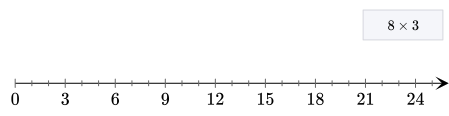 The endpoint is 24. This is the product of 8*3. This means that it will take LaShay 24 minutes to play her 8 pieces. Total Time= 8* 3 ⇓ Total Time=24
Example
Share
Report error
Auntie's Pizza Shop
In the afternoons, LaShay takes a break from her studies and piano lessons to help her aunt with her pizza shop.

LaShay's aunt pays her $10 for each day she helps her. However, every time LaShay is late, she loses $3.
a LaShay helped her aunt for 15 days last month, but she was late six days. How much money did LaShay lose last month? Give the answer as a negative integer.
{"type":"text","form":{"type":"math","options":{"comparison":"1","nofractofloat":false,"keypad":{"simple":true,"useShortLog":false,"variables":[],"constants":[]},"rendered":false},"text":" "},"formTextBefore":null,"formTextAfter":"dollars","answer":{"text":["-18"]}}
b How much money did LaShay earn at the pizza shop last week?
{"type":"text","form":{"type":"math","options":{"comparison":"1","nofractofloat":false,"keypad":{"simple":true,"useShortLog":false,"variables":[],"constants":[]},"rendered":false},"text":" "},"formTextBefore":null,"formTextAfter":"dollars","answer":{"text":["132"]}}
Hint
a Multiply the number of days she was late by the amount of money she lost each day for being late. Use a number line to find the product.
b Multiply the days worked by the amount paid per day. Add the amount from Part A to this product.
Solution
a A loss means something negative. This means that the opposite of 3 represents the amount of money LaShay loses each day for being late. Amount Lost for Being Late Each Day -$3
Next, remember that she was late 6 out of the 15 days she helped her aunt last month. The amount she lost last month is given by multiplying the number of days she was late by the amount she lost each day for being late. Total Amount Lost Last Month 6* (-3)
This situation is a multiplication of a positive integer by a negative integer. Recall that the result is negative when multiplying two integers with different signs. With this in mind, perform the multiplication as if both were whole numbers by ignoring their signs. 6* (-3) ⇒ 6* 3
The resulting multiplication indicates 6 equal intervals of 3. A number line can be used to help find this product.
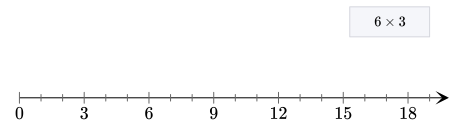 The product of the resulting multiplication is 18. Finally, change 18 to its opposite -18 to get the final product of the initial multiplication. 6*3= 18 ⇒ 6*(- 3)= -18 The amount LaShay lost last month is then -$18.
b LaShay's total possible earnings are the product of the number of days worked by the amount paid per day gives her total earnings. However, since she was late six days, the amount she lost for being late must be added to the total amount of money she could earn. Start by finding the total possible earnings. Total Possible Earnings $10*15
This is a multiplication of two positive integers, so the result is also positive. Because the integers are two-digit numbers, use the multiplication digit by digit to find their product. 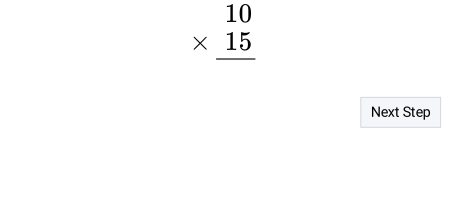 LaShay could have earned a total of $150. Add to this amount the amount she lost — -$ 18 — to find her total earnings.
150+(-18)
The result is the sum of a positive and a negative integer. Change the addition sign to a subtraction sign and -18 to its opposite 18 to simplify this expression. 150-18=132 Therefore, LaShay's earned a total of $ 132 for working at the pizza shop last week.
LaShay could have earned a total of $150. Add to this amount the amount she lost — -$ 18 — to find her total earnings.
150+(-18)
The result is the sum of a positive and a negative integer. Change the addition sign to a subtraction sign and -18 to its opposite 18 to simplify this expression. 150-18=132 Therefore, LaShay's earned a total of $ 132 for working at the pizza shop last week.
Discussion
Share
Report error
Dividing Integer Numbers
The division of integer numbers is similar to the division of whole numbers. However, when dividing integers, the signs of the dividend and the divisor determine whether the quotient is positive or negative.
Method
Share
Report error
Dividing Integers With the Same Sign
The quotient of dividing an integer a by an integer b is always positive if those integers have the same sign. This means the dividend and the divisor are both negative or both positive. If this condition is met, ignore their signs and perform the division as if they were whole numbers. This will be illustrated using the following division of integers.
-15÷(-3)
Follow these two steps when dividing two integers with the same sign.
1
Verify the Signs of the Dividend and the Divisor
expand_more If the dividend and the divisor are positive, keep the numbers as they are. On the other hand, if the dividend and the divisor are negative, ignore their sings to reduce the division to a division of two positive integers. In the given example, the signs of the integers will be removed because both are negative. -15÷(-3) ⇔ 15÷ 3 The expression is now a division of two whole numbers.
2
Find the Quotient Using a Number Line
expand_more The quotient can be found by moving to the right starting from zero on a number line. Use intervals the size of the divisor until the dividend is reached. The number of jumps needed to reach the dividend equals the quotient. In this case, move to the right of zero in intervals of 3 since the divisor is 3.
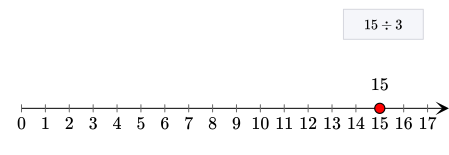 It took 5 jumps of 3 units to reach 15. This means that the quotient of the initial division is 5. 15÷ 3=5 ⇔ -15÷(-3)=5
The quotient of two numbers with the same sign is always positive.
It took 5 jumps of 3 units to reach 15. This means that the quotient of the initial division is 5. 15÷ 3=5 ⇔ -15÷(-3)=5
The quotient of two numbers with the same sign is always positive.
Discussion
Share
Report error
Dividing Integers With Different Sings
The quotient of dividing two integers is always negative if and only if one is negative and the other is positive. Change the negative number to its opposite and perform the division as if they were whole numbers. Next, change the result to its opposite to get the quotient of the initial division. This process will be illustrated with the following division. -12÷4
There are three steps to follow to find the quotient when dividing two numbers with different signs.
1
Check the Signs of the Integers
expand_more Identify which of the numbers involved in the division is negative. Next, change it to its opposite to get a division of two positive integers. In the given example, the dividend -12 is negative. Its opposite is 12. -12÷4 ⇒ 12÷4
2
Find the Quotient of the Resulting Division
expand_more Find the quotient of the division of two whole numbers. For this example, 12÷4 means how many jumps of 4 are needed to reach 12 on a number line, starting from zero. 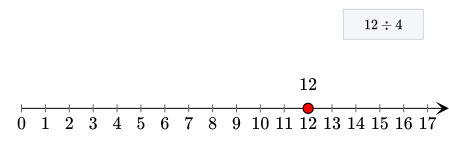 It took three jumps of 4 units to reach 12. This means that 12÷4=3.
3
Change the Quotient to Its Opposite
expand_more Change the quotient found in the previous step to its opposite to get the quotient of the initial division of integers with different sings. For the given example, the quotient is 3. Its opposite is -3. Therefore, the quotient of - 12 ÷ 4 is - 3. 12÷4= 3 ⇒ -12÷4= -3 In summary, divide two integers with different signs as if they were whole numbers and change the result to its opposite to get the final quotient.
Example
Share
Report error
Waiting for the Elevator
LaShay wants to buy a new dress for her upcoming performance with her earnings for helping her aunt at the pizza shop. She and her parents are at the shopping center. They must take the elevator to the sixth floor to get to LaShay's favorite clothing store.

{"type":"text","form":{"type":"math","options":{"comparison":"1","nofractofloat":false,"keypad":{"simple":true,"useShortLog":false,"variables":[],"constants":[]},"rendered":false},"text":" "},"formTextBefore":null,"formTextAfter":"trips","answer":{"text":["5"]}}
Hint
Divide the number of people in line by the number of people that can ride in the elevator per trip.
Solution
LaShay wants to know how many elevator trips it will take before she and her parents can get into the elevator. The elevator can only carry 7 people per trip. Because there are 35 people in line ahead of them, dividing this amount by the number of people per trip gives the total number of elevator trips it would take to carry all the people in the line.
Number of Elevator Trips=35/7 [0.5em]
The result is a division of two positive integers. The dividend is 35 and the divisor is 7. Move to the right on a number line, starting from zero and using intervals of size the divisor, until the dividend is reached. The number of intervals will be the quotient.
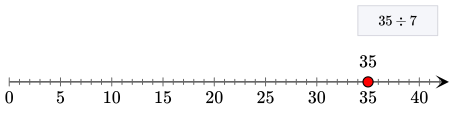 Since it takes 5 jumps of 7 to reach 35, 35÷ 7=5. Now, recall that LaShay and her family are at the end of the line. This means that it will take 5 elevator trips until they get into the elevator. LaShay cannot wait to get her new dress!
Example
Share
Report error
The Music Competition
LaShay's concert went so well that she decided to play one of her favorite pieces for an upcoming competition.

{"type":"text","form":{"type":"math","options":{"comparison":"1","nofractofloat":false,"keypad":{"simple":true,"useShortLog":false,"variables":[],"constants":[]},"rendered":false},"text":" "},"formTextBefore":null,"formTextAfter":"points","answer":{"text":["-16"]}}
Hint
Divide the number of points lost by the number of mistakes made.
Solution
Divide the number of points lost by the number of mistakes made to get the number of points LaShay lost for each mistake. Note that she lost -96 points in total and made 6 mistakes. Points Lost Per Mistake -96÷ 6
The result is a division of two integers with different sings. Recall that the quotient of two integers with different signs is always negative. With this information in mind, ignore the signs for now and perform the division of whole numbers. -96÷ 6 ⇒ 96÷ 6
Because 96 is a two-digit number, use long division to perform the resulting division. 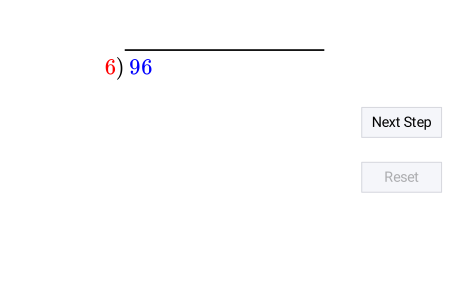 The quotient is 16. However, to get the result of the original division, remember to change 16 to its opposite, -16.
96÷ 6= 16 ⇒ -96÷ 6= -16
This means that LaShay lost 16 points for each mistake made. This did not stop her, though — she took the competition by storm with her incredible talent!
The quotient is 16. However, to get the result of the original division, remember to change 16 to its opposite, -16.
96÷ 6= 16 ⇒ -96÷ 6= -16
This means that LaShay lost 16 points for each mistake made. This did not stop her, though — she took the competition by storm with her incredible talent!
Pop Quiz
Share
Report error
Multiplying and Dividing Random Integers
Closure
Share
Report error
Facts About Negative Numbers
Negative numbers have a 2000-year history. As early as the 7^(th) century, Brahmagupta established the initial rules for handling negative numbers. However, it was not until the 16^(th) that negative numbers were used to solve equations. 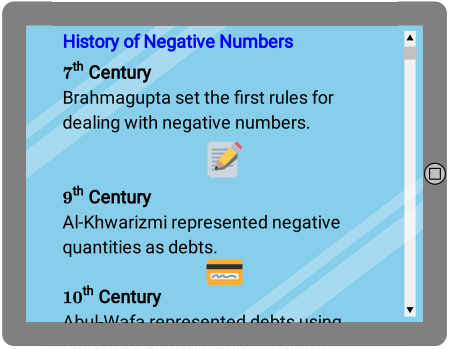 Negative numbers were controversial in their early days. Some mathematicians did not like the idea of quantities less than zero, while others thought negative numbers were imaginary or even evil.
 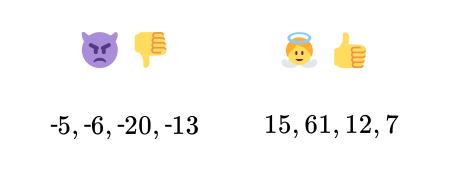 Despite the initial controversies, negative numbers have proven to be incredibly useful in many areas of math, science, and technology. They allow people to measure quantities like temperature and debt and to describe relationships between numbers.
Multiply and Divide Integers
Exercise 2.1
If Dominika reads 17 pages of a book every day, how many pages will she have read after 11 days?
{"type":"text","form":{"type":"math","options":{"comparison":"1","nofractofloat":false,"keypad":{"simple":true,"useShortLog":false,"variables":[],"constants":[]},"rendered":false},"text":" "},"formTextBefore":null,"formTextAfter":"pages","answer":{"text":["187"]}}
security
report
code
security
report
code
We want to calculate the number of pages Dominika will have read after 11 days. We are told that she reads 17 pages each day. We can find this number by multiplying the number of pages read per day by the number of days. Number of Pages Read = 17 * 11 This is a multiplication of two positive integers, so the product will also be positive. Let's use digit by digit multiplication to find this result.
The product is 187. Dominika will have read 187 pages after 11 days if she reads 17 pages each day.
security
report
code
Magdalena burns 650 calories by running for one hour. She ran for six hours this week. How many calories did she burn by running this week?
{"type":"text","form":{"type":"math","options":{"comparison":"1","nofractofloat":false,"keypad":{"simple":true,"useShortLog":false,"variables":[],"constants":[]},"rendered":false},"text":" "},"formTextBefore":null,"formTextAfter":"calories","answer":{"text":["3900"]}}
security
report
code
security
report
code
We want to find how many calories Magdalena burned by running this week. The total calories burned is given by the product of the calories burned per hour and the number of hours run. Calories Burned ⇕ Calories Burned per Hour*Hours Run We are told that she ran for a total of 6 hours this week while burning 650 calories per hour. Let's plug this information into our expression. Calories Burned = 650 * 6 This situation represents a multiplication of two positive integers. The product will also be positive. Let's find it by using digit by digit multiplication.
The product is 3900. This means that Magdalena burned 3900 calories this week by running.
security
report
code
Emily ran 816 meters in 24 minutes. What was her average running speed in meters per minute?
{"type":"text","form":{"type":"math","options":{"comparison":"1","nofractofloat":false,"keypad":{"simple":true,"useShortLog":false,"variables":[],"constants":[]},"rendered":false},"text":" "},"formTextBefore":null,"formTextAfter":"meters per minute","answer":{"text":["34"]}}
security
report
code
security
report
code
We want to calculate Emily's average speed. We can do this by dividing the distance she ran by the time it took her to run the distance. Speed = Distance÷Time In this case, Emily ran 816 meters in 24 minutes. Let's plug these values into the expression we wrote previously. Speed = 816 ÷ 24 We have a division of two positive integers. This means that the quotient of this division will also be positive. We can use long division to find this quotient.
The quotient is 34. This means that on average, Emily ran 34 meters per minute.
security
report
code
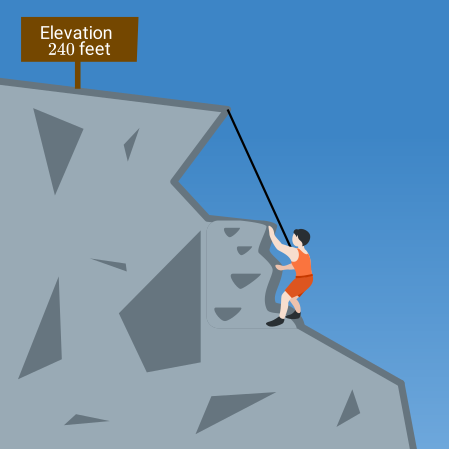
Kriz is a rock climber learning to rappel down the face of a granite rock formation. On an outing with a climbing guide, Kriz descends the rock face in five equal descents.
{"type":"text","form":{"type":"math","options":{"comparison":"1","nofractofloat":false,"keypad":{"simple":true,"useShortLog":false,"variables":[],"constants":[]},"rendered":false},"text":" "},"formTextBefore":null,"formTextAfter":null,"answer":{"text":["-48"]}}
security
report
code
security
report
code
We are asked to calculate the integer that represents Kriz's change in altitude in feet each time they descend. We can find this integer by dividing the total distance descended by the number of rappels down. Change in Altitude = Distance÷ Number of Rappels Note that the elevation of the boulder is 240 feet. This is the total distance Kriz descended. However, because they went down, we will represent this distance as negative 240. In addition, the number of rappels down is 5. Change in Altitude = - 240 ÷ 5 We wrote a division of two integers with different signs, so the quotient must be negative. We can begin by finding the quotient ignoring the signs of the numbers and putting the negative sign in the result at the end. Let's use long division to find this number.
The quotient of this division is 48. Remember to change it to its opposite -48 to get the result of the initial division. This means that the integer representing Kriz's change in altitude in feet each time they descend is -48.
security
report
code
Multiply and Divide Integers
Recommended exercises
To get personalized recommended exercises, please login first.
Loading content
≤
>
■2
■▢
e▢
7
8
9
×
÷■1
=
=
√▢
▢√
∫▢▢
4
5
6
+
−
≤
<
log
ln
log▢
1
2
3
()
∣
sin
cos
tan
0
.
π
x
y
Loading content