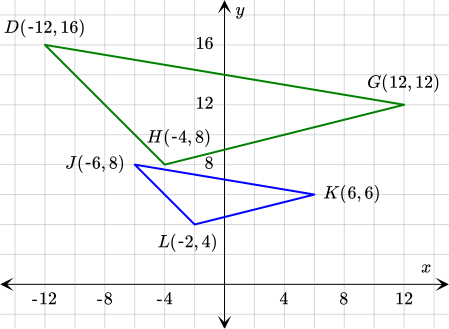
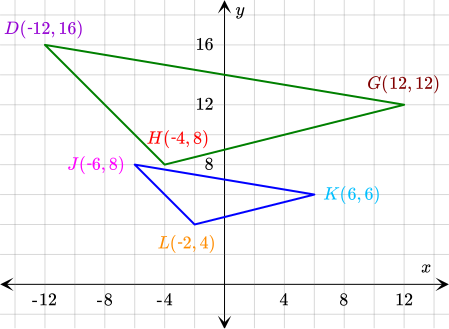
Let's use the given coordinates to draw the original figure and the image of its dilation.
Let's use the coordinates of the vertices to find the lengths of the sides of each triangle.
Side
Vertices
Distance Formula
Simplified
JK
( - 6,8), (6,6)
sqrt((6-( -6))^2+(6- 8)^2)
2sqrt(37)
DG
( - 12,16), (12,12)
sqrt((12-( - 12))^2+(12- 16)^2)
4sqrt(37)
KL
(6,6), ( - 2,4)
sqrt(( - 2-6)^2+( 4-6)^2)
2sqrt(17)
GH
(12,12), ( - 4,8)
sqrt(( - 4-12)^2+( 8-12)^2)
4sqrt(17)
LJ
( - 2,4), ( - 6,8)
sqrt(( - 6-( - 2))^2+( 8- 4)^2)
4sqrt(2)
HD
( - 4,8), ( - 12,16)
sqrt(( - 12-( - 4))^2+( 16- 8)^2)
8sqrt(2)
Now, we can find the ratios between the corresponding sides.
DG/JK=4sqrt(37)/2sqrt(37) = 2 [1.2em]
GH/KL=4sqrt(17)/2sqrt(17) = 2 [1.2em]
HD/LJ=8sqrt(2)/4sqrt(2) = 2
We can tell that these ratios are equivalent. Therefore, the corresponding side lengths of △ JKL and △ DGH are proportional. By the Side-Side-Side Similarity Theorem, we can conclude that △ JKL is similar to △ DGH.
△ JKL ~ △ DGH
Therefore, the dilation is a similarity transformation.