{{ tocSubheader }}
{{ 'ml-label-loading-course' | message }}
An error ocurred, try again later!
Chapter {{ article.chapter.number }}
{{ article.number }}.
{{ article.displayTitle }}
{{ article.intro.summary }}
Show less Show more expand_more Lesson Settings & Tools
| | {{ 'ml-lesson-number-slides' | message : article.intro.bblockCount }} |
| | {{ 'ml-lesson-number-exercises' | message : article.intro.exerciseCount }} |
| | {{ 'ml-lesson-time-estimation' | message }} |
This lesson will define the concept of a radical function and explain how to draw its graph. Furthermore, a radical inequality in two variables will also be defined, and an explanation on how to graph it on a coordinate plane will be provided.
Catch-Up and Review
Here are a few recommended readings before getting started with this lesson.
- Function
- Intercepts
- End Behavior
- Quadratic Function
- Inverse Functions
- Table of Values and Making a Table of Values
- Root, Index, and Radicand
- Domain and Range of a Function
- Inequalities in Two Variables
Explore
Reflecting the Graph of a Quadratic Function
It is known that f(x)=x2 and g(x)=x are inverse functions. Therefore, the graph of g can be drawn by reflecting the graph of f over the line y=x. In the applet, the graphs of these functions can be seen for values of x greater than or equal to 0.
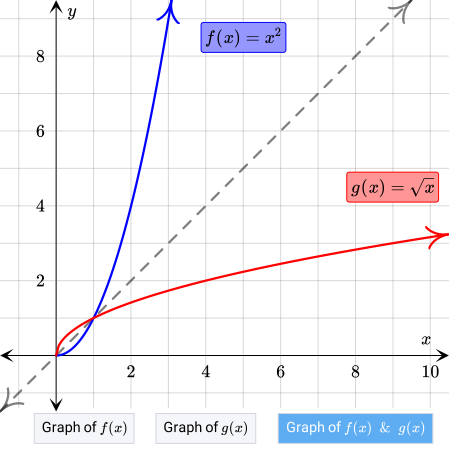 What is the range of the functions? What happens if the domain of f and g is not restricted to only non-negative values?
Discussion
Radical Functions and Square Root Functions
Functions are usually named after the algebraic expression that defines them.
| Example function | Type of expression | Name of the function |
|---|---|---|
| y=7 | Constant | Constant function |
| y=3x−2 | Linear | Linear function |
| y=-x2−2x+1 | Quadratic | Quadratic function |
The same holds true to those functions whose function rule is a radical expression.
Concept
Radical Function
A radical function is a function in which the independent variable is in the radicand of a radical expression or has a rational exponent.
| Variable in a Radicand | Variable with a Rational Exponent |
|---|---|
| y=x | y=x21 |
| y=3x+1 | y=(x+1)31 |
| y=243x+1−4 | y=2(3x+1)41−4 |
Recall that a root with an even index and a negative radicand is not a real number. Therefore, if the index of the radical is even, then the radicand must be non-negative. By following the same reasoning, if the denominator of the rational exponent is even, then the base of the power must be non-negative. The domain of a radical function can be determined with this information.
Domain of y=x x≥0 Domain ofy=2(3x+1)41−43x+1≥0⇕x≥-31
Concept
Square Root Function
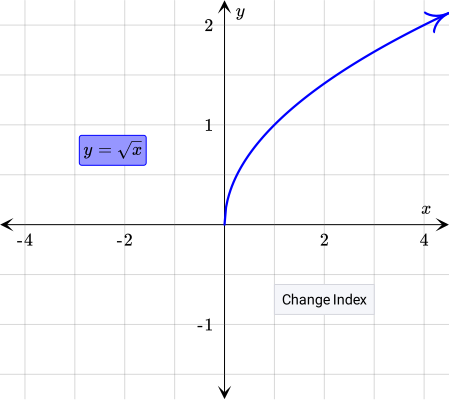
A radical function in which the index of the radical is 2 is also called a square root function. The parent function of the square root function family is f(x)=x.
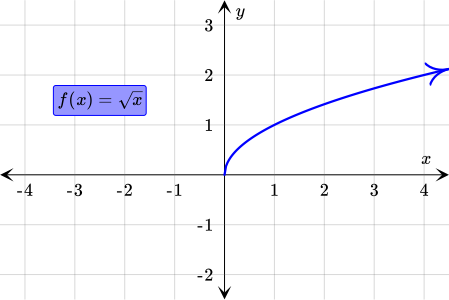
Because the square root of a negative number is not a real number, the radicand in a square root function must be non-negative. Therefore, the domain of f(x)=x can be defined as all real numbers greater than or equal to 0. The square root of a non-negative number is also non-negative, which leads to the range of this function being all real numbers greater than or equal to 0.
f(x)=x↙↘Domainx≥0Rangey≥0
Discussion
Domain and Range of Even Indexed Radical Functions
The domain and range of radical functions depend on the index of the radical expression. The radicand of a root with an even index must be non-negative. So, to find the domain of any even indexed radical function, set the radicand greater than or equal to 0. The solution set of this inequality is the domain of the function. Consider an example radical function.
The domain is the set of all real numbers less than or equal to 2. With this information in mind, a table of values can be made.
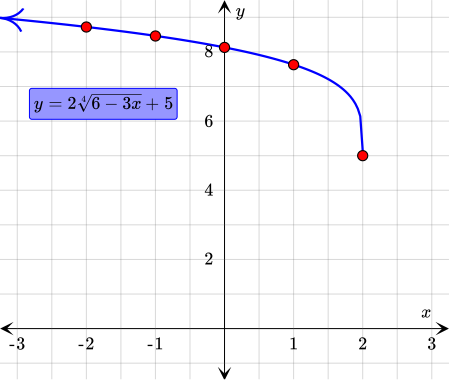 The graph shows that the minimum value for y is 5. Also, y tends to infinity as x tends to negative infinity. Therefore, the range of the function is the set of all real numbers greater than or equal to 5.
y=246−3x+5
Set the radicand greater than or equal to 0 to find the domain.
6−3x≥0
▼
Solve for x
x≤2
| x | 246−3x+5 | y |
|---|---|---|
| -2 | 246−3(-2)+5 | ≈8.72 |
| -1 | 246−3(-1)+5 | ≈8.46 |
| 0 | 246−3(0)+5 | ≈8.13 |
| 1 | 246−3(1)+5 | ≈7.63 |
| 2 | 246−3(2)+5 | 5 |
Next, the points obtained in the table can be plotted on a coordinate plane and connected with a smooth curve.
Domain: Range: x≤2y≥5
In general, to find the range of an even-indexed radical function, keep in mind that the least value for an nth root when n is even is 0. Consider, for example, the function y=anbx+c+d, where a, b, c, and d are real numbers. - If a>0, then the range of the function is the set of all real numbers greater than or equal to d.
- If a<0, the range of the function is the set of real numbers less than or equal to d.
This information can be summarized in a table.
| y=anbx+c+d, when n is even | |
|---|---|
| Sign of a | Range |
| Positive (a>0) |
y≥d |
| Negative (a<0) |
y≤d |
Example
Football and Square Root Functions
Vincenzo is practicing for his first game as a quarterback. To help him, his friend Mark stands on a car and they pass the ball to each other.
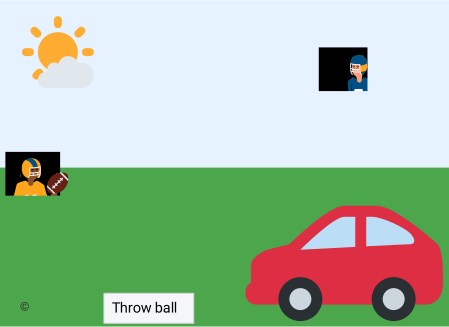 Mark throws the ball on a straight line. Conversely, to make it harder for the opposite team to intercept the ball, Vincenzo throws it following the path of a radical function.
External credits: @freepik
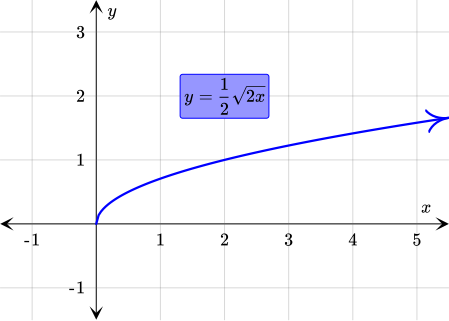
y=212x
Find the domain and range of this function and draw its graph by making a table of values. Determine its x- and y-intercepts and end behavior.
Answer
Domain: x≥0
Range: y≥0
Graph:
x-intercept: x=0
y-intercept: y=0
End Behavior: yx→0 ⟶ 0 and yx→+∞ ⟶+∞
Hint
The radicand of a square root must be non-negative.
Solution
Since the index of the radical expression on the right-hand side of the equation is 2, the given radical function is a square root function. Therefore, the radicand must be non-negative.
2x≥0⇔x≥0
This means that the domain of the function is the set of all real numbers greater than or equal to 0. To determine its range, let's compare the given function to the general form of a square root function.
General Form: Given Function: abx+c+d 212x+0+0
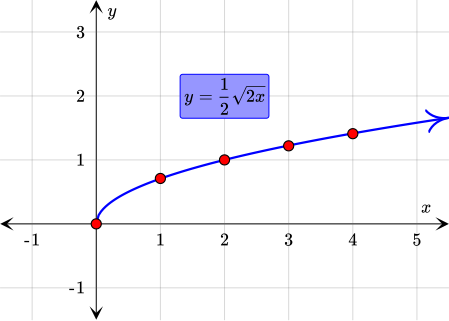
Since a=21 is positive, the range of the function is all real numbers greater than or equal to 0. To determine the intercepts and end behavior, the function will be first drawn on a coordinate plane. To do so, a make a table of values. Be careful to use only x-values that belong to the domain in the table! | x | 212x | y |
|---|---|---|
| 0 | 212(0) | 0 |
| 1 | 212(1) | ≈0.71 |
| 2 | 212(2) | 1 |
| 3 | 212(3) | ≈1.22 |
| 4 | 212(4) | ≈1.41 |
Next, the obtained points can be plotted and connected with a smooth curve.
From the graph, it is seen that the x-intercept and the y-intercept both occur at the origin. It can also be seen that this function increases over its entire domain and that y tends to infinity as x tends to infinity. With this information, the desired characteristics can be written. Recall that the domain and range are both all non-negative real numbers!
| Domain | x≥0 |
|---|---|
| Range | y≥0 |
| x-intercept | x=0 |
| y-intercept | y=0 |
| End Behavior | yx→0 ⟶ 0 and yx→+∞ ⟶+∞ |
Discussion
Cube Root Functions
A radical function in which the index of the radical is 3 is also called a cube root function. The parent function of the cube root function family is f(x)=3x.
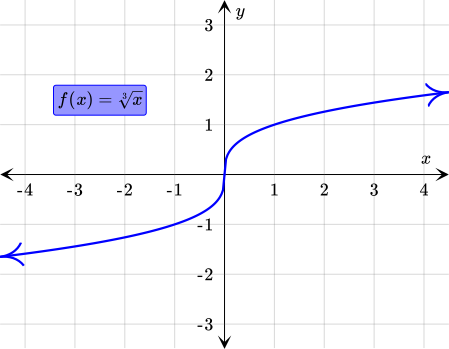
It is worth noting that the cube root is defined for all real numbers. This means that the domain of f(x)=3x is the set of all real numbers. Furthermore, any real number can be written as the cube root of a number. This leads to the range of this function being all real numbers.
f(x)=3x↙↘Domainall real numbersRangeall real numbers
Discussion
Domain and Range of Odd Indexed Radical Functions
A root that has an odd index is defined for all real numbers. Therefore, the domain of any odd indexed radical function is the set of all real numbers. Furthermore, because this type of function is monotonic, the range of an odd-indexed radical function is also the set of all real numbers. Consider an example function.
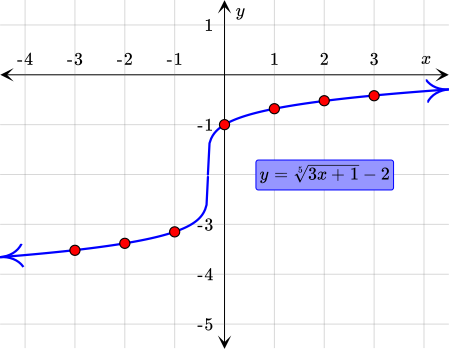
y=53x+1−2
A table can be made to find ordered pairs. Recall that the variable x can take any real value. | x | 53x+1−2 | y |
|---|---|---|
| -3 | 53(-3)+1−2 | ≈-3.52 |
| -2 | 53(-2)+1−2 | ≈-3.38 |
| -1 | 53(-1)+1−2 | ≈-3.15 |
| 0 | 53(0)+1−2 | -1 |
| 1 | 53(1)+1−2 | ≈-0.68 |
| 2 | 53(2)+1−2 | ≈-0.52 |
| 3 | 53(3)+1−2 | ≈-0.42 |
The obtained points can now be plotted and connected with a smooth curve.
The graph shows that y tends to infinity as x tends to infinity and that y tends to negative infinity as x tends to negative infinity. Therefore, the range of the function is the set of all real numbers.
Domain: Range: all real numbersall real numbers
Example
Football and Cube Root Functions
Tonight is Vincenzo's first game as a quarterback! Right before the game, he discovered that a pass is more precise and harder to intercept if the ball follows the path of a cube root function. Vincenzo decides to try this in the game.
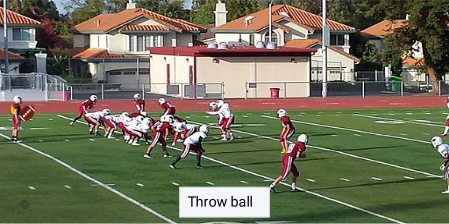 According to his calculations, the optimal path for the ball is described by the following radical function.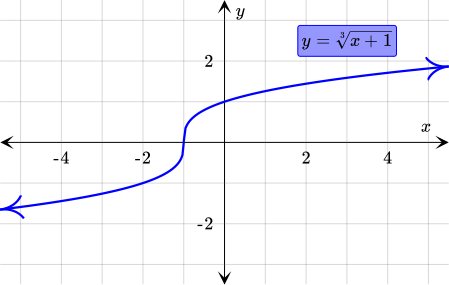
External credits: DanielPenfield
y=3x+1
Find the domain and range of this function, and draw its graph by making a table of values. Determine its x- and y-intercepts and end behavior.
Answer
Domain: All real numbers
Range: All real numbers
Graph:
x-intercept: x=-1
y-intercept: y=1
End Behavior: yx→-∞ ⟶ -∞ and yx→+∞ ⟶+∞
Hint
The radicand of a cube root can be any real number.
Solution
The radicand of a cube root can be any real number. Therefore, the domain of the function is the set of all real numbers. To determine the range, intercepts, and end behavior, the function will be first drawn on a coordinate plane. To do so, a make a table of values using both positive and negative values!
| x | 3x+1 | y |
|---|---|---|
| -4 | 3-4+1 | ≈-1.44 |
| -3 | 3-3+1 | ≈-1.26 |
| -2 | 3-2+1 | -1 |
| -1 | 3-1+1 | 0 |
| 0 | 30+1 | 1 |
| 1 | 31+1 | ≈1.26 |
| 2 | 32+1 | ≈1.44 |
| 3 | 33+1 | ≈1.59 |
| 4 | 34+1 | ≈1.71 |
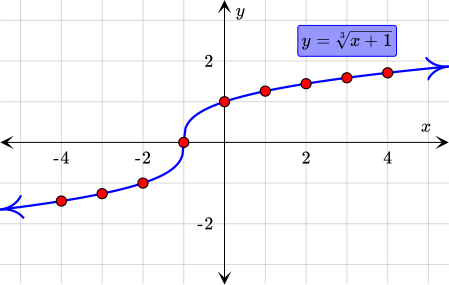
Next, the calculated points can be plotted and connected with a smooth curve.
The graph suggests that the range is the set of all real numbers. It shows that the x-intercept occurs at x=-1 and the y-intercept at y=1. It can also be seen that y tends to negative infinity as x tends to negative infinity, and that y tends to infinity as x tends to infinity. With this information, the desired characteristics can be written.
| Domain | All real numbers |
|---|---|
| Range | All real numbers |
| x-intercept | x=-1 |
| y-intercept | y=1 |
| End Behavior | yx→-∞ ⟶ -∞ and yx→+∞ ⟶+∞ |
Pop Quiz
Finding the Domain and Range of Radical Functions
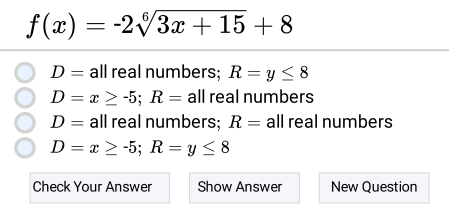
Find the domain and the range of the given radical function.
Discussion
Radical Inequalities
A radical inequality in two variables is an inequality that contains an radical expression and shows the relationship between two variables.
A radical inequality in two variables is similar to a radical equation in two variables. The difference is that instead of an equals sign, the inequality contains a less than, less than or equal to, greater than, or greater than or equal to sign.
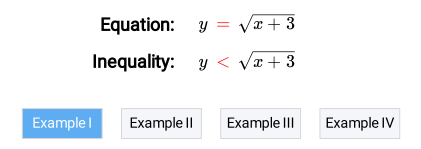 While the graph of a radical equation is a curve, the graph of a two-variable radical inequality is a region on the plane. When graphing a two-variable radical inequality, its boundary curve plays an important role.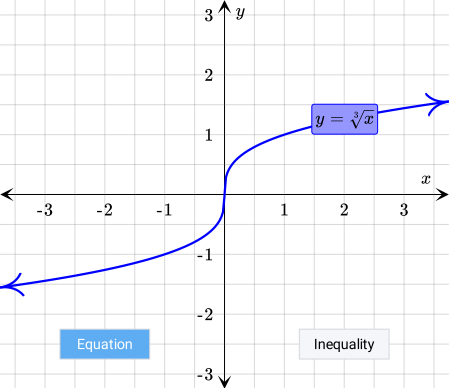
It is worth noting that radical inequalities in two variables can be graphed the same way as any other inequality in two variables.
Method
Graphing a Radical Inequality in Two Variables
The steps for graphing a radical inequality in two variables are similar to the steps for graphing other types of inequalities. The general method is to draw the graph of the boundary curve and then determine the region to be shaded by testing a point. The following inequality will be drawn as an example.
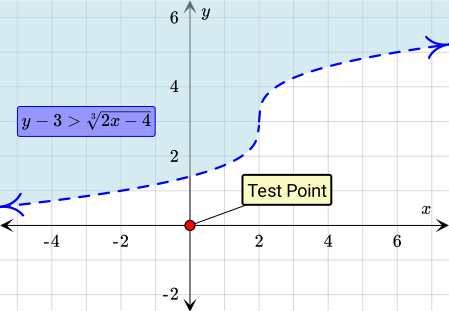
y−3>32x−4
To draw the graph of this inequality, the following steps can be followed.
1
Graph the Boundary Curve
expand_more The boundary curve of the inequality can be determined by replacing the inequality symbol with an equals sign.
Inequality: Boundary Curve: y−3>32x−4 y−3=32x−4
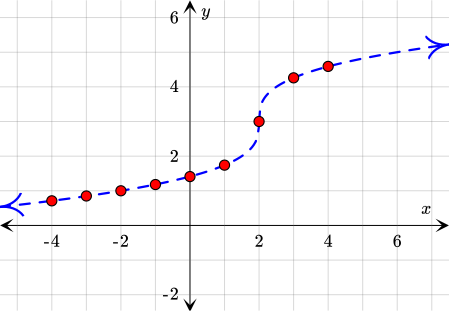
The graph of the boundary curve can be drawn using a table of values. To make the calculations easier, first the variable y will be isolated.
y−3=32x−4⇕y=32x−4+3
Note that the index of the root on the right-hand side of the equation is odd. Therefore, the domain of the function is the set of all real numbers. With this information in mind, the make the table of values, making sure to include positive and negative values. | x | 32x−4+3 | y |
|---|---|---|
| -4 | 32(-4)−4+3 | ≈0.71 |
| -3 | 32(-3)−4+3 | ≈0.85 |
| -2 | 32(-2)−4+3 | 1 |
| -1 | 32(-1)−4+3 | ≈1.18 |
| 0 | 32(0)−4+3 | ≈1.41 |
| 1 | 32(1)−4+3 | ≈1.74 |
| 2 | 32(2)−4+3 | 3 |
| 3 | 32(3)−4+3 | ≈4.26 |
| 4 | 32(4)−4+3 | ≈4.59 |
Plot the points and draw the boundary curve. Since the given inequality is strict, the boundary curve will be dashed.
2
Test a Point
expand_more Next, the region that represents the solution set for the inequality needs to be determined. To do so, choose an arbitrary point not on the boundary curve and substitute it into the original inequality. Since (0,0) is not on the boundary, it can be used as a test point.
Because a false statement was obtained, the region that does not contain (0,0) will be shaded.
y−3>32x−4
SubstituteII
x=0, y=0
0−3>?32(0)−4
▼
Evaluate right-hand side
ZeroPropMult
Zero Property of Multiplication
0−3>?30−4
SubTerms
Subtract terms
-3>?3-4
UseCalc
Use a calculator
-3≱-1.587401… ×
3
Shade the Region
expand_more The region above the curve should be shaded.
Example
Football and Cube Root Inequalities
Thanks to his knowledge of radical functions, Vincenzo is continuously improving his performance at football.

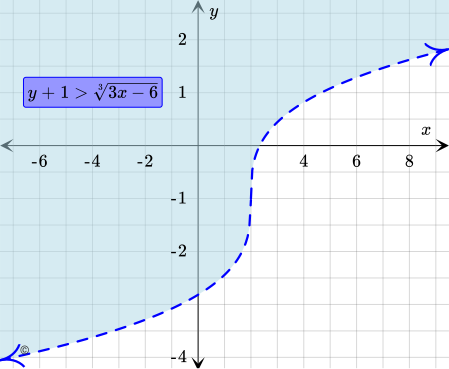
y+1>33x−6
Graph this inequality on a coordinate plane.
Answer
Hint
A radical inequality can be graphed by drawing the boundary curve, testing a point, and shading the corresponding region.
Solution
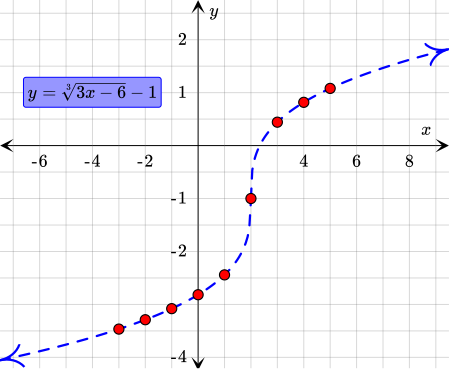
The first step to graph a radical inequality is to draw the boundary curve. The equation for this curve is written by replacing the inequality sign with an equals sign.
 Now the correct region must be shaded. To determine which region to shade, a point not on the boundary curve will be tested. The point (0,0) seems like the easiest choice.
The point (0,0) satisfies the given inequality. Therefore, the region that contains this point will be shaded.
Now the correct region must be shaded. To determine which region to shade, a point not on the boundary curve will be tested. The point (0,0) seems like the easiest choice.
The point (0,0) satisfies the given inequality. Therefore, the region that contains this point will be shaded. 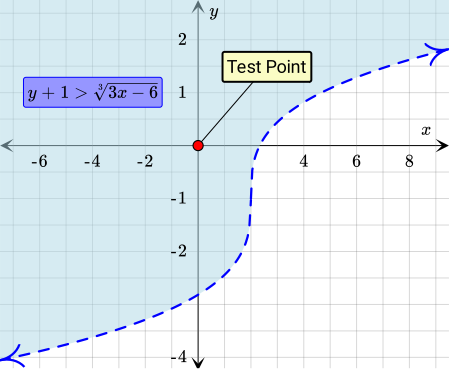
Inequalityy+1>33x−6 Equation y+1=33x−6
To graph the equation, the radical expression must be first isolated.
y+1=33x−6⇕y=33x−6−1
Because the index of the root is 3, this radical function is a cube root function. Therefore, the domain for this function is the set of all real numbers. With this information in mind, a make a table of values to find points on the curve, using both positive and negative values for the variable x. | x | 33x−6−1 | y |
|---|---|---|
| -3 | 33(-3)−6−1 | ≈-3.47 |
| -2 | 33(-2)−6−1 | ≈-3.29 |
| -1 | 33(-1)−6−1 | ≈-3.08 |
| 0 | 33(0)−6−1 | ≈2.82 |
| 1 | 33(1)−6−1 | ≈-2.44 |
| 2 | 33(2)−6−1 | -1 |
| 3 | 33(3)−6−1 | ≈0.44 |
| 4 | 33(4)−6−1 | ≈0.82 |
| 5 | 33(5)−6−1 | ≈1.08 |
Next, the points obtained in the table can be plotted and connected with a smooth curve. Because the given inequality is a strict inequality, the curve will be dashed.
y+1>33x−6
SubstituteII
x=0, y=0
0+1>?33(0)−6
▼
Evaluate
IdPropAdd
Identity Property of Addition
1>?33(0)−6
ZeroPropMult
Zero Property of Multiplication
1>?30−6
SubTerm
Subtract term
1>?3-6
CalcRoot
Calculate root
1>-1.817120… ✓
Example
Football and Square Root Inequalities
Vincenzo's knowledge about radical functions and inequalities led his team to the regional finals!

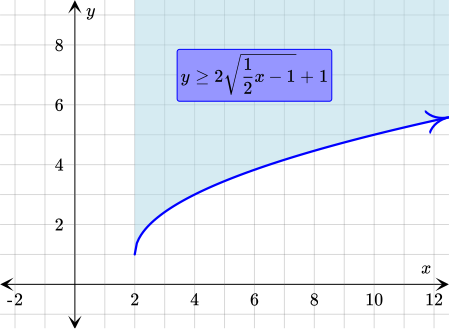
y≥221x−1+1
Graph this inequality on a coordinate plane.
Answer
Hint
To graph the inequality, start by drawing the boundary curve. Then, test a point not on the curve and shade the corresponding region.
Solution
To graph the inequality, start by drawing the boundary curve. To find the boundary curve, replace the inequality sign with an equals sign.
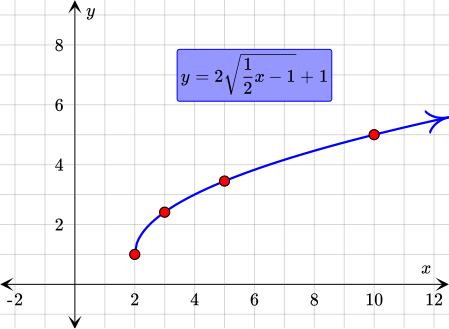 Finally, the correct region should be shaded. To determine which region to shade, a point not on the curve must be tested. The point (10,3) looks like a good choice. This point will be evaluated in the given inequality.
The test point does not satisfy the inequality. Therefore, the region that does not contain this point should be shaded. Keep in mind that the domain of the related function is the set of real numbers greater than or equal to 2. Therefore, to shade the region, only the x-values greater than 2 must be considered.
Finally, the correct region should be shaded. To determine which region to shade, a point not on the curve must be tested. The point (10,3) looks like a good choice. This point will be evaluated in the given inequality.
The test point does not satisfy the inequality. Therefore, the region that does not contain this point should be shaded. Keep in mind that the domain of the related function is the set of real numbers greater than or equal to 2. Therefore, to shade the region, only the x-values greater than 2 must be considered. 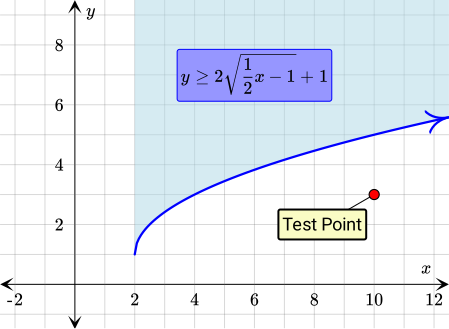
Inequalityy ≥ 221x−1+1Equationy = 221x−1+1
To graph the function, a table of values can be used. However, the domain of the function must be found first. To do so, recall that the radicand of a square root must be greater than or equal to 0.
The domain of the function is the set of all real numbers greater than or equal to 2. Now the make the table of values, keeping in mind that only x-values that belong to the domain can be used. | x | 221x−1+1 | y |
|---|---|---|
| 2 | 221(2)−1+1 | 1 |
| 3 | 221(3)−1+1 | ≈2.41 |
| 5 | 221(5)−1+1 | ≈3.45 |
| 10 | 221(10)−1+1 | 5 |
The points can be plotted and connected with a smooth curve. Remember that since the inequality is not strict, the curve will be solid.
Closure
Comparing Radical Functions with Even and Odd Indices
This lesson explored the concept of radical functions. In particular, it has been seen that the domain of odd-indexed radical functions is the set of all real numbers. Conversely, the domain of even-indexed radical functions is the set of real numbers that make the radicand greater than or equal to zero.
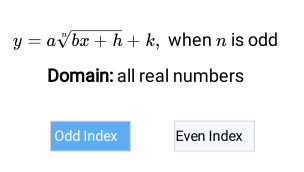
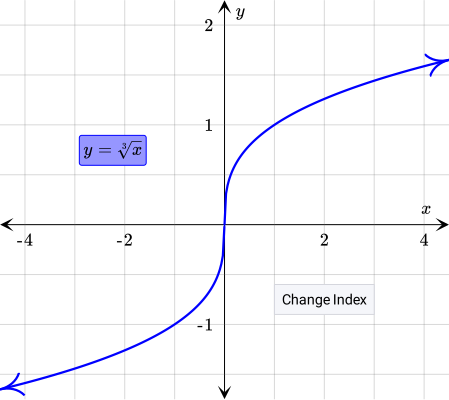
The difference in the domain of each type of function is reflected in its graph.
Odd-Indexed Radical Functions
The domain of this type of function is the set of all real numbers. Therefore, the corresponding graph extends from negative infinity to positive infinity on the horizontal axis.Even-Indexed Radical Functions
As already stated, the domain of this type of function is the set of all real numbers that makes the radicand non-negative. This means that the corresponding graph does not extend from negative infinity to positive infinity on the horizontal axis. The graph instead starts at a certain x-value.
Loading content