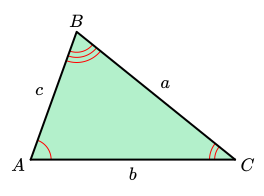
Consider △ ABC with sides of length a, b, and c, which are respectively opposite the angles with measures A, B, and C.
The following equations hold true with regard to △ ABC.
a^2=b^2+c^2-2bc cos(A)
b^2=a^2+c^2-2ac cos(B)
c^2=a^2+b^2-2ab cos(C)
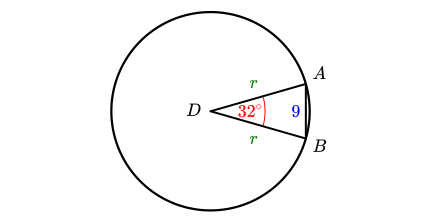
Using this law, we can write the following equation relating the radius r to the mAB and AB.
AB^2 = r^2 + r^2 - 2 r * r * cos m AB
We know that AB = 9 and mAB = 32^(∘), so let's substitute these values into the above equation. Then, we will solve the equation for r.
We have that r is about 16.33 millimeters. Note that we only care about the principal root since the radius has to be positive. Now, let's recall the formula for the circumference of a circle.
C = 2 π r
Let's substitute 16.33, the approximate value of our radius, for r in the above formula and simplify.
The circumference is about 102.60 millimeters. Since AB is mAB360^(∘) = 32^(∘)360^(∘) of the complete angle, the length of AB is 32360 of the circumference of the circle. Therefore, to find the length of AB we will multiply the approximate value of the circumference by 32360. Let's do it!