What types of angles can be formed by two intersecting lines?
B
What angle do the two angles form?
A
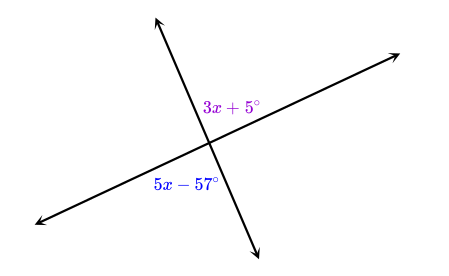
Geometric Relationship: the angles are vertical Angle Measure Relationship: the measures are equal Equation: 3x+5^(∘)=5x-57^(∘) Solution: x=31^(∘)
B
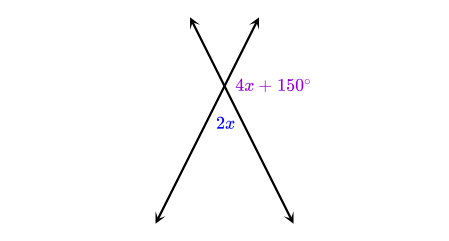
Geometric Relationship: angles are supplementary Angle Measure Relationship: the measures add up to 180^(∘) Equation: (4x+150^(∘))+2x=180^(∘) Solution: x=5^(∘)
Practice makes perfect
Let's consider the given diagram.
We can see that the 3x+5^(∘) angle and the 5x-57^(∘) angle are two opposite angles formed by two intersecting lines. This means that these angles are vertical and they have equal measure. With this in mind, let's write an equation.
3x+5^(∘) = 5x-57^(∘)
Now we can solve this equation for x. Let's ignore the degree symbol to make the math easier.
We can see that the 4x+150^(∘) angle and the 2x angle form a straight angle. This means that these angles are supplementary and their measures add up to 180^(∘). Let's write an equation using this information.
(4x+150^(∘)) + 2x = 180^(∘)
Now we can solve this equation for x.