{{ tocSubheader }}
{{ 'ml-label-loading-course' | message }}
An error ocurred, try again later!
Chapter {{ article.chapter.number }}
{{ article.number }}.
{{ article.displayTitle }}
{{ article.intro.summary }}
Show less Show more expand_more Lesson Settings & Tools
| | {{ 'ml-lesson-number-slides' | message : article.intro.bblockCount }} |
| | {{ 'ml-lesson-number-exercises' | message : article.intro.exerciseCount }} |
| | {{ 'ml-lesson-time-estimation' | message }} |
Right triangles are found in everyday settings. Just look at the steps of stairs, a ladder leaning against a wall, or an inclined ramp. Additionally, right triangles are special in mathematics because their side lengths are related by a well-known equation. Continue on and learn about the awesome right triangle.
Catch-Up and Review
Here are a few recommended readings before getting started with this lesson.
Challenge
Designing a Putting Green with Right Triangles
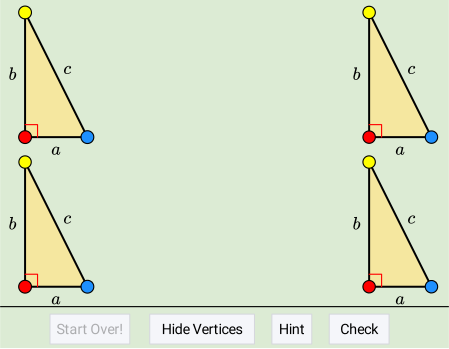
Paulina loves to play mini golf on her phone app. She plays against friends and she can even design her own golf course. The game has challenged her to design a square putting green surrounded by a sand bunker. The instructions are very specific. 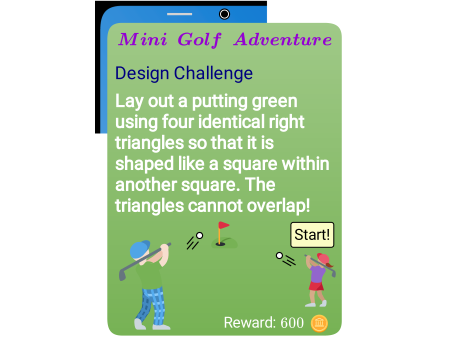 Join Paulina in her design challenge using the following applet. Use the finished design to verify the equation a^2+b^2=c^2. If help is needed, press the hint button.
Extra
How to Use the Applet- To move a triangle, click either the red vertex, the blue vertex, or inside the triangle and drag.
- To rotate a triangle, click on the yellow vertex and drag. The triangle will rotate about the blue vertex.
- Press the check button to verify whether the arrangement is correct.
- Press the hint button to get some help.
Discussion
Relation Between the Side Lengths of a Right Triangle
Right triangles are special among all types of triangles. One reason for that is their side lengths meet a particular relationship, which is established in the Pythagorean Theorem.
Rule
Pythagorean Theorem
For right triangles, the length of the hypotenuse squared equals the sum of the squares of the lengths of the legs.
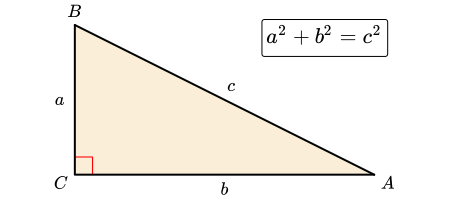
The theorem can be used to find the length of the third side when two side lengths are known.
Proof
Using AreaStart by drawing four congruent right triangles with legs a and b, and hypotenuse c. These triangles can be arranged to form two squares, with one square inside the other.
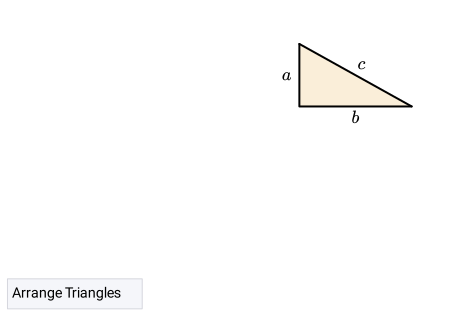 Notice that the side lengths of the outer square are equal to (a+b). Additionally, the side lengths of the inner square are equal to c. The area of both squares and the area of the four triangles are as follows.
The area of the outer square equals the sum of the area of the inner square and the area of the four triangles. The previous diagram shows that. (a+b)^2=c^2+2ab
This equation can be simplified by expanding the square of the binomial on the left-hand side.
| Area of the Inner Square | Area of the Outer Square | Area of the Four Triangles |
|---|---|---|
| c^2 | (a+b)^2 | 4* ab/2 = 2ab |
(a+b)^2=c^2+2ab
PowToProdTwoFac
a^2=a* a
(a+b)(a+b)=c^2+2ab
Distr
Distribute (a+b)
(a+b)a+(a+b)b = c^2+2ab
Distr
Distribute a & b
a^2 + ab + ab + b^2 = c^2+2ab
AddTerms
Add terms
a^2+2ab+b^2=c^2+2ab
SubEqn
LHS-2ab=RHS-2ab
a^2+b^2=c^2 ✓
Example
Mini Golf Tournament
Paulina is playing mini golf at a local course against a mighty rival — her mom, Momma Paulina. They are at the final hole 18 and Momma Paulina is wining by one stroke!
a Paulina is determined to beat Momma. Their friend acts as an announcer.
Paulina aims carefully. The ball is coming to a stop at the middle of the bridge! Wait. It is still going. It is rolling, rolling, and...it lands just 5 feet from the hole. What a stroke!
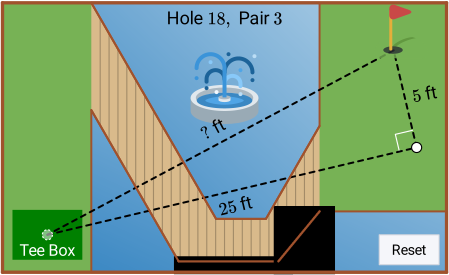
{"type":"text","form":{"type":"math","options":{"comparison":"1","nofractofloat":false,"keypad":{"simple":true,"useShortLog":false,"variables":[],"constants":[]},"rendered":false},"text":" "},"formTextBefore":null,"formTextAfter":"feet","answer":{"text":["25.5"]}}
b Their friend continues to act as an announcer.
Paulina's stroke has Momma sweating. She needs to focus if she wants to win this match. Here it goes. Not bad. Not bad at all. Momma's ball lands just 3 feet from Paulina's.
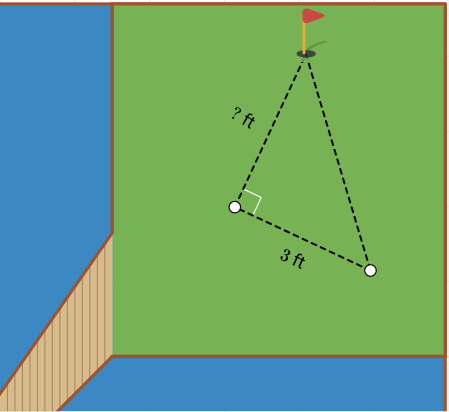
{"type":"text","form":{"type":"math","options":{"comparison":"1","nofractofloat":false,"keypad":{"simple":true,"useShortLog":false,"variables":[],"constants":[]},"rendered":false},"text":" "},"formTextBefore":null,"formTextAfter":"feet","answer":{"text":["4"]}}
Hint
a Use the Pythagorean Theorem to find the length of the hypotenuse of the right triangle formed.
b Use the Pythagorean Theorem.
Solution
a Note that the tee box, the hole, and Paulina's ball form a right triangle. The right angle is formed at Paulina's ball.
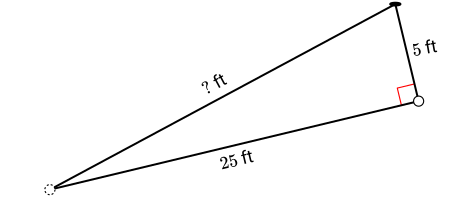
a^2 + b^2 = c^2
SubstituteII
a= 25, b= 5
25^2 + 5^2 = c^2
▼
Solve for c
CalcPow
Calculate power
625 + 25 = c^2
AddTerms
Add terms
650 = c^2
SqrtEqn
sqrt(LHS)=sqrt(RHS)
sqrt(650) = c
RearrangeEqn
Rearrange equation
c = sqrt(650)
c ≈ 25.5
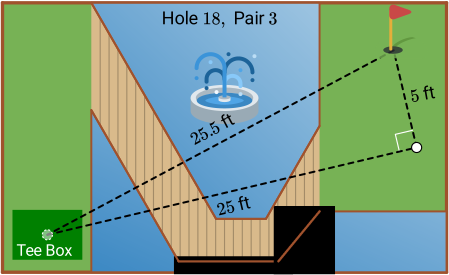
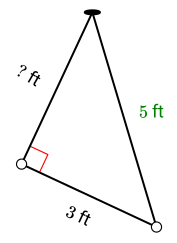
b Notice that the balls and the hole form a right triangle. The right angle is formed at Momma Paulina's ball. The balls are 3 feet apart.
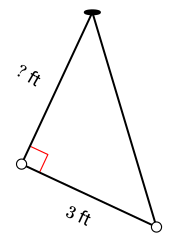
The distance from Momma's ball to the hole is the length of a leg. However, the hypotenuse's length is also missing. Wait! From Part A, Paulina's ball is 5 feet from the hole. This means that the hypotenuse of the triangle is 5 feet long.
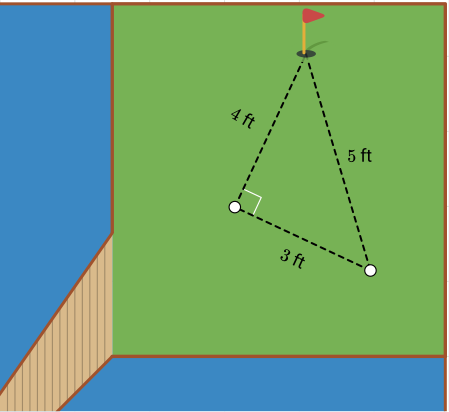
On the next stroke, Paulina put the ball in the hole. What a champ! Momma is currently winning by two strokes. If Momma puts it in on her very next stroke, she will win. If Momma misses, she needs to put the ball in on her next stroke to end in a tie. Otherwise, she will lose the game. What a thrilling match!
"Momma Paulina's final words say it all," exclaimed their announcer friend.
Pop Quiz
Finding the Missing Length
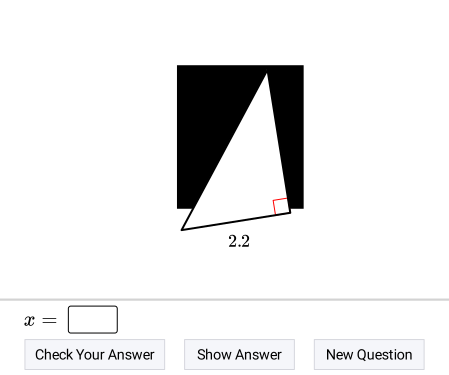
Determine the missing side length of the given right triangle. Round the answer to two decimal places if needed.
Discussion
Determining Whether a Triangle is a Right Triangle
The Pythagorean Theorem gives an equation that is only true if the triangle is a right triangle. However, swapping the hypothesis and the conclusion also makes a valid statement. This is known as the Converse of the Pythagorean Theorem.
Rule
Converse Pythagorean Theorem
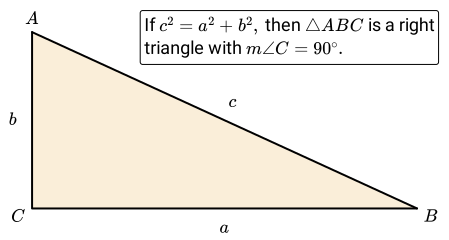
Given a triangle, if the length of the longest side squared is equal to the sum of the squares of the other two side lengths, then the triangle is a right triangle. In this case, the right angle is opposite the longest side.
Example
Flags
Paulina and her mom played an amazing game from start to finish. On their exit from the course, Paulina spots a very tall flag near the entrance that she did not notice earlier. Her mom says that it serves to indicate the wind direction to the golfers.
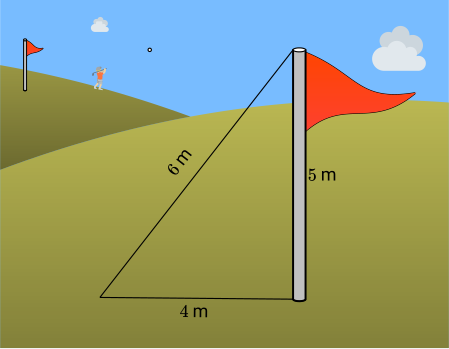 The wire, foot, and tip of the flag form a triangle with sides 4, 5, and 6 meters long. Is this a right triangle?
 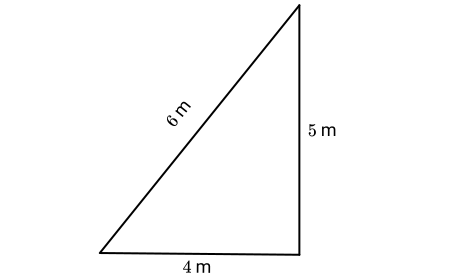 The given triangle has 4, 5, and 6 meters long sides. Now, substitute these values into the equation to verify whether they satisfy it. Remember that c is the length of the longest side.
Since 41 is not equal to 36, the side lengths do not satisfy the equation. This implies that the triangle is not a right triangle.
The given triangle has 4, 5, and 6 meters long sides. Now, substitute these values into the equation to verify whether they satisfy it. Remember that c is the length of the longest side.
Since 41 is not equal to 36, the side lengths do not satisfy the equation. This implies that the triangle is not a right triangle.
{"type":"choice","form":{"alts":["Yes","No"],"noSort":true},"formTextBefore":"","formTextAfter":"","answer":1}
Hint
Use the Converse of the Pythagorean Theorem.
Solution
A triangle is a right triangle if its side lengths meet the equation a^2+b^2=c^2 where c is the length of the longest side. This is thanks to the Converse of the Pythagorean Theorem.
a^2+b^2=c^2
SubstituteValues
Substitute values
4^2 + 5^2 ? = 6^2
CalcPow
Calculate power
16 + 25 ? = 36
AddTerms
Add terms
41 ≠ 36
Pop Quiz
Is It a Right Triangle?
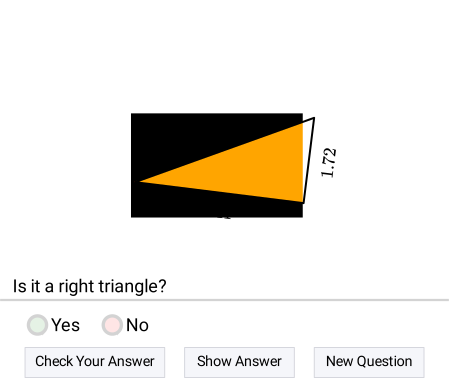
Determine whether the given triangle is a right triangle. Round the computations to one decimal place.
Extra
HintIt is enough to check if the length of the longest side squared is equal to the sum of the squares of the lengths of the other two sides.
Discussion
Pythagorean Triple
A Pythagorean triple, commonly written as (a,b,c), is a set of three natural numbers that satisfy the Pythagorean Theorem. a^2+b^2=c^2 A right triangle can be drawn using the numbers of a Pythagorean triple as its side lengths. The lowest valued set of numbers that form a Pythagorean triple are 3, 4, and 5. There are infinitely many Pythagorean triples. The following table shows a few.
| Triple | Substitute in a^2+b^2=c^2 | Simplify |
|---|---|---|
| ( 3, 4, 5) | 3^2+ 4^2? = 5^2 | 9+16=25 ✓ |
| ( 5, 12, 13) | 5^2+ 12^2? = 13^2 | 25+144=169 ✓ |
| ( 8, 15, 17) | 8^2+ 15^2? = 17^2 | 64+225=289 ✓ |
| ( 7, 24, 25) | 7^2+ 24^2? = 25^2 | 49+576=625 ✓ |
If (a,b,c) is a Pythagorean triple, then so is (ka,kb,kc) for any natural number k.
| (a,b,c) | k | (ka,kb,kc) |
|---|---|---|
| ( 3, 4, 5) | 3 | ( 3( 3), 3( 4), 3( 5)) ⇕ (9,12,15) |
| ( 5, 12, 13) | 2 | ( 2( 5), 2( 12), 2( 13)) ⇕ (10,24,26) |
Pop Quiz
Studying Triples
Consider the numbers in the following table and answer what is required. Keep in mind that the numbers are always ordered from smallest to greatest.
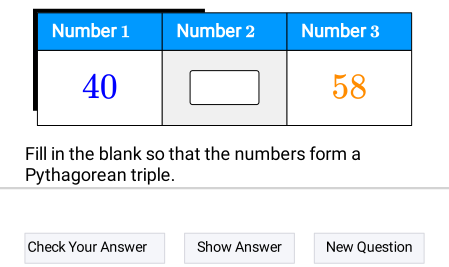 Remember, in a Pythagorean triple, the greatest number squared is equal to the sum of the squares of the other two numbers.
Discussion
Distance Between Two Points
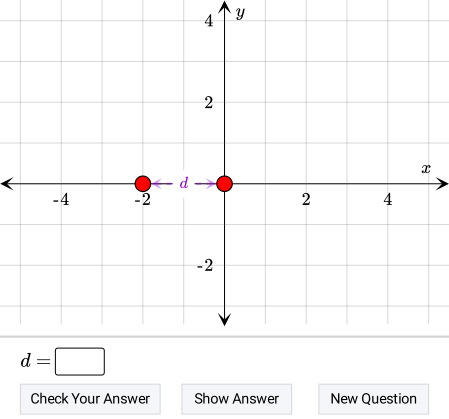
In many situations it is useful to know the distance between two objects. If those objects are plotted on a coordinate plane, the Distance Formula can be used to find their distance.
Rule
Distance Formula
Given two points A(x_1, y_1) and B(x_2, y_2) on a coordinate plane, their distance d is given by the following formula.
d = sqrt((x_2-x_1)^2 + (y_2-y_1)^2)
Example
A Long Stroke
On the drive home, Paulina breaks out a game of golf on her smartphone. She is about to take her first stroke using the driver golf club. This club is used for hitting the ball the farthest down the fairway. There she goes!
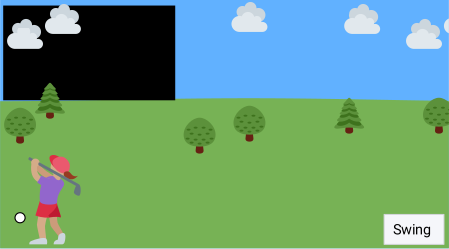
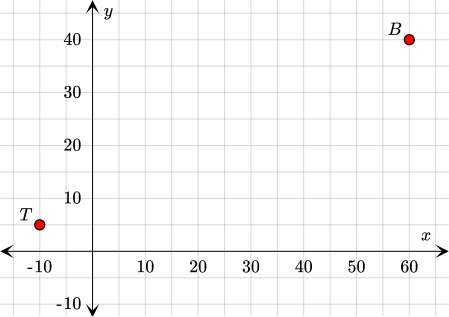 The distance traveled by the ball is the distance between these two points. It can be found by using the distance formula.
d = sqrt((x_2-x_1)^2 + (y_2-y_1)^2)
Substitute the coordinates of points T and B into the formula and simplify.
The ball traveled about 78.3 yards.
The distance traveled by the ball is the distance between these two points. It can be found by using the distance formula.
d = sqrt((x_2-x_1)^2 + (y_2-y_1)^2)
Substitute the coordinates of points T and B into the formula and simplify.
The ball traveled about 78.3 yards.
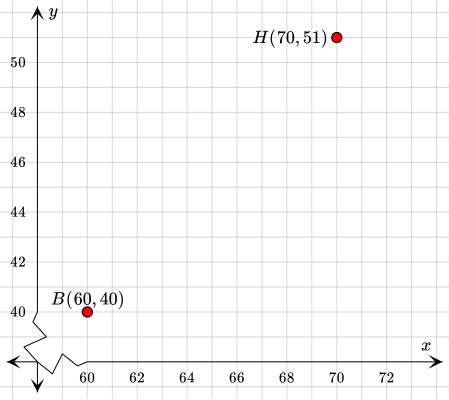 The distance is found by using the distance formula.
The ball is about 14.9 yards away from the hole. Since it is less than 15 yards, the ball is on the putting green. Paulina should use the putter for her next stroke.
The distance is found by using the distance formula.
The ball is about 14.9 yards away from the hole. Since it is less than 15 yards, the ball is on the putting green. Paulina should use the putter for her next stroke.
{"type":"text","form":{"type":"math","options":{"comparison":"1","nofractofloat":false,"keypad":{"simple":true,"useShortLog":false,"variables":[],"constants":[]},"rendered":false},"text":" "},"formTextBefore":null,"formTextAfter":"yards","answer":{"text":["78.3"]}}
b The putter is a golf club that is used when the ball is on the putting green, in this case, less than 15 yards from the hole. The hole is located at (70,51). Should Paulina use the putter for her next stroke?
{"type":"choice","form":{"alts":["Yes","No"],"noSort":true},"formTextBefore":"","formTextAfter":"","answer":0}
Hint
a Use the distance formula.
b Find the distance between the ball and the hole. If the distance is less than 15 yards, the ball is on the putting green.
Solution
a According to the app, the tee box is located at T(-10,5). The ball, after Paulina's stroke, is at B(60,40). Graph these points on a coordinate plane.
d = sqrt((x_2-x_1)^2 + (y_2-y_1)^2)
SubstitutePoints
Substitute ( -10,5) & ( 60,40)
d = sqrt(( 60-( -10))^2 + ( 40- 5)^2)
SubNeg
a-(- b)=a+b
d = sqrt((60+10)^2 + (40-5)^2)
AddSubTerms
Add and subtract terms
d = sqrt(70^2 + 35^2)
CalcPow
Calculate power
d = sqrt(4900 + 1225)
AddTerms
Add terms
d = sqrt(6125)
UseCalc
Use a calculator
d = 78.262 37...
RoundDec
Round to 1 decimal place(s)
d ≈ 78.3
b If a ball is less than 15 yards away from the hole, it is on the putting green. Calculate the distance between the ball and the hole. Begin by drawing the given points on a coordinate plane.
d = sqrt((x_2-x_1)^2 + (y_2-y_1)^2)
SubstitutePoints
Substitute ( 60,40) & ( 70,51)
d = sqrt(( 70- 60)^2 + ( 51- 40)^2)
SubTerms
Subtract terms
d = sqrt(10^2 + 11^2)
CalcPow
Calculate power
d = sqrt(100 + 121)
AddTerms
Add terms
d = sqrt(221)
UseCalc
Use a calculator
d = 14.866 06...
Pop Quiz
Finding the Distance Between Two Points
Closure
Contributions by Pythagoras
The Pythagorean Theorem is named after the Greek philosopher and mathematician Pythagoras, who lived in the 6th century BC. He is known as the founder of the Pythagorean school and is considered one of the most influential thinkers of the ancient world.
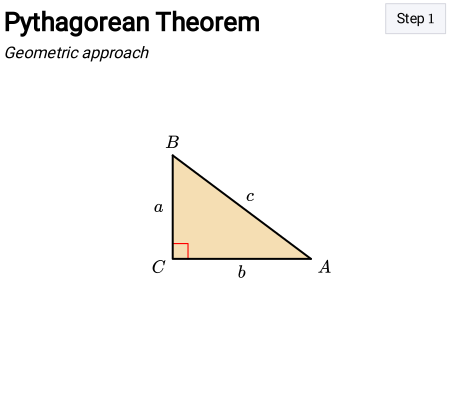 This theorem is one of his greatest contributions to mathematics. Pythagoras is considered one of the first mathematicians to use irrational numbers in his calculations. Additionally, he studied perfect solids, perfect numbers, and polygonal numbers, among other topics. Here is the definition of perfect numbers along with some examples.
 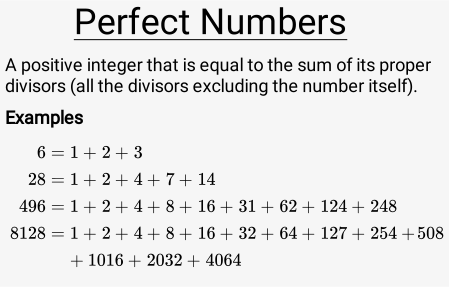 Pythagoras is also credited with other discoveries and contributions to astronomy and philosophy. With all of that, consider this fun fact: There are no books or notes written by Pythagoras himself!
Loading content