2. Circle Theorems
Sign In
An error ocurred, try again later!
Chapter 5
2.
Circle Theorems
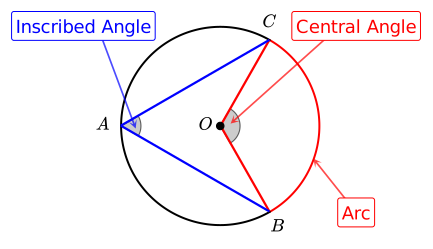
Circles, with their intricate properties, have given rise to several theorems that help in understanding their geometry. Among these, the outside angle theorem sheds light on the relationship between an exterior angle and the circle's arcs. On the other hand, central and inscribed angles play pivotal roles in circle-related problems. A central angle is formed by two radii, while an inscribed angle involves a chord and an arc. These angles and their properties are vital in many real-world applications, from designing circular objects to deciphering complex geometrical patterns.
Show less Show more expand_more 


Lesson Settings & Tools
| | 17 Theory slides |
| | 11 Exercises - Grade E - A |
| | Each lesson is meant to take 1-2 classroom sessions |
Circle Theorems
Slide of 17
Explore
Share
Report error
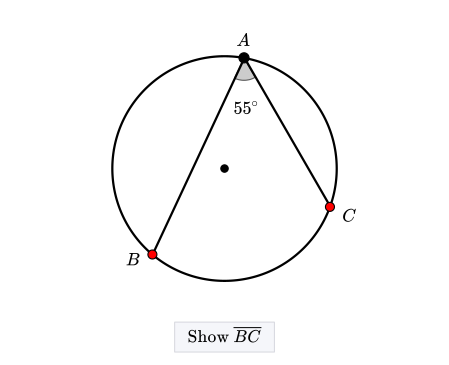
Investigating Inscribed Angles of a Circle
Explore
Share
Report error
Inscribed and Central Angles of a Circle
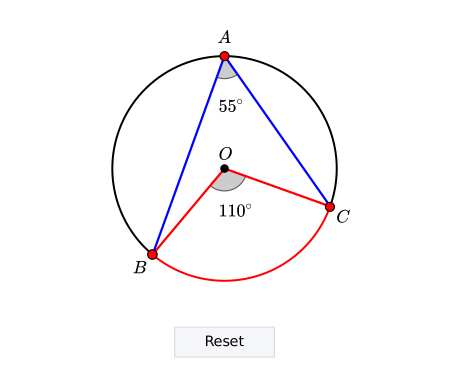
On the circle above, construct an angle with a vertex at the center of the circle. The angle being constructed should also cut off the same arc. In other words, construct the corresponding central angle.
Discussion
Share
Report error
Inscribed Angle of a Circle
Discussion
Share
Report error
Inscribed Angle Theorem
Observe the measures of the angle and the arc intercepted by the angle. Start by moving B so that B, O, and A are collinear. Then, move it once again so that B, O, and C are collinear.

As can be seen, when B, O, and C are collinear, BC becomes the diameter of the circle, and the angle cuts off the semicircle. Furthermore, the measure of BC is twice the measure of an inscribed angle that intercepts it. This statement can be restated as a theorem.
The measure of an inscribed angle is half the measure of its intercepted arc.
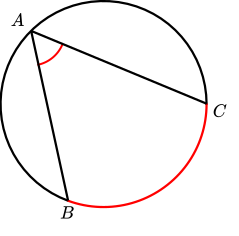
In this figure, the measure of ∠ BAC is half the measure of BC.
m∠ BAC=1/2mBC
Proof
An inscribed angle can be created in three different ways depending on where the angle is located in relation to the center of the circle.
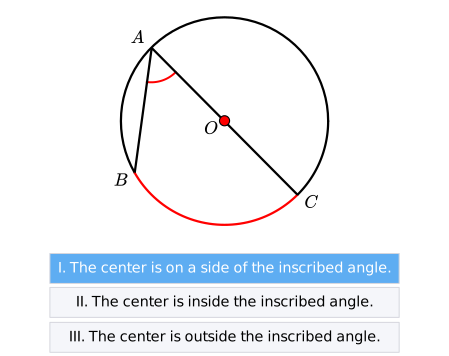
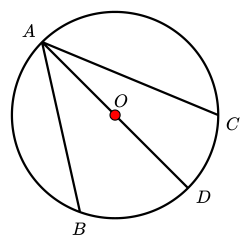
Let the measures of ∠ BAD and ∠ DAC be α and β, respectively.
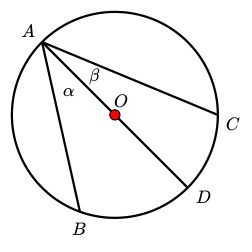
Because the radii of a circle are all congruent, two isosceles triangles can be obtained by drawing OB and OC.
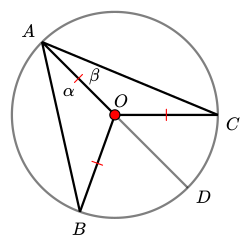
Therefore, by the Isosceles Triangle Theorem, the measures of ∠ OBA and ∠ OCA will also be α and β, respectively.
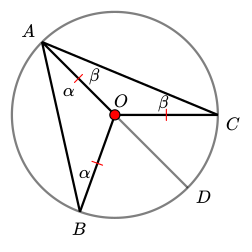
By the Triangle Exterior Angle Theorem, it is recognized that m∠ BOD=2α and m∠ COD = 2β.
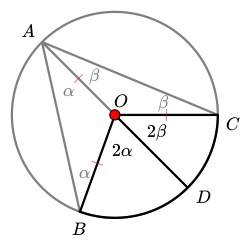
The measure of an intercepted arc is the same as the measure of its central angle. Therefore, the measures of BD and CD are 2α and 2β, respectively. mBD=2α and mCD=2β From here, using the Angle Addition Postulate and the Arc Addition Postulate, m∠ BAC and mBC can be written in terms of α and β. m∠ BAC &= α + β [0.7em] mBC &= 2α + 2β [0.7em] mBC &= 2(α+β) Consequentially, the measure of ∠ BAC is half the measure of mBC. The proof of Case II has been completed.
m∠ BAC=1/2mBC
By applying similar logic as the procedure above, Case I and Case III can be proven.
Example
Share
Report error
Finding the Inscribed Angle of a Circle
In the diagram, the vertex of ∠ UVT is on the circle O, and the sides of the angle are chords of the circle. Given the measure of UT, find the measure of the angle.
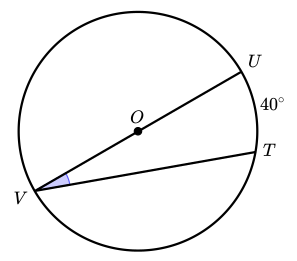
Write the answer without the degree symbol.
{"type":"text","form":{"type":"math","options":{"comparison":"1","nofractofloat":false,"keypad":{"simple":true,"useShortLog":false,"variables":["x"],"constants":["PI"]},"rendered":false},"text":" "},"formTextBefore":"m∠ UVT=","formTextAfter":null,"answer":{"text":["20"]}}
Hint
The Inscribed Angle Theorem can be used to find the measure of the angle.
Solution
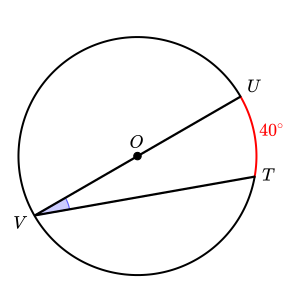
The angle shown in the diagram fits the definition of an inscribed angle. For this reason, the measure of the angle can be found using the Inscribed Angle Theorem. The theorem states that the measure of an inscribed angle is half the measure of its intercepted arc.
Pop Quiz
Share
Report error
Practice Finding Inscribed Angles
Find the measure of the inscribed angle in the circle.
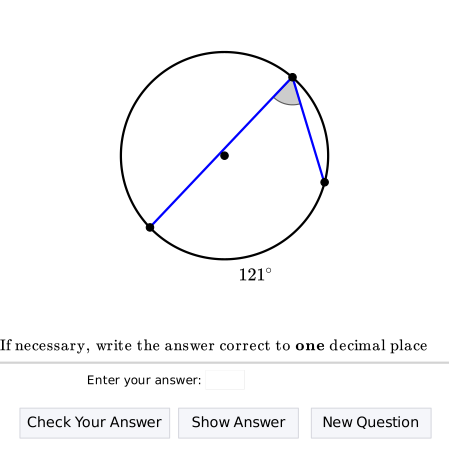
Example
Share
Report error
Finding the Central Angle of a Circle
Similarly, given the measure of an inscribed angle, the measure of its corresponding central angle can be found using the Inscribed Angle Theorem. This can be done because the measure of the central angle is the same as the measure of the arc that the central angle cuts off.
In the circle, ∠ KLM measures 67^(∘).
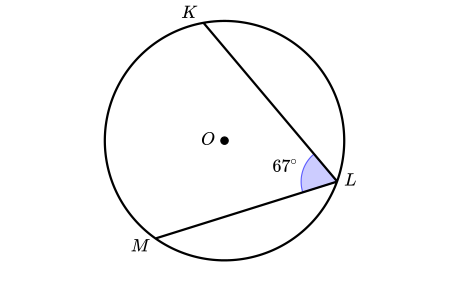
Find the measure of the corresponding central angle.
{"type":"text","form":{"type":"math","options":{"comparison":"1","nofractofloat":false,"keypad":{"simple":true,"useShortLog":false,"variables":["x"],"constants":["PI"]},"rendered":false},"text":" "},"formTextBefore":null,"formTextAfter":null,"answer":{"text":["134"]}}
Hint
Start by drawing the corresponding central angle.
Solution
Recall that a central angle is an angle whose vertex lies at the center of the circle. Additionally, the inscribed angle and its corresponding central angle intercept the same arc KM for this example. Therefore, the corresponding central angle is ∠ KOM.
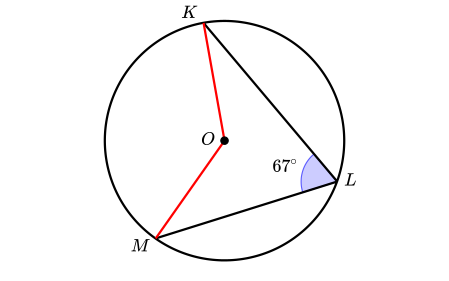
Pop Quiz
Share
Report error
Practice Finding Central Angles
Given the measure of an inscribed angle, find the measure of its corresponding central angle.
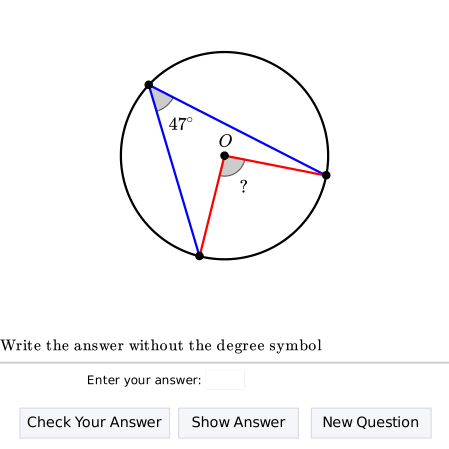
Discussion
Share
Report error
Inscribed Angles of a Circle Theorem
Up to now, the relationship between inscribed angles and their corresponding central angles has been discussed. Now the relationship between two inscribed angles that intercept the same arc will be investigated.
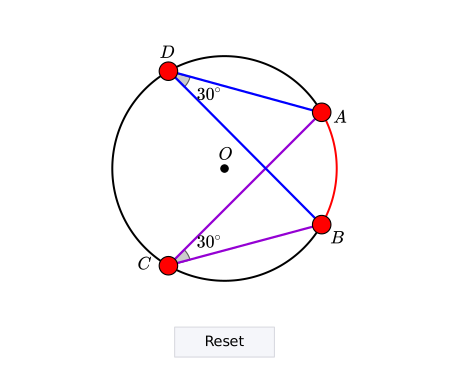
As can be observed, the angles are congruent, so long as they intercept the same arc.
If two inscribed angles of a circle intercept the same arc, then they are congruent.
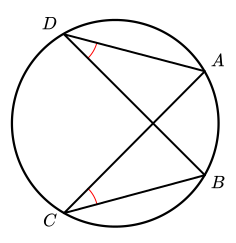
By this theorem, ∠ ADB and ∠ ACB in the above diagram are congruent angles.
∠ ADB ≅ ∠ ACB
Proof
Consider two inscribed angles ∠ ADB and ∠ ACB that intercept the same arc AB in a circle.
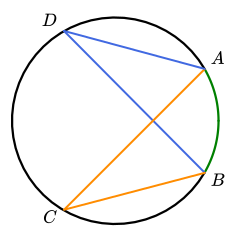
By the Inscribed Angle Theorem, the measures of ∠ ADB and ∠ ACB are half the measure of AB. m ∠ ADB = 1/2m AB [1em] m ∠ ACB = 1/2m AB Therefore, by the Transitive Property of Equality, it can be said that these two angles have the same measure. m ∠ ADB = m ∠ ACB Consequently, by the definition of congruent angles, ∠ ADB and ∠ ACB are congruent.
∠ ADB ≅ ∠ ACB
Example
Share
Report error
Using the Inscribed Angles of a Circle Theorem
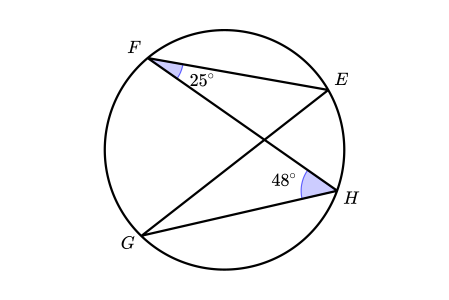
Mark and Jordan have been asked to find the measure of ∠ G.
{"type":"choice","form":{"alts":["Mark","Neither","Jordan","Both"],"noSort":false},"formTextBefore":"","formTextAfter":"","answer":1}
{"type":"text","form":{"type":"math","options":{"comparison":"1","nofractofloat":false,"keypad":{"simple":true,"useShortLog":false,"variables":["x"],"constants":["PI"]},"rendered":false},"text":" "},"formTextBefore":null,"formTextAfter":null,"answer":{"text":["25"]}}
Hint
Determine which angles intercept the same arc. Use the Inscribed Angles of a Circle Theorem to find m∠ G.
Solution
The inscribed angles E and H intercept FG.
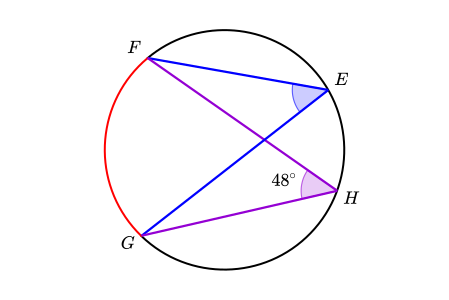
By the Inscribed Angles of a Circle Theorem, ∠ E is congruent to ∠ H. ∠ E ≅ ∠ H ⇕ m∠ E = m∠ H = 48^(∘) Accordingly, half the measure of ∠ E can be found as 48^(∘)2=24^(∘). Additionally, ∠ F and ∠ G intercept the same arc, EH.
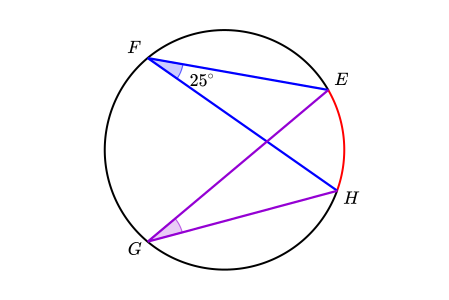
Again by the Inscribed Angles of a Circle Theorem, ∠ F is congruent to ∠ G. Therefore, m∠ G = 25^(∘). ∠ F ≅ ∠ G ⇕ m∠ F =25^(∘) = m∠ G Since m∠ G = 25^(∘), neither Mark's claim nor Jordan's claim is correct.
Discussion
Share
Report error
Constructing Angles Outside of a Circle
Inscribed angles, or the central angles, are not the only angles related to circles. In the next part, the angles constructed outside the circles will be examined. To construct an angle outside a circle, tangents can be used.
Concept
Share
Report error
Tangent
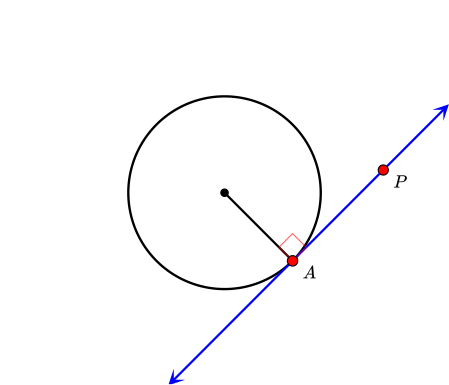
Rule
Share
Report error
Tangent to a Circle Theorem
A line is a tangent to a circle if and only if the line is perpendicular to the endpoint of a radius on the circle's circumference.
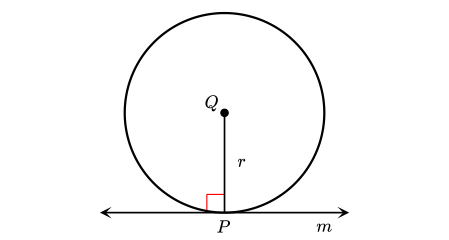
Based on the diagram, the following relation holds true.
Line m is tangent to ⊙ Q ⇔ m ⊥ QP
Proof
The theorem will be proven in two parts as it is a biconditional statement. Each will be proven by using an indirect proof.
Part I: If a Line Is a Tangent to a Circle, Then It Is Perpendicular to the Endpoint of a Radius on the Circle’s Circumference
Assume that line m is tangent to the circle centered at Q and not perpendicular to QP. By the Perpendicular Postulate, there is another segment from Q that is perpendicular to m. Let that segment be QT. The goal is to prove that QP must be that segment. The following diagram shows the mentioned characteristics.
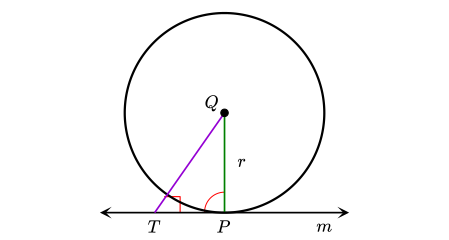
Since QT is said to be perpendicular to m, △ QTP is a right triangle. In this case, QP, whose length is r units, is the hypotenuse and, therefore, the longest side. As a result, QT is less than QP. QT < QP There is a part of QT that lies outside of the circle. Let b be the length of that part. The other part of QT is the radius of ⊙ Q, because it is a segment from the center of the circle to a point on the circle.
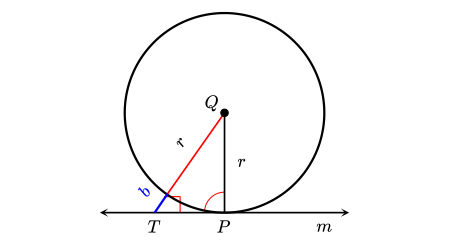
Line m is tangent to ⊙ Q ⇒ m ⊥ QP
Part II: If a Line Is Perpendicular to the Endpoint of a Radius on a Circle’s Circumference, Then It Is a Tangent to the Circle
For the second part, it will be assumed that m is perpendicular to the radius QP at P, and that line m is not tangent to ⊙ Q. In this case, line m intersects ⊙ Q at a second point R.
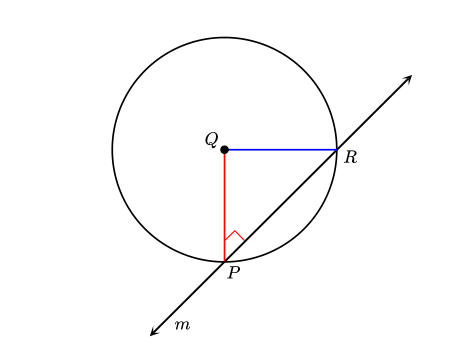
Since m is said to be perpendicular to QP at P, △ QPR is a right triangle and QR is the hypotenuse. Therefore, QP is less than QR. QP < QR However, it can also be seen that both QP and QR are radii of ⊙ Q. Therefore, they have the same length. QP = QR These two statements are contradictory to each other. Therefore, both cannot be true. The contradiction came from supposing that line m was not tangent to ⊙ Q. Consequently, m must be a tangent line to the circle. This completes the second part of the proof.
m ⊥ QP ⇒ line m is tangent to ⊙ Q
Having proven both parts, the proof of the biconditional statement of the theorem is now complete.
Line m is tangent to ⊙ Q ⇔ m ⊥ QP
Example
Share
Report error
Using the Tangent to Circle Theorem
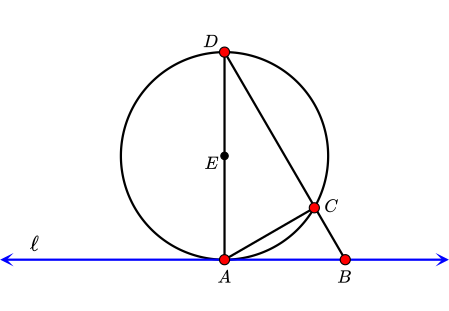
In the diagram, l is tangent to the circle at the point A, and DA is a diameter.
{"type":"choice","form":{"alts":["30^(∘)","60^(∘)","90^(∘)","120^(∘)"],"noSort":false},"formTextBefore":"","formTextAfter":"","answer":3}
Hint
A tangent is perpendicular to the radius of a circle through the point of tangency.
Solution
It has been given that m∠ ABC = 60^(∘). By the Tangent to Circle Theorem, l is perpendicular to DA. In other words, m ∠ BAD = 90^(∘).
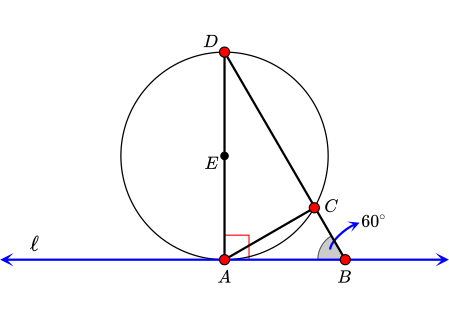
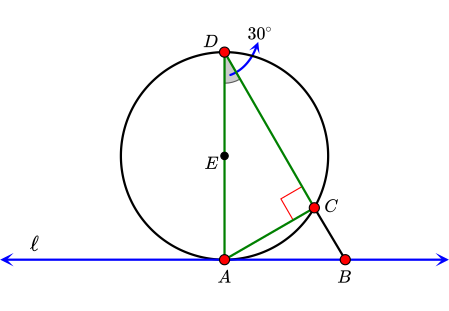
Since the sum of the measures of the interior angles of a triangle is 180^(∘), m∠ D=30 ^(∘). 90^(∘) + 60^(∘) + m∠ ADB & = 180^(∘) m∠ ADB & = 30 ^(∘) Notice that ∠ ACD is an inscribed angle on the diameter AD of ⊙ E. Therefore, ∠ ACD measures 90^(∘).
Discussion
Share
Report error
Circumscribed Angle Theorem
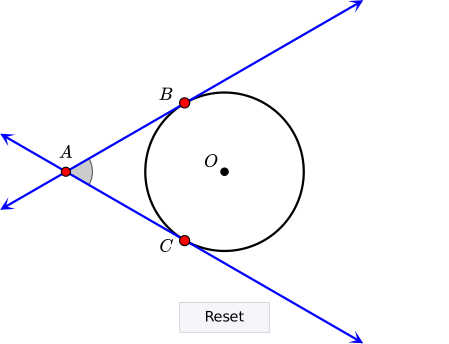
A circumscribed angle is supplementary to the central angle it cuts off.
The measure of a circumscribed angle is equal to 180^(∘) minus the measure of the central angle that intercepts the same arc.
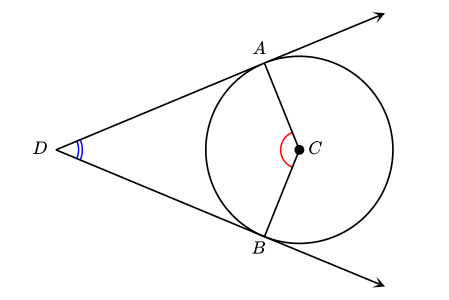
Considering the above diagram, the following relation holds true.
m∠ ADB = 180^(∘) -m∠ ACB
Proof
By definition, a circumscribed angle is an angle whose sides are tangents to a circle. Since ∠ ADB is a circumscribed angle, DA and DB are tangents to ⊙ C at points A and B, respectively. By the Tangent to Circle Theorem, CA is perpendicular to DA and CB is perpendicular to DB.
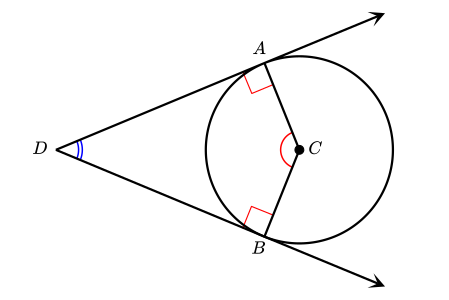
m∠ ADB + m∠ DAC + m∠ ACB + m∠ CBD = 360^(∘)
SubstituteII
m∠ DAC= 90^(∘), m∠ CBD= 90^(∘)
m∠ ADB + 90^(∘) + m∠ ACB + 90^(∘) = 360^(∘)
m∠ ADB = 180 ^(∘) - m∠ ACB
Pop Quiz
Share
Report error
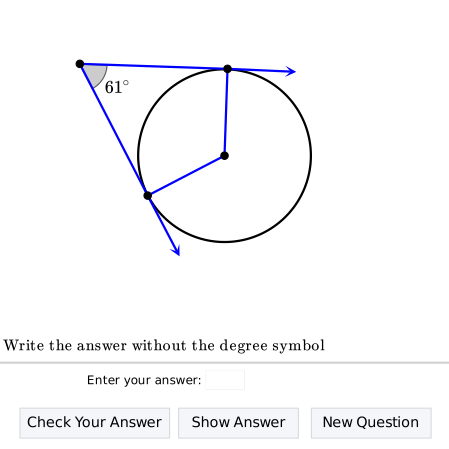
Practice Using the Circumscribed Angle Theorem
Find the measure of the central angle.
Example
Share
Report error
Using Circle Theorems to Solve Problems
The following example involving circumscribed angles and inscribed angles could require the use of the previously learned theorems.
Two tangents from P to ⊙ M are drawn. The measure of ∠ KPL is 40^(∘).
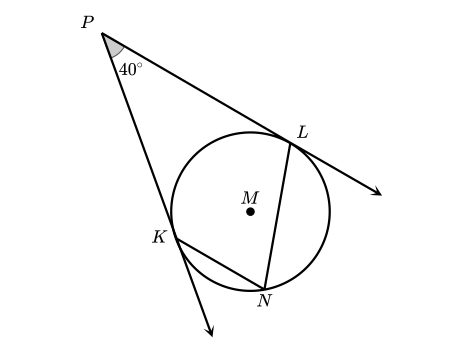
Find the measure of the inscribed angle that intercepts the same arc as ∠ KPL?
{"type":"text","form":{"type":"math","options":{"comparison":"1","nofractofloat":false,"keypad":{"simple":true,"useShortLog":false,"variables":["x"],"constants":["PI"]},"rendered":false},"text":" "},"formTextBefore":null,"formTextAfter":null,"answer":{"text":["70"]}}
Hint
Use the Circumscribed Angle Theorem and Inscribed Angle Theorem.
Solution
The inscribed angle that intercepts KL is ∠ KNL. By the Inscribed Angle Theorem, m∠ KNL is half mKL. m∠ KNL = 1/2 m KL Recall that the measure of an arc is the same as the measure of its corresponding central angle. Therefore, m∠ KML is equal to mKL.
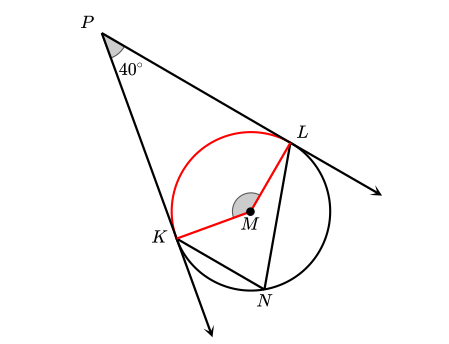
m∠ KNL = 1/2 (180^(∘) -m ∠ KPL)
Substitute
m ∠ KPL= 40 ^(∘)
m∠ KNL = 1/2 (180^(∘) - 40^(∘))
m∠ KNL = 70^(∘)
Closure
Share
Report error
Summarizing Angle Theorems Related to Circles
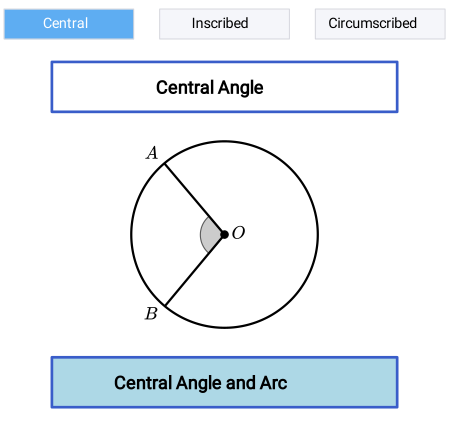
This lesson defined three angles related to circles as well as the relationships between these angles. The diagram below shows the definitions and the main theorems of this lesson.
Circle Theorems
Exercise 2.1
Write an equation that relates b to a.

{"type":"text","form":{"type":"math","options":{"comparison":"1","nofractofloat":false,"keypad":{"simple":false,"useShortLog":false,"variables":["a"],"constants":["PI"]},"rendered":false},"text":" "},"formTextBefore":"b=","formTextAfter":null,"answer":{"text":["360-2a"]}}
security
report
code
security
report
code
We are looking for a relationship between b and the inscribed angle a. Notice though that these do not have the same intercepted arc. The intercepted arc to a has the same measure as the reflexive angle to b. We can calculate this arc measure by subtracting b from 360^(∘).
Now we can use the Inscribed Angle Theorem to write a relationship between a and b.
security
report
code
The marked angles in ⊙ M are congruent.

{"type":"text","form":{"type":"math","options":{"comparison":"1","nofractofloat":false,"keypad":{"simple":true,"useShortLog":false,"variables":["x"],"constants":["PI"]},"rendered":false},"text":" "},"formTextBefore":"m∠ BCA=","formTextAfter":"^(∘)","answer":{"text":["30"]}}
security
report
code
security
report
code
Examining the diagram, we notice two intercepted arcs, DCE and AB. Let's mark them together with the given information about DCE.
By the Inscribed Angle Theorem, we know that the inscribed angle is half the measure of its intercepted arc. With this information, we can write an expression for ∠ DFE. Also remember that ∠ DFE and ∠ BMA are congruent. Therefore, we can label both of them as half the measure of DCE.
Remember that a central angle and its corresponding intercepted arc have the same measure. Let's add this information to the diagram.
To determine an expression for m∠ BCA, we can once more use the Inscribed Angles Theorem.
Recall that we in the exercises were given that m∠ BCA=(x+3)^(∘). Therefore, we have two expressions for m∠ BCA. Let's equate them and solve for x.
Now we can determine m∠ BCA by substituting 27 for x in either of the two expressions we have for ∠ BCA. m∠ BCA=( x+3)^(∘) ⇓ m∠ BCA=( 27+3)^(∘)=30^(∘)
security
report
code
The points A, B, and C are on the circumference of ⊙ O.

{"type":"text","form":{"type":"math","options":{"comparison":"1","nofractofloat":false,"keypad":{"simple":true,"useShortLog":false,"variables":["x"],"constants":["PI"]},"rendered":false},"text":" "},"formTextBefore":"m∠ OBC =","formTextAfter":"^(∘)","answer":{"text":["40"]}}
security
report
code
security
report
code
Examining the diagram, we see that both ∠ C and ∠ AOB fall on the intercepted arc AB. Since ∠ AOB is a central angle, it has the same measure as AB. According to the Inscribed Angle Theorem, m∠ C is half the measure of the intercepted arc. Therefore, we know that m∠ C is 70^(∘).
To determine the angles of △ ABC, we will first turn our attention to △ ABO. Two of its sides are the radius of the circle. Therefore, these sides are congruent and we know that we have an isosceles triangle. According to the Base Angles Theorem, the unknown angles of △ ABO are congruent. Let's label them v.
Using the Interior Angles Theorem, we can determine v.
Let's add this information to the diagram.
Examining the diagram, we see that △ ABC has the following angles. & m∠ A= 20^(∘)+ 30^(∘) & m∠ B= m∠ OBC +20^(∘) & m∠ C= 70^(∘) Using the Interior Angles Theorem, we can write an equation that we can solve for m∠ OBC.
security
report
code
Determine the measure of ∠ v.

{"type":"text","form":{"type":"math","options":{"comparison":"1","nofractofloat":false,"keypad":{"simple":true,"useShortLog":false,"variables":["x"],"constants":["PI"]},"rendered":false},"text":" "},"formTextBefore":"m∠ v=","formTextAfter":"^(∘)","answer":{"text":["30"]}}
security
report
code
security
report
code
Notice that the sum of v and 40^(∘) is the inscribed angle of the intercepted arc AC. According to the Inscribed Angle Theorem, the inscribed angle is half the measure of the intercepted arc.
security
report
code
Circle Theorems
Recommended exercises
To get personalized recommended exercises, please login first.
Loading content
≤
>
■2
■▢
e▢
7
8
9
×
÷■1
=
=
√▢
▢√
∫▢▢
4
5
6
+
−
≤
<
log
ln
log▢
1
2
3
()
∣
sin
cos
tan
0
.
π
x
y
Loading content