Sign In
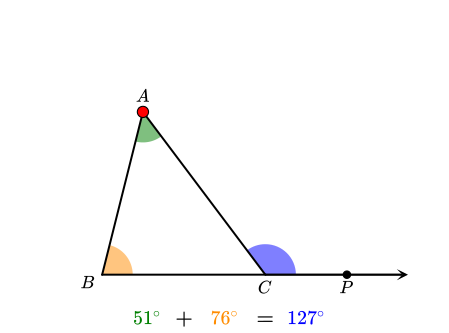
The measure of an exterior angle of a triangle is equal to the sum of the measures of the two nonadjacent interior angles, or remote interior angles.
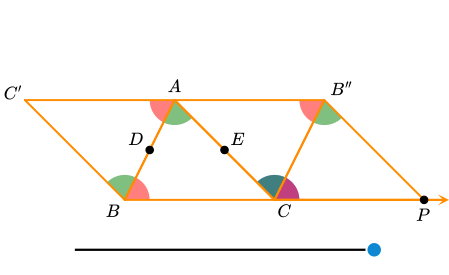
Based on the diagram above, the following relation holds true.
m∠ PCA = m∠ A + m∠ B
The diagram shows that ∠ C and ∠ PCA form a linear pair, so the sum of their measures is 180^(∘). Additionally, by the Triangle Angle Sum Theorem, the sum of the angle measures of △ ABC is 180^(∘). m∠ C + m∠ PCA = 180^(∘) & (I) m∠ A + m∠ B + m∠ C = 180^(∘) & (II) Now m∠ C can be isolated in Equation (I). m∠ C + m∠ PCA = 180^(∘) ⇕ m∠ C = 180^(∘)-m∠ PCA Next, the expression of m∠ C can be substituted into Equation (II).
m∠ C= 180^(∘)-m∠ PCA
Remove parentheses
LHS-180^(∘)=RHS-180^(∘)
LHS+m∠ PCA=RHS+m∠ PCA
Rearrange equation
It has been proven that the measure of ∠ PCA is equal to the sum of the measures of ∠ A and ∠ B. Therefore, it can be said that the measure of an exterior angle of a triangle is equal to the sum of the measures of the two nonadjacent interior angles.
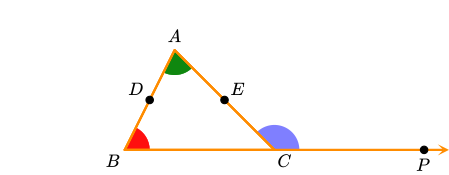
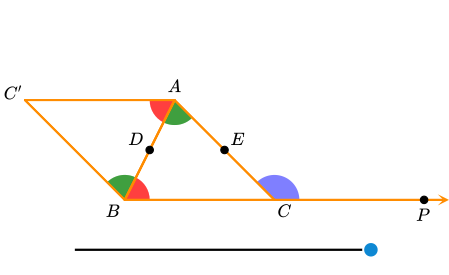
Now, △ ABC can be rotated 180^(∘) about D. Since a rotation is a rigid motion, the image of △ ABC after the rotation is congruent to △ ABC. Corresponding parts of congruent figures are congruent, so the measures of the angles and the lengths of the sides remain unchanged.
Since a 180^(∘)-rotation is equivalent to a reflection, C'A is parallel to BC and C'B is parallel to AC. Therefore, C'ACB is a parallelogram and ∠ C'AC is congruent to ∠ CBC'. Now the parallelogram C'ACB will be rotated 180^(∘) about E.
By the Parallelogram Opposite Angles Theorem, ∠ PCA is congruent to ∠ AB''P. Congruent angles have the same measure by the definition. ∠ PCA &≅ ∠ AB''P &⇕ m∠ PCA &= m∠ AB''P Since m∠ AB''P is equal to the sum of m∠ A and m∠ B and because of the Transitive Property of Equality, m∠ PCA is equal to the sum of m∠ A and m∠ B. m∠ PCA=m∠ AB''P m∠ AB''P = m∠ A + m∠ B ⇓ m∠ PCA = m∠ A + m∠ B This completes the proof.