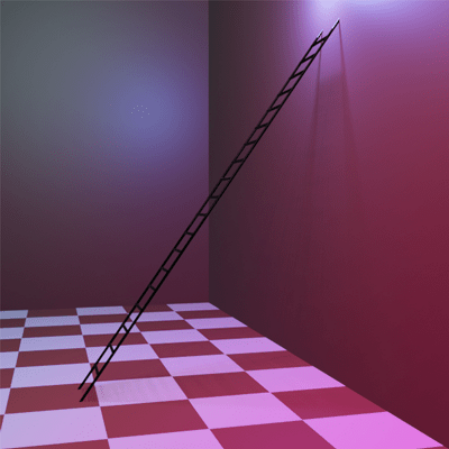
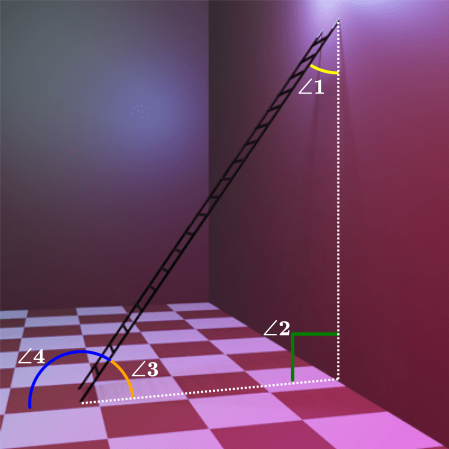
Now, we will examine each angle and the sides that form them.
Angle
Sides
∠ 1
ladder and wall
∠ 2
wall and floor
∠ 3
ladder and floor
∠ 4
ladder and floor
Let's first focus on the angles formed by the ladder and the floor. One of these angles is an interior angle and the other one is an exterior angle. Together these angles form a straight angle, so they are supplementary.
m∠ 3 + m∠ 4 = 180^(∘)
Next, we will focus on the interior angles. By the Triangle Sum Theorem, we know that the sum of the measures of the angles formed by the ladder and the wall, the wall and the floor, and the ladder and the floor is 180^(∘).
m∠ 1 + m∠ 2 + m∠ 3= 180^(∘)
With these two equations we can form a system of two equations. To find the relationship between the exterior angle and the interior angles, we will solve this system for m∠ 4. Note that we will be using the Substitution Method.
We can see that the measure of the exterior angle is the sum of the measures of the remote interior angles. From here we can make our conclusions.
The exterior and interior angles formed by the ladder and the floor are supplementary.
The measure of the exterior angle formed by the ladder and floor is the sum of the measures of the interior angle formed by the ladder and wall and the interior angle formed by the wall and floor.