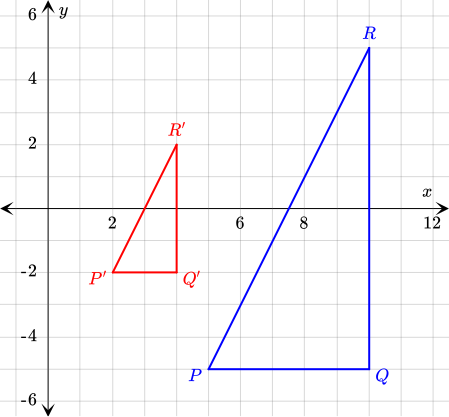
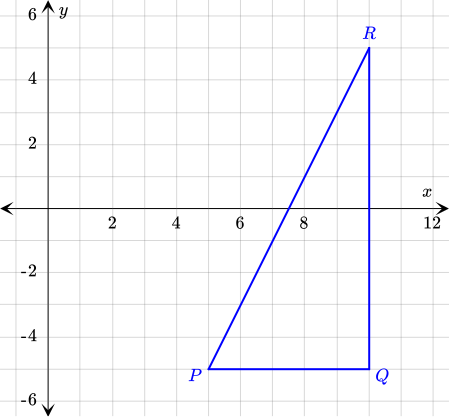
Let's start by graphing △ PQR. We have been given the points P(5,-5), Q(10,-5), and R(10,5).
A dilation can be an enlargement, a reduction, or the same size as the preimage. Which type of dilation it is depends on the value of the scale factor k.
Enlargement
k>1
Reduction
0
Same
k=1
When the center of dilation in the coordinate plane is the origin, each coordinate of the preimage is multiplied by the scale factor k to find the coordinates of the image.
ccc
Preimage & & Image [0.5em]
(x,y)& ⇒ & ( kx, ky)
Now, let's find the coordinates of the vertices of ABC after a dilation with a scale factor k= 0.4.
ccccc
(x,y) &→& ( 0.4x, 0.4y) &→& (x',y') [0.5em]
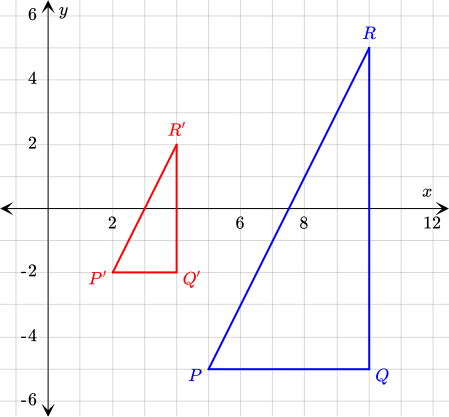
P(5,-5) &→& ( 0.4(5), 0.4(-5)) &→& P'(2,-2) [0.8em]
Q(10,-5) &→& ( 0.4(10), 0.4(-5)) &→& Q'(4,-2) [0.8em]
R(10,5) &→& ( 0.4(10), 0.4(5)) &→& R'(4,2) [0.8em]
Now that we have calculated the points for the image, we can graph them in the same coordinate system as the preimage.