Be sure to think about the horizontal transformations before any vertical transformations. Work from the inside to the outside. Then make a table of values to find points on the graph.
Transformations:
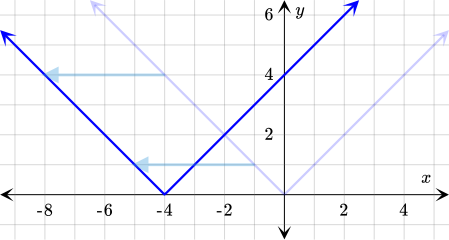
A horizontal translation 4 units to the left.
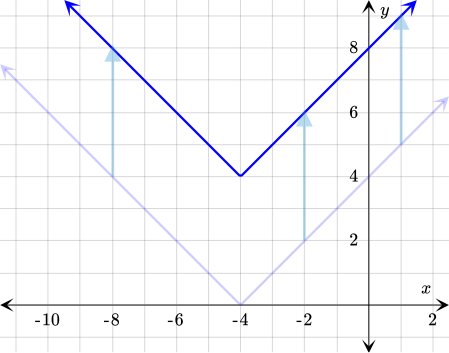
A vertical translation 4 units up. Graph:
Practice makes perfect
First we will go through all the transformations from the graph of f(x)=|x| to the graph of given function. After that we will make a table of values to graph this function.
Transformations
The given equation is a transformation of the parent function f(x)=|x|. We can define each transformation from the inside to the outside. We will start with the transformation closest to x and end with the farthest from x. Let's review our function.
c(x)=|x+4|+4First, there is a horizontal translation 4 units to the left, |x|⇒|x+4|. Remember, typically |x-h| is a horizontal translation h units to the right, while |x+h| is translated h units to the left.
Next, we have a vertical translation 4 units up, |x+4|⇒|x+4|+4. Remember, in most cases |x|+k is a vertical translation k units up, while |x|-k is translated k units down.
Graphing c(x)
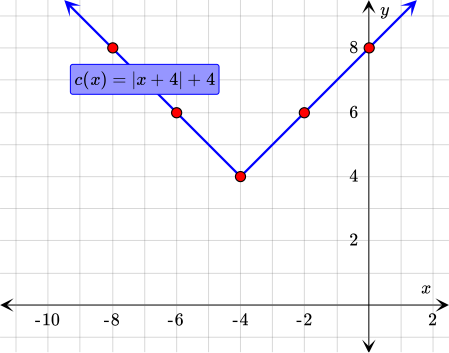
To graph the function without going through the entire process of transforming the parent function, we could instead make a table of values. Then we only need to plot the ordered pairs that we find.
x
|x+4|+4
Simplify
c(x)
-8
| -8+4|+4
|-4|+4
8
-6
| -6+4|+4
|-2|+4
6
-4
| -4+4|+4
|0|+4
4
-2
| -2+4|+4
|2|+4
6
0
| 0+4|+4
|4|+4
8
Now we can plot these points and connect them to create our graph of c(x).