Sign In
Create two tables of values and plot the graphs on the same coordinate plane.
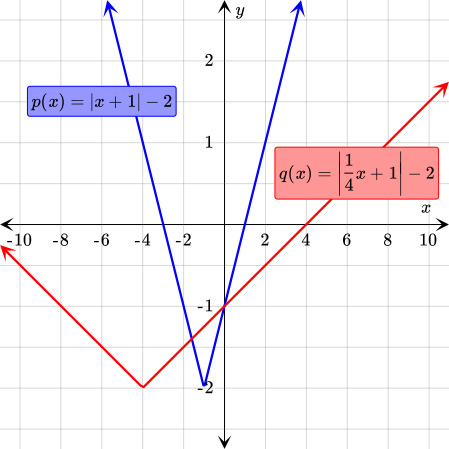
Graph:
Comparison: See solution.
To graph the functions without going through the entire process of transforming the parent function, we can make two tables of values. Then, we only need to plot and connect the obtained points and compare the graphs.
Let's begin with creating a table of values of function p.
| x | |x+1|-2 | Simplify | p(x) |
|---|---|---|---|
| -5 | | -5+1|-2 | |-4|-2 | 2 |
| -3 | | -3+1|-2 | |-2|-2 | 0 |
| -1 | | -1+1|-2 | |0|-2 | -2 |
| 1 | | 1+1|-2 | |2|-2 | 0 |
| 3 | | 3+1|-2 | |4|-2 | 2 |
| x | |1/4x+1|-2 | Simplify | q(x) |
|---|---|---|---|
| -5 | |1/4( -5)+1|-2 | |-1/4|-2 | -1 34 |
| -3 | |1/4( -3)+1|-2 | |1/4|-2 | -1 34 |
| -1 | |1/4( -1)+1|-2 | |3/4|-2 | -1 14 |
| 1 | |1/4( 1)+1|-2 | |1 14|-2 | -3/4 |
| 3 | |1/4( 3)+1|-2 | |1 34|-2 | -1/4 |
Finally we can plot these ordered pairs on one coordinate plane.
We can rewrite q(x) as p( 14x), which is a horizontal stretch of p(x) by a factor of 4. It is being stretched farther away from the y-axis. Note, while this may look like a horizontal translation, it is not. The x-intercept changes not because the graph was shifted but because the input values are being moved four times as far away from the y-axis.