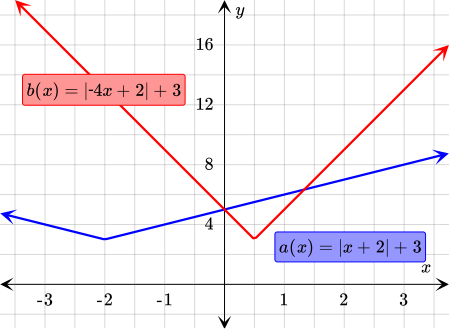
Let's begin with creating a table of values for a.
x
|x+2|+3
a(x)
-3
| -3+2|+3
4
-1
| -1+2|+3
4
1
| 1+2|+3
6
3
| 3+2|+3
8
Now we do the same with function b.
x
|-4x+2|+3
b(x)
-3
|-4( -3)+2|+3
17
-1
|-4( -1)+2|+3
9
1
|-4( 1)+2|+3
5
3
|-4( 3)+2|+3
13
Finally, we will plot and connect these ordered pairs. Keep in mind that the graph of an absolute value function has a V-shape!
Comparison
Note that we can rewrite b in terms of a.
la(x)=|x+2|+3 b(x)=|- 4x+2|+3 ⇒ b(x)=a(- 4x)
The graph of b is a horizontal shrink of the graph of a by a factor of 14, followed by a reflection in the y-axis. Note that the y-intercept is the same for both graphs.