Let's start by recalling the general forms for horizontal and vertical translations of an absolute value function.
Vertical translation:& g(x)=|x|+k
Horizontal translation:& g(x)=|x-h|
When considering a horizontal translation, we subtract the number of units that we are translating a graph. Since x+p can be written as x-(- p) and we know that p is a positive number, the graph of y=|x+p| represents a horizontal translation of the graph of y=|x| in the negative direction. Let's make a table of values for y=|x|.
x
|x|
y=|x|
-2
| -2|
2
-1
| -1|
1
0
| 0|
0
1
| 1|
1
2
| 2|
2
Let's now make a table of values for y=|x+p|. We will arbitrarily let p=2, resulting in the function y=|x+2|.
x
|x+2|
y=|x+2|
-2
| -2+2|
0
-1
| -1+2|
1
0
| 0+2|
2
1
| 1+2|
3
2
| 2+2|
4
Finally let's make a table for y=|x+p|, with p=- 2. The resulting function is y=|x-2|.
x
|x-2|
y=|x-2|
-2
| -2-2|
4
-1
| -1-2|
3
0
| 0-2|
2
1
| 1-2|
1
2
| 2-2|
0
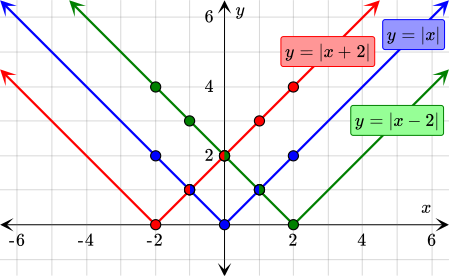
We can plot and connect the points in the same coordinate plane. Keep in mind that the graph of an absolute value function has a V shape.
Though it may seem counterintuitive, the graph of y=|x+2| is a negative horizontal translation of the graph of y=|x| by 2 units. Conversely, the graph of y=|x-2| is a positive horizontal translation of the graph of y=|x| by 2 units.