Graph a few absolute value functions with different values of a, h, and k to see how the vertex changes.
(h/a,k)
Practice makes perfect
The best way to understand how different transformations change graphs is by graphing a few examples and comparing the differences. Ultimately, we want to know how a affects the vertex of the absolute value function.
f(x)=|ax-h|+k
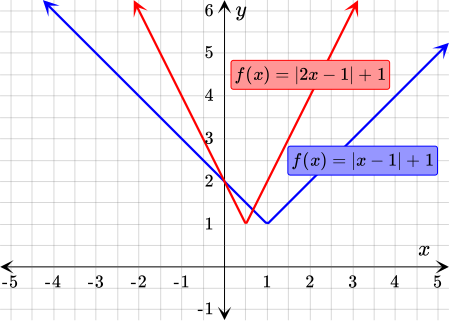
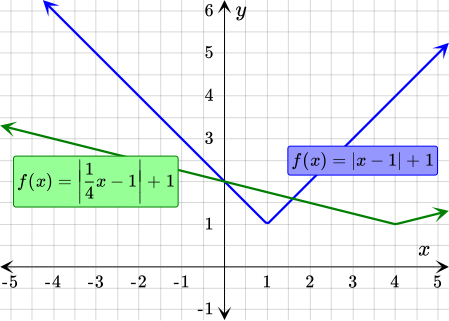
When a=1 the vertex is (h,k). First let's test a couple of functions, keeping h=1 and k=1. We can see how the vertex changes from a function where a=1 — where we already know that the vertex is (1,1) — to functions with a=2 and a= 14. This will give us an idea of how a changes the vertex.
As shown above, when a=2 the vertex becomes ( 12,1).
When a= 14, the vertex becomes (4,1). Let's compare these functions and vertices.
a
f(x)=|ax-1|+1
Vertex
1
f(x)=|x-1|+1
(1,1)
2
f(x)=|2x-1|+1
(1/2,1)
1/4
f(x)=|1/4x-1|+1
(4,1)
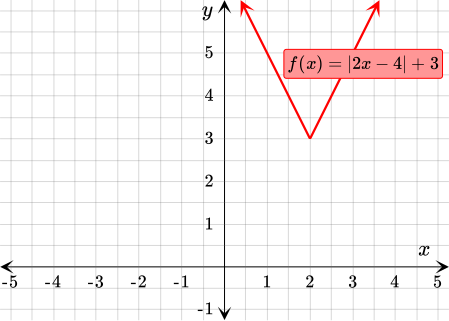
We can see that we can create the x-coordinate of the vertex by dividing h or k by a. We can graph one more function with different values for h and k to confirm this. Let's graph the function f(x)=|2x-4|+3.
The vertex of this function is (2,3). Since 4÷2=2, we can conclude that we are dividing h by a. Now we can write a general form for the vertex.
Iff(x)=|ax-h|+k, then V=(h/a,k)