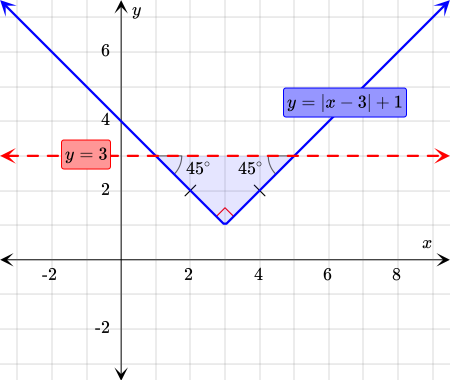
We want to write an absolute value function whose graph forms a square with the given graph. To do so, we will need to draw anyhorizontal line. Let's arbitrarily choose the line y=3.
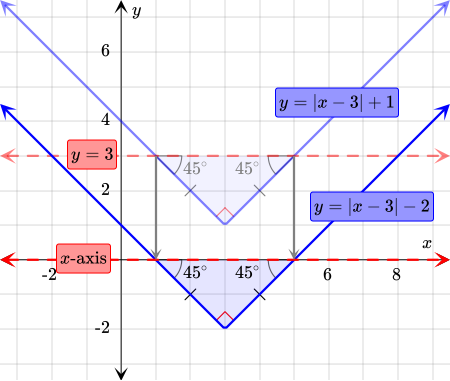
Note that, due to the symmetry of the absolute value function, we have an isosceles triangle. Since one of the angles is a right angle, the measure of the other two angles must be 45^(∘). Let's now translate our graph down 3 units. We obtain this transformation by subtracting 3 units from the output.
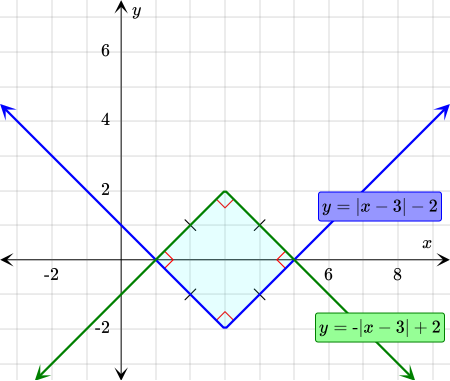
y=|x-3|+1- 3 ⇔ y=|x-3|-2Now the triangle will be formed with the x-axis.
Let's now reflect our graph in the x-axis. We obtain this by changing the sign of the output.
y=-(|x-3|-2) ⇔ y=- |x-3|+2
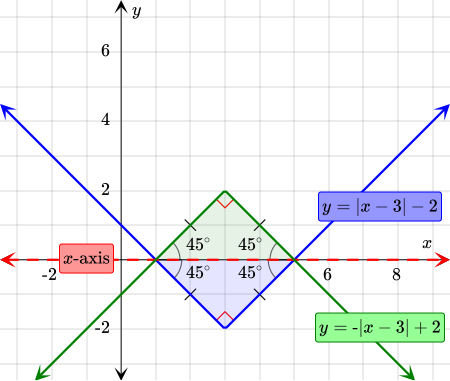
Let's graph the above function.
Note that the triangles above are congruent. Therefore, the obtained triangle is an isosceles triangle with one right angle and two angles whose measure is 45^(∘). If we merge these isosceles triangles, we obtain a square.
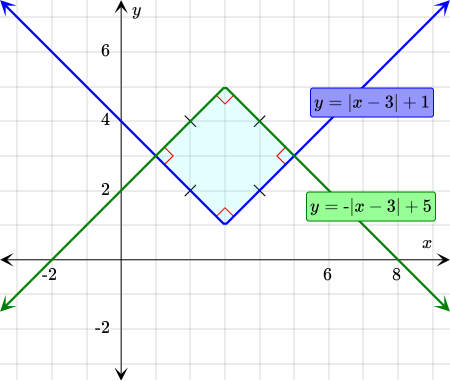
Finally, we have to go back to the original position. To do so, we will translate both graphs up 3 units by adding 3 to the outputs.
c|c
y=|x-3|-2 + 3 & y=- |x-3|+2 + 3
⇕ & ⇕
y=|x-3|+1 & y=- |x-3|+5
Let's see the final graph.
Note that there are infinitely many functions whose graphs form a square with the given graph. The function we found, y=- |x-3|+5, is just one of them.