{{ tocSubheader }}
{{ 'ml-label-loading-course' | message }}
An error ocurred, try again later!
Chapter {{ article.chapter.number }}
{{ article.number }}.
{{ article.displayTitle }}
{{ article.intro.summary }}
Show less Show more expand_more Lesson Settings & Tools
| | {{ 'ml-lesson-number-slides' | message : article.intro.bblockCount }} |
| | {{ 'ml-lesson-number-exercises' | message : article.intro.exerciseCount }} |
| | {{ 'ml-lesson-time-estimation' | message }} |
Trigonometric functions are often used to perform calculations in real-life fields, such as architecture, optics, and trajectories. In many cases, multiple trigonometric functions appear in one expression, potentially causing confusion. Fortunately, rules that relate different trigonometric functions exist, providing the ability to simplify calculations. This lesson will present some of them.
Catch-Up and Review
Here are a few recommended readings before getting started with this lesson.
Challenge
Firework's Height Given by Trigonometric Functions
Best friends Paulina and Maya graduated high school last Friday. At the graduation party, they, along with the rest of the graduates and guests, were admiring bright and colorful fireworks.  Their physics teacher came up with a contest to play for a prize — three tickets to an Ali Styles concert! He said that the height of the firework h and horizontal displacement x were related by the following equation.
h=- gx^2/2v^2cos^2 θ+xsinθ/cosθ
Here, v is the initial velocity of the projectile, θ is the angle at which it was fired, and g is the acceleration due to gravity. The first student, who can rewrite the equation so that tan θ is the only trigonometric function, will win the tickets.
Their physics teacher came up with a contest to play for a prize — three tickets to an Ali Styles concert! He said that the height of the firework h and horizontal displacement x were related by the following equation.
h=- gx^2/2v^2cos^2 θ+xsinθ/cosθ
Here, v is the initial velocity of the projectile, θ is the angle at which it was fired, and g is the acceleration due to gravity. The first student, who can rewrite the equation so that tan θ is the only trigonometric function, will win the tickets.
External credits: @pch.vector
{"type":"text","form":{"type":"math","options":{"comparison":"1","nofractofloat":false,"keypad":{"simple":false,"useShortLog":false,"variables":["x"],"constants":["v","THETA","g"]},"rendered":false},"text":" "},"formTextBefore":"h(x)=","formTextAfter":null,"answer":{"text":["\\dfrac{- gx^2}{2v^2}(1+\\tan^2(\\theta))+x\\tan(\\theta)","-\\dfrac{gx^2}{2v^2}(1+\\tan^2(\\theta))+x\\tan(\\theta)","\\dfrac{-gx^2}{2v^2}+\\dfrac{-gx^2}{2v^2}\\tan^2(\\theta)+x\\tan(\\theta)","-\\dfrac{gx^2}{2v^2}-\\dfrac{gx^2}{2v^2}\\tan^2(\\theta)+x\\tan(\\theta)"]}}
Discussion
The Concept of a Trigonometric Identity and Some Examples
Consider the two given equalities. First, analyze if any of them can be simplified. Then, focus on how many values of x make each of them true. What is the main difference between the equalities?
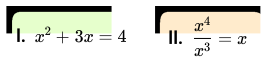
The first equality is an equation that can be solved to find the few, if any, values of x that make the equation true. However, the second equality can be simplified to x=x and, therefore, is an equation that is true for all values of x for which the expressions in the equation are defined. Given that characteristic, the second equality is called an identity.
A trigonometric identity is an equation involving trigonometric functions that is true for all values for which every expression in the equation is defined.
Two of the most basic trigonometric identities are tangent and cotangent Identities. These identities relate tangent and cotangent to sine and cosine.
Rule
Tangent and Cotangent Identities
The tangent of an angle θ can be expressed as the ratio of the sine of θ to the cosine of θ.
tanθ = sinθ/cosθ
Similarly, the cotangent of θ can be expressed as the ratio of the cosine of θ to the sine of θ.
cotθ = cosθ/sinθ
Proof
Tangent IdentityTwo proofs will be written for this identity, one using a right triangle and the other using a unit circle.
Right Triangle
In a right triangle, the tangent of an angle θ is defined as the ratio of the length of the opposite side k to the length of the adjacent side l.
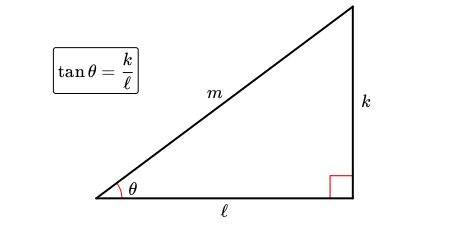
tanθ = k/l
ReduceFrac
a/b=.a /m./.b /m.
tanθ = k/m/l/m
SubstituteII
k/m= sin(θ), l/m= cos(θ)
tanθ = sinθ/cosθ
Unit Circle
Consider a unit circle and an angle θ in standard position.
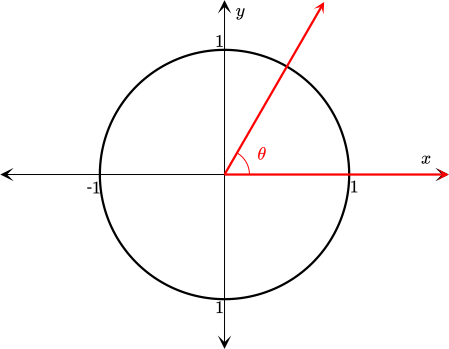
It is known that the point of intersection P of the terminal side of the angle and the unit circle has coordinates (cos θ , sin θ).
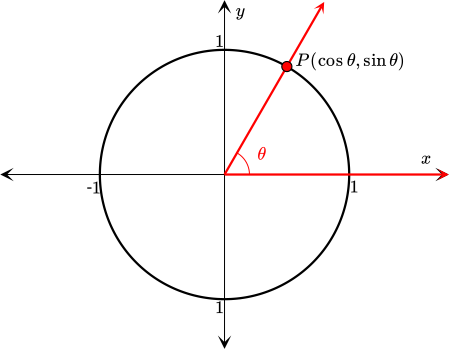
Draw a right triangle using the origin and P(cos θ , sin θ) as two of its vertices. The length of the hypotenuse is 1 and the lengths of the legs are sin θ and cos θ.
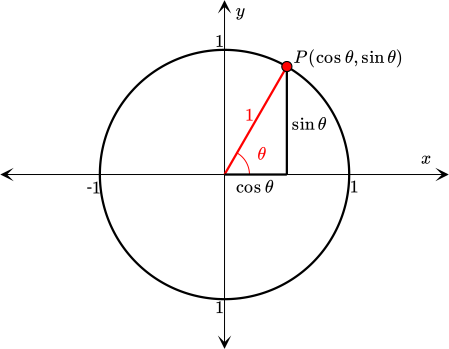
As shown previously, the tangent of a right triangle is defined as the ratio of the length of the opposite side — in this case, sin θ — to the length of the adjacent side, which here is cos θ. tan θ =sin θ/cos θ ✓
Proof
Cotangent IdentityTwo more proofs will be written for this identity, one of them using just a right triangle and the other using a unit circle.
Right Triangle
In a right triangle, the cotangent of an angle θ is defined as the ratio of the length of the adjacent side l to the length of the opposite side k.
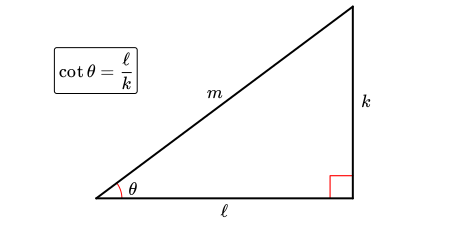
cotθ = l/k
ReduceFrac
a/b=.a /m./.b /m.
cotθ = l/m/k/m
SubstituteII
l/m= cos(θ), k/m= sin(θ)
cotθ = cosθ/sinθ
Unit Circle
Using a unit circle, it has been already proven that the tangent of an angle θ is the ratio of the sine to the cosine of the angle θ. tan θ = sin θ/cos θ By manipulating the above equation, it can be shown that the cotangent of θ is the ratio of the cosine of θ to the sine of θ.tan θ = sin θ/cos θ
MultEqn
LHS * cos θ/sin θ=RHS* cos θ/sin θ
tan θ (cos θ/sin θ)=1
DivEqn
.LHS /tan θ.=.RHS /tan θ.
cos θ/sin θ=1/tan θ
cot(θ) = 1/tan(θ)
cos θ/sin θ=cot θ
RearrangeEqn
Rearrange equation
cot θ =cos θ/sin θ ✓
There are also trigonometric identities which show that some trigonometric functions are reciprocals of others.
Rule
Reciprocal Identities
The trigonometric ratios cosecant, secant, and cotangent are reciprocals of sine, cosine, and tangent, respectively.
csc θ=1/sin θ
sec θ=1/cos θ
cot θ=1/tan θ
Proof
Consider a right triangle with the three sides labeled with respect to an acute angle θ.
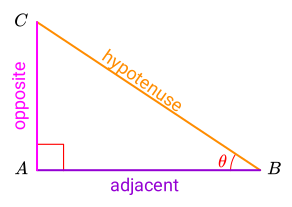
sin θ=opp/hyp
▼
Solve for 1/sin θ
MultEqn
LHS * 1/sin θ=RHS* 1/sin θ
1=opp/hyp (1/sin θ)
MultEqn
LHS * hyp/opp=RHS* hyp/opp
hyp/opp=1/sin θ
RearrangeEqn
Rearrange equation
1/sin θ=hyp/opp
Example
Simplifying Expressions by Using Trigonometric Identities
Thinking of different ways to solve the firework challenge, Paulina found herself thinking about her time learning trigonometric identities earlier in the school year. She really enjoyed those lessons.
A few of her favorite exercises included the following where she was asked to simplify these expressions.
a sin^2 θ/tan^2 θ
{"type":"text","form":{"type":"math","options":{"comparison":"1","nofractofloat":false,"keypad":{"simple":false,"useShortLog":false,"variables":["THETA"],"constants":[]},"rendered":false},"text":" "},"formTextBefore":null,"formTextAfter":null,"answer":{"text":["\\cos^2\\theta","(\\cos\\theta)^2"]}}
b cotθsecθ
{"type":"text","form":{"type":"math","options":{"comparison":"1","nofractofloat":false,"keypad":{"simple":false,"useShortLog":false,"variables":["THETA"],"constants":[]},"rendered":false},"text":" "},"formTextBefore":null,"formTextAfter":null,"answer":{"text":["\\csc\\theta"]}}
c cscθtanθ+3secθ
{"type":"text","form":{"type":"math","options":{"comparison":"1","nofractofloat":false,"keypad":{"simple":false,"useShortLog":false,"variables":["THETA"],"constants":[]},"rendered":false},"text":" "},"formTextBefore":null,"formTextAfter":null,"answer":{"text":["4\\sec\\theta"]}}
Hint
a Recall the Tangent Identity.
b Use the Cotangent Identity and the Reciprocal Identity for secant.
Solution
a The first expression contains two different trigonometric functions — sine and tangent. This means the Tangent Identity could be useful here.
sin^2 θ/tan^2 θ
Substitute
tanθ= sinθ/cosθ
sin^2 θ/( sinθ/cosθ)^2
PowQuot
(a/b)^m=a^m/b^m
sin^2 θ/sin^2 θ/cos^2 θ
DivByFracD
a/b/c= a * c/b
sin^2 θ* cos^2 θ/sin^2 θ
▼
Reduce by sin^2 θ
CrossCommonFac
Cross out common factors
sin^2 θ* cos^2 θ/sin^2 θ
CancelCommonFac
Cancel out common factors
1* cos^2 θ/1
OneMult
1* a=a
cos^2 θ/1
DivByOne
a/1=a
cos^2 θ
b To simplify the second expression, recall the Cotangent Identity and the Reciprocal Identity for secant.
cotθsecθ
SubstituteII
cotθ= cosθ/sinθ, secθ= 1/cosθ
cosθ/sinθ* 1/cosθ
MultFrac
Multiply fractions
cosθ*1/sinθ* cosθ
ReduceFrac
a/b=.a /cosθ./.b /cosθ.
1*1/sinθ* 1
MultByOne
a * 1=a
1/sinθ
c The last expression is the sum of two terms.
cscθtanθ
SubstituteII
cscθ= 1/sinθ, tanθ= sinθ/cosθ
1/sinθ*sinθ/cosθ
MultFrac
Multiply fractions
sinθ/sinθcosθ
CrossCommonFac
Cross out common factors
sinθ/sinθcosθ
CancelCommonFac
Cancel out common factors
1/cosθ
Discussion
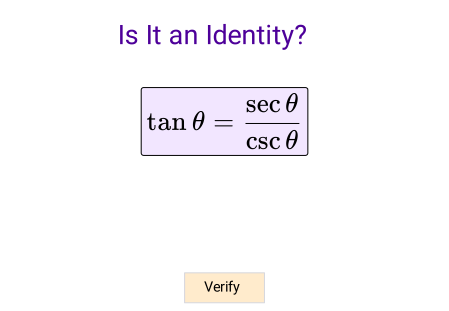
Suggestions for Verifying Identities
Some techniques, like the following, are helpful when verifying if trigonometric identities are true.
- Substitute one or more basic trigonometric identities to simplify the expression.
- Factor or multiply as necessary. Sometimes it is necessary to multiply both the numerator and denominator by the same trigonometric expression.
- Write each side of the identity in terms of sine and cosine only. Then simplify each side as much as possible.
Discussion
Presenting Pythagorean Identities
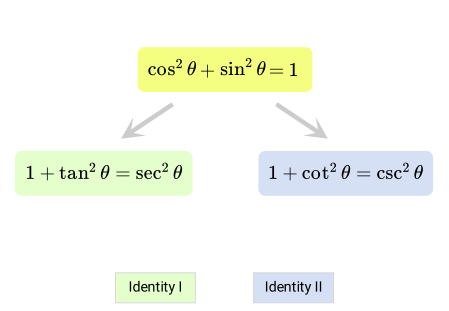
One of the most known trigonometric identities relates the square of sine and cosine of any angle θ. This identity can be manipulated to obtain two more identities involving other trigonometric functions.
Rule
Pythagorean Identities
For any angle θ, the following trigonometric identities hold true.
sin^2 θ + cos^2 θ = 1
1 + tan^2 θ = sec^2 θ
1 + cot^2 θ = csc^2 θ
Proof
For Acute AnglesConsider a right triangle with a hypotenuse of 1.
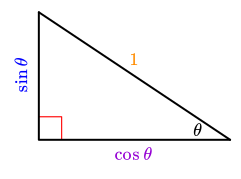
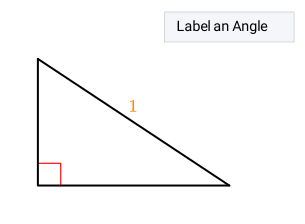 By recalling the sine and cosine ratios, the lengths of the opposite and adjacent sides to ∠ θ can be expressed in terms of the angle.
 Since cos θ represents a side length, it is not 0. Therefore, by diving both sides of the above equation by cos^2θ, the second identity can be obtained.
The second identity was obtained.
Since sin θ represents a side length, it is not 0. Therefore, by dividing both sides of sin ^2 θ +cos ^2 θ = 1 by sin ^2 θ, the third identity can be proven.
Finally, the third identity was obtained.
Since cos θ represents a side length, it is not 0. Therefore, by diving both sides of the above equation by cos^2θ, the second identity can be obtained.
The second identity was obtained.
Since sin θ represents a side length, it is not 0. Therefore, by dividing both sides of sin ^2 θ +cos ^2 θ = 1 by sin ^2 θ, the third identity can be proven.
Finally, the third identity was obtained.
| Definition | Substitute | Simplify | |
|---|---|---|---|
| sin θ | Length of oppositeside to∠ θ/Hypotenuse | opp/1 | opp |
| cos θ | Length of adjacentside to∠ θ/Hypotenuse | adj/1 | adj |
It can be seen that if the hypotenuse of a right triangle is 1, the sine of an acute angle is equal to the length of its opposite side. Similarly, the cosine of the angle is equal to the length of its adjacent side.
By the Pythagorean Theorem, the sum of the squares of the legs of a right triangle is equal to the square of the hypotenuse. Therefore, for the above triangle, the sum of the squares of sin θ and cos θ is equal to the square of 1.
sin^2 θ+ cos^2 θ&= 1^2 ⇓ & sin^2 θ+cos^2 θ&=1
sin^2 θ+cos^2 θ=1
DivEqn
.LHS /cos^2θ.=.RHS /cos^2θ.
sin^2 θ+cos^2 θ/cos^2θ=1/cos^2θ
▼
Simplify
WriteSumFrac
Write as a sum of fractions
sin^2 θ/cos^2θ+cos^2 θ/cos^2θ=1/cos^2θ
QuotOne
a/a=1
sin^2 θ/cos^2θ+1=1/cos^2θ
WritePow
Write as a power
sin^2 θ/cos^2θ+1=1^2/cos^2θ
a^m/b^m=(a/b)^m
(sin θ/cosθ)^2+1=(1/cosθ)^2
sin θ/cos θ=tan θ
tan ^2 θ+1=(1/cosθ)^2
1/cos θ=sec θ
tan ^2 θ+1=sec ^2 θ
CommutativePropAdd
Commutative Property of Addition
1+tan ^2 θ=sec ^2 θ
1+tan ^2 θ=sec ^2 θ
sin^2 θ+cos^2 θ=1
DivEqn
.LHS /sin^2θ.=.RHS /sin^2θ.
sin^2 θ+cos^2 θ/sin^2θ=1/sin^2θ
▼
Simplify
WriteSumFrac
Write as a sum of fractions
sin^2 θ/sin^2θ+cos^2 θ/sin^2θ=1/sin^2θ
QuotOne
a/a=1
1+cos^2 θ/sin^2θ=1/sin^2θ
WritePow
Write as a power
1+cos^2 θ/sin^2θ=1^2/sin^2θ
a^m/b^m=(a/b)^m
1+(cos θ/sinθ)^2=(1/sinθ)^2
cos θ/sin θ=cot θ
1+cot ^2 θ=(1/sinθ)^2
1/sin θ=csc θ
1+cot ^2 θ=csc ^2 θ
1+cot ^2 θ=csc ^2 θ
Proof
For Any AngleThe first identity can be shown using the unit circle and the Pythagorean Theorem. Consider a point (x,y) on the unit circle in the first quadrant, corresponding to the angle θ. A right triangle can be constructed with θ.
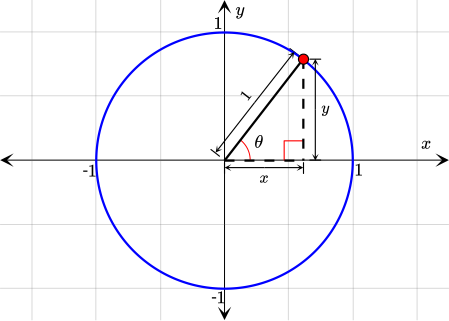
By the Pythagorean Theorem, the sum of the squares of x and y equals 1. x^2 + y^2 = 1 In fact, this is true not only for points in the first quadrant, but for every point on the unit circle. Recall that, for points (x,y) on the unit circle corresponding to angle θ, it is known that x = cos θ and that y = sin θ. By substituting these expressions into the equation, the first identity can be obtained.
cos^2 θ + sin^2 θ = 1
Example
Trigonometric Functions of Angles on the Map
Enjoying the graduation party, Maya and Paulina shared some memories about some of the fun they had exploring their neighborhood as kids. After school they would buy junk food at the 24-hour store, bird watch in the trees of the park, and play around the lake.
 The sine of the angle θ formed by the road connecting Paulina's and Maya's houses to the store is 45. The cosine of the angle β formed by the road connecting Paulina's and Maya's houses to the school is - 78. Interact with the map to view these angles.
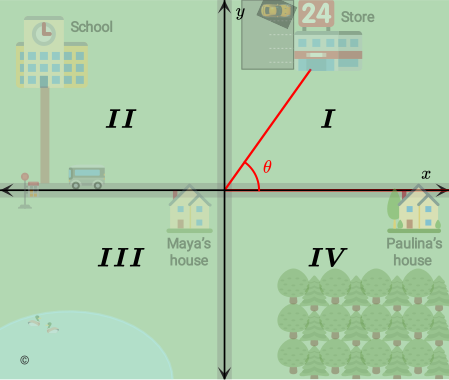 tanθ=sinθ/cosθ Since both sinθ and cosθ are known, substitute their values and solve for tanθ.
Next, identify the quadrant of the angle to determine the sign of the sine of β.
tanθ=sinθ/cosθ Since both sinθ and cosθ are known, substitute their values and solve for tanθ.
Next, identify the quadrant of the angle to determine the sign of the sine of β. 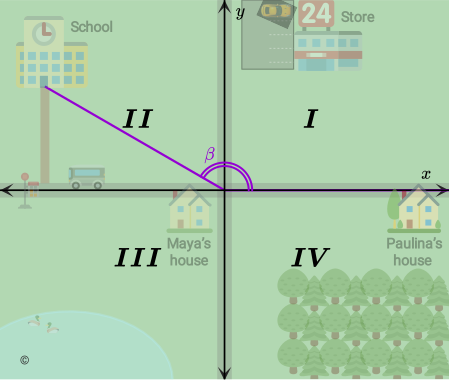 cotβ=cosβ/sinβ
Substitute cosβ with - 78 and sinβ with sqrt(15)8 and solve for cotβ.
cotβ=cosβ/sinβ
Substitute cosβ with - 78 and sinβ with sqrt(15)8 and solve for cotβ.
External credits: Hari Panicker
a What is the cosine of θ?
{"type":"text","form":{"type":"math","options":{"comparison":"1","nofractofloat":false,"keypad":{"simple":true,"useShortLog":false,"variables":[],"constants":[]},"rendered":false},"text":" "},"formTextBefore":"cos\u03b8=","formTextAfter":null,"answer":{"text":["\\dfrac{3}{5}"]}}
b What is the tangent of θ?
{"type":"text","form":{"type":"math","options":{"comparison":"1","nofractofloat":false,"keypad":{"simple":true,"useShortLog":false,"variables":[],"constants":[]},"rendered":false},"text":" "},"formTextBefore":"tan\u03b8=","formTextAfter":null,"answer":{"text":["\\dfrac{4}{3}"]}}
c What is the sine of β?
{"type":"text","form":{"type":"math","options":{"comparison":"1","nofractofloat":false,"keypad":{"simple":false,"useShortLog":false,"variables":[],"constants":[]},"rendered":false},"text":" "},"formTextBefore":"sin\u03b2=","formTextAfter":null,"answer":{"text":["\\dfrac{\\sqrt{15}}{8}"]}}
d What is the cotangent of β?
{"type":"text","form":{"type":"math","options":{"comparison":"1","nofractofloat":false,"keypad":{"simple":false,"useShortLog":false,"variables":[],"constants":[]},"rendered":false},"text":" "},"formTextBefore":"cot\u03b2=","formTextAfter":null,"answer":{"text":["-\\dfrac{7}{\\sqrt{15}}","\\dfrac{-7}{\\sqrt{15}}","\\dfrac{7}{-\\sqrt{15}}"]}}
Hint
a Apply the Pythagorean Identity.
b Recall the Tangent Identity.
c To determine the sign of the sine, identify in which quadrant β is located.
d Use the Cotangent Identity.
Solution
a It is given that the sine of θ is 45. To find the value of the cosine of θ, the Pythagorean Identity can be used.
External credits: Hari Panicker
The angle is in the first quadrant, where cosine is positive. Therefore, it can be concluded that the cosine of θ is 35.
b To calculate the tangent of θ, the Tangent Identity can be used.
tanθ=sinθ/cosθ
SubstituteII
sinθ= 4/5, cosθ= 3/5
tanθ=4/5/3/5
▼
Simplify right-hand side
DivFracByFracSL
.a/b /c/d.=a/b*d/c
tanθ=4/5*5/3
MultFrac
Multiply fractions
tanθ=4*5/5* 3
CrossCommonFac
Cross out common factors
tanθ=4*5/5* 3
CancelCommonFac
Cancel out common factors
tanθ=4/3
c This time the sine of the angle is known, while the cosine should be found. Again, the Pythagorean Theorem can be used. Substitute - 78 for cosβ and solve for sinβ.
External credits: Hari Panicker
The angle is in the second quadrant, where sine is positive. Therefore, the sine of β is sqrt(15)8.
d In order to find the cotangent of β, recall the Cotangent Identity.
cotβ=cosβ/sinβ
SubstituteII
cosβ= - 7/8, sinβ= sqrt(15)/8
cotβ=- 7/8/sqrt(15)/8
▼
Simplify right-hand side
DivFracByFracSL
.a/b /c/d.=a/b*d/c
cotβ=- 7/8* 8/sqrt(15)
MultFrac
Multiply fractions
cotβ=- 7*8/8* sqrt(15)
CrossCommonFac
Cross out common factors
cotβ=- 7*8/8* sqrt(15)
CancelCommonFac
Cancel out common factors
cotβ=- 7/sqrt(15)
Pop Quiz
Practicing Applying Pythagorean Identities
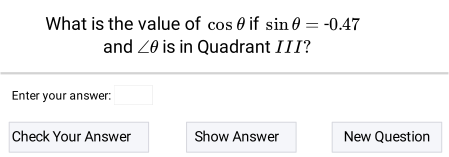
Given the value of a trigonometric function and the quadrant of the angle, use one of the Pythagorean Identities to find the value of another trigonometric function. Round the answer to two decimal places.
Example
Verifying an Identity
Maya told Jordan, who was late for the graduation party, all about the contest and asked her to recall the trigonometric identities they learned on her way over. While thinking about the identities, Jordan remembered that, when they studied the topic, Maya sent her one interesting identity and decided to find that text.

{"type":"choice","form":{"alts":["Yes","No"],"noSort":false},"formTextBefore":"","formTextAfter":"","answer":0}
Hint
Use the known trigonometric identities to rewrite the left- and right-hand sides of the equation until they match.
Solution
To verify the given identity, its sides should be rewritten until they match. First, rewrite the left-hand side using the Reciprocal Identities for secant and cosecant.
Next, the right-hand side can be rewritten by applying the Tangent and Cotangent Identities.
Finally, by the Pythagorean Identity, the numerator of the fraction on the right-hand side is 1.
1/cosθsinθ=sin^2θ+cos^2θ/sinθcosθ ⇓ 1/cosθsinθ=1/sinθcosθ
A true statement was obtained, which means that the equation Maya sent is, indeed, a trigonometric identity.
secθcscθ=tanθ+cotθ
SubstituteII
secθ= 1/cosθ, cscθ= 1/sinθ
1/cosθ* 1/sinθ=tanθ+cotθ
MultFrac
Multiply fractions
1/cosθsinθ=tanθ+cotθ
1/cosθsinθ=tanθ+cotθ
SubstituteII
tanθ= sinθ/cosθ, cotθ= cosθ/sinθ
1/cosθsinθ= sinθ/cosθ+ cosθ/sinθ
ExpandFrac
a/b=a * sinθ/b * sinθ
1/cosθsinθ=sin^2θ/sinθcosθ+cosθ/sinθ
ExpandFrac
a/b=a * cosθ/b * cosθ
1/cosθsinθ=sin^2θ/sinθcosθ+cos^2θ/sinθcosθ
AddFrac
Add fractions
1/cosθsinθ=sin^2θ+cos^2θ/sinθcosθ
Discussion
Cofunction and Negative Angles Identities
Studying angles and their trigonometric values in a right triangle more closely reveals further relationships between sine and cosine, and between tangent and cotangent.
Rule
Cofunction Identities
For any angle θ, the following trigonometric identities hold true.
sin ( π/2 - θ ) = cosθ
\cos\left(\dfrac \pi 2 - \theta\right) = \sin\theta
\tan\left(\dfrac \pi 2 - \theta\right) = \cot\theta
Proof
For Acute AnglesConsider a right triangle. The measure of its right angle is 90^(∘) or π2 radians. Let θ be the radian measure of one of the acute angles. Since the sum of two acute angles in a right triangle is π2, the measure of the third acute angle must be π2-θ.
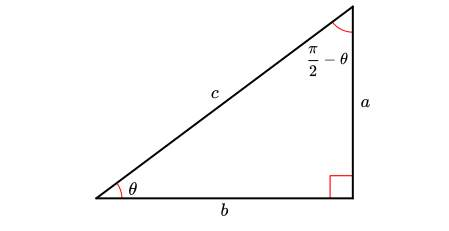
Let also a, b, and c represent the side lengths of the triangle. In this case, cosine of θ can be expressed as the ratio of the lengths of the angle's adjacent side and the hypotenuse. cosθ = b/c At the same time, sine of the opposite angle can be expressed as the ratio of the lengths of the angle's opposite side and the hypotenuse. sin ( π/2 - θ ) = b/c Since the right-hand sides of the equations are equal, by the Transitive Property of Equality, the left-hand sides are also equal.
sin ( π/2 - θ ) = cosθ
This identity is true for all angles, not just those that make it possible to construct a right triangle. Using similar reasoning, the corresponding identities for cosine and tangent can be proven.
When dealing with negative angles, identities that relate trigonometric values of negative and positive angles become very useful.
Rule
Negative Angle Identities
The function y = sin(x) has odd symmetry, and y = cos(x) has even symmetry, which can be seen from their graphs. As a result, the corresponding identities hold true.
sin(- θ) = - sinθ cos(- θ) = cosθ tan(- θ) = - tanθ
Proof
sin(- θ) = - sinθ and cos(- θ) = cosθThe identities will be proven using a unit circle. Consider an arbitrary ∠ θ on a unit circle. Let A be the point that the angle forms on the circle.
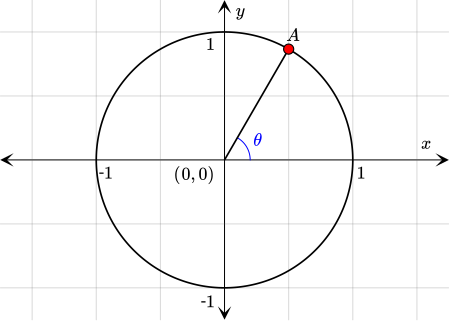
Recall that the values on the x-axis are represented by cosine and the value on the y-axis are represented by sine. Therefore, the coordinates of A are (cosθ,sinθ).
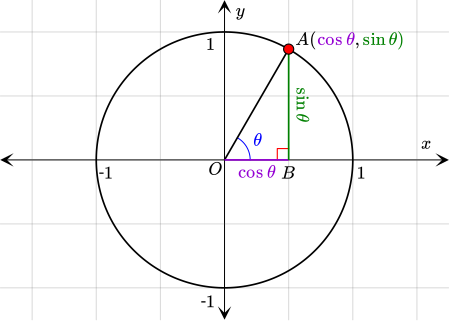
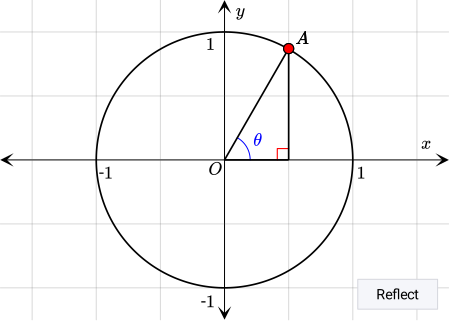
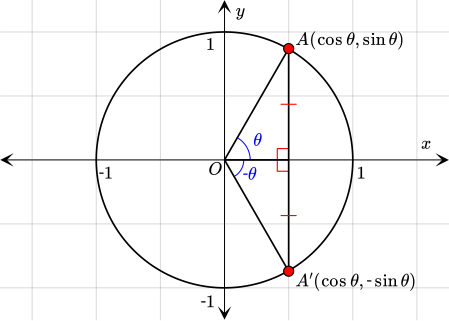
Additionally, after the reflection, the angle between A', the origin, and the x-axis is - θ. This means that the lengths of the newly created horizontal and vertical segments are cos(- θ) and sin(- θ). Therefore, the coordinates of A' can also be written as (cos(- θ),sin(- θ)).
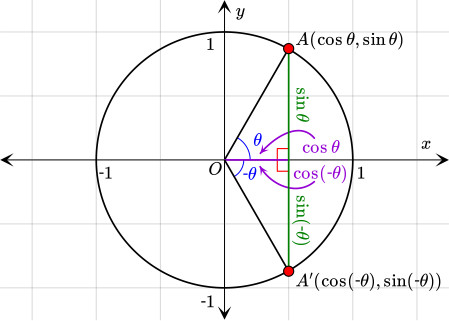
This way there are two pairs of coordinates of the same point A'. This allows to conclude the following. A'( cos(- θ), sin(- θ)) &and A'( cosθ, - sinθ) & ⇓ cos(- θ)&= cos θ sin(- θ)&= - sinθ
Proof
tan(- θ) = - tanθBy expressing tan(- θ) using sine and cosine, this identity can be shown.
tan(- θ)
tan(θ)=sin(θ)/cos(θ)
sin(- θ)/cos(- θ)
sin(- θ)=- sin(θ)
- sin(θ)/cos(- θ)
cos(- θ)=cos(θ)
- sin(θ)/cos(θ)
MoveNegNumToFrac
Put minus sign in front of fraction
- sin(θ)/cos(θ)
sin(θ)/cos(θ)=tan(θ)
- tan(θ)
Example
Solving an Online Quiz
Jordan, still on the bus ride to the graduation party, feels excited about getting to solve a trig problem to win tickets to see Ali Styles live. She still has a bit of time before arriving so she used her tablet to look up a 10-minute online quiz as practice.
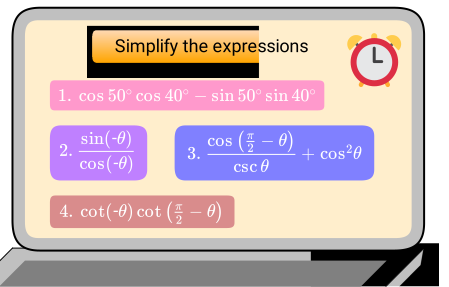
Here are the expressions that Jordan is asked to simplify. What answers should be submitted to score a perfect 100 %?
a cos 50^(∘)cos 40^(∘)-sin 50^(∘)sin 40^(∘)
{"type":"text","form":{"type":"math","options":{"comparison":"1","nofractofloat":false,"keypad":{"simple":true,"useShortLog":false,"variables":[],"constants":[]},"rendered":false},"text":" "},"formTextBefore":null,"formTextAfter":null,"answer":{"text":["0"]}}
b sin(- θ)/cos(- θ)
{"type":"text","form":{"type":"math","options":{"comparison":"1","nofractofloat":false,"keypad":{"simple":false,"useShortLog":false,"variables":["THETA"],"constants":[]},"rendered":false},"text":" "},"formTextBefore":null,"formTextAfter":null,"answer":{"text":["-\\tan\\theta"]}}
c cos( π2-θ)/cscθ+cos^2 θ
{"type":"text","form":{"type":"math","options":{"comparison":"1","nofractofloat":false,"keypad":{"simple":true,"useShortLog":false,"variables":[],"constants":[]},"rendered":false},"text":" "},"formTextBefore":null,"formTextAfter":null,"answer":{"text":["1"]}}
d cot(- θ)cot( π2-θ)
{"type":"text","form":{"type":"math","options":{"comparison":"1","nofractofloat":false,"keypad":{"simple":true,"useShortLog":false,"variables":[],"constants":[]},"rendered":false},"text":" "},"formTextBefore":null,"formTextAfter":null,"answer":{"text":["-1"]}}
Hint
a Use the Cofunction Identities for sine and cosine.
b Recall the Negative Angle Identities.
c Rewrite the expression by applying the Cofunction Identity for cosine and the Reciprocal Identity for cosecant.
d Begin by using the Cotangent Identity.
Solution
a The first expression consists of two similar terms. To rewrite it, the Cofunction Identities can be used.
cos 50^(∘)cos 40^(∘)-sin 50^(∘)sin 40^(∘)
cos(θ)=sin(90^(∘)-θ)
sin(90^(∘)-50^(∘))cos 40^(∘)-sin 50^(∘)sin 40^(∘)
sin(θ)=cos(90^(∘)-θ)
sin(90^(∘)-50^(∘))cos 40^(∘)-cos (90^(∘)-50^(∘))sin 40^(∘)
SubTerm
Subtract term
sin 40^(∘)cos 40^(∘)-cos 40^(∘)sin 40^(∘)
DiffZero
A-A=0
0
b To simplify the second expression, first recall the Negative Angle Identities.
sin(- θ)/cos(- θ)
sin(- θ)=- sin(θ)
- sinθ/cos(- θ)
cos(- θ)=cos(θ)
- sinθ/cos θ
MoveNegNumToFrac
Put minus sign in front of fraction
- sinθ/cos θ
tan(θ)=sin(θ)/cos(θ)
- tanθ
c First, analyze the given expression.
cos( π2-θ)/cscθ+cos^2 θ
cos(π/2-θ)=sin(θ)
sinθ/cscθ+cos^2 θ
csc(θ) = 1/sin(θ)
sinθ/1/sinθ+cos^2 θ
DivByFracD
a/b/c= a * c/b
sinθsinθ/1+cos^2 θ
ProdToPowTwoFac
a* a=a^2
sin^2 θ/1+cos^2 θ
DivByOne
a/1=a
sin^2 θ+cos^2 θ
d Start by rewriting the cotangent by applying the Cotangent Identity.
cot(- θ)cot( π2-θ)
cot(θ) = 1/tan(θ)
1/tan(- θ)* 1/tan( π2-θ)
MultFrac
Multiply fractions
1/tan(- θ)tan( π2-θ)
1/tan(- θ)tan( π2-θ)
tan(- θ)=- tan(θ)
1/- tanθtan( π2-θ)
Substitute
tan( π2-θ)= cotθ
1/- tanθcotθ
WriteProdFrac
Write as a product of fractions
1/- tanθ* 1/cotθ
MoveNegDenomToFrac
Put minus sign in front of fraction
- 1/tanθ* 1/cotθ
Example
Building a Birdhouse
Back to remembering their fun times before graduation, Paulina and Maya laughed about a walk in the park they had. One day, they noticed a beautiful birdhouse hanging on a maple tree. Multiple birds were eating from it and others were singing! They just had to try and build one themselves.  They measured the dimensions of the birdhouse and the angle of its roof incline θ, as the applet can display. However, they decided to change one part of the birdhouse and agreed to calculate its length at home. Later, when they compared notes, they saw their results were different.
Paulina's Result:& 3cos(90^(∘)-θ)/1-cos(- θ) [0.3cm]
Maya's Result:& 3(cscθ+cotθ)
Are the girl's results equivalent or did someone make a mistake?
They measured the dimensions of the birdhouse and the angle of its roof incline θ, as the applet can display. However, they decided to change one part of the birdhouse and agreed to calculate its length at home. Later, when they compared notes, they saw their results were different.
Paulina's Result:& 3cos(90^(∘)-θ)/1-cos(- θ) [0.3cm]
Maya's Result:& 3(cscθ+cotθ)
Are the girl's results equivalent or did someone make a mistake?
External credits: @brgfx
{"type":"choice","form":{"alts":["The results are equivalent.","Someone made a mistake."],"noSort":false},"formTextBefore":"","formTextAfter":"","answer":0}
Hint
Start by applying the Cofunction and Negative Angle Identities for cosine. Then find by which factor the fraction should be expanded so that the Pythagorean Identity could be used.
Solution
In order to determine whether the expressions are equivalent, try to rewrite Paulina's expression until it matches Maya's expression.
3cos(90^(∘)-θ)/1-cos(- θ)
Since the arguments of the cosines are 90^(∘)-θ and - θ, use the Cofunction and Negative Angle Identities for cosine to change the arguments to θ.
Next, to be able to apply another trigonometric identity to the denominator, expand the fraction by the factor of (1+cosθ).
Note that the denominator has the term cos^2 θ. This term is also in the Pythagorean Identity. Rewrite this identity to get a similar expression on one side of the identity as the one in the denominator.
sin^2 θ+cos^2 θ=1 ⇓ sin^2 θ=1-cos^2 θ
The rewritten identity can now be used to simplify the denominator and reduce the fraction by the factor of sinθ. Next, distribute 3 in the numerator and split the fraction as a sum of fractions.
Finally, notice that the fractions can be rewritten by using the Cotangent Identity and the Reciprocal Identity for cosecant.
This expression is the same as Maya's result, which means that Paulina's and Maya's expressions are equivalent. Therefore, both of their calculations are correct — they just obtained different forms of the same answer. Eventually, they were able to build an awesome birdhouse. What a memory.
3cos(90^(∘)-θ)/1-cos(- θ)
cos(90^(∘)-θ)=sin(θ)
3sinθ/1-cos(- θ)
cos(- θ)=cos(θ)
3sinθ/1-cosθ
3sinθ/1-cosθ
ExpandFrac
a/b=a * (1+cosθ)/b * (1+cosθ)
3sinθ (1+cosθ)/(1-cosθ) (1+cosθ)
(a-b)(a+b)=a^2-b^2
3sinθ(1+cosθ)/1^2-cos^2 θ
BaseOne
1^a=1
3sinθ(1+cosθ)/1-cos^2 θ
3sinθ(1+cosθ)/1-cos^2 θ
1 - cos^2(θ) = sin^2(θ)
3sinθ(1+cosθ)/sin^2 θ
ReduceFrac
a/b=.a /sinθ./.b /sinθ.
3(1+cosθ)/sinθ
Distr
Distribute 3
3+3cosθ/sinθ
WriteSumFrac
Write as a sum of fractions
3/sinθ+3cosθ/sinθ
3/sinθ+3cosθ/sinθ
MoveNumLeft
a/b=a* 1/b
31/sinθ+3cosθ/sinθ
csc(θ) = 1/sin(θ)
3cscθ+3cosθ/sinθ
MovePartNumLeft
a* b/c=a*b/c
3cscθ+3cosθ/sinθ
cot(θ) = cos(θ)/sin(θ)
3cscθ+3cotθ
FactorOut
Factor out 3
3(cscθ+cotθ)
Closure
Trying to Win the Contest
Earlier, it was said that at the graduation party, Paulina and Maya, along with the rest of the graduates and guests, were admiring the bright sparkles of a firework.  Their physics teacher came up with a contest to win a prize — three tickets to an Ali Styles concert! The teacher said that the height of the firework h and horizontal displacement x were related by the following equation.
h=- gx^2/2v^2cos^2 θ+xsinθ/cosθ
Here, v is the initial velocity of the projectile, θ is the angle at which it was fired, and g is the acceleration due to gravity. How can this equation be rewritten so that tan θ is the only trigonometric function that appears in the equation?
Their physics teacher came up with a contest to win a prize — three tickets to an Ali Styles concert! The teacher said that the height of the firework h and horizontal displacement x were related by the following equation.
h=- gx^2/2v^2cos^2 θ+xsinθ/cosθ
Here, v is the initial velocity of the projectile, θ is the angle at which it was fired, and g is the acceleration due to gravity. How can this equation be rewritten so that tan θ is the only trigonometric function that appears in the equation?
External credits: @pch.vector
{"type":"text","form":{"type":"math","options":{"comparison":"1","nofractofloat":false,"keypad":{"simple":false,"useShortLog":false,"variables":["x"],"constants":["v","THETA","g"]},"rendered":false},"text":" "},"formTextBefore":"h(x)=","formTextAfter":null,"answer":{"text":["\\dfrac{- gx^2}{2v^2}(1+\\tan^2(\\theta))+x\\tan(\\theta)","-\\dfrac{gx^2}{2v^2}(1+\\tan^2(\\theta))+x\\tan(\\theta)","\\dfrac{-gx^2}{2v^2}+\\dfrac{-gx^2}{2v^2}\\tan^2(\\theta)+x\\tan(\\theta)","-\\dfrac{gx^2}{2v^2}-\\dfrac{gx^2}{2v^2}\\tan^2(\\theta)+x\\tan(\\theta)"]}}
Hint
Use two of the Reciprocal Identities for tangent and secant. Then apply one of the Pythagorean Identities.
Solution
Paulina and Maya really want to win the prize, so much so that they even sent practice problems to Jordan on her bus ride to the party. Now that Jordan has finally joined, they started analyzing the given equation.
h=- gx^2/2v^2cos^2 θ+xsinθ/cosθ
First, Maya noticed that one of the Reciprocal Identities can be used to rewrite the second fraction in terms of tanθ. tanθ=sinθ/cosθ
They decided to substitute it into the equation.
Remember, the purpose is to rewrite the expression in terms of tangent. Paulina notices that cosine still remains in the equation. It hits her that there is another Reciprocal Identity that relates cosine and secant. Since the equation contains a square of cosine, the girls decided to square each side of the identity.
secθ=1/cos θ ⇓ sec^2 θ=1^2/cos^2 θ
Then, they substituted the expression into the equation.
Finally, Jordan suggests the idea to use one of the Pythagorean Identities containing secant.
This way they arrived at the equation where the tangent is the only trigonometric function. Their physics teacher checked their work. The results are in, and they won the tickets to the concert! 
h=- gx^2/2v^2cos^2 θ+xsinθ/cosθ
MovePartNumLeft
a* b/c=a*b/c
h=- gx^2/2v^2cos^2 θ+xsinθ/cosθ
Substitute
sinθ/cosθ= tanθ
h=- gx^2/2v^2cos^2 θ+x tanθ
h=- gx^2/2v^2cos^2 θ+x tanθ
WriteProdFrac
Write as a product of fractions
h=- gx^2/2v^2*1/cos^2 θ+x tanθ
Substitute
1/cos^2 θ= sec^2 θ
h=- gx^2/2v^2( sec^2 θ)+x tanθ
Loading content