5. Applications of Exponential and Logarithmic Functions
Sign In
An error ocurred, try again later!
Chapter 5
5.
Applications of Exponential and Logarithmic Functions
Exponential and logarithmic functions are not just abstract concepts; they have tangible applications in various fields. This lesson unveils the intricate ways these functions manifest in real-life situations. For instance, they play a crucial role in understanding phenomena like population growth, radioactive decay, and financial modeling. When we use exponential and logarithmic models, they offer a lens to predict and analyze these scenarios with greater accuracy. By embracing the practical implications of these mathematical tools, one gains a clearer perspective on the underlying mechanisms that drive numerous processes in our world.
Show less Show more expand_more 


Lesson Settings & Tools
| | 9 Theory slides |
| | 10 Exercises - Grade E - A |
| | Each lesson is meant to take 1-2 classroom sessions |
Applications of Exponential and Logarithmic Functions
Slide of 9
This lesson will work with real-life applications of exponential and logarithmic functions.
Catch-Up and Review
Here are a few recommended readings before getting started with this lesson.
Explore
Share
Report error
Graphing in the (x,ln y) Coordinate Plane
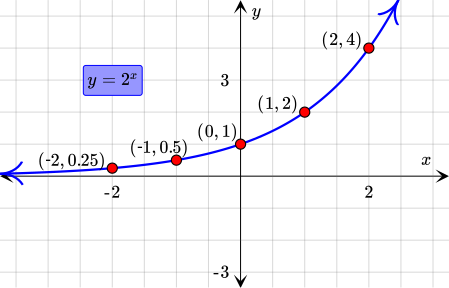
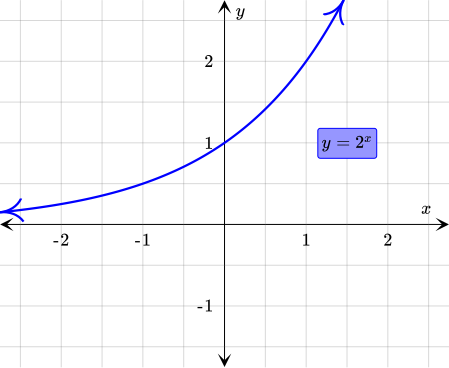
Exponential functions have nonlinear graphs. In the diagram, the graph of y=2^x and some of its points are shown.
Example
Share
Report error
Tables, Logarithmic Models, and Exponential Models
Heichi and Ignacio are good friends. However, when it comes to mathematics, they are pretty competitive. Neither Heichi nor Ignacio admits that the other person might be more knowledgeable in math.

Instead of letting this silly argument go, they decide to duel! They will challenge each other by asking one math question to the other.
a Ignacio presents a table that corresponds to the logarithmic function y=3-5 ln x.
| x | y |
|---|---|
| 1 | 3 |
| 2 | ≈ - 0.47 |
| 3 | ≈ - 2.49 |
| 4 | ≈ - 3.93 |
| 5 | ≈ - 5.05 |
{"type":"choice","form":{"alts":["Ignacio","Heichi"],"noSort":false},"formTextBefore":"","formTextAfter":"","answer":0}
b Heichi, waiting for this moment to outsmart Ignacio, pulls out the following table from his notebook.
| x | y |
|---|---|
| 1 | 1k |
| 2 | 2k |
| 3 | 4k |
| 4 | 8k |
| 5 | 16k |
{"type":"text","form":{"type":"math","options":{"comparison":"1","nofractofloat":false,"keypad":{"simple":false,"useShortLog":false,"variables":["k","x"],"constants":[]},"rendered":false},"text":" "},"formTextBefore":"y=","formTextAfter":null,"answer":{"text":["k(2)^{x-1}","k\\t 2^{x-1}","k\\times 2^{x-1}","\\dfrac{k}{2}(2)^{x}","\\dfrac{1}{2}k(2)^{x}","\\dfrac{k}{2}\\t 2^{x}"]}}
Solution
a To find out who is correct, the x-variable will be isolated. Start by using inverse operations to isolate the natural logarithm.
y=3-5ln x
▼
Solve for ln x
SubEqn
LHS-3=RHS-3
y-3=- 5ln x
DivEqn
.LHS /(- 5).=.RHS /(- 5).
y-3/- 5=ln x
RearrangeEqn
Rearrange equation
ln x=y-3/- 5
b Paying close attention to the y-values of the table, a constant multiplier can be identified.
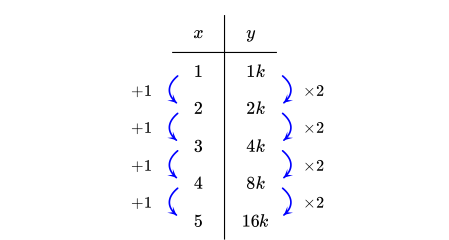
It is seen that the constant multiplier is 2. Also, the initial value is 1k, or just k. With this information, an exponential function can be written. y= k( 2)^(x-1) Ignacio pats himself on the back.
Example
Share
Report error
Carbon 14 in Vegetables
Heichi is upset that he lost to Ignacio in the last round. He decides to take a breather and turn to his favorite science book to practice some other problems. Here is one of his favorite topics: It is estimated that a preserved vegetable contains about 1 microgram (a millionth of a gram) of Carbon 14.

The amount of Carbon 14 in the preserved vegetable can be modeled by the following exponential function. C(t)=I (1/2)^(t5500) Here, t is the time in years that has passed since the vegetable's death, and I is the amount of Carbon 14 present in the vegetable at death, measured in micrograms. Heichi, feeling good about seeing a familiar topic, dives into solving the following problems.
a If the vegetable died 2000 years ago, how much Carbon 14 was present in the living vegetable? Round the answer to two decimal places.
{"type":"text","form":{"type":"math","options":{"comparison":"1","nofractofloat":false,"keypad":{"simple":true,"useShortLog":false,"variables":["x"],"constants":["PI"]},"rendered":false},"text":" "},"formTextBefore":null,"formTextAfter":"micrograms","answer":{"text":["1.29"]}}
b If the vegetable died 10 000 years ago, how much Carbon 14 was present in the living vegetable? Round the answer to two decimal places.
{"type":"text","form":{"type":"math","options":{"comparison":"1","nofractofloat":false,"keypad":{"simple":true,"useShortLog":false,"variables":["x"],"constants":["PI"]},"rendered":false},"text":" "},"formTextBefore":null,"formTextAfter":"micrograms","answer":{"text":["3.53"]}}
c The amount it takes for half of the Carbon 14 to decay is called its half-life. What half-life does the expression for the given function C(t) imply for Carbon 14?
{"type":"text","form":{"type":"math","options":{"comparison":"1","nofractofloat":false,"keypad":{"simple":true,"useShortLog":false,"variables":[],"constants":[]},"rendered":false},"text":" "},"formTextBefore":null,"formTextAfter":"years","answer":{"text":["5500"]}}
Hint
a Substitute 2000 for t in the given function.
b Substitute 10 000 for t in the given function.
c The initial amount of Carbon 14 is I. Therefore, half the initial amount is I2.
Solution
a It is known that there is 1 microgram of Carbon 14 present in a vegetable that died 2000 years ago. To calculate how much Carbon 14 was present in the living vegetable, 2000 will be substituted for t and 1 will be substituted for C(2000). Then, the equation can be solved for I.
C(t)=I (1/2)^(t5500)
Substitute
t= 2000
C( 2000)=I (1/2)^(20005500)
Substitute
C(2000)= 1
1=I (1/2)^(20005500)
▼
Solve for I
ReduceFrac
a/b=.a /500./.b /500.
1=I (1/2)^(411)
PowQuot
(a/b)^m=a^m/b^m
1=I (1/2^(411))
MultEqn
LHS * 2^(411)=RHS* 2^(411)
2^(411)=I(1)
IdPropMult
Identity Property of Multiplication
2^(411)=I
RearrangeEqn
Rearrange equation
I=2^(411)
UseCalc
Use a calculator
I=1.286664...
RoundDec
Round to 2 decimal place(s)
I≈ 1.29
b Similar to Part A, it is known that there is 1 microgram of Carbon 14 present in a vegetable that died 10 000 years ago. This sentence can also be expressed mathematically.
C(10 000)=1
With this information, the amount of Carbon 14 that was present in the living vegetable I can be found by substituting 10 000 for t and 1 for C(10 000).C(t)=I (1/2)^(t5500)
Substitute
t= 10 000
C( 10 000)=I (1/2)^(10 0005500)
Substitute
C(10 000)= 1
1=I (1/2)^(10 0005500)
▼
Solve for I
ReduceFrac
a/b=.a /500./.b /500.
1=I (1/2)^(2011)
PowQuot
(a/b)^m=a^m/b^m
1=I (1/2^(2011))
MultEqn
LHS * 2^(2011)=RHS* 2^(2011)
2^(2011)=I(1)
IdPropMult
Identity Property of Multiplication
2^(2011)=I
RearrangeEqn
Rearrange equation
I = 2^(2011)
UseCalc
Use a calculator
I = 3.526365...
RoundDec
Round to 2 decimal place(s)
I≈ 3.53
c Half the initial amount of Carbon 14 present in the vegetable is I2. Therefore, the half-life of Carbon 14 present in the vegetable can be found by substituting I2 for C(t), and isolating the variable t.
C(t)=I (1/2)^(t5500)
Substitute
C(t)= I/2
I/2=I (1/2)^(t5500)
DivEqn
.LHS /I.=.RHS /I.
1/2=(1/2)^(t5500)
a=a^1
(1/2)^1=(1/2)^(t5500)
Example
Share
Report error
Uranium 238
Ignacio, feeling good about showing his prowess in math, goes to explore the chemistry lab. He sees none other than Heichi studying. Heichi invites Ignacio to see that Uranium 238 is the most common isotope of uranium found in nature. It also has many applications in nuclear technology. Uranium 238 decays exponentially and its half-life is about 4.5 billion years.

Ignacio feels a sense of joy that Heichi has shown him this.
a Heichi, unable to control his competitive urge, metaphorically flips the tables and once again challenges Ignacio. "Write an exponential function expressing how much Uranium 238 remains after t billion years if the initial sample size is 40 grams. If you can!"
{"type":"choice","form":{"alts":["U(t)=40e^(- 0.154t)","U(t)=40e^(- 0.5t)","U(t)=20e^(- 0.154t)","U(t)=20e^(- 0.5t)"],"noSort":false},"formTextBefore":"","formTextAfter":"","answer":0}
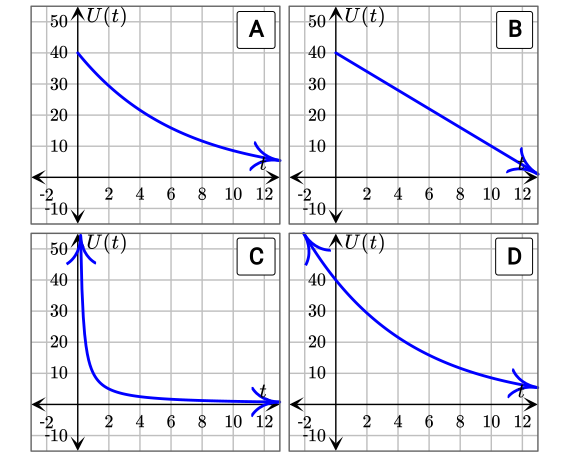
b Ignacio will not be taken down so easily. He asks Heichi which of the following graphs, in the context of this situation, corresponds to the function found in Part A.
{"type":"choice","form":{"alts":["A","B","C","D"],"noSort":true},"formTextBefore":"","formTextAfter":"","answer":0}
Hint
b Graph the function and compare it with the given choices. What is the y-intercept of the graph if the initial sample size is 40?
Solution
a Let U(t) be the amount of uranium 238 left from the sample, in grams, after t billions years. Knowing that the uranium decays exponentially, a general equation can be written.
U(t)=40e^(- kt)
Substitute
t= 4.5
U( 4.5)=40e^(- k( 4.5))
Substitute
U(4.5)= 20
20=40e^(- k(4.5))
DivEqn
.LHS /40.=.RHS /40.
20/40=e^(- k(4.5))
ReduceFrac
a/b=.a /20./.b /20.
1/2=e^(- k(4.5))
MultNegPos
(- a)b = - ab
1/2=e^(- 4.5k)
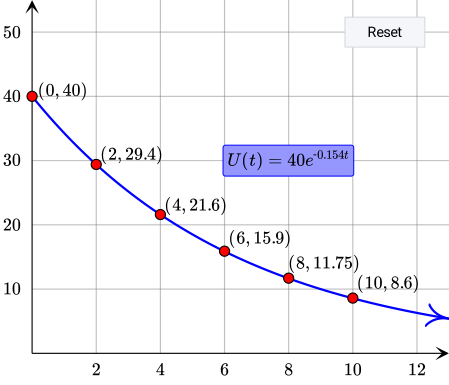
b It is now Heichi's turn to take on Ignacio's challenge to draw the graph of the function U(t)=40e^(- 0.154t). To do this, Heichi will make a table of values. Since time cannot be negative, only non-negative values of t will be considered.
| x | 40e^(- 0.154t) | y |
|---|---|---|
| 0 | 40e^(- 0.154( 0)) | 40 |
| 2 | 40e^(- 0.154( 2)) | ≈ 29.4 |
| 4 | 40e^(- 0.154( 4)) | ≈ 21.6 |
| 6 | 40e^(- 0.154( 6)) | ≈ 15.9 |
| 8 | 40e^(- 0.154( 8)) | ≈ 11.7 |
| 10 | 40e^(- 0.154( 10)) | ≈ 8.6 |
Example
Share
Report error
Modeling a Village's Population
Ignacio and Heichi see that this competition has turned ugly. They make a truce and decide to team up in studying for a geography test — together, as buddies.

However, the formulas did not allow the rivalry between Ignacio and Heichi to fade. While learning the concepts related to population, they find out that the population P of a small village in the north of Argentina is modeled by an exponential function. P(t)=500(1.04)^(2t) Here, t is the time in years that has passed since the foundation of the village in the year 2020. Heichi and Ignacio cannot help themselves and start challenging each other.
a Ignacio says that by the year 2050 the population, rounded to the nearest integer, will be about 5260 people. Is this true or false?
{"type":"choice","form":{"alts":["True","False"],"noSort":true},"formTextBefore":"","formTextAfter":"","answer":0}
b Heichi wants to find the year in which the population will be 3037 people, but does not know how to do it. Help Heichi find this year before Ignacio realizes that he cannot find the answer! Round the answer to the nearest integer.
{"type":"text","form":{"type":"math","options":{"comparison":"1","nofractofloat":false,"keypad":{"simple":true,"useShortLog":false,"variables":["x"],"constants":["PI"]},"rendered":false},"text":" "},"formTextBefore":null,"formTextAfter":null,"answer":{"text":["2043"]}}
Hint
a How many years are there between 2020 and 2050?
b Substitute 3037 for P(t) and solve for t. Then, add this value to 2020.
Solution
a To determine whether Ignacio is correct, the population in the village for the year 2050 will be calculated. To do so, the difference between 2050 and 2020 needs to be found.
b To determine the year in which the population of the village will be about 3037 people, this number will be substituted for P(t). Then, the variable t will be isolated.
P(t)=500(1.04)^(2t)
Substitute
P(t)= 3037
3037=500(1.04)^(2t)
DivEqn
.LHS /500.=.RHS /500.
3037/500=(1.04)^(2t)
UseCalc
Use a calculator
6.074=(1.04)^(2t)
log_(1.04) 6.074 =2t
log_c a = log_b a/log_b c
log 6.074/log 1.04 =2t
▼
Solve for t
UseCalc
Use a calculator
45.996546... =2t
DivEqn
.LHS /2.=.RHS /2.
22.998273... =t
RearrangeEqn
Rearrange equation
t=22.998273...
RoundInt
Round to nearest integer
t≈ 23
Discussion
Share
Report error
Relation Between Exponential and Linear Models
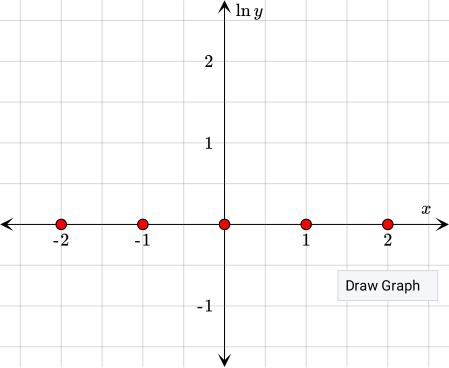
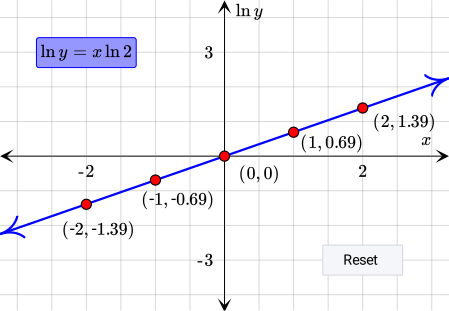
Recall the exploration seen at the beginning. In general, a set of more than two points (x,y) fits an exponential model if and only if the set of transformed points (x,ln y) fits a linear model. For example, consider the following function. y=2^x This function can be graphed on an (x,y) coordinate plane.
y=2^x
ln(LHS)=ln(RHS)
ln y=ln 2^x
ln(a^b)= b*ln(a)
ln y=xln 2
| x | x ln 2 | ln y=xln 2 |
|---|---|---|
| - 2 | - 2ln 2 | ≈ - 1.39 |
| - 1 | - 1ln 2 | ≈ - 0.69 |
| 0 | 0ln 2 | 0 |
| 1 | 1ln 2 | ≈ 0.69 |
| 2 | 2ln 2 | ≈ 1.39 |
Example
Share
Report error
Visual Near Point
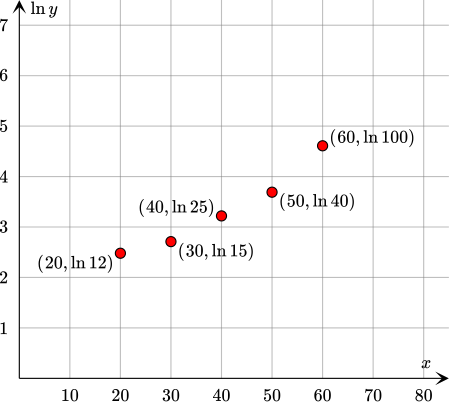
Heichi realizes that he might not be as great at math as Ignacio. To regain some confidence, he tells Ignacio that Ignacio's eyesight will worsen over time. "How can you prove that, Heichi?" asks Ignacio. "The visual near point of a person is the closest point at which an object can be placed and distinctly be observed by the person, and it varies with age," proudly states Heichi.  Ignacio admits his interest in the topic. He decides to learn more and wants to create a scatter plot for the data pairs (x,ln y), where x is the age in years and y the distance of the visual near point in centimeters. Then, he needs to write an exponential model for the original data pairs (x,y). Give Ignacio a hand.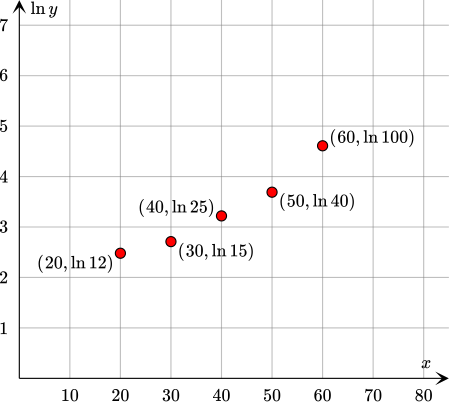
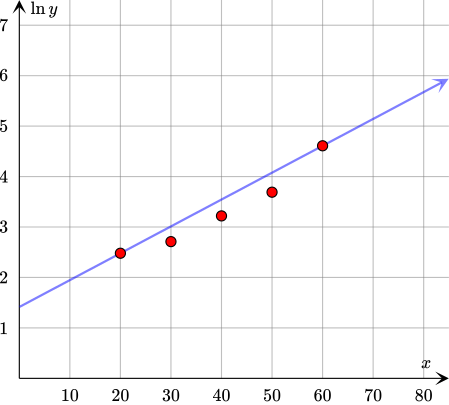 Since the set of points (x,ln y) fits a linear model, an exponential model should be a good fit for the original data. Now recall the slope-intercept form of a line to write the equation for the line of fit. Remember that, in this case, the dependent variable is ln y, therefore the form of the equation should be as follows.
ln y=mx+b
Two points can be used to find the slope m. The points (20,ln 12) and (60,ln 100) can be substituted in the Slope Formula.
Knowing that the slope is about 0.053, a partial equation of the line can be written.
ln y=0.053x+b
To find the value of b, the intersection with the vertical axis, a point must be used. For simplicity, choose the first point of the table.
The equation of the line can now be written.
ln y=0.053x+1.42
Finally, to find the exponential model that represents the original data, the variable y must be isolated. To do so, the definition of a natural logarithm will be used.
ln y=0.053x+1.42 ⇕ y=e^(0.053x+1.42)
To simplify the obtained equation, the Product of Powers Property and the Power of a Power Property will be used.
Note that this is only an example exponential model. If any two other points are used, a different model will be obtained. Ignacio is happy to have solved this and has regained some trust in Heichi's math knowledge. Heichi, too, feels good about sharing a topic of interest with his friend.
Since the set of points (x,ln y) fits a linear model, an exponential model should be a good fit for the original data. Now recall the slope-intercept form of a line to write the equation for the line of fit. Remember that, in this case, the dependent variable is ln y, therefore the form of the equation should be as follows.
ln y=mx+b
Two points can be used to find the slope m. The points (20,ln 12) and (60,ln 100) can be substituted in the Slope Formula.
Knowing that the slope is about 0.053, a partial equation of the line can be written.
ln y=0.053x+b
To find the value of b, the intersection with the vertical axis, a point must be used. For simplicity, choose the first point of the table.
The equation of the line can now be written.
ln y=0.053x+1.42
Finally, to find the exponential model that represents the original data, the variable y must be isolated. To do so, the definition of a natural logarithm will be used.
ln y=0.053x+1.42 ⇕ y=e^(0.053x+1.42)
To simplify the obtained equation, the Product of Powers Property and the Power of a Power Property will be used.
Note that this is only an example exponential model. If any two other points are used, a different model will be obtained. Ignacio is happy to have solved this and has regained some trust in Heichi's math knowledge. Heichi, too, feels good about sharing a topic of interest with his friend.
Answer
Scatter Plot:
Example Exponential Model: y=4.137(1.054)^x
Hint
To create the scatter plot make a table of values and plot the obtained points on an (x,ln y) coordinate plane. To write the exponential model use any two of the obtained points.
Solution
To make the scatter plot, a table of data pairs (x,ln y) will be created using the given information.
| x | y | ln y |
|---|---|---|
| 20 | 12 | ln 12≈ 2.48 |
| 30 | 15 | ln 15≈ 2.71 |
| 40 | 25 | ln 25≈ 3.22 |
| 50 | 40 | ln 40≈ 3.69 |
| 60 | 100 | ln 100≈ 4.61 |
Next, the obtained points will be plotted on an (x,ln y) coordinate plane. Since all the values are positive, only the first quadrant will be considered.
The points are not collinear. However, they lie close to a straight line. Consider the line passing through the first and last points.
m=ln y_2-ln y_1/x_2-x_1
SubstitutePoints
Substitute ( 20,ln 12) & ( 60,ln 100)
m=ln 100- ln 12/60- 20
m≈ 0.053
y=e^(0.053x+1.42)
▼
Simplify right-hand side
SumInExponent
a^(m+n)=a^m*a^n
y=e^(0.053x)e^(1.42)
CommutativePropMult
Commutative Property of Multiplication
y=e^(1.42)e^(0.053x)
ProdInExponent
a^(m* n)=(a^m)^n
y=e^(1.42)(e^(0.053))^x
UseCalc
Use a calculator
y=4.137120...(1.054429...)^x
RoundDec
Round to 3 decimal place(s)
y=4.137(1.054)^x
Closure
Share
Report error
Using Technology
While it is extremely impressive to do math by hand, an exponential model for the last example can also be found by using a graphing calculator. Recall the given data points.
| x | y |
|---|---|
| 20 | 12 |
| 30 | 15 |
| 40 | 25 |
| 50 | 40 |
| 60 | 100 |
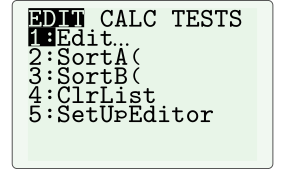
It was previously discussed that if graphing the data points in the form (x, ln y) results in a linear pattern, then an exponential function is a good model for the data points in the form (x,y). To find the equation of the exponential model using a graphing calculator, press STAT, choose EDIT,
and enter the values in the first two columns, L1 and L2.
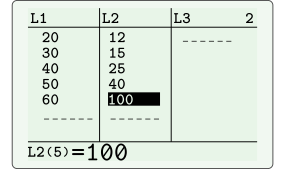
Now, to find the values of ln y, place the cursor in the heading of L3 and press LN. After that, press 2ND, and then 2 before finally closing the parentheses. By pressing ENTER, L3 will be filled automatically with the corresponding values for ln y.
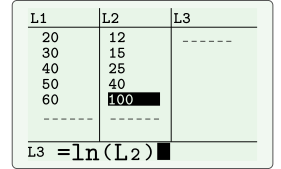
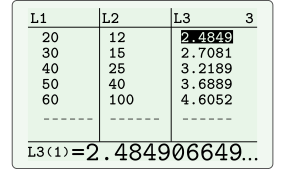
Having entered the values, they can be plotted in a scatter plot by pressing 2nd and Y=. Then, choose one of the plots in the list. Make sure to turn the desired plot ON. Choose the type to be a scatterplot, and assign L1 and L3 as XList and YList, respectively. Any mark can be picked.
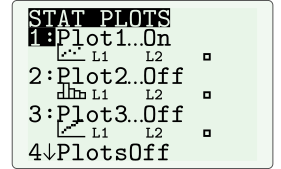
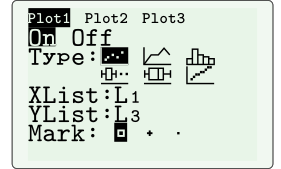
After this, press GRAPH. If needed, the scale and the minimum and maximum x- and y-values can be adjusted by pressing WINDOW.
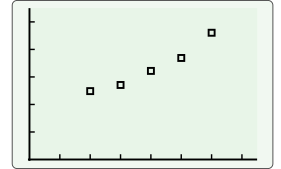
The points approximate a line. Therefore, an exponential function is an appropriate model. The best fitting exponential function for the given data can be found by performing an exponential regression. To do this press STAT, and from the CALC
menu choose the exponential regression option.
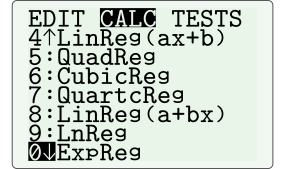

Here, a≈ 3.5 and b≈ 1.054, rounded to three decimal places. With this information, the exponential function can be written. y=3.5(1.054)^x
Note that the value of a is not the same as in the last example, but the value of b is exactly the same.
Applications of Exponential and Logarithmic Functions
Exercise 2.1
A musical cent is a unit in a logarithmic scale of relative pitch or intervals. One octave is equal to 1200 cents. Consider the following formula. n=1200(log_2 a/b) This formula can be used to determine the difference in cents between two notes with frequencies a and b.
{"type":"text","form":{"type":"math","options":{"comparison":"1","nofractofloat":false,"keypad":{"simple":true,"useShortLog":false,"variables":["x"],"constants":["PI"]},"rendered":false},"text":" "},"formTextBefore":"About","formTextAfter":"cents","answer":{"text":["20.73"]}}
{"type":"text","form":{"type":"math","options":{"comparison":"1","nofractofloat":false,"keypad":{"simple":true,"useShortLog":false,"variables":["x"],"constants":["PI"]},"rendered":false},"text":" "},"formTextBefore":"About","formTextAfter":"Hertz","answer":{"text":["225.69"]}}
security
report
code
security
report
code
To find the interval in cents for a frequency that changes from 420Hz to 415Hz, we will substitute a=420 and b=415 in the given formula. Then we will evaluate the right-hand side. To do so, we will use the Change of Base Formula to be able to use a calculator.
If a frequency changes from 420Hz to 415Hz, the interval is about 20.73 cents.
We know that the final frequency is 218Hz and that the interval is 60 cents. To find the initial frequency, we will substitute b=218 and n=60 into the given formula and solve for the initial frequency a.
Now, to isolate a, we will use the definition of a logarithm. Definition y=log_b x ⇔ b^y= x [1em] Equation 1/20=log_2 a/218 ⇔ 2^(120)= a/218 Finally, let's solve this equation for a.
If the interval is 60 cents and the final frequency is 218Hz, then the beginning frequency is about 225.69Hz.
security
report
code
An environmental protection company is conducting a study to test drinking water wells in coastal communities for unsafe levels of arsenic.

The safe standard for arsenic is 0.025 parts per million (ppm). Furthermore, the pH of the arsenic level should be less than 9.5. The formula for the pH of the arsenic level is given based on the hydrogen ion concentration H. pH=- log H
{"type":"choice","form":{"alts":["Yes","No"],"noSort":true},"formTextBefore":"","formTextAfter":"","answer":0}
{"type":"choice","form":{"alts":["Yes","No"],"noSort":true},"formTextBefore":"","formTextAfter":"","answer":1}
{"type":"text","form":{"type":"math","options":{"comparison":"1","nofractofloat":false,"keypad":{"simple":false,"useShortLog":false,"variables":[],"constants":[]},"rendered":false},"text":" "},"formTextBefore":null,"formTextAfter":"ppm","answer":{"text":["3.16\\times 10^{-10}"]}}
security
report
code
security
report
code
Let's consider the given formula. pH=-log H The variable H is the hydrogen ion concentration. In our case it is equal to 1.25* 10^(- 11). We know that the pH of the arsenic level should be less than 9.5. Let's check it out by substituting 1.25* 10^(- 11) for H and evaluating the right-hand side of the equation.
Since 10.9 is greater than 9.5, the environmental protection company should worried that the arsenic content is too high.
The safety standard for arsenic is 0.025 ppm. The environmental protection company finds 1 milligram of arsenic in a 3 liter sample. Since 1 kilogram of water occupies 1 liter, let's find out the ratio of arsenic in the tested water.
1 mg/3 kg = 1/3 mg/kg ≈ 0.33 mg/kg
Since 1ppm is equivalent to 1 mg/kg, we get that in our case the level of arsenic is about 0.33ppm.
0.33 > 0.025
This value is greater than the safety standard for arsenic. Therefore, the tested well is not safe.
Let's consider the given formula one more time. pH=-log H Here, H is the hydrogen ion concentration. We are asked to find the hydrogen ion concentration that meets the troublesome pH level of 9.5. Let's substitute 9.5 for pH into the given formula, and solve for H.
To solve the equation for H, we will use the definition of a logarithm. Notice also that the common logarithm of H is equal to the logarithm base 10 of H. Therefore, to use the definition of a logarithm, we will use log_(10) H instead of log H. Definition:& y=log_b x ⇔ x= b^y Equation:& - 9.5=log_(10) H ⇔ H= 10^(- 9.5) Let's evaluate the right-hand side of the obtained equation to find the value of H.
We found that the hydrogen ion concentration H that meets the troublesome pH level of 9.5 is about 3.16* 10^(- 10)ppm.
security
report
code
Some studies suggest that an animal will defend a territory with an area that is directly proportional to the animal's weight in pounds, raised to the power of 1.31. A=kw^(1.31) In this formula, A is the area in square yards, w the weight of the animal, and k is the constant of proportionality.
{"type":"text","form":{"type":"math","options":{"comparison":"1","nofractofloat":false,"keypad":{"simple":false,"useShortLog":false,"variables":["w"],"constants":[]},"rendered":false},"text":" "},"formTextBefore":"A=","formTextAfter":null,"answer":{"text":["1.16w^{1.31}"]}}
{"type":"text","form":{"type":"math","options":{"comparison":"1","nofractofloat":false,"keypad":{"simple":true,"useShortLog":false,"variables":["x"],"constants":["PI"]},"rendered":false},"text":" "},"formTextBefore":"\u2248","formTextAfter":"square yards","answer":{"text":["3268"]}}
security
report
code
security
report
code
We know that an animal will defend a territory of area A square yards that is directly proportional to the 1.31 power of its weight w in pounds. We are told that a 45-pound beaver will defend 170 square yards. Let's substitute A=170 and w=45 into the given equation and solve for the constant of proportionality k.
We found that the value of k is about 1.16. Let's substitute this value into the equation. A=1.16w^(1.31)
To find the area defended by an animal with a weight of 430 pounds, we will substitute w=430 in the formula in Part A and evaluate the right-hand side.
The area defended by this animal is about 3268 square yards.
security
report
code
Applications of Exponential and Logarithmic Functions
Recommended exercises
To get personalized recommended exercises, please login first.
Loading content
≤
>
■2
■▢
e▢
7
8
9
×
÷■1
=
=
√▢
▢√
∫▢▢
4
5
6
+
−
≤
<
log
ln
log▢
1
2
3
()
∣
sin
cos
tan
0
.
π
x
y
Loading content