{{ tocSubheader }}
{{ 'ml-label-loading-course' | message }}
An error ocurred, try again later!
Chapter {{ article.chapter.number }}
{{ article.number }}.
{{ article.displayTitle }}
{{ article.intro.summary }}
Show less Show more expand_more Lesson Settings & Tools
| | {{ 'ml-lesson-number-slides' | message : article.intro.bblockCount }} |
| | {{ 'ml-lesson-number-exercises' | message : article.intro.exerciseCount }} |
| | {{ 'ml-lesson-time-estimation' | message }} |
Triangles are polygons with three sides and three angles. Its angles help to classify the triangle, and the relationships between those angles are significant. This lesson explores such angle relationships as well as how they relate to an angle formed outside of the triangle.
Catch-Up and Review
Here are a few recommended readings before getting started with this lesson.
Explore
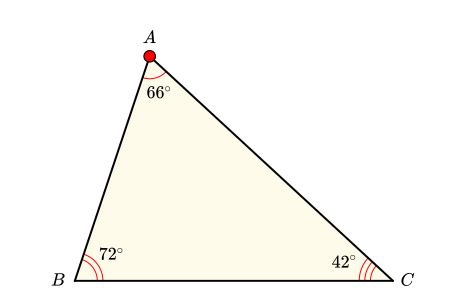
Investigating the Sum of the Angle Measures
Discussion
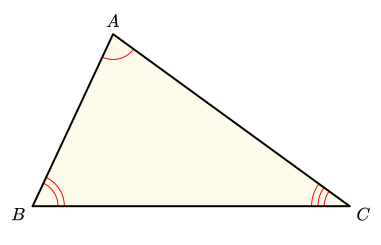
Interior Angles of a Triangle
Discussion
Relationship Between the Interior Angles of a Triangle
Triangles can be classified into different types depending on the side lengths or angle measures. Despite all this variety in triangles, the relationship between the interior angles of any triangle can be explained with a single equation.
Rule
Interior Angles Theorem
The sum of the measures of the interior angles of a triangle is 180∘. 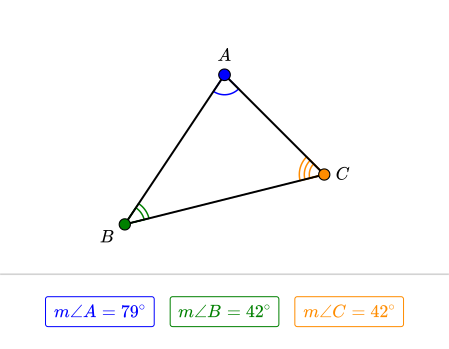 Based on this diagram, the following relation holds true.
m∠A+m∠B+m∠C=180∘
Example
Bermuda Triangle
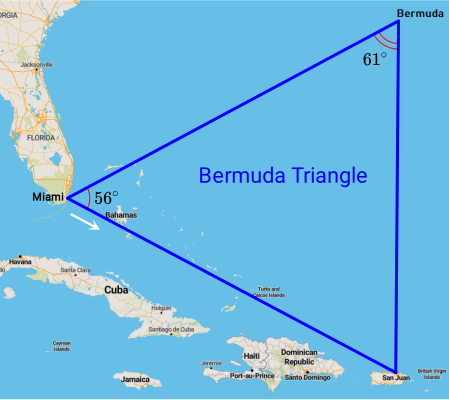
For summer vacation, Ali and his parents went on a cruise in the Caribbean Sea. The ship sailed from Miami and headed for San Juan, Puerto Rico. Ali was a little scared because the route went through one side of the Bermuda Triangle 🛳️.
{"type":"text","form":{"type":"math","options":{"comparison":"1","nofractofloat":false,"keypad":{"simple":true,"useShortLog":false,"variables":[],"constants":[]},"rendered":false},"text":"<span class=\"katex\"><span class=\"katex-html\" aria-hidden=\"true\"><\/span><\/span>"},"formTextBefore":"<span class=\"katex\"><span class=\"katex-html\" aria-hidden=\"true\"><span class=\"base\"><span class=\"strut\" style=\"height:0.69224em;vertical-align:0em;\"><\/span><span class=\"mord mathdefault\">m<\/span><span class=\"mord\">\u2220<\/span><span class=\"mord mathdefault\" style=\"margin-right:0.05764em;\">S<\/span><span class=\"mspace\" style=\"margin-right:0.2777777777777778em;\"><\/span><span class=\"mrel\">=<\/span><\/span><\/span><\/span>","formTextAfter":"<span class=\"katex\"><span class=\"katex-html\" aria-hidden=\"true\"><span class=\"base\"><span class=\"strut\" style=\"height:0.674115em;vertical-align:0em;\"><\/span><span class=\"mord\"><span><\/span><span class=\"msupsub\"><span class=\"vlist-t\"><span class=\"vlist-r\"><span class=\"vlist\" style=\"height:0.674115em;\"><span style=\"top:-3.063em;margin-right:0.05em;\"><span class=\"pstrut\" style=\"height:2.7em;\"><\/span><span class=\"sizing reset-size6 size3 mtight\"><span class=\"mbin mtight\">\u2218<\/span><\/span><\/span><\/span><\/span><\/span><\/span><\/span><\/span><\/span><\/span>","answer":{"text":["63"]}}
Hint
What is the sum of the measures of the interior angles of a triangle?
Solution
Notice that Miami, San Juan, and Bermuda form a triangle for which the measures of two interior angles are given.
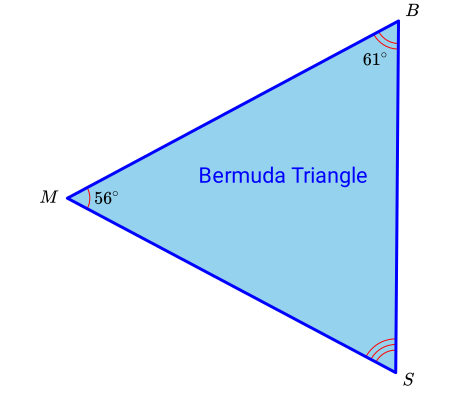
m∠M+m∠S+m∠B=180∘
Substitute the known measures and solve the equation for m∠S.
m∠M+m∠S+m∠B=180∘
SubstituteValues
Substitute values
56∘+m∠S+61∘=180∘
AddTerms
Add terms
m∠S+117∘=180∘
SubEqn
LHS−117∘=RHS−117∘
m∠S=63∘
Example
A Starry Night
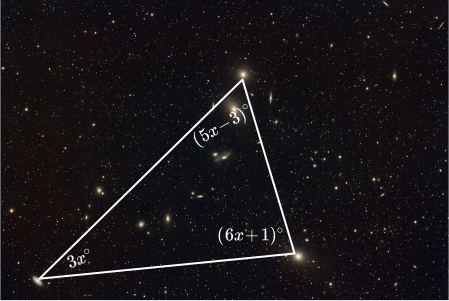
It got dark before the cruise ship arrived in San Juan. Ali noticed that the sky looked much more starry than it does in his hometown. His father explained that it was due to the low light pollution. Ali recognized a triangle made up of three glowing stars.
{"type":"text","form":{"type":"list","options":{"comparison":"1","nofractofloat":false,"keypad":{"simple":true,"useShortLog":false,"variables":[],"constants":[]},"rendered":false,"ordermatters":false,"numinput":3,"listEditable":false,"hideNoSolution":true},"text":"<span class=\"katex\"><span class=\"katex-html\" aria-hidden=\"true\"><\/span><\/span>"},"formTextBefore":"Angle Measures <span class=\"katex\"><span class=\"katex-html\" aria-hidden=\"true\"><span class=\"base\"><span class=\"strut\" style=\"height:0.36687em;vertical-align:0em;\"><\/span><span class=\"mrel\">=<\/span><span class=\"mspace\" style=\"margin-right:0.2777777777777778em;\"><\/span><\/span><span class=\"base\"><span class=\"strut\" style=\"height:1.80002em;vertical-align:-0.65002em;\"><\/span><span class=\"mord\"><span class=\"delimsizing size2\">{<\/span><\/span><\/span><\/span><\/span>","formTextAfter":"<span class=\"katex\"><span class=\"katex-html\" aria-hidden=\"true\"><span class=\"base\"><span class=\"strut\" style=\"height:1.80002em;vertical-align:-0.65002em;\"><\/span><span class=\"mord\"><span class=\"delimsizing size2\">}<\/span><\/span><\/span><\/span><\/span>","answer":{"text":["39","79","62"]}}
Hint
Use the Interior Angles Theorem to set and solve an equation for x. Then, use the value of x to determine each angle measure.
Solution
The measures of the three interior angles of the triangle depend on x. The first step is finding the value of x. The sum of the measures of the interior angles of a triangle is 180∘, according to the Interior Angles Theorem. Write an equation using this fact.
The measures of the angles of the triangle can be found by substituting x=13 into each of the expressions.
3x+(6x+1)+(5x−3)=180
Solve the equation for x.
3x+(6x+1)+(5x−3)=180
CommutativePropAdd
Commutative Property of Addition
3x+6x+5x+1−3=180
AddSubTerms
Add and subtract terms
14x−2=180
AddEqn
LHS+2=RHS+2
14x=182
DivEqn
LHS/14=RHS/14
x=13
| Angle Measure | Substitute x=13 | Simplify |
|---|---|---|
| 3x∘ | 3(13)∘ | 39∘ |
| (6x+1)∘ | (6(13)+1)∘ | 79∘ |
| (5x−3)∘ | (5(13)−3)∘ | 62∘ |
Discussion
Angles Outside a Triangle
When the sides of a triangle are extended beyond each vertex, a few more angles are formed. Some of these angles are called exterior angles.
Concept
Exterior Angles of a Triangle
An exterior angle of a triangle is the angle formed between one side of the triangle and the extension of an adjacent side. Any triangle has six exterior angles, two at each vertex and all formed outside the triangle.
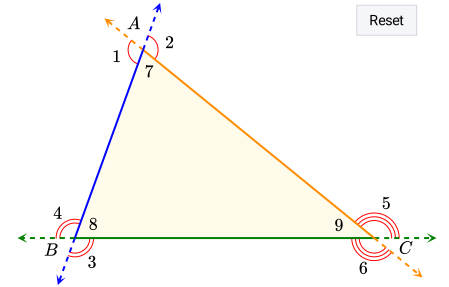 Notice that each exterior angle forms a linear pair with its corresponding interior angle. This means that each exterior angle is supplementary to its interior angle.
| Interior Angle | Corresponding Exterior Angles | Sum of Measures |
|---|---|---|
| ∠7 | ∠1 and ∠2 | m∠1+m∠7=180∘ m∠2+m∠7=180∘ |
| ∠8 | ∠3 and ∠4 | m∠3+m∠8=180∘ m∠4+m∠8=180∘ |
| ∠9 | ∠5 and ∠6 | m∠5+m∠9=180∘ m∠6+m∠9=180∘ |
Discussion
Remote Interior Angles
In a triangle, a remote interior angle is an interior angle that is not adjacent to a specific exterior angle. Every exterior angle has two remote interior angles. In the diagram, click on each exterior angle to highlight its two corresponding remote interior angles.
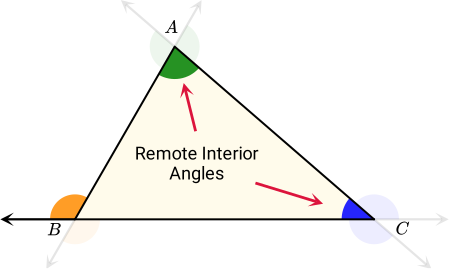 The remote interior angles do not share the vertex with their corresponding exterior angle.
Discussion
Relationship Between an Exterior Angle and Its Remote Interior Angles
In the same way the three interior angles of a triangle are related, the measure of an exterior angle and its two remote interior angles are related.
Rule
Triangle Exterior Angle Theorem
The measure of an exterior angle of a triangle is equal to the sum of the measures of the two nonadjacent interior angles, or remote interior angles.
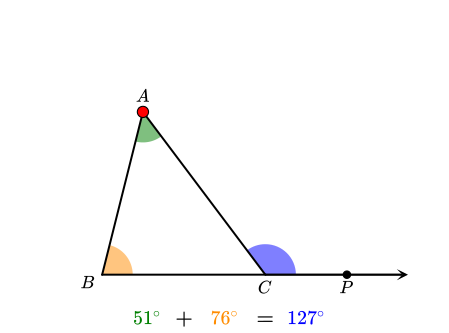 Based on the diagram above, the following relation holds true.
m∠PCA=m∠A+m∠B
Example
Beach's Day
The day after arriving in Puerto Rico, Ali and his parents took a tour of three of the beautiful Leeward Islands. The captain shared the route plan.

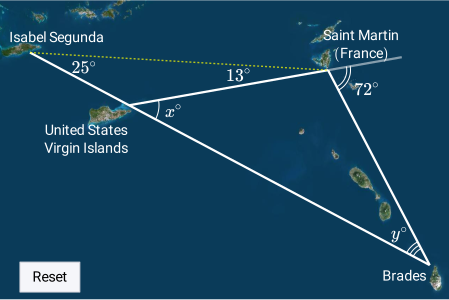
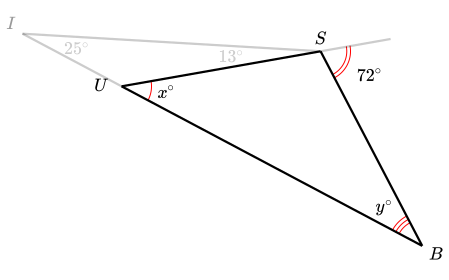
a Determine the value of x, which corresponds to the angle that the ship turned to go to Saint Martin island.
{"type":"text","form":{"type":"math","options":{"comparison":"1","nofractofloat":false,"keypad":{"simple":true,"useShortLog":false,"variables":[],"constants":[]},"rendered":false},"text":"<span class=\"katex\"><span class=\"katex-html\" aria-hidden=\"true\"><\/span><\/span>"},"formTextBefore":"<span class=\"katex\"><span class=\"katex-html\" aria-hidden=\"true\"><span class=\"base\"><span class=\"strut\" style=\"height:0.43056em;vertical-align:0em;\"><\/span><span class=\"mord mathdefault\">x<\/span><span class=\"mspace\" style=\"margin-right:0.2777777777777778em;\"><\/span><span class=\"mrel\">=<\/span><\/span><\/span><\/span>","formTextAfter":"<span class=\"katex\"><span class=\"katex-html\" aria-hidden=\"true\"><span class=\"base\"><span class=\"strut\" style=\"height:0.674115em;vertical-align:0em;\"><\/span><span class=\"mord\"><span><\/span><span class=\"msupsub\"><span class=\"vlist-t\"><span class=\"vlist-r\"><span class=\"vlist\" style=\"height:0.674115em;\"><span style=\"top:-3.063em;margin-right:0.05em;\"><span class=\"pstrut\" style=\"height:2.7em;\"><\/span><span class=\"sizing reset-size6 size3 mtight\"><span class=\"mbin mtight\">\u2218<\/span><\/span><\/span><\/span><\/span><\/span><\/span><\/span><\/span><\/span><\/span>","answer":{"text":["38"]}}
b Determine the value of y, which is the angle at Brades island.
{"type":"text","form":{"type":"math","options":{"comparison":"1","nofractofloat":false,"keypad":{"simple":true,"useShortLog":false,"variables":[],"constants":[]},"rendered":false},"text":"<span class=\"katex\"><span class=\"katex-html\" aria-hidden=\"true\"><\/span><\/span>"},"formTextBefore":"<span class=\"katex\"><span class=\"katex-html\" aria-hidden=\"true\"><span class=\"base\"><span class=\"strut\" style=\"height:0.625em;vertical-align:-0.19444em;\"><\/span><span class=\"mord mathdefault\" style=\"margin-right:0.03588em;\">y<\/span><span class=\"mspace\" style=\"margin-right:0.2777777777777778em;\"><\/span><span class=\"mrel\">=<\/span><\/span><\/span><\/span>","formTextAfter":"<span class=\"katex\"><span class=\"katex-html\" aria-hidden=\"true\"><span class=\"base\"><span class=\"strut\" style=\"height:0.674115em;vertical-align:0em;\"><\/span><span class=\"mord\"><span><\/span><span class=\"msupsub\"><span class=\"vlist-t\"><span class=\"vlist-r\"><span class=\"vlist\" style=\"height:0.674115em;\"><span style=\"top:-3.063em;margin-right:0.05em;\"><span class=\"pstrut\" style=\"height:2.7em;\"><\/span><span class=\"sizing reset-size6 size3 mtight\"><span class=\"mbin mtight\">\u2218<\/span><\/span><\/span><\/span><\/span><\/span><\/span><\/span><\/span><\/span><\/span>","answer":{"text":["34"]}}
Hint
a The angle whose measure is x∘ is an exterior angle to the triangle formed by the first three islands of the route. Also, the value of x is equal to the sum of the measures of the two remote interior angles.
b The angle at Saint Martin island whose measure is 72∘ is an exterior angle to the triangle formed by the last three islands in the ship's route. The angles whose measures are x∘ and y∘ are remote interior angles corresponding to the 72∘ angle.
Solution
a Start by naming the islands so that it is easier to refer to them. Focus on △IUS and ignore the map to have a clearer view.
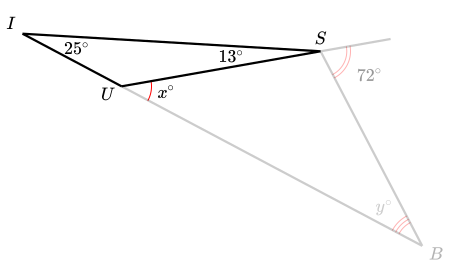
Notice that UB is an extension of IU which means that ∠BUS is an exterior angle to △IUS. Also, ∠I and ∠ISU are remote interior angles corresponding to ∠BUS.
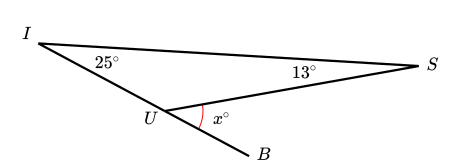
m∠BUS=m∠I+m∠ISU
Finally, substitute the corresponding measures to find the value of x.
b Focus on △SBU this time.
In Part A, the measure of ∠BUS is 38∘. The 72∘ angle is an exterior angle to △SBU. Additionally, ∠U and ∠B are remote interior angles corresponding to the 72∘ exterior angle.
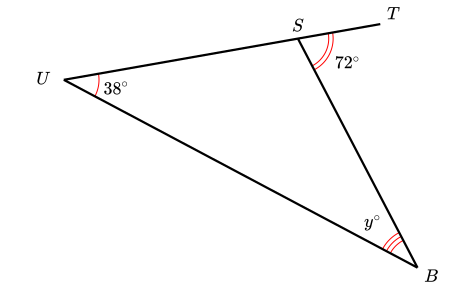
m∠BST=m∠U+m∠B
Finally, substitute the measures of the angles and solve the equation for y.
m∠BST=m∠U+m∠B
SubstituteValues
Substitute values
72∘=38∘+y
SubEqn
LHS−38=RHS−38
34∘=y
RearrangeEqn
Rearrange equation
y=34∘
Example
Angles in the Ship
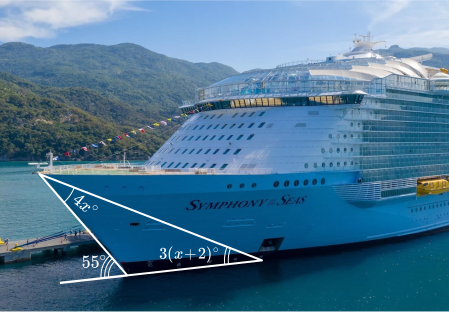
It is the last day of the cruise and they are on their final island. Ali climbed up a small cliff to take in the beautiful view of the ocean. From the top of the cliff, he could see the docked ship. It is huge! He is curious about some of its measurements.
{"type":"text","form":{"type":"math","options":{"comparison":"1","nofractofloat":false,"keypad":{"simple":true,"useShortLog":false,"variables":[],"constants":[]},"rendered":false},"text":"<span class=\"katex\"><span class=\"katex-html\" aria-hidden=\"true\"><\/span><\/span>"},"formTextBefore":"<span class=\"katex\"><span class=\"katex-html\" aria-hidden=\"true\"><span class=\"base\"><span class=\"strut\" style=\"height:0.43056em;vertical-align:0em;\"><\/span><span class=\"mord mathdefault\">x<\/span><span class=\"mspace\" style=\"margin-right:0.2777777777777778em;\"><\/span><span class=\"mrel\">=<\/span><\/span><\/span><\/span>","formTextAfter":"<span class=\"katex\"><span class=\"katex-html\" aria-hidden=\"true\"><span class=\"base\"><span class=\"strut\" style=\"height:0.674115em;vertical-align:0em;\"><\/span><span class=\"mord\"><span><\/span><span class=\"msupsub\"><span class=\"vlist-t\"><span class=\"vlist-r\"><span class=\"vlist\" style=\"height:0.674115em;\"><span style=\"top:-3.063em;margin-right:0.05em;\"><span class=\"pstrut\" style=\"height:2.7em;\"><\/span><span class=\"sizing reset-size6 size3 mtight\"><span class=\"mbin mtight\">\u2218<\/span><\/span><\/span><\/span><\/span><\/span><\/span><\/span><\/span><\/span><\/span>","answer":{"text":["7"]}}
Hint
The angle that is outside the boat is an exterior angle. The angles inside the triangle are remote interior angles corresponding to the exterior angle.
Solution
Start by labeling the vertices of the triangle and the left endpoint of the extended side. Ignore the photo of the ship to have a clearer view of the diagram.
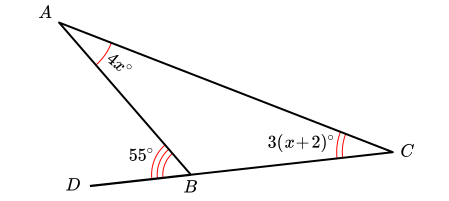
m∠ABD=m∠A+m∠C
The measure of the exterior angle is 55∘ and the measures of the two remote interior angles were given in terms of x. Substitute the measure and expressions into the equation and solve it for x.
m∠ABD=m∠A+m∠C
Substitute
m∠ABD=55∘
55∘=m∠A+m∠C
SubstituteExpressions
Substitute expressions
55∘=4x+3(x+2)
Distr
Distribute 3
55∘=4x+3x+6
AddTerms
Add terms
55∘=7x+6
SubEqn
LHS−6=RHS−6
49∘=7x
DivEqn
LHS/7=RHS/7
7∘=x
RearrangeEqn
Rearrange equation
x=7∘
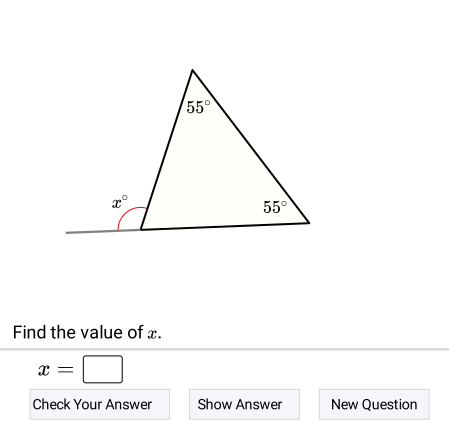
Pop Quiz
Finding the Missing Angle Measure
Closure
Relationship Between the Exterior Angles of a Triangle
Consider a triangle ABC. No matter the characteristics of this triangle, the sum of the measures of its interior angles is 180∘. This fact leads to the question of whether there is a similar relationship between the exterior angles of a triangle.
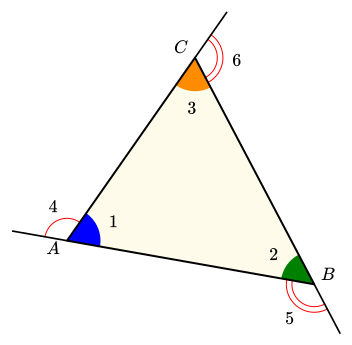
m∠4m∠5m∠6=m∠2+m∠3=m∠1+m∠3=m∠1+m∠2
Next, add these three equations. The left-hand side of the resulting equation is the sum of the measures of the exterior angles. The right-hand side can be simplified using the fact that the measures of the interior angles add up to 180∘.
m∠4+m∠5+m∠6=(m∠2+m∠3)+(m∠1+m∠3)+(m∠1+m∠2)
AddTerms
Add terms
m∠4+m∠5+m∠6=2m∠1+2m∠2+2m∠3
FactorOut
Factor out 2
m∠4+m∠5+m∠6=2(m∠1+m∠2+m∠3)
Substitute
m∠1+m∠2+m∠3=180∘
m∠4+m∠5+m∠6=2(180∘)
Multiply
Multiply
m∠4+m∠5+m∠6=360∘
Loading content