Sign In
An error ocurred, try again later!
Triangle
Slide 1 of 0
Reference
Triangles
Concept
Triangle
A triangle is a polygon with three angles and three sides. The symbol 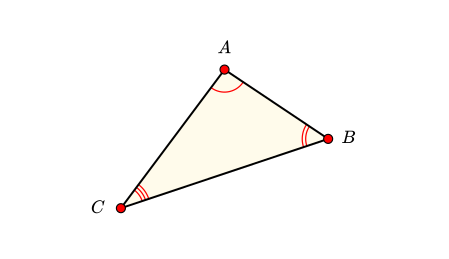 Triangles can be classified either according to their side lengths or to their internal angle measures.
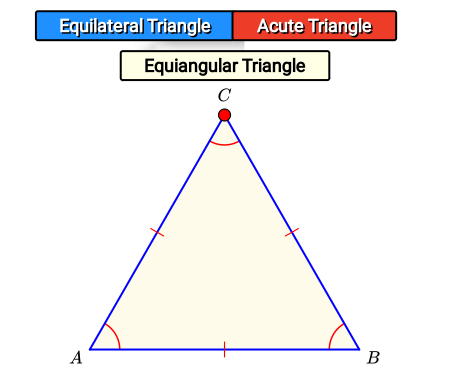 The following table lists all the different types of triangles according to their corresponding classification.
△is used to algebraically denote a triangle. Next to this symbol, the three vertices of the triangle are written in any order. For example, △ ABC and △ BCA both denote the triangle whose vertices are A, B, and C.
| Classification of Triangles | |
|---|---|
| By Angle Measures | By Side Lengths |
| Acute Triangle | Scalene Triangle |
| Right Triangle | Isosceles Triangle |
| Obtuse Triangle | Equilateral Triangle |
| Equiangular Triangle | |
Concept
Scalene Triangle
A scalene triangle is a triangle in which all three sides have different lengths. In other words, it has no congruent sides.
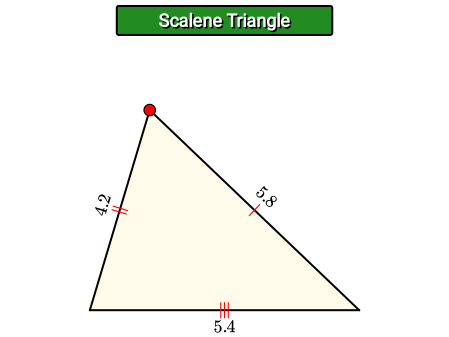 Additionally, in a scalene triangle, the three angles have different measures. In other words, scalene triangles have no congruent angles.
Concept
Isosceles Triangle
An isosceles triangle is a triangle that has exactly two sides of the same length. In other words, it has two congruent sides. The congruent sides are called legs while the third side is called the base. The angle between the legs is called the vertex angle and the other two angles are called base angles.
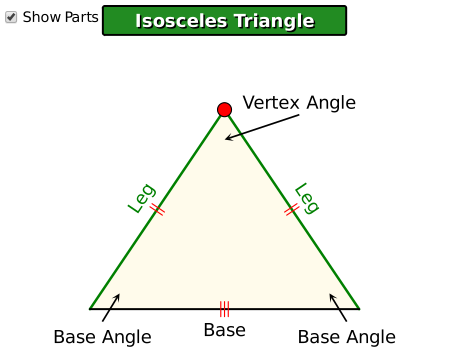 In an isosceles triangle, the base angles are congruent angles — they have the same measure.
Concept
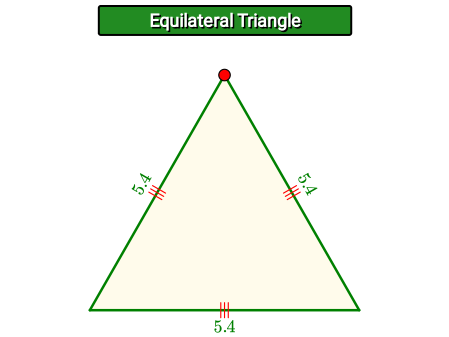
Equilateral Triangle
Concept
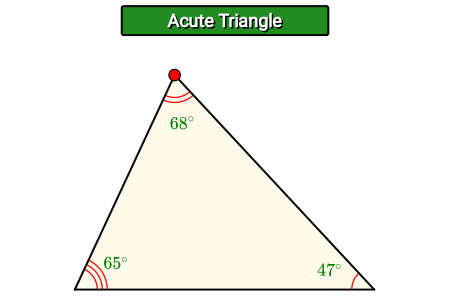
Acute Triangle
Concept
Obtuse Triangle
An obtuse triangle is a triangle that has one obtuse angle. In other words, one of the angles measures more than 90^(∘).
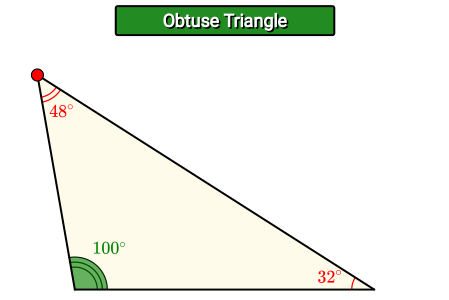 In case the angles are measured in radians, a triangle is obtuse when one of the angles measures more than π2, or about 1.57 radians.
Concept
Right Triangle
A right triangle is a triangle that has one right angle. The side opposite the right angle is always the longest and is known as the hypotenuse. The other sides are commonly called legs. Notice that in a right triangle, the legs are perpendicular to each other.
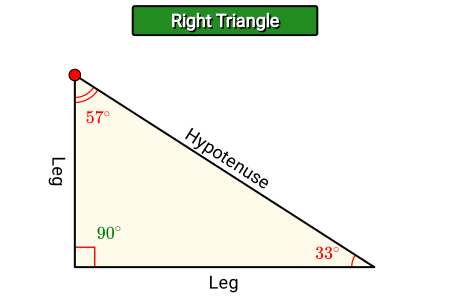 If one of the acute angles in the triangle is labeled, the legs can be discussed relative to that angle. Consider an acute angle labeled as ∠ θ on the diagram. The side that forms the angle is the adjacent side and the side not touching the angle is the opposite side.
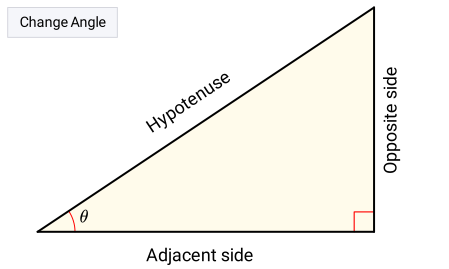 Note that the opposite and adjacent sides change when ∠ θ changes, but the hypotenuse is always the same.
Concept
Equiangular Triangle
An equiangular triangle is a triangle in which the three angles have the same measure. In other words, the three angles are congruent. In fact, the three angles measure 60^(∘) each. If the angles are measured in radians, then the three measures are equal to π3.
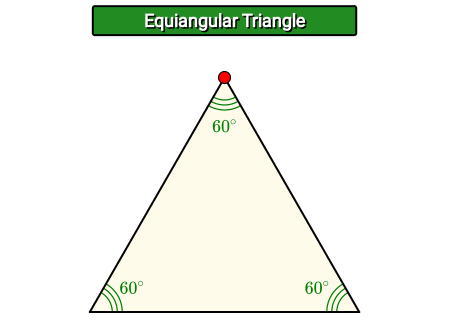 Notice that an equiangular triangle is also an acute triangle. In an equiangular triangle, the three sides have the same measure. Therefore, equiangular triangles are also equilateral triangles.
Exercises
Recommended exercises
To get personalized recommended exercises, please login first.
Loading content
Loading content