2. Adding and Subtracting Polynomials
Sign In
An error ocurred, try again later!
Chapter 7
2.
Adding and Subtracting Polynomials
Adding polynomials is a crucial skill. These mathematical expressions have a unique structure, where variables are combined with coefficients. When combined or added, they give rise to new expressions. By understanding how to add polynomials, you equip yourself to solve various real-life problems. Whether it's related to finance, engineering, or physics, polynomials play a fundamental role. Hence, mastering their addition can be your stepping stone to excel in many complex scenarios that require mathematical interpretation.
Show less Show more expand_more 


Lesson Settings & Tools
| | 9 Theory slides |
| | 9 Exercises - Grade E - A |
| | Each lesson is meant to take 1-2 classroom sessions |
Adding and Subtracting Polynomials
Slide of 9
Polynomials are often applied to solve real-life problems. In many situations, more than one polynomial is used. In such cases, it can be useful to calculate the sum or the difference of two or more polynomials. In this lesson, the procedure of adding and subtracting polynomials will be presented and practiced.
Catch-Up and Review
Here are a few recommended readings before getting started with this lesson.
Challenge
Share
Report error
Investigating Polynomial Sum and Difference
Consider two different polynomials P(x) and Q(x).
P(x) &= 5x^3-2x+7 [0.1cm] Q(x) &= 3(x-1)(x+4)
Is it possible to calculate the sum and the difference of P(x) and Q(x)? Are the obtained results also polynomials? If yes, what is the degree, the leading coefficient, and the constant term of P(x)+Q(x)?
{"type":"text","form":{"type":"math","options":{"comparison":"1","nofractofloat":false,"keypad":{"simple":true,"useShortLog":false,"variables":[],"constants":[]},"rendered":false},"text":" "},"formTextBefore":"Degree =","formTextAfter":null,"answer":{"text":["3"]}}
{"type":"text","form":{"type":"math","options":{"comparison":"1","nofractofloat":false,"keypad":{"simple":true,"useShortLog":false,"variables":[],"constants":[]},"rendered":false},"text":" "},"formTextBefore":"Leading Coefficient =","formTextAfter":null,"answer":{"text":["5"]}}
{"type":"text","form":{"type":"math","options":{"comparison":"1","nofractofloat":false,"keypad":{"simple":true,"useShortLog":false,"variables":[],"constants":[]},"rendered":false},"text":" "},"formTextBefore":"Constant Term =","formTextAfter":null,"answer":{"text":["-5"]}}
Discussion
Share
Report error
Adding and Subtracting Polynomials
Given two polynomials, their sum or difference can be calculated. Consider the following pair of polynomials.
- 2x^2 + x + 3 and 2x^2 + 4x - 10
In order to add these polynomials, there are three steps to follow. Note that subtraction of the polynomials can be performed by applying the same three steps, only instead of adding the like terms, they will be subtracted.
When adding or subtracting two polynomials of degrees m and n, the degree of the resulting polynomial is at most the equal to the degree of higher degree polynomial.
1
Rearrange Terms
expand_more Generally speaking, polynomials are added by adding their like terms. Therefore, it can be helpful to rearrange the terms so that the like terms are next to each other.
When subtracting polynomials, remember to distribute - 1 to the terms of the second polynomial before rearranging the terms.
(- 2x^2 + x + 3) + (2x^2 + 4x - 10)
RemovePar
Remove parentheses
- 2x^2 + x + 3 + 2x^2 + 4x - 10
CommutativePropAdd
Commutative Property of Addition
(- 2x^2 + 2x^2) + (x + 4x) + (3 - 10)
(- 2x^2 + x + 3) - (2x^2 + 4x - 10)
RemovePar
Remove parentheses
- 2x^2 + x + 3 - (2x^2 + 4x - 10)
Distr
Distribute - 1
- 2x^2 + x + 3 - 2x^2 - 4x + 10
CommutativePropAdd
Commutative Property of Addition
(- 2x^2 - 2x^2) + (x - 4x) + (3 + 10)
2
Add and Subtract Like Terms
expand_more Next, the like terms can be combined. In other words, the monomials should be added or subtracted by adding or subtracting their coefficients.
3
Simplify the Result
expand_more Finally, the obtained result of addition can be simplified. For example, since the coefficient before x^2-term is 0, this term is equal to 0 and can be omitted.
Therefore, the sum is 5x-7. Note that the given polynomials are of degree 2. However, the new polynomial is of degree 1 because the x^2-terms canceled each other out. If they had not canceled each other out, the new polynomial would have also been of degree 2.
Extra
Vertical Format of Addition and SubtractionPreviously, polynomials were added by using the horizontal format. The vertical format of polynomial addition or subtraction will now be presented. Note that for this method, the like terms should be aligned vertically. &-2x^2 + x + 3 +& 2x^2 + 4x - 10 & 0x^2 + 5x - 7 By comparing the results, it can be concluded that no matter which format of addition is used, the sums are the same.
Discussion
Share
Report error
Closure Property of Polynomial Addition and Subtraction
Is the result of addition or subtraction of polynomials always another polynomial? This can be verified by analyzing the sum of two arbitrary polynomials.
3x^3+5x^2-x+7 and 12x^2+6x-3
To add these polynomials, their like terms will be rearranged to be next to each other and then added.
This expression seems to be a polynomial. To show that it is in fact a polynomial, consider a general case of adding two polynomials.
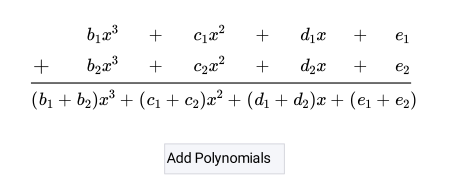 Note that adding two polynomials comes down to adding their monomials. Since a sum of two or more monomials is always a monomial, the result of adding two polynomials is an expression containing monomials. It is, by definition, a polynomial. Adding or subtracting polynomials results in another polynomial, which means that polynomials are closed under addition and subtraction.
(3x^3+5x^2-x+7)+(12x^2+6x-3)
RemovePar
Remove parentheses
3x^3+5x^2-x+7+12x^2+6x-3
CommutativePropAdd
Commutative Property of Addition
3x^3+(5x^2+12x^2)+(- x+6x)+(7-3)
AddSubTerms
Add and subtract terms
3x^3+17x^2+5x+4
Example
Share
Report error
Adding Polynomials in Different Order and Formats
Dylan's family is moving into an apartment. He is curious about how many people live in apartements as opposed to houses. He finds a study that states that during a 6-year period, the amounts of money in millions of dollars spent on buying houses B and renting houses R by United States residents are modeled by the following two polynomials.

B&=- 0.023n^3+0.08n^2+0.1n+15 R&=- 0.41n^2+1.3n+36 Here, n=1 represents the first year in the 6-year period.
a Calculate B+R. Express the polynomial in standard form.
{"type":"text","form":{"type":"math","options":{"comparison":"1","nofractofloat":false,"keypad":{"simple":false,"useShortLog":false,"variables":["n"],"constants":[]},"rendered":false},"text":" "},"formTextBefore":"B+R=","formTextAfter":null,"answer":{"text":["-0.023n^3-0.33n^2+1.4n+51"]}}
b Calculate R+B. Express the polynomial in standard form.
{"type":"text","form":{"type":"math","options":{"comparison":"1","nofractofloat":false,"keypad":{"simple":false,"useShortLog":false,"variables":["n"],"constants":[]},"rendered":false},"text":" "},"formTextBefore":"R+B=","formTextAfter":null,"answer":{"text":["-0.023n^3-0.33n^2+1.4n+51"]}}
c Compare B+R and R+B. Are the sums the same or different?
{"type":"choice","form":{"alts":["Same","Different"],"noSort":false},"formTextBefore":"","formTextAfter":"","answer":0}
d What are the degrees of the calculated sums?
{"type":"text","form":{"type":"math","options":{"comparison":"1","nofractofloat":false,"keypad":{"simple":true,"useShortLog":false,"variables":["x"],"constants":["PI"]},"rendered":false},"text":" "},"formTextBefore":null,"formTextAfter":null,"answer":{"text":["3"]}}
{"type":"text","form":{"type":"math","options":{"comparison":"1","nofractofloat":false,"keypad":{"simple":true,"useShortLog":false,"variables":["x"],"constants":["PI"]},"rendered":false},"text":" "},"formTextBefore":null,"formTextAfter":null,"answer":{"text":["-0.023"]}}
Hint
a Start by rearranging like terms so that they are situated next to each other.
b Add the polynomials by adding their like terms. Use either the horizontal or vertical format of addition.
c Compare the sums obtained in Parts A and B. Does it matter in which order the polynomials are added?
d Recall the definitions of the degree and the leading coefficient of a polynomial.
Solution
a In order to add the two given polynomials, rearrange the terms so that like terms are next to each other. Then, add the like terms and simplify the sum.
(- 0.023n^3+0.08n^2+0.1n+15)+(- 0.41n^2+1.3n+36)
RemovePar
Remove parentheses
- 0.023n^3+0.08n^2+0.1n+15-0.41n^2+1.3n+36
CommutativePropAdd
Commutative Property of Addition
- 0.023n^3+(0.08n^2-0.41n^2)+(0.1n+1.3n)+(15+36)
AddSubTerms
Add and subtract terms
- 0.023n^3+(- 0.33n^2)+1.4n+51
AddNeg
a+(- b)=a-b
- 0.023n^3-0.33n^2+1.4n+51
b To find the sum of R+B, the polynomials will be added using the vertical format of polynomial addition. Again, the sum can be found by adding the like terms of the polynomials. To perform the addition correctly, do not forget to align the like terms vertically.
- &0.41n^2+1.3n+36 + (- 0.023n^3+&0.08n^2+0.1n+15) - 0.023n^3-&0.33n^2+1.4n+51
c Now, the sums found in Parts A and B can be compared.
B + R = - 0.023n^3 - 0.33n^2 + 1.4n + 51 R + B = - 0.023n^3 - 0.33n^2 + 1.4n + 51 As can be seen, these sums are the same polynomial. Recall that addition of real numbers is commutative. Since adding polynomials comes down to adding the coefficients of like terms, which are real numbers, it can be concluded that the addition of polynomials is also commutative.
d Recall that the degree of a polynomial is the highest degree of its monomials. In this case, the first monomial has the highest degree, which is 3.
- 0.023n^3-0.33n^2+1.4n+51 Therefore, the degree of this polynomial is 3. The leading coefficient of a polynomial is the coefficient of the term with the highest degree. Since the first term has the highest degree, the leading coefficient is - 0.023. - 0.023n^3-0.33n^2+1.4n+51
Example
Share
Report error
Subtracting Polynomials to Solve a Real-Life Problem
Dylan is delighted to find out that one of his classmates lives in his apartment building, although they live on different floors. They decided to run a little experiment for their science class. Both of them would drop an object from their window at the same time and would see whose object reached the ground first.
 The following two polynomials T and P represent the height of the teddy bear and the pencil x seconds after being released, respectively.
T(x)&=- 16x^2-45x+180 P(x)&=- 16x^2+100
The following two polynomials T and P represent the height of the teddy bear and the pencil x seconds after being released, respectively.
T(x)&=- 16x^2-45x+180 P(x)&=- 16x^2+100
What are their leading coefficients?
External credits: @freepik
a Write the simplified polynomial that represents the difference between the heights of the teddy bear and the pencil x seconds after being dropped.
{"type":"text","form":{"type":"math","options":{"comparison":"1","nofractofloat":false,"keypad":{"simple":false,"useShortLog":false,"variables":["n"],"constants":[]},"rendered":false},"text":" "},"formTextBefore":"T(x)-P(x)=","formTextAfter":null,"answer":{"text":["-45x+80"]}}
b Calculate P(x)-T(x). Express the polynomial in standard form.
{"type":"text","form":{"type":"math","options":{"comparison":"1","nofractofloat":false,"keypad":{"simple":false,"useShortLog":false,"variables":["n"],"constants":[]},"rendered":false},"text":" "},"formTextBefore":"P(x)-T(x)=","formTextAfter":null,"answer":{"text":["45x-80"]}}
c Compare T(x)-P(x) and P(x)-T(x). Are these differences the same or different?
{"type":"choice","form":{"alts":["Same","Different"],"noSort":false},"formTextBefore":"","formTextAfter":"","answer":1}
d What are the degrees of the calculated differences?
{"type":"text","form":{"type":"math","options":{"comparison":"1","nofractofloat":false,"keypad":{"simple":true,"useShortLog":false,"variables":["x"],"constants":["PI"]},"rendered":false},"text":" "},"formTextBefore":"Degree of T(x)-P(x):","formTextAfter":null,"answer":{"text":["1"]}}
{"type":"text","form":{"type":"math","options":{"comparison":"1","nofractofloat":false,"keypad":{"simple":true,"useShortLog":false,"variables":["x"],"constants":["PI"]},"rendered":false},"text":" "},"formTextBefore":"Degree of P(x)-T(x):","formTextAfter":null,"answer":{"text":["1"]}}
{"type":"text","form":{"type":"math","options":{"comparison":"1","nofractofloat":false,"keypad":{"simple":true,"useShortLog":false,"variables":["x"],"constants":["PI"]},"rendered":false},"text":" "},"formTextBefore":"Leading Coefficient of T(x)-P(x):","formTextAfter":null,"answer":{"text":["-45"]}}
{"type":"text","form":{"type":"math","options":{"comparison":"1","nofractofloat":false,"keypad":{"simple":true,"useShortLog":false,"variables":["x"],"constants":["PI"]},"rendered":false},"text":" "},"formTextBefore":"Leading Coefficient of P(x)-T(x):","formTextAfter":null,"answer":{"text":["45"]}}
Hint
a First, rearrange the like terms so that they are situated next to each other, then add them.
b Subtract the polynomials by subtracting their like terms. Use either the horizontal or vertical format of subtraction.
c Compare the results obtained in Parts A and B. Does the order in which the polynomials are subtracted matter?
d Use the definitions of the degree and the leading coefficient of a polynomial.
Solution
a To subtract the two given polynomials, rearrange the terms so that like terms are next to each other. Next, add the like terms and simplify the difference.
T(x)-P(x)
SubstituteExpressions
Substitute expressions
(- 16x^2-45x+180)-(- 16x^2+100)
RemovePar
Remove parentheses
- 16x^2-45x+180-(- 16x^2+100)
Distr
Distribute - 1
- 16x^2-45x+180+16x^2-100
CommutativePropAdd
Commutative Property of Addition
(- 16x^2+16x^2)-45x+(180-100)
AddSubTerms
Add and subtract terms
- 45x+80
b To find the polynomial that represents the difference P(x)-T(x), align the like terms of the polynomials vertically and then subtract them.
- 16x^2+ 0x&+100 - - 16x^2-45x &+180 45x &- 80
c Now, the differences found in Parts A and B can be compared.
T(x)-P(x)&=- 45x+80 P(x)-T(x)&=45x-80 The polynomials are different. This suggests that when subtracting polynomials, their order does matter. In other words, the subtraction of polynomials is not commutative.
d To determine the degrees of the polynomials, look for the highest degree of their monomials.
T(x)-P(x)&=- 45x^1+80 P(x)-T(x)&=45x^1-80 The degree of each polynomial is 1. Next, recall that the leading coefficient of a polynomial is the coefficient of the term with the highest degree. T(x)-P(x)&= - 45x+80 P(x)-T(x)&= 45x-80 In the first polynomial, the leading coefficient is - 45, while it is 45 in the second polynomial.
Pop Quiz
Share
Report error
Determining the Degree and Leading Coefficient of Polynomials
Consider the sum or difference of the given polynomials. Identify their degree or leading coefficient.
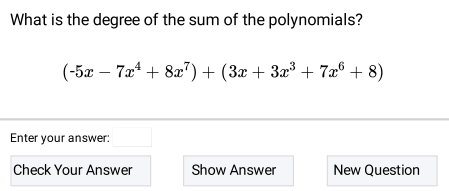
Example
Share
Report error
Solving a Riddle to Win a Prize
In the evening, Dylan is reading his apartment complex's newsletter on his tablet and finds a small mathematical riddle. Readers who solve it correctly can get a 50 % discount for a highly innovative online course called  Dylan really likes studying mathematics, so he eagerly starts solving the riddle. A.& 7n^6+12n^5+9n^4+n^3-8n^2-4n+44 B.& - 7n^6-12n^5+7n^4-n^3+2n^2-18n+40 C.& 7n^6-12n^5+9n^4-7n^3+2n^2-18n+44 D.& - 7n^6+12n^5+7n^4+7n^3-8n^2-4n+40
Help him match the equivalent polynomials.
Dylan really likes studying mathematics, so he eagerly starts solving the riddle. A.& 7n^6+12n^5+9n^4+n^3-8n^2-4n+44 B.& - 7n^6-12n^5+7n^4-n^3+2n^2-18n+40 C.& 7n^6-12n^5+9n^4-7n^3+2n^2-18n+44 D.& - 7n^6+12n^5+7n^4+7n^3-8n^2-4n+40
Help him match the equivalent polynomials.
Smart Applications of Math.
{"type":"pair","form":{"alts":[[{"id":0,"text":"A"},{"id":1,"text":"B"},{"id":2,"text":"C"},{"id":3,"text":"D"}],[{"id":0,"text":"P+Q+R"},{"id":1,"text":"P-Q-R"},{"id":2,"text":"P+Q-R"},{"id":3,"text":"P-Q+R"}]],"lockLeft":true,"lockRight":false},"formTextBefore":"","formTextAfter":"","answer":[[0,1,2,3],[0,1,2,3]]}
Hint
In order to add or subtract polynomials, align the like terms vertically and then perform the addition or subtraction.
Solution
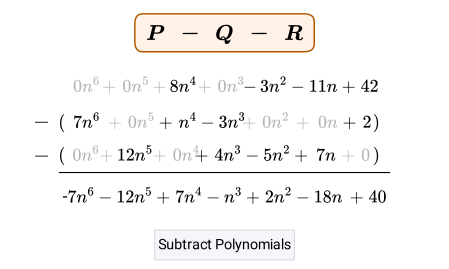
First, the sum of the three given polynomials can be found. In order to add polynomials, align the alike terms vertically and add them. 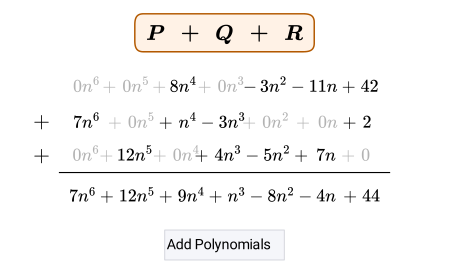 The polynomial corresponding to P-Q-R can be calculated in a similar manner, this time subtracting the terms. Consider how the sign of each term might be affected by the subtraction sign — remember, subtracting a negative number is the same as adding the terms. There are three rows of polynomials, but the subtraction will be done by considering only two terms at a time.
 Next, the polynomial Q will be added to P and then R will be subtracted. Remember to carefully consider the signs of the terms when subtracting R.
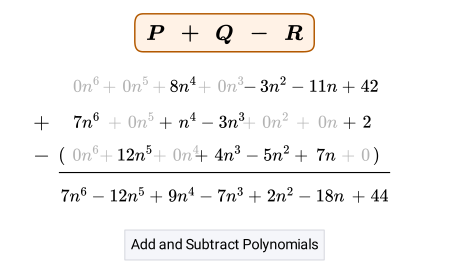 Finally, the polynomial P-Q+R will be calculated.
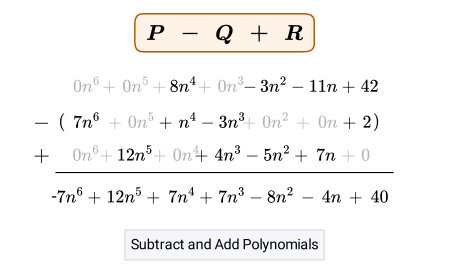
Closure
Share
Report error
Calculating the Sum and Difference of Two Polynomials
With the information presented in the lesson, the challenge given in the beginning can finally be solved. The challenge was to calculate the sum and the difference of the two given polynomials P(x) and Q(x).
P(x) &= 5x^3-2x+7 [0.1cm]
Q(x) &= 3(x-1)(x+4)
Furthermore, if P(x)+Q(x) is also a polynomial, what are its degree, leading coefficient, and constant term?
{"type":"text","form":{"type":"math","options":{"comparison":"1","nofractofloat":false,"keypad":{"simple":true,"useShortLog":false,"variables":[],"constants":[]},"rendered":false},"text":" "},"formTextBefore":"Degree =","formTextAfter":null,"answer":{"text":["3"]}}
{"type":"text","form":{"type":"math","options":{"comparison":"1","nofractofloat":false,"keypad":{"simple":true,"useShortLog":false,"variables":[],"constants":[]},"rendered":false},"text":" "},"formTextBefore":"Leading Coefficient =","formTextAfter":null,"answer":{"text":["5"]}}
{"type":"text","form":{"type":"math","options":{"comparison":"1","nofractofloat":false,"keypad":{"simple":true,"useShortLog":false,"variables":[],"constants":[]},"rendered":false},"text":" "},"formTextBefore":"Constant Term =","formTextAfter":null,"answer":{"text":["-5"]}}
Hint
First, rewrite Q(x) in standard form. Then add and subtract the polynomials by adding and subtracting their like terms.
Solution
First, the sum of the polynomials will be calculated. Note that the second polynomial is not written in standard form, so it has to be rewritten first. To add these polynomials, the horizontal format of addition will be used. Like terms should be rearranged to be next to each other and then combined.
By the Closure Property of Polynomial Addition, the obtained result is also a polynomial. The highest degree of its monomials is 3, so 3 is the degree of P(x)+Q(x). The coefficient of the monomial with the highest degree is 5, so the leading coefficient is 5. Moreover, the constant term is - 5. 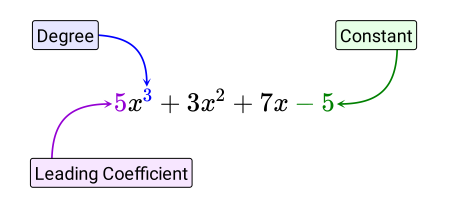 Now, the difference of P(x) and Q(x) can be found following a similar procedure. For simplicity, the previously found standard form of Q(x) will be used.
The obtained expression consists of monomials, so it is also a polynomial.
P(x) + Q(x)& = 5x^3 + 3x^2 + 7x - 5 P(x) - Q(x)& = 5x^3 - 3x^2 - 11 x+ 19
Now, the difference of P(x) and Q(x) can be found following a similar procedure. For simplicity, the previously found standard form of Q(x) will be used.
The obtained expression consists of monomials, so it is also a polynomial.
P(x) + Q(x)& = 5x^3 + 3x^2 + 7x - 5 P(x) - Q(x)& = 5x^3 - 3x^2 - 11 x+ 19
P(x)+Q(x)
SubstituteExpressions
Substitute expressions
(5x^3-2x+7)+3(x-1)(x+4)
5x^3-2x+7+3x^2+9x-12
CommutativePropAdd
Commutative Property of Addition
5x^3+3x^2+(- 2x+9x)+(7-12)
AddSubTerms
Add and subtract terms
5x^3+3x^2+7x-5
P(x)-Q(x)
SubstituteExpressions
Substitute expressions
(5x^3-2x+7)-(3x^2+9x-12)
RemovePar
Remove parentheses
5x^3-2x+7-(3x^2+9x-12)
Distr
Distribute - 1
5x^3-2x+7-3x^2-9x+12
CommutativePropAdd
Commutative Property of Addition
5x^3-3x^2+(- 2x-9x)+(7+12)
AddSubTerms
Add and subtract terms
5x^3-3x^2-11x+19
Adding and Subtracting Polynomials
Exercise 3.1
An odd integer can be written as 2n-1, where n is a natural number. Write an expression that represents the sum of this number and the next two odd integers.
{"type":"text","form":{"type":"math","options":{"comparison":"1","nofractofloat":false,"keypad":{"simple":false,"useShortLog":false,"variables":["n"],"constants":[]},"rendered":false},"text":" "},"formTextBefore":null,"formTextAfter":null,"answer":{"text":["6n+3"]}}
security
report
code
security
report
code
Since we are given an odd number 2n-1, we will add 2 to the given expression to find the next consecutive odd number. cc Odd Number & Consecutive Odd Number & 2n-1+ 2 2n-1 & ⇕ & 2n+1 Then to get the third and final consecutive odd number, we will add 2 again. ccc First Odd & Second Odd & Third Odd Number & Number & Number & & 2n+1+ 2 2n-1 & 2n+1 & ⇕ & & 2n+3 We now have three polynomials that represent three consecutive odd numbers. To find an expression that represents their sum, we will add these polynomials. Let's do it!
The expression that represents the sum of the three consecutive odd integers is 6n+3.
Let's find an example case. Since n is a natural number, we can arbitrarily choose the odd number n= 1. We can find the three consecutive odd numbers for this value of n.
| Expression | Substitute | Simplify |
|---|---|---|
| 2n-1 | 2( 1)-1 | 1 |
| 2n+1 | 2( 1)+1 | 3 |
| 2n+3 | 2( 1)+3 | 5 |
The sum of these three numbers is 1+ 3+ 5= 9. Let's verify if the expression that represents the sum we have already found is equal to 9 for n= 1.
The expression we found resulted in the same sum as adding the integers directly. Therefore, we know our expression is correct.
security
report
code
Adding and Subtracting Polynomials
Recommended exercises
To get personalized recommended exercises, please login first.
Loading content
≤
>
■2
■▢
e▢
7
8
9
×
÷■1
=
=
√▢
▢√
∫▢▢
4
5
6
+
−
≤
<
log
ln
log▢
1
2
3
()
∣
sin
cos
tan
0
.
π
x
y
Loading content