{{ tocSubheader }}
{{ 'ml-label-loading-course' | message }}
An error ocurred, try again later!
Chapter {{ article.chapter.number }}
{{ article.number }}.
{{ article.displayTitle }}
{{ article.intro.summary }}
Show less Show more expand_more Lesson Settings & Tools
| | {{ 'ml-lesson-number-slides' | message : article.intro.bblockCount }} |
| | {{ 'ml-lesson-number-exercises' | message : article.intro.exerciseCount }} |
| | {{ 'ml-lesson-time-estimation' | message }} |
In some equations, more than two operations are applied to the variable. These equations often require the use of properties of operations, like the Distributive Property, to solve. Sometimes, the variable appears on both sides of the equation. In these cases, inverse operations are used to transfer the variable terms all to one side. This lesson focuses on solving and writing multi-step equations.
Catch-Up and Review
Here are a few recommended readings before getting started with this lesson.
Challenge
Simulated Stock Market
Tiffaniqua's class is taking part in a simulated stock market project to learn about investing money. Every student starts with the same amount of money and their task is to make as much money as possible in three weeks!

Tiffaniqua invested all her money into one stock. After the first week, her stock was worth $65 more! After the second week, her stock was worth twice its value after the first week. During the last week of the project, the value of her stock fell by $50, making Tiffaniqua's stock worth $280.
a Write an equation in terms of w that represents the situation.
{"type":"text","form":{"type":"math","options":{"comparison":"1","nofractofloat":false,"keypad":{"simple":false,"useShortLog":false,"variables":["w"],"constants":[]},"rendered":false},"text":"<span class=\"katex\"><span class=\"katex-html\" aria-hidden=\"true\"><\/span><\/span>"},"formTextBefore":null,"formTextAfter":null,"answer":{"text":["2(w+65)-50=280","280=2(w+65)-50","2w+130-50=280","280=2w+130-50","2w+80=280","280=2w+80","2w=280-80","280-80=2w","2w=200","200=2w"]}}
b Solve the equation to find the initial amount of money Tiffaniqua had during the project.
{"type":"text","form":{"type":"math","options":{"comparison":"1","nofractofloat":false,"keypad":{"simple":true,"useShortLog":false,"variables":[],"constants":[]},"rendered":false},"text":"<span class=\"katex\"><span class=\"katex-html\" aria-hidden=\"true\"><\/span><\/span>"},"formTextBefore":"<span class=\"katex\"><span class=\"katex-html\" aria-hidden=\"true\"><span class=\"base\"><span class=\"strut\" style=\"height:0.80556em;vertical-align:-0.05556em;\"><\/span><span class=\"mord\">$<\/span><\/span><\/span><\/span>","formTextAfter":null,"answer":{"text":["100"]}}
Discussion
Solving Multi-Step Equations
When solving equations, sometimes more than one step is needed. Both the number of steps and the operations required depend on the complexity of the given equation. For example, consider the following pair of equations.
Equation (I):Equation (II):23(x−2)+5=14y+2y−4=11−2y
The general idea is to simplify both sides of the equation and then isolate the variable on one side of the equation. This is usually done by collecting all the variable terms on one side of the equations and combining them. Then, the operations applied to the variable are undone in reverse order.
Solving Equation (I)
Equation (I) contains a fraction and parentheses.23(x−2)+5=14
1
Clear Parentheses and Combine Like Terms on Each Side
expand_more Apply the Distributive Property to clear the parentheses on the left-hand side of the equation. In this case, distribute 23 to each term inside the parentheses. Then, combine like terms on the left-hand side.
23(x−2)+5=14
Distr
Distribute 23
23x−23⋅2+5=14
FracMultDenomToNumber
2a⋅2=a
23x−3+5=14
AddTerms
Add terms
23x+2=14
2
Isolate the Variable
expand_more Apply the Properties of Equality to isolate the variable on one side of the equation. In this case, first apply the Subtraction Property of Equality.
The coefficient of the variable is a fraction. The Multiplication Property of Equality can be used to multiply both sides of the equation by the reciprocal of the coefficient.
As such, x=8 is the solution of Equation (I).
23x=12
MultEqn
LHS⋅32=RHS⋅32
23x⋅32=12⋅32
CommutativePropMult
Commutative Property of Multiplication
23⋅32⋅x=12⋅32
MultFracByInverse
ba⋅ab=1
1⋅x=12⋅32
OneMult
1⋅a=a
x=12⋅32
MoveLeftFacToNum
a⋅cb=ca⋅b
x=312⋅2
Multiply
Multiply
x=324
CalcQuot
Calculate quotient
x=8
Solving Equation (II)
In this equation, the variable is on both sides of the equation.y+2y−4=11−2y
Solving the equation will require the additional step of collecting the variables on one side of the equation.
1
Clear Parentheses and Combine Like Terms on Each Side
expand_more Apply the Distributive Property to clear the parentheses on each side of the equation. There are no parentheses to clear in this equation, so start by combining like terms instead.
2
Collect the Variable on One Side of the Equation
expand_more Apply the Properties of Equality to collect all the variables on one side of the equation. In this case, add 2y to both sides of the equation to group the y-terms on the left-hand side.
3y−4=11−2y
AddEqn
LHS+2y=RHS+2y
3y−4+2y=11
CommutativePropAdd
Commutative Property of Addition
3y+2y−4=11−2y+2y
AddTerms
Add terms
5y−4=11
3
Isolate the Variable
expand_more Apply the Properties of Equality again to isolate the variable on one side of the equation. In this case, add 4 to both sides, then divide both sides of the equation by 5.
In conclusion, y=3 is the solution of Equation (II).
5y−4=11
AddEqn
LHS+4=RHS+4
5y=11+4
AddTerms
Add terms
5y=15
DivEqn
LHS/5=RHS/5
y=515
CalcQuot
Calculate quotient
y=3
Example
Finding the Initial Value of an Investment
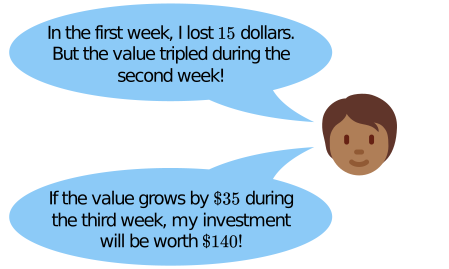
Tiffaniqua and her friend Kevin are talking about the stock market project. Kevin is telling her how his investment is doing after two weeks.
{"type":"text","form":{"type":"math","options":{"comparison":"1","nofractofloat":false,"keypad":{"simple":false,"useShortLog":false,"variables":["p"],"constants":[]},"rendered":false},"text":"<span class=\"katex\"><span class=\"katex-html\" aria-hidden=\"true\"><\/span><\/span>"},"formTextBefore":null,"formTextAfter":null,"answer":{"text":["3(p-15)+35 = 140","140=3(p-15)+35","3p-45 +35= 140","140=3p-45+35","3p-10 = 140","140=3p-10","3p = 140+10","140+10=3p","3p = 150","150=3p"]}}
b Solve the equation to find the amount Kevin invested in the stock.
{"type":"text","form":{"type":"math","options":{"comparison":"1","nofractofloat":false,"keypad":{"simple":true,"useShortLog":false,"variables":[],"constants":[]},"rendered":false},"text":"<span class=\"katex\"><span class=\"katex-html\" aria-hidden=\"true\"><\/span><\/span>"},"formTextBefore":"<span class=\"katex\"><span class=\"katex-html\" aria-hidden=\"true\"><span class=\"base\"><span class=\"strut\" style=\"height:0.80556em;vertical-align:-0.05556em;\"><\/span><span class=\"mord\">$<\/span><\/span><\/span><\/span>","formTextAfter":null,"answer":{"text":["50"]}}
Hint
a The value of Kevin's investment after two weeks is 3 times its value after the first week.
b Use the Distributive Property and inverse operations to solve the equation.
Solution
a Let p be the starting value of Kevin's investment. Kevin said that during the first week, the value of the stock he bought fell by $15. This means that the value of the investment after the first week is the difference between p and 15.
Value After First Week:p−15
The value of the stock tripled the next week. In other words, during the second week, the value of Kevin's investment is three times the value at the first week.
Value After First Week:Value After Second Week:p−153(p−15)
If the value of the investment grows by $35 during the last week, it will be $35 more than the value after the second week.
Value After First Week:Value After Second Week:Value After Third Week:p−153(p−15)3(p−15)+35
The final value of Kevin's investment would be $140, which will complete the equation.
3(p−15)+35=140
b Solve the equation written in Part A to find the amount of money Kevin invested in the stock.
3(p−15)+35=140
First, apply the Distributive Property to clear the parentheses. Then, apply the Properties of Equality to isolate the variable p.
3(p−15)+35=140
Distr
Distribute 3
3p−3⋅15+35=140
Multiply
Multiply
3p−45+35=140
AddTerms
Add terms
3p−10=140
AddEqn
LHS+10=RHS+10
3p−10+10=140+10
AddTerms
Add terms
3p=150
DivEqn
LHS/3=RHS/3
33p=3150
CrossCommonFac
Cross out common factors
33p=3150
SimpQuot
Simplify quotient
p=3150
CalcQuot
Calculate quotient
p=50
Example
Comparing Two Investments
Tearrik and Ramsha both invested the same amount in a single stock. After two weeks, they compared how their investments were doing.
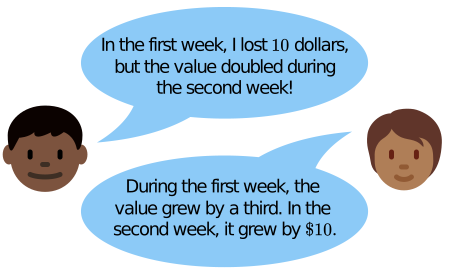
It turns out that after two weeks, both investments are worth exactly the same amount of money!
{"type":"text","form":{"type":"math","options":{"comparison":"1","nofractofloat":false,"keypad":{"simple":false,"useShortLog":false,"variables":["m"],"constants":[]},"rendered":false},"text":"<span class=\"katex\"><span class=\"katex-html\" aria-hidden=\"true\"><\/span><\/span>"},"formTextBefore":null,"formTextAfter":null,"answer":{"text":["2(m-10)=\\frac{4}{3}m+10","\\frac{4}{3}m+10=2(m-10)","2m-2*10=\\frac{4}{3}m+10","\\frac{4}{3}m+10=2m-20","\\frac{4}{3}m+10=2m-20"]}}
b Solve the equation to find the amount Tearrik and Ramsha invested in the stocks.
{"type":"text","form":{"type":"math","options":{"comparison":"1","nofractofloat":false,"keypad":{"simple":true,"useShortLog":false,"variables":[],"constants":[]},"rendered":false},"text":"<span class=\"katex\"><span class=\"katex-html\" aria-hidden=\"true\"><\/span><\/span>"},"formTextBefore":"<span class=\"katex\"><span class=\"katex-html\" aria-hidden=\"true\"><span class=\"base\"><span class=\"strut\" style=\"height:0.80556em;vertical-align:-0.05556em;\"><\/span><span class=\"mord\">$<\/span><\/span><\/span><\/span>","formTextAfter":null,"answer":{"text":["45"]}}
Hint
a Express the final value of each investment using m.
b Collect all the variable terms on one side of the equation.
Solution
a Let m be the starting value of each investment. The value of Tearrik's investment fell by $10 during the first week, then doubled during the second week. This means that the value of Tearrik's investment after two weeks can be expressed as 2(m−10).
Value of Tearrik’s Investment:2(m−10)
The value of Ramsha's investment grew by a third during the first week, so its value after the first week was 1m+31m=34m. During the second week, the value grew by $10. Then, the value of Ramsha's investment after two weeks is 34m+10.
Value of Ramsha’s Investment:34m+10
Since the final values of Tearrik's and Ramsha's investments are equal, an equation can be written by setting these two expressions equal to each other.
2(m−10)=34m+10
b Solve the equation written in Part A to find the amount of money that Tearrik and Ramsha invested in their respective stocks.
2(m−10)=34m+10
First, use the Distributive Property.
The resulting equation has variable terms on both sides. To solve the equation, all the variable terms are first collected on one side of the equation. Use the Subtraction Property of Equality to subtract 34m from both sides.
2m−20=34m+10
SubEqn
LHS−34m=RHS−34m
2m−20−34m=34m+10−34m
CommutativePropAdd
Commutative Property of Addition
2m−34m−20=34m−34m+10
Rewrite
Rewrite 2m as 36m
36m−34m−20=34m−34m+10
SubTerms
Subtract terms
32m−20=10
32m−20=10
AddEqn
LHS+20=RHS+20
32m−20+20=10+20
AddTerms
Add terms
32m=30
MultEqn
LHS⋅23=RHS⋅23
32m⋅23=30⋅23
CommutativePropMult
Commutative Property of Multiplication
32⋅23⋅m=30⋅23
MultFracByInverse
ba⋅ab=1
m=30⋅23
MoveLeftFacToNum
a⋅cb=ca⋅b
m=230⋅3
Multiply
Multiply
m=290
CalcQuot
Calculate quotient
m=45
Pop Quiz
Solving Different Equations
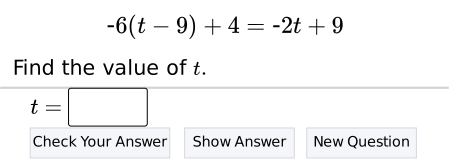
Solve the given equation for the indicated variable. If necessary, round the answer to two decimal places.
Discussion
Equations With No Solutions or More Than One Solution
Equations with linear terms may have zero, one, or infinitely many solutions. This lesson has already shown how to solve equations with one solution. Now it is time to focus on the other two possibilities.
Concept
Identity
There are three possible results when solving an equation.
- If an identify is obtained, then every number is a solution to the equation. In other words, the equation has infinitely many solutions.
- If a false statement is obtained instead, the equation has no solutions. In this case, it can be said that the solution set is the null set.
- If the result is an equation in which the variable is isolated, then the equation has one solution.
Example
Solving Equations With No Solutions or Infinitely Many Solutions
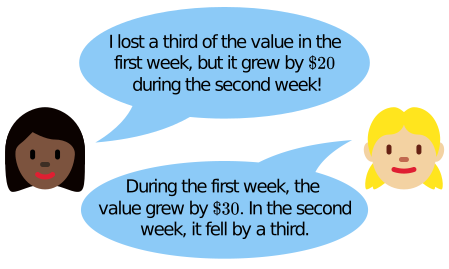
a Tiffaniqua and Zosia both invested the same amount of money in one stock each. After two weeks, they compare how their investments are doing.
{"type":"text","form":{"type":"math","options":{"comparison":"1","nofractofloat":false,"keypad":{"simple":false,"useShortLog":false,"variables":["t"],"constants":[]},"rendered":false},"text":"<span class=\"katex\"><span class=\"katex-html\" aria-hidden=\"true\"><\/span><\/span>"},"formTextBefore":null,"formTextAfter":null,"answer":{"text":["\\frac{2}{3}t+20=\\frac{2}{3}(t+30)","\\frac{2}{3}(t+30)=\\frac{2}{3}t+20"]}}
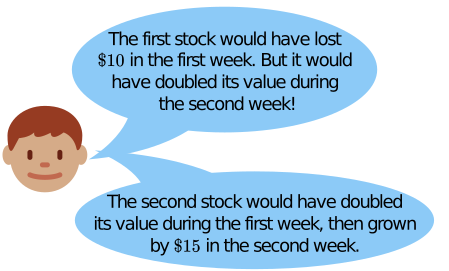
b Ali is tracking two different stocks. He compared how much each stock would be worth after two weeks if he invested g dollars into each at the beginning of the project.
{"type":"text","form":{"type":"math","options":{"comparison":"1","nofractofloat":false,"keypad":{"simple":false,"useShortLog":false,"variables":["g"],"constants":[]},"rendered":false},"text":"<span class=\"katex\"><span class=\"katex-html\" aria-hidden=\"true\"><\/span><\/span>"},"formTextBefore":null,"formTextAfter":null,"answer":{"text":["2(g-10)=2g+15","2g+15=2(g-10)"]}}
c Select all the true sentences.
{"type":"multichoice","form":{"alts":["The equation from Part A has no solutions.","The equation from Part A has one solution.","The equation from Part A has infinitely many solutions.","The equation from Part B has no solutions.","The equation from Part B has one solution.","The equation from Part B has infinitely many solutions."],"noSort":true},"formTextBefore":"","formTextAfter":"","answer":[2,3]}
Hint
a Represent the unknown value using the variable. Write two different expressions that represent the ladies' investments.
b Write two expressions that represent the investments. Use the variable to represent the unknown value.
Solution
a Let t be the amount of money that Tiffaniqua and Zosia invested in their stocks. First, express the final value of Tiffaniqua's investment in terms of t. The investment lost a third of its value in the first week, so the value at this point is 32t. In the second week, the value grew by $20. The value of the investment after two weeks is 32t+20.
Value of Tiffaniqua’s Investment:32t+20
The value of Zosia's investment grew by $30 during the first week, so its value was t+30 at that point. Then the value fell by a third during the second week. This means that the value of Zosia's investment after two weeks is 32(t+30).
Value of Zosia’s Investment:32(t+30)
The values of Tiffaniqua's and Zosia's investments after two weeks are equal. This makes it possible to write an equation that models the given situation.
32t+20=32(t+30)
b Write an expression that describes the final value of each investment. The first stock would lose $10 in value during the first week, so its value would be g−10. The value would then double during the second week, so the final value would be 2(g−10).
First Stock:2(g−10)
The second stock doubled its value during the first week, so the value would be 2g at that point. In the second week, the value would grow by $15, so the final value is 2g+15.
Second Stock:2g+15
Ali wants to know how much money invested into both stocks would result in the final values being equal. The best way to find this information is to set the two expressions equal to each other.
2(g−10)=2g+15
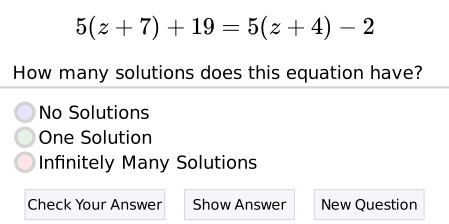
c To find the number of solutions of the equations from Parts A and B, solve the equations. There are three possible outcomes for these equations.
- If solving the equation results in a false statement, the equation has no solutions.
- If solving the equation results in a solution, the equation has one solution.
- If solving the equation results in an identity, the equation has infinitely many solution.
32t+20=32(t+30)
Distr
Distribute 32
32t+20=32t+32⋅30
MoveRightFacToNum
ca⋅b=ca⋅b
32t+20=32t+32⋅30
Multiply
Multiply
32t+20=32t+360
CalcQuot
Calculate quotient
32t+20=32t+20
SubEqn
LHS−32t=RHS−32t
32t+20−32t=32t+20−32t
SubTerms
Subtract terms
20=20
- The equation from Part A has infinitely many solutions.
- The equation from Part B has no solutions.
Pop Quiz
Determining the Number of Solutions to an Equation
Closure
Simulated Stock Market
To solve the challenge presented at the beginning of the lesson, write and solve an equation that models the situation. The challenge stated that during her class simulated stock market project, Tiffaniqua invested all her money into a single stock.

After the first week, Tiffaniqua's investment was worth $65 more than it was at the beginning of the project. After the second week, her stock was worth twice its value after the first week. During the last week of the project, the value of her stock fell by $50, making Tiffaniqua's stock worth $280.
a Write an equation in terms of w that represents the situation.
{"type":"text","form":{"type":"math","options":{"comparison":"1","nofractofloat":false,"keypad":{"simple":false,"useShortLog":false,"variables":["w"],"constants":[]},"rendered":false},"text":"<span class=\"katex\"><span class=\"katex-html\" aria-hidden=\"true\"><\/span><\/span>"},"formTextBefore":null,"formTextAfter":null,"answer":{"text":["2(w+65)-50=280","280=2(w+65)-50","2w+130-50=280","280=2w+130-50","2w+80=280","280=2w+80","2w=280-80","280-80=2w","2w=200","200=2w"]}}
b Solve the equation to find the initial amount of money Tiffaniqua had during the project.
{"type":"text","form":{"type":"math","options":{"comparison":"1","nofractofloat":false,"keypad":{"simple":true,"useShortLog":false,"variables":[],"constants":[]},"rendered":false},"text":"<span class=\"katex\"><span class=\"katex-html\" aria-hidden=\"true\"><\/span><\/span>"},"formTextBefore":"<span class=\"katex\"><span class=\"katex-html\" aria-hidden=\"true\"><span class=\"base\"><span class=\"strut\" style=\"height:0.80556em;vertical-align:-0.05556em;\"><\/span><span class=\"mord\">$<\/span><\/span><\/span><\/span>","formTextAfter":null,"answer":{"text":["100"]}}
Hint
a Assign the variable to the starting amount of money.
b Undo the operations applied to the variable in reverse order.
Solution
a To write an equation that models a real-life situation, a variable is used to represent an unknown quantity. In this situation, the unknown quantity is the amount of money that Tiffaniqua invested initially. This quantity can be represented by w.
Starting Amount of Money:w
Next, the final value of Tiffaniqua's stock can be expressed in terms of w. - After the first week, Tiffaniqua's investment was worth $65 more, or w+65.
- During the second week, the stock value doubled, so the investment was worth 2(w+65) at this point.
- During the last week of the project, the value of the stock fell by $50, making the final value 2(w+65)−50.
Final Value:2(w+65)−50
Finally, write the equation by setting this expression equal to the final value of the investment, $280.
2(w+65)−50=280
b The w-variable must be isolated to solve the equation. To do this, the operations applied to the variable are undone in reverse order.
2(w+65)−50=280
Start by analyzing the expression. Here, 65 is added to w and the result is then multiplied by 2. Finally, 50 is subtracted from the product. These operations can be undone using inverse operations. The first operation to be undone is the subtraction. Use the Addition Property of Inequality to undo the subtraction.
Then, the multiplication is undone using the Division Property of Equality.
2(w+65)=330
DivEqn
LHS/2=RHS/2
22(w+65)=2330
CrossCommonFac
Cross out common factors
22(w+65)=2330
SimpQuot
Simplify quotient
w+65=2330
CalcQuot
Calculate quotient
w+65=165
Alternative Solution
The equation can be simplified using a different set of operations. This time the process will start by using the Distributive Property to distribute 2 to the parentheses and then combining like terms.
In the resulting equation, the variable w is multiplied by 2 and then 80 is added to the result. These operations can be undone using inverse operations, starting with the addition. Use the Subtraction Property of Inequality to undo the addition.
Finally, the multiplication is undone using the Division Property of Equality.
The solution to the equation is w=100, the same result as before.
2(w+65)−50=280
Distr
Distribute 2
2w+2⋅65−50=280
Multiply
Multiply
2w+130−50=280
SubTerm
Subtract term
2w+80=280
Loading content