13. Solving and Graphing One Variable Absolute Value Inequalities
Sign In
An error ocurred, try again later!
Chapter 1
13.
Solving and Graphing One Variable Absolute Value Inequalities
Understanding absolute value inequalities is crucial. These inequalities involve the absolute value of an expression containing a variable. Through real-world examples, such as determining the acceptable weight range for chocolate bars or understanding the temperature variations on Mars, one can grasp the practical applications of these inequalities. For instance, a chocolate factory aims to produce bars weighing a specific amount, and any deviation beyond a set limit is unacceptable. Similarly, the temperature on Mars has its highs and lows, and understanding these ranges is essential for future explorations. By mastering absolute value inequalities, one can tackle complex problems with ease and precision.
Show less Show more expand_more 


Lesson Settings & Tools
| | 10 Theory slides |
| | 11 Exercises - Grade E - A |
| | Each lesson is meant to take 1-2 classroom sessions |
Solving and Graphing One Variable Absolute Value Inequalities
Slide of 10
What can ensure a quality approach when analyzing elements such as water or soil? How about when making chocolate? Predetermined ranges for specific characteristics, that is. For instance, it is possible to use inequalities that involve absolute values to ensure the quality of a chocolate bar or in understanding elements of nature. Here, one-variable absolute value inequalities will be solved, and their solution sets will be drawn.
Catch-Up and Review
Here are a few recommended readings before getting started with this lesson.
Challenge
Share
Report error
Representing Water Temperature in Non-liquid States With Absolute Value Inequality
From the school yard to the kitchen, three states of water are observable at a moments notice: solid, liquid, and gas.
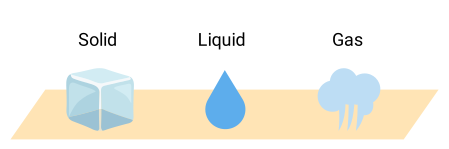
It is known that, at atmospheric pressure, water freezes at 32^(∘) F and vaporizes at 212^(∘) F.
a Write the range of temperatures in which water is not liquid.
b Graph the given range of when water freezes and vaporizes.
c Write the absolute value inequality that describes this situation.
Explore
Share
Report error
From Compound Inequalities to Absolute Value Inequalities
An inequality that results from combining two inequalities by using the the word 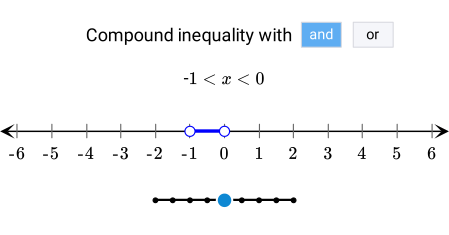 Can these compound inequalities be represented in a different form? Is it possible to use an absolute value expression?
andor the word
or, is called a compound inequality. The applet shows compound inequalities and their solution sets. Examine the solution set for the indicated inequality and explore how it changes for different compound inequalities.
Discussion
Share
Report error
Absolute Value Inequalities
An absolute value inequality is an inequality that involves the absolute value of an expression containing a variable. As with other inequalities, absolute value inequalities can be strict or non-strict.
| Strict Absolute Value Inequalities | Non-Strict Absolute Value Inequalities | ||
|---|---|---|---|
| |x+2| > 5 | |x+7| < 5 | |2x| ≥ 10 | |x-2| ≤ 4 |
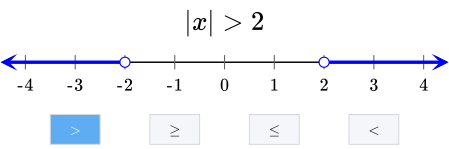
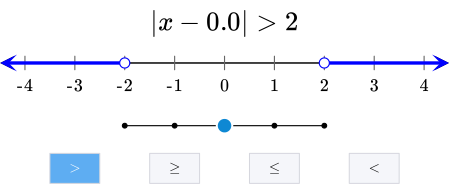
Method
Share
Report error
Solving an Absolute Value Inequality
Using the definition of absolute value, an absolute value inequality can be written as a compound inequality. Therefore, solving absolute value inequalities is quite similar to solving compound inequalities. To detail the reasoning, the following inequality will be solved. 3 |x-7| +2 > 20
There are four steps to follow.
1
Isolate the Absolute Value Expression
expand_more To be able to rewrite the given inequality as a compound inequality, the absolute value expression should be isolated first. To do so, the Properties of Inequalities and inverse operations will be used.
Here, the number on the other side of the absolute value is positive. However, it should be noted that if that number were negative, then the inequality either has no solution or all real numbers as a solution depending on the inequality symbol.
Example Inequality & Solution Set [-1em]
|x-7|< - 5 & No Solution |x-7| > - 5 & All Real Numbers
Since the absolute value of an expression is always non-negative, |x-7| should be greater than or equal to 0. Therefore, all real numbers satisfy |x-7|> - 5, and there is no x-value which satisfies |x-7|< - 5.
2
Rewrite It as a Compound Inequality
expand_more Now, the absolute value inequality |x-7|>6 will be rewritten. It represents the set of all numbers that are less than - 6 or greater than 6. |x-7| > 6 ⇓ x-7 < - 6 or x-7 > 6
3
Solve the Individual Inequalities
expand_more Next, the individual inequalities will be solved by adding 7 to both sides of the inequalities. c|c Inequality I & Inequality II [0.7em] x-7 < - 6 & x-7 > 6 ⇓ & ⇓ x < 1 & x > 13 The solution set of Inequality I contains all real numbers less than 1. The solutions to Inequality II are all real numbers greater than 13.
4
Combine the Solution Sets
expand_more The combination of the solution sets for the individual inequalities is the solution set of the given absolute value inequality. Since the derived compound inequality was combined with the word or,
the combination of the solution sets is also written with that word.
x < 1 or x > 13
Example
Share
Report error
Representing Acceptable Chocolate Weights Using an Absolute Value Inequality
Izabella goes on a tour of a chocolate factory. They aim to produce chocolate bars weighing 93 grams. A machine at the factory weighs chocolates chosen at random. The bars must not deviate from the predetermined weight by more than 5 grams. Otherwise, the machine has to send them back.

a Write a range of allowable weights w for a chocolate bar using a compound inequality.
b Graph the range on a number line.
c Write an absolute value inequality that describes this situation.
Answer
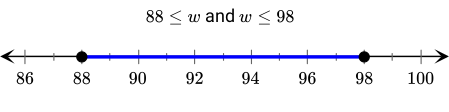
a 88 ≤ w ≤ 98
b Graph:
c |w-93| ≤ 5
Hint
a Determine the maximum and minimum acceptable weights.
b Should the solution set contain the maximum and minimum w-values?
c Which inequality symbol should be used?
Solution
a For a chocolate bar to be sent back, the difference between the weight of the chocolate bar and the predetermined weight is more than 5 grams. Therefore, an acceptable weight w for a chocolate bar, not to be sent back, must be greater than or equal to 93-5=88 grams.
88 ≤ w At the same time, it must weigh less than or equal to 93+5=98 grams. w ≤ 98 Consequently, the combination of these individual inequalities will result in a compound inequality describing the range of acceptable weights. 88 ≤ w and w ≤ 98 ⇕ 88 ≤ w ≤ 98
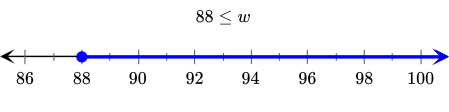
b The inequality 88≤ w is the set of values which are greater than or equal to 88. Since the inequality sign is non-strict, 88 itself is included.
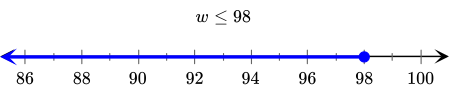
The other inequality represents all the points to the left of 98. Again, the inequality sign is non-strict, so 98 is included.
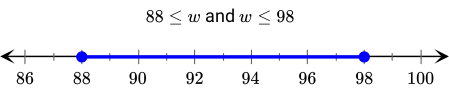
Because the inequalities are combined using word and,
the solution set of the resulting compound inequality is equal to the union of the solution sets of the individual inequalities. Therefore, the graph of the acceptable weight range is the combination of the graphs.
c Any chocolate bar that varies from the predetermined weight by more than 5 grams is sent back. Therefore, the absolute value of the difference between the weight of a bar w and the predetermined weight should be less than or equal to 5. This can be expressed as follows.
|w-93| ≤ 5 Since this absolute value inequality can be rewritten as the compound inequality obtained in the previous steps, both have the same set of solutions.
Example
Share
Report error
Writing an Absolute Value Inequality to Define a Range of Prices
Izabella, looking around the chocolate factory, discovers a room full of chocolate fondue fountains on sale for special events! The prices are high and they vary significantly. She decides to make a list of the prices to see which is a fair price.
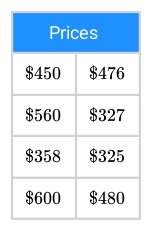
a To define a fair price, Izabella decides a fondue with a price within $100 of the average price of all the fondues is fair. Write an absolute value inequality describing the situation. Which prices meet this condition?
b Izabella decides to narrow the range. She thinks that a fondue that is no more than 20 above the average price is what is really fair. Write an absolute value inequality for this case and determine the prices that meet this condition.
Answer
a Absolute Value Inequality: |x-447| < 100
Prices: $ 358, $ 450, $ 476, and $ 480
Prices: $ 358, $ 450, $ 476, and $ 480
b Absolute Value Inequality: |x-447| ≤ 20
Price: $ 450
Price: $ 450
Hint
a The average price of the chocolate fondues is the sum of the prices divided by the number of prices. The absolute value of the difference between the amount of money Izabella thinks is fair and the average price should be less than 100.
b The absolute value of the difference between the amount of money Izaballa thinks is fair and the average price should be less than or equal to 20.
Solution
a To find the average price p of the chocolate fondues, the sum of the prices will be divide by the number of prices, 8.
p = Sum of Values/Number of Values
SubstituteValues
Substitute values
p = 450 + 476+560+ 327+358+325+600+480/8
p = 447
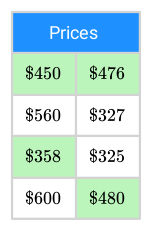
As seen, 4 prices meet Izabella's condition. $ 450, $ 476, $ 358, and $480
b In the previous part, the average price of the fondue's was found to be $447. Now, the range is narrowed to $20. The absolute value of the difference between x and 447 should be less than or equal to 20.
|x-447| ≤ 20 By solving the inequality, the fondue prices satisfying this condition can be determined. |x-447| ≤ 20 ⇓ - 20 ≤ x-447 ≤ 20 ⇓ 427 ≤ x ≤ 467 The fondue prices are within this range are those which Izabella would consider to be priced fairly.
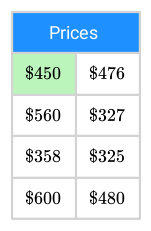
There is only one price that meets Izabella's condition. $ 450
Example
Share
Report error
Representing the Temperature of Mars With an Absolute Value Inequality
Izabella learns that the factory has future plans to develop packaging that can withstand the harshest conditions, including Mars! The temperature of the surface of Mars reaches its highest value at the equator where it is less than 36^(∘) C. Mars reaches its lowest temperature at the poles where it is always greater than - 144^(∘) C.
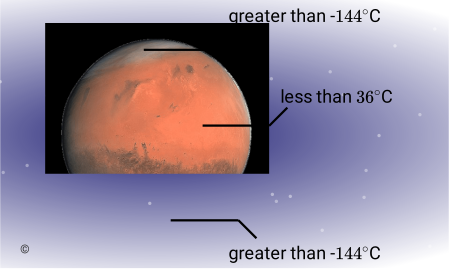
External credits: ESA & MPS for OSIRIS Team MPS/UPD/LAM/IAA/RSSD/INTA/UPM/DASP/IDA
{"type":"text","form":{"type":"math","options":{"comparison":"1","nofractofloat":false,"keypad":{"simple":false,"useShortLog":false,"variables":["t"],"constants":["PI"]},"rendered":false},"text":" "},"formTextBefore":null,"formTextAfter":null,"answer":{"text":["|t+54| < 90"]}}
Hint
Start by writing a compound inequality for the possible temperature values t on Mars.
Solution
From the given information, the temperature on Mars is always less than 36^(∘) C but greater than - 144^(∘) C. At the equator: & t < 36 At the poles: & t > - 144 These individual inequalities can be combined to form an equivalent compound inequality that describe the possible temperatures on Mars. - 144 < t and t < 36 ⇕ - 144 < t < 36 To write this compound inequality as an absolute value inequality, the midpoint between - 144 and 36 on the number line should be found. Let d be the distance to the midpoint.
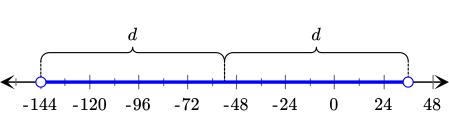
d = 36- (- 144)/2
d = 90
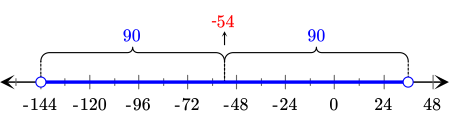
The points that are within 90 units of the midpoint represent the range can be written as the following absolute inequality. Note that since the endpoints are not included, the inequality should be strict. |t-( - 54)| < 90 ⇕ |t + 54| < 90 Now that Izabella has this information, she is even more impressed with the chocolate factory!
Example
Share
Report error
Representing a Salary Range With an Absolute Value Inequality
At this special chocolate factory the average salary for a Chocolatier is a whopping $ 45 700.

As a company policy, a new Chocolatier's actual salary can only differ from the company average by less than $1250.
a Write and solve an absolute value inequality to find a range for the possible salaries s for a new Chocolatier. Draw the range on a number line.
b Write an absolute value inequality for the salaries that are not offered to new Chocolatiers.
Answer
a Absolute Value Inequality: |s-45 700|<1250
Range: 44 450 < s < 49 950

b Absolute Value Inequality: |s-45 700|≥ 1250
Hint
a The absolute value of the difference between the salary for a new Chocolatier and the average salary of any Chocolatier is less than 1250.
b Use the graph drawn in the part A.
Solution
a This special chocolate factory pays a new Chocolatier's salary within $1250 of the company's average salary of $ 45 700. This means that the absolute value of the difference between the salary s for a new employee and the average salary of any Chocolatier is less than 1250.
Absolute Value Inequality [0.6em] |s-45 700| < 1250 By solving this absolute value inequality, the range for the possible salaries can be found. To do so, the inequality will be rewritten. |s-45 700| < 1250 ⇓ - 1250 < s-45 700 < 1250 ⇓ 44 450 < s < 46 950 The solution set of the inequality is the set of values between 44 450 and 46 950. Since the inequality sign is strict, those numbers are not included.
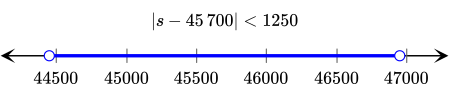
b Consider the graph of the absolute value inequality found in Part A.
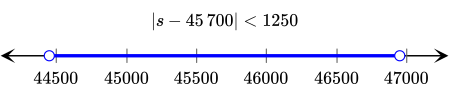
The values that are more than 1250 units away from the average salary in the number line, need to be represented by an absolute value inequality.

These values can be written as the following absolute value inequality. |s-45 700| ≥ 1250
Pop Quiz
Share
Report error
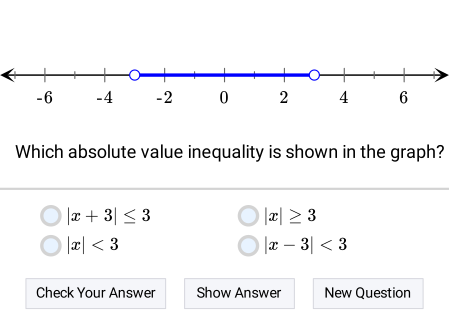
Determining an Absolute Value Inequality From Its Graph
Analyze the given graph and determine the corresponding absolute value inequality.
Closure
Share
Report error
Representing Water Temperature in Non-liquid States With Absolute Value Inequality
In this lesson, the relationship between absolute value inequalities and compound inequalities has been explained using real-world examples. Considering those examples, the challenge presented at the beginning can now be solved seamlessly.
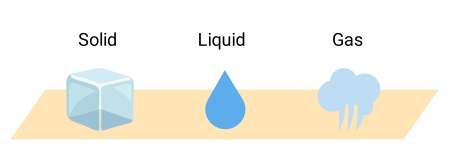
It is known that, at atmospheric pressure, water freezes at 32^(∘) F and vaporizes at 212^(∘) F.
a Write the range of temperatures in which water is not liquid.
b Graph this range.
c Write the absolute value inequality that describes this situation.
Answer
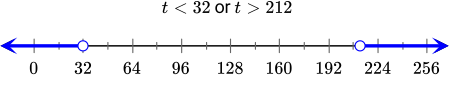
a t< 32 or t > 212
b Graph:
c |t-122|>90
Hint
a Determine the values of temperature that water freezes or vaporizes.
b Does the solution set contain the numbers 32 and 212?
c Find the middle point between 32 and 212 on the number line.
Solution
a Water is not liquid when it is in frozen form nor when it is vapor form. Noting the given information, it is known that, at atmospheric pressure, water is not liquid for temperatures less than 32^(∘) F or greater than 212^(∘) F
Solid: & t < 32 Gas: & t > 212 The values 32^(∘) F and 212^(∘) F are not included because at these temperatures water starts to change its physical state and the liquid form of water can be present in both states of the transition. Under these conditions, the following compound inequality shows the temperatures in which water is not a liquid. t<32 or t>212
b The compound inequality is the combination of two inequalities. The inequality t<32 shows the set of values less than 32. Since the inequality sign is strict, the value 32 is not included.
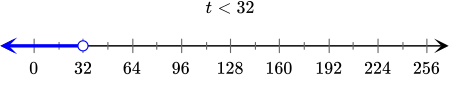
The other inequality represents all of the points to the right of 212. Again, the inequality sign is strict, so 212 is not included.
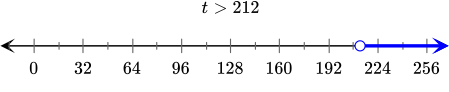
Since the inequalities were combined with the word or,
the solution set of the resulting compound inequality is the union of the solutions sets of the two individual inequalities. Therefore, the graph of the range is the combination of the above graphs.
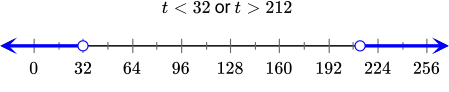
c To write the absolute value equation, the midpoint between 32 and 212 on the number line should be found. To do so, half the difference between these numbers will be calculated.
212-32/2= 180/2 ⇒ 180/2=90 The midpoint is 90 units away from the endpoints. Therefore, the midpoint is 32 + 90 = 122.
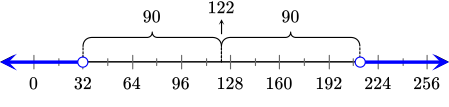
The points that are further away in units than the calculated distance of 90 represent the range, which can be written as the following absolute inequality. |t-122|>90
Solving and Graphing One Variable Absolute Value Inequalities
Exercise 1.1
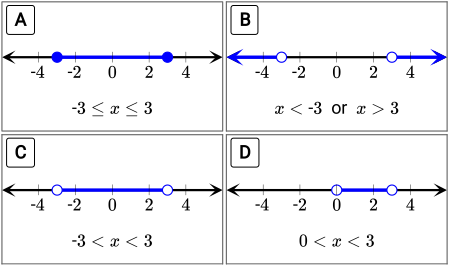
Which graph shows the solution set of the absolute value inequality |x|<3?
{"type":"choice","form":{"alts":["A","B","C","D"],"noSort":true},"formTextBefore":"","formTextAfter":"","answer":2}
Which graph shows the solution set of the absolute value inequality |y| ≥ 4.5?
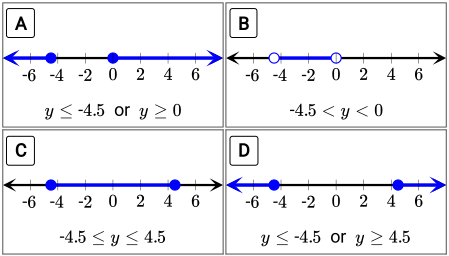
{"type":"choice","form":{"alts":["A","B","C","D"],"noSort":true},"formTextBefore":"","formTextAfter":"","answer":3}
security
report
code
security
report
code
We are asked to graph the solution set for all possible values of x in the given inequality. |x|<3 To do this, we will create a compound inequality by removing the absolute value. In this case, the inequality represents the set of all numbers that are less than 3 and greater than - 3.
| Absolute Value Inequality | |x| < 3 |
|---|---|
| Compound Inequality | - 3 < x and x < 3 |
The first inequality tells us that all values greater than -3 will satisfy the inequality. The second inequality tells us that all values less than 3 will satisfy the inequality. The intersection of these two solution sets is the solution set of the compound inequality. First Solution Set:& -3 < x Second Solution Set:& x < 3 Intersecting Solution Set:& -3 < x < 3 The graph of this inequality includes all values from -3 to 3, not inclusive. We can show this by using open circles on the endpoints.
This corresponds to option C.
We are asked to graph the solution set for all possible values of y in the given inequality.
|y|≥ 4.5
We can rewrite this inequality as a compound inequality.
| Absolute Value Inequality | |y| ≥ 4.5 |
|---|---|
| Compound Inequality | y ≤ - 4.5 or y≥ 4.5 |
The first inequality tells us that all values less than or equal to - 4.5 will satisfy the inequality. The second inequality tells us that all values greater than or equal to 4.5 will satisfy the inequality. The union of these two solution sets is the solution set of the compound inequality. First Solution Set: & y≥ 4.5 Second Solution Set: & y≤ - 4.5 Combined Solution Set: & y≤ - 4.5 or y≥ 4.5 The graph of this inequality includes all values less than or equal to - 4.5 or greater than or equal to 4.5. We can show this by keeping the endpoints closed.
This corresponds to option D.
security
report
code
Consider the absolute value inequality. 3|14-m|>18
{"type":"choice","form":{"alts":["m < - 20 or m > 8","8 < m < 20","m < 8 or m > 20","m < - 6 or m > 20"],"noSort":true},"formTextBefore":"","formTextAfter":"","answer":2}
Which graph shows the solution set of the absolute value inequality?
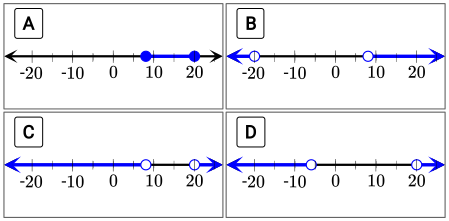
{"type":"choice","form":{"alts":["A","B","C","D"],"noSort":true},"formTextBefore":"","formTextAfter":"","answer":2}
security
report
code
security
report
code
We are asked to find the solution set of the given absolute value inequality. 3|14-m|>18 Let's start by isolating the absolute value expression.
This inequality means that the distance between m and 14 is greater than 6. We can write it as a compound inequality. 14-m < - 6 or 14-m > 6 We can solve the individual inequalities by performing inverse operations on both sides of the inequality. Let's first solve 14-m < - 6.
This inequality tells us that all values greater than 20 will satisfy the inequality. Now, we will solve the other inequality.
This inequality tells us that all values less than 8 will satisfy the inequality. The combination of the solution sets for the individual inequalities is the solution set of the given absolute value inequality. First Solution Set:& m< 8 Second Solution Set:& m>20 Combined Solution Set:& m< 8 or m >20
We will now graph the absolute value inequality. The graph of the given inequality includes all values less than 8 or greater than 20. Since the inequality sign is strict, the endpoints are not included. Therefore, the endpoints should be open circles.
This corresponds to C.
security
report
code
The rules for an essay contest say that entries can have 500 words with an absolute deviation of at most 40 words.
{"type":"text","form":{"type":"math","options":{"comparison":"1","nofractofloat":false,"keypad":{"simple":false,"useShortLog":false,"variables":["w"],"constants":[]},"rendered":false},"text":" "},"formTextBefore":null,"formTextAfter":null,"answer":{"text":["|w-500| \\leq 40"]}}
{"type":"text","form":{"type":"extrema","options":{"comparison":"1","nofractofloat":false,"keypad":{"simple":true,"useShortLog":false,"variables":["x"],"constants":["PI"]},"rendered":false,"valueTypes":["Minimum","Maximum"],"point":false},"text":" "},"formTextBefore":null,"formTextAfter":null,"answer":{"text":[{"type":0,"text":["460"]},{"type":1,"text":["540"]}]}}
security
report
code
security
report
code
We have been told that essay contest entries can have 500 words with an absolute deviation of at most 40 words. Let w be the number of words written. The absolute deviation is the difference between w and 500. We can state this as an absolute value inequality as follows. |w- 500|≤ 40 Another way of looking at this is to say an essay that falls under 40 words below 500 will not be accepted, and an essay with 40 words over 500 also will not be accepted.
We need to solve the absolute value inequality written in Part A to find the minimum and maximum acceptable numbers of words. To do this, we will rewrite the inequality as a compound inequality.
Absolute Value Inequality
|w-500|≤ 40
⇓
Compound Inequality
- 40 ≤ w-500 ≤ 40
This compound inequality means that the distance from w-500 is greater than or equal to - 40 and less than or equal to 40.
w-500≥- 40 and w-500≤ 40
We can solve the individual inequalities by performing inverse operations. Let's first solve w-500 ≥ - 40.
This inequality tells us that all values greater than or equal to 460 will satisfy the inequality. Now, let's solve the other inequality.
This inequality tells us that all values less than or equal to 540 will satisfy the inequality. The solution to this type of compound inequality is the union of the solution sets. First Solution Set:& 460≤ w Second Solution Set:& w≤ 540 Intersecting Solution Set:& 460≤ w≤ 540 Therefore, the minimum acceptable number of words is 460 and the maximum acceptable number of words is 540.
security
report
code
The ideal temperature for most pet birds is between 65 and 80 degrees Fahrenheit, inclusive. Write an absolute value inequality that represents this range.
{"type":"text","form":{"type":"math","options":{"comparison":"1","nofractofloat":false,"keypad":{"simple":false,"useShortLog":false,"variables":["x"],"constants":[]},"rendered":false},"text":" "},"formTextBefore":null,"formTextAfter":null,"answer":{"text":["|x-72.5| \\leq 7.5","|x-\\dfrac{145}{2}| \\leq \\dfrac{15}{2}"]}}
security
report
code
security
report
code
We know that most pet birds’ comfort range is between 65 and 80 degrees Fahrenheit. Let's show this range on a number line.
To write an absolute value inequality representing this range, we need to find the midpoint between 65 and 80. Let d be the distance to the midpoint. To find d, we will find the half of the difference between the endpoints.
The distance d to the midpoint from the endpoints is 7.5. Therefore, the midpoint is equal to 65+7.5 = 72.5.
The points that are within 7.5 units of the midpoint represent the range and they can be written as the following absolute value inequality. Since the endpoints are included, the inequality should be non-strict. |x- 72.5| ≤ 7.5
security
report
code
The diagram shows the steps a student takes when solving an absolute value inequality.
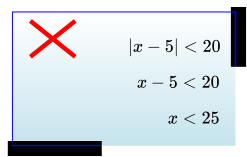
{"type":"choice","form":{"alts":["The inequality was not written correctly as a compound inequality.","The Addition Property of Inequality was applied incorrectly.","The Subtraction Property of Inequality was applied incorrectly.","The inequality symbol should be flipped."],"noSort":false},"formTextBefore":"","formTextAfter":"","answer":0}
{"type":"text","form":{"type":"math","options":{"comparison":"1","nofractofloat":false,"keypad":{"simple":false,"useShortLog":false,"variables":["x"],"constants":[]},"rendered":false},"text":" "},"formTextBefore":null,"formTextAfter":null,"answer":{"text":["-15 < x < 25"]}}
security
report
code
security
report
code
Let's examine the steps.
To solve absolute value inequalities we must write the given inequality as two inequalities. If we have an inequality of the form |x+a|
Let's solve the inequality by correcting this mistake!
Here, we only applied Addition Property of Inequality to solve the individual inequalities. The solution set of the absolute value inequality is - 15 < x < 25.
security
report
code
Write an absolute value inequality for each graph.

{"type":"text","form":{"type":"math","options":{"comparison":"1","nofractofloat":false,"keypad":{"simple":false,"useShortLog":false,"variables":["x"],"constants":[]},"rendered":false},"text":" "},"formTextBefore":null,"formTextAfter":null,"answer":{"text":["|x+2| \\geq 3"]}}
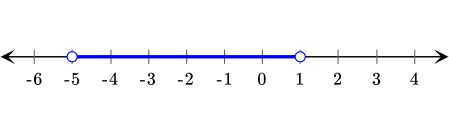
{"type":"text","form":{"type":"math","options":{"comparison":"1","nofractofloat":false,"keypad":{"simple":false,"useShortLog":false,"variables":["x"],"constants":[]},"rendered":false},"text":" "},"formTextBefore":null,"formTextAfter":null,"answer":{"text":["|x+2| < 3"]}}

{"type":"text","form":{"type":"math","options":{"comparison":"1","nofractofloat":false,"keypad":{"simple":false,"useShortLog":false,"variables":["x"],"constants":[]},"rendered":false},"text":" "},"formTextBefore":null,"formTextAfter":null,"answer":{"text":["|x+2| \\leq 3"]}}

{"type":"text","form":{"type":"math","options":{"comparison":"1","nofractofloat":false,"keypad":{"simple":false,"useShortLog":false,"variables":["x"],"constants":[]},"rendered":false},"text":" "},"formTextBefore":null,"formTextAfter":null,"answer":{"text":["|x+2| > 3"]}}
security
report
code
security
report
code
Before we can write the inequality for the given graph, we should remember two points.
- An absolute value equation is written as |x-a|=b, where a is the midpoint on the number line and b is distance from the midpoint to either endpoint.
- The midpoint can be found as the mean of the two endpoints P_1 and P_2.
Midpoint=P_1+P_2/2 Consider the given graph.
We can see that the endpoints are -5 and 1. Knowing this we can find the midpoint.
The midpoint at - 2 is at a distance of 3 from -5 and 1. Therefore, we can write the absolute value equation. |x-( - 2)|= 3 ⇔ |x+2| = 3 In order to write it as an absolute value inequality, we first notice in the graph that the endpoints are closed. This means that the inequality is non-strict. Since the solution set includes points that are farther away from the endpoints, the distance is greater than or equal to 3. |x+2|≥ 3
Consider the given graph.
Since this graph has the same endpoints, the midpoint is also - 2. We can write the same absolute value equation. |x+2|=3 In order to write it as an absolute value inequality, we first notice in the graph that the endpoints are open. This means that the inequality is strict. Since the solution set includes points that are between the endpoints, the distance is less than 3. |x+2|<3
Consider the given graph.
Since this graph has the same endpoints, the midpoint is also - 2. We can write the same absolute value equation. |x+2|=3 In order to write it as an absolute value inequality, we first notice in the graph that the endpoints are closed. This means that the inequality is non-strict. Since the solution set includes points that are between the endpoints, the distance is less than or equal to 3. |x+2|≤ 3
Consider the given graph.
Since this graph has the same endpoints, the midpoint is also - 2. We can write the same absolute value equation. |x+2|=3 In order to write it as an absolute value inequality, we first notice in the graph that the endpoints are open. This means that the inequality is strict. Since the solution set includes points that are farther away from the endpoints, the distance is greater than 3. |x+2|>3
security
report
code
Solving and Graphing One Variable Absolute Value Inequalities
Recommended exercises
To get personalized recommended exercises, please login first.
Loading content
≤
>
■2
■▢
e▢
7
8
9
×
÷■1
=
=
√▢
▢√
∫▢▢
4
5
6
+
−
≤
<
log
ln
log▢
1
2
3
()
∣
sin
cos
tan
0
.
π
x
y
Loading content