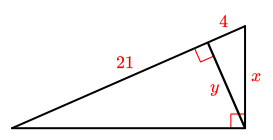
Let's analyze the given right triangle so that we can find the values of x and y.
Consider the bigger triangle. We know an expression for the length of the shorter leg, an expression for the altitude, and the lengths of two segments of the hypotenuse. Therefore, we can use the corollaries of the Right Triangle Similarity Theorem to write two proportions. Let's do it!
Finding x
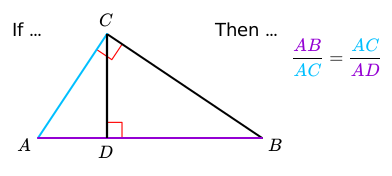
To find the value of x, we will use the following corollary of the Right Triangle Similarity Theorem.
Let's compare the theorem's corollary to the expressions in our figure. In our case, AB is 21+4= 25, AD is 4, and x is the length of the shorter leg of the bigger triangle.
AB/AC=AC/AD
⇔
25/x=x/4
Now we can use the Cross Product Property to find the value of x.
Note that, when solving the equation, we only considered the principal root. The reason for this is that, since x represents a side length, it must be positive. Therefore, the value of x is 10.
Finding y
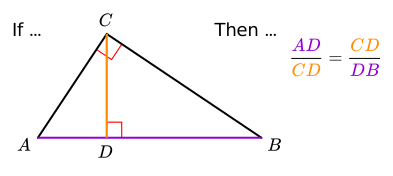
To find the value of y, we will use the following corollary.
In a similar manner, let's compare the other theorem's corollary to the expressions in our figure. Consider the bigger triangle. The length of the altitude is y, the shorter segment of the hypotenuse is 4, and the longer segment is 21.
AD/CD=CD/DB
⇔
4/y=y/21
Now we can use the Cross Product Property to find the value of y.
Again, when solving the equation, we only considered the principal root. The reason for this is that, since y also represents a side length, it must be positive. The value of y is 2sqrt(21).