Let's answer the questions given in the exercise to explain why the oars on each side of the shell stay parallel.
What type of information do you need to prove lines parallel?
To prove that lines are parallel, we need information about certain angle pairs that are congruent. If we know that certain angle pairs form congruent angles, then we can use converses of different theorems to prove the lines parallel.
How do the positions of the angles of equal measure relate?
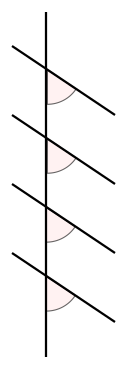
We know that the oars sweep out at angles of equal measure. If we look at the boat as a transversal and the oars on one side as lines, then we can make the following diagram of the situation.
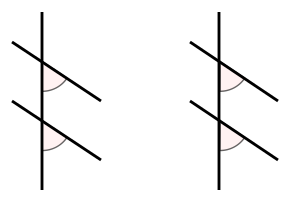
We are given that these angles are congruent. As we can see, they are also corresponding angles. The Converse of the Corresponding Angles Theorem tells us that if two lines and a transversal form corresponding angles that are congruent, then the lines are parallel. Notice that we can divide the diagram as shown below.
In both cases we have two lines and a transversal that form corresponding angles. Thus, by the Converse of the Corresponding angles Theorem, these lines are parallel. Hence, the oars on each side of the shell stay parallel.