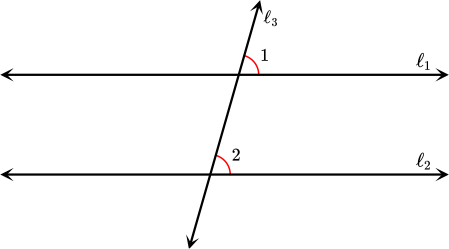
This theorem can be proven by an . Let ℓ1 and ℓ2 be two lines intersected by a transversal line ℓ3 forming corresponding congruent angles ∠1 and ∠2.
Since the goal is to prove that
ℓ1 is parallel to
ℓ2, it will be temporarily assumed that
ℓ1 and
ℓ2 are
not parallel.
Temporary Assumptionℓ1∦ℓ2
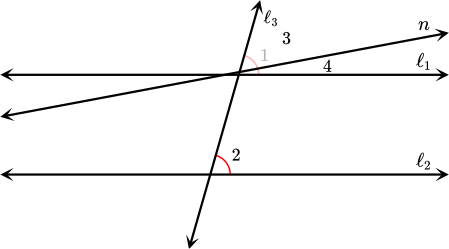
By the , there exists a line
n parallel to
ℓ2 that passes through the between
ℓ1 and
ℓ3. This line forms
∠3 and
∠4.
By the ,
m∠1 is equal to the sum of
m∠3 and
m∠4. m∠1=m∠3+m∠4
Since
n and
ℓ2 are parallel lines that are cut by a transversal, by the ,
∠3 and
∠2 are congruent. By the definition of congruence, these angles have the same measure.
∠3≅∠2⇕m∠3=m∠2
By the ,
m∠2 can be substituted for
m∠3 into the for
m∠1.
m∠1=m∠3+m∠4↓m∠1=m∠2+m∠4
From the above equation and since
m∠4 is a number, it can be concluded that
m∠1 is greater than
m∠2.
m∠1>m∠2
This contradicts the given fact that
∠1 and
∠2 are congruent. The contradiction came from assuming that
ℓ1 and
ℓ2 are not parallel lines. Therefore,
ℓ1 and
ℓ2 must be parallel lines.