To draw the graph of the given quadratic function written in standard form, we must start by identifying the values of a, b, and c.
y=3x^2-20x ⇔ y=3x^2+(-20)x+
We can see that a=3, b=-20, and c= . Now, we will follow four steps to graph the function.
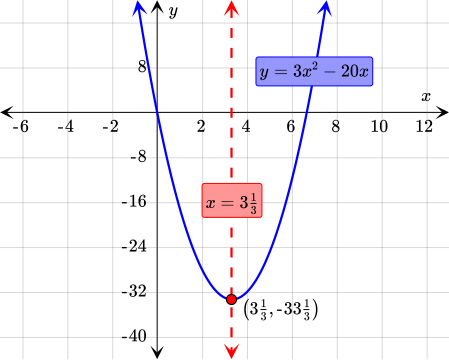
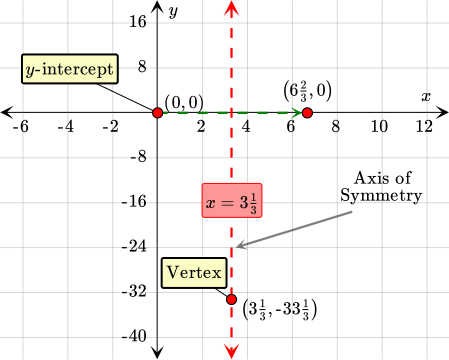
The axis of symmetry of the parabola is the vertical line with equation x= 103, or x=3 13.
Calculating the Vertex
To calculate the vertex, we need to think of y as a function of x, y=f(x). We can write the expression for the vertex by stating the x- and y-coordinates in terms of a and b.
Vertex: ( - b/2a, f( - b/2a ) )
Note that the formula for the x-coordinate is the same as the formula for the axis of symmetry, which is x= 103. Thus, the x-coordinate of the vertex is also 103. To find the y-coordinate, we need to substitute 103 for x in the given equation.
The y-coordinate of the vertex is - 1003, or - 33 13. Therefore, the vertex is ( 103,- 1003), or (3 13,- 33 13).
Identifying the y-intercept and its Reflection
The y-intercept of the graph of a quadratic function written in standard form is given by the value of c. Thus, the point where our graph intercepts the y-axis is (0, ). Let's plot this point and its reflection across the axis of symmetry.
Connecting the Points
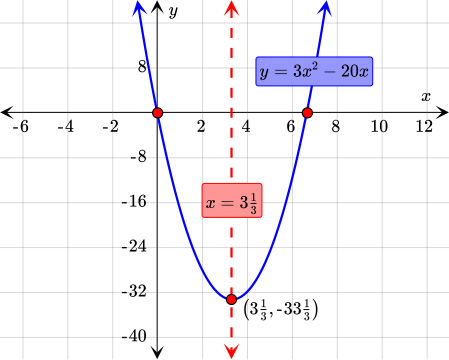
We can now draw the graph of the function. Since a=3, which is positive, the parabola will open upwards. Let's connect the three points with a smooth curve.