Consider the standard form of a quadratic function. What information can the coefficients a, b, and c give you?
Vertex: (0,3) Axis of Symmetry: x=0
Practice makes perfect
We have a quadratic function written in standard form. This kind of equation can give us a lot of information about the parabola by observing the values of a, b, and c.
y=2x^2+3 ⇔ y=2x^2+ x+3
We see that for the given equation, a=2, b= , and c=3.
x-value of the Vertex
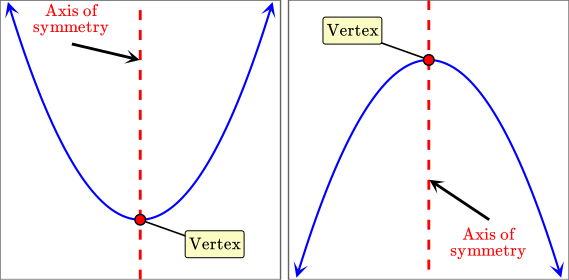
Consider the point at which the curve of the parabola changes direction.
This point is the vertex of the parabola, and defines the axis of symmetry. If we want to calculate the x-value of this point, we can substitute the given values of a and b into the expression - b2a and simplify.
The axis of symmetry is the vertical line through the vertex and divides the parabola into two mirror images. Since every point on this line will have the same x-coordinate as the vertex, we can form its equation.
x=0
y-value of the Vertex
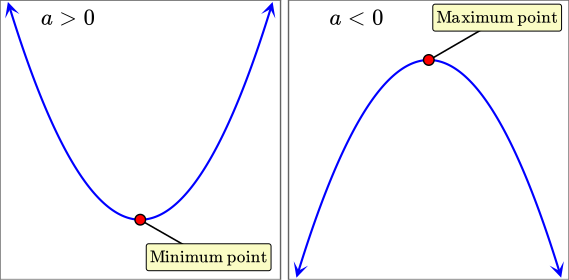
The point at which the graph of a parabola changes direction also defines the maximum or minimum point of the graph. Whether the parabola has a minimum or maximum is determined by the value of a.
Since the given value of a is positive, the parabola has a minimum value at the vertex. To find this value, think of y as a function of x, y=f(x). By substituting the x-value of the vertex into the given equation and simplifying, we will get the y-value of the vertex.