{{ tocSubheader }}
{{ 'ml-label-loading-course' | message }}
An error ocurred, try again later!
Chapter {{ article.chapter.number }}
{{ article.number }}.
{{ article.displayTitle }}
{{ article.intro.summary }}
Show less Show more expand_more Lesson Settings & Tools
| | {{ 'ml-lesson-number-slides' | message : article.intro.bblockCount }} |
| | {{ 'ml-lesson-number-exercises' | message : article.intro.exerciseCount }} |
| | {{ 'ml-lesson-time-estimation' | message }} |
The basic mathematical operations make up most of the mathematical ideas applied to the real world. Generally, these operations are combined in different ways to express different things. The goal of this lesson is to show how to evaluate a set of mathematical operations.
Catch-Up and Review
Here are a few recommended readings before getting started with this lesson.
Challenge
Which Result is Correct?
If a mathematical operation is done correctly, there is always a single correct result. When adding two numbers, there is only one correct value for the sum.
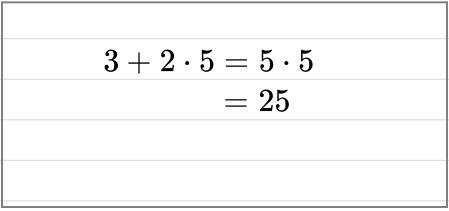
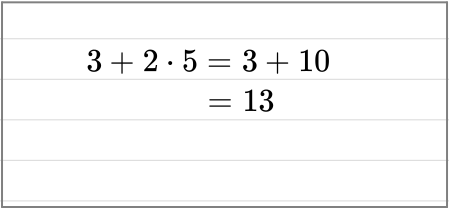 Both times the operations were done correctly, but the results are different. Who evaluated the expression correctly?
 Now consider more operations, like the set of operations below.
3+2=7×3+2=5✓
The same happens when two numbers are multiplied. If the multiplication is done correctly, the result is correct.
2⋅5=13×2⋅5=10✓
But what happens if multiple operations are combined? Izabella and Kriz are discussing how to solve an expression that includes both addition and multiplication.
3+2⋅5
Izabella says that the operations should be done left to right. Here is how she evaluated the operations. But Kriz thinks that the multiplication should be done first. This is how Kriz evaluated the operations.
{"type":"choice","form":{"alts":["Izabella","Kriz"],"noSort":false},"formTextBefore":"","formTextAfter":"","answer":1}
42−448÷8+18
Can the same method be used to evaluate it? What is the resulting value? {"type":"text","form":{"type":"math","options":{"comparison":"1","nofractofloat":false,"keypad":{"simple":true,"useShortLog":false,"variables":["x"],"constants":["PI"]},"rendered":false},"text":"<span class=\"katex\"><span class=\"katex-html\" aria-hidden=\"true\"><\/span><\/span>"},"formTextBefore":null,"formTextAfter":null,"answer":{"text":["2"]}}
Discussion
Numerical Expressions
A numeric expression, or numerical expression, is a sequence of mathematical operations that only involves numbers. Consider the following examples.
| Example | Is It a Numeric Expression? |
|---|---|
| 5+3−2⋅8 | ✓ |
| (9+12)3−4⋅7 | ✓ |
| 73+[(5−1)⋅(7+4)]5−71 | ✓ |
| 9w2+4s+7 | × |
| 1125 | × |
Pop Quiz
Identifying Numerical Expressions
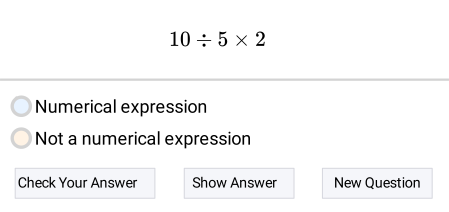
Select whether each given expression is a numerical expression or not.
Discussion
Order of Operations
The order of operations is the order to follow when evaluating an expression that has more than one operation. The order of operations can be described as a series of steps.
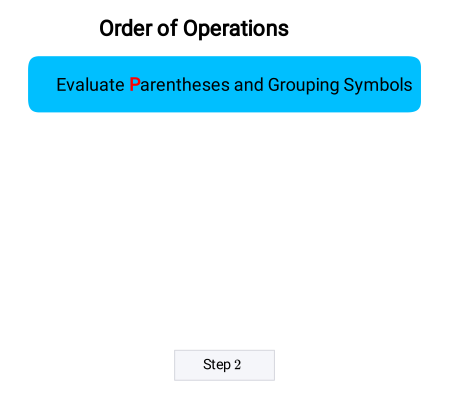 Consider this expression to see the steps in action.
(1+2)⋅32−25+5=?
The example expression contains a set of parentheses, an exponent, multiplication, division, addition, and subtraction. The expression is evaluated following the order of operations. | Expression | Simplified | Operation |
|---|---|---|
| (1+2)⋅32−25+5 | 3⋅32−210 | Evaluating Parentheses and Grouping Symbols |
| 3⋅32−210 | 3⋅9−210 | Exponents |
| 3⋅9−210 | 27−5 | Multiplication and Division |
| 27−5 | 22 | Subtraction |
There are a few things to note about this evaluation.
- The addition in the numerator of 25+5 was evaluated at the same time as the expression between parentheses (1+2). This is because fraction bars are grouping symbols like parentheses.
- The order of operations must be followed when evaluating expressions in grouping symbols.
- Operations that are inverse and at the same level must be evaluated from left to right. This rule applies for multiplication and division and for addition and subtraction.
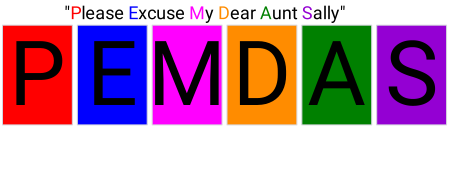
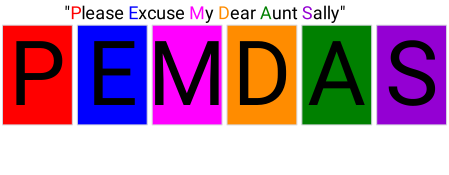
To remember the order of operations, it is useful to memorize the acronym PEMDAS. Each letter of PEMDAS indicates a set of operations. A fun sentence to remember this acronym is Please Excuse My Dear Aunt Sally.
Example
Baseball Practice
While waiting for baseball practice to start, Zain passed the time by counting how many people arrived to the field to practice and how many people left the field.

When Zain arrived and started counting, there were 9 people on the field practicing. Before Zain's practice started, two groups of three people left and four groups of six people arrived to the field. Then Zain's practice started.
a Write a numerical expression of the number of people in the field.
{"type":"text","form":{"type":"math","options":{"comparison":"1","nofractofloat":false,"keypad":{"simple":false,"useShortLog":false,"variables":[],"constants":[]},"rendered":false},"text":"<span class=\"katex\"><span class=\"katex-html\" aria-hidden=\"true\"><\/span><\/span>"},"formTextBefore":null,"formTextAfter":null,"answer":{"text":["9-2*3+6*4"]}}
b How many people were at Zain's practice that day?
{"type":"text","form":{"type":"math","options":{"comparison":"1","nofractofloat":false,"keypad":{"simple":true,"useShortLog":false,"variables":["x"],"constants":["PI"]},"rendered":false},"text":"<span class=\"katex\"><span class=\"katex-html\" aria-hidden=\"true\"><\/span><\/span>"},"formTextBefore":null,"formTextAfter":null,"answer":{"text":["27"]}}
Hint
a Consider the given information carefully. What is the first number of people in the field?
b Follow the order of operations.
Solution
a To write the numerical expression, it is important to consider the given information carefully. First, it is given that there were 9 people on the field when Zain started counting. Write this number as the first part of the numerical expression.
9
Then, 2 groups of 3 people left. The 2 groups of 3 people can be written as the product of 2 times 3. Since these people are leaving, the product is subtracted from 9.
9−2⋅3
Finally, 4 groups of 6 people arrived to the field. This number of people can be written as the multiplication of 4 times 6. This time the product is added because the people are arriving.
9−2⋅3+4⋅6
This is a complete numerical expression to find the number of people at the field when Zain's practice started.
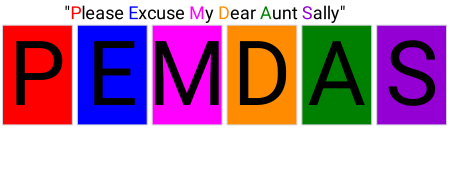
b The order of operations must be followed to evaluate the numerical expression found in Part A. The acronym PEMDAS is useful to recall the order of operations.
9−2⋅3+4⋅6
In this case, the expression does not have any grouping symbols or exponents. The symbols × and ⋅ are used to indicate multiplication, which means that the expression has two multiplications. These multiplications should be done from left to right.
The resulting expression has a subtraction and an addition. Since both of these operations are on the same tier of the order of operations, they are performed at the same time. Remember to do the operations from left to right.
Therefore, there were 27 people at Zain's practice that day.
Example
Baseball Equipment
Zain's baseball team needs new equipment before the season starts. Since Zain lives close to a good baseball equipment store, they were in charge of checking the prices. They noted these prices in a table.
| Item | Price |
|---|---|
| Bat | $200 |
| Glove | $95 |
| Uniform | $130 |
Zain's team need 2 new bats, 8 new gloves, and 4 new uniforms. Luckily, there is a sale going on where bats and gloves are half their regular prices. Zain also has a $100 discount coupon that they will give the coach for equipment.
a Write a numerical expression for the total cost of the equipment that Zain's team needs.
{"type":"text","form":{"type":"math","options":{"comparison":"1","nofractofloat":false,"keypad":{"simple":false,"useShortLog":false,"variables":[],"constants":[]},"rendered":false},"text":"<span class=\"katex\"><span class=\"katex-html\" aria-hidden=\"true\"><\/span><\/span>"},"formTextBefore":null,"formTextAfter":null,"answer":{"text":["1\/2*(2*200+8*95)+4*130-100","(2*200+8*95)\/2+4*130-100","\\dfrac{2*200+8*95}{2}+4*130-100","(200*2)\/2+(95*8)\/2+130*4-100"]}}
b Evaluate the expression to find how much money Zain's team needs to buy the equipment.
{"type":"text","form":{"type":"math","options":{"comparison":"1","nofractofloat":false,"keypad":{"simple":false,"useShortLog":false,"variables":[],"constants":[]},"rendered":false},"text":"<span class=\"katex\"><span class=\"katex-html\" aria-hidden=\"true\"><\/span><\/span>"},"formTextBefore":"<span class=\"katex\"><span class=\"katex-html\" aria-hidden=\"true\"><span class=\"base\"><span class=\"strut\" style=\"height:0.80556em;vertical-align:-0.05556em;\"><\/span><span class=\"mord\">$<\/span><\/span><\/span><\/span>","formTextAfter":null,"answer":{"text":["1000"]}}
Hint
a Consider the given information carefully. The total cost per group of items can be written as a product.
b Remember the order of operations.
Solution
a Start by carefully considering the given information. It is given that Zain's team needs 2 new bats. Since each bat costs $200, the total cost of the bats is the multiplication of 2 and 200.
2⋅200
Next consider the cost of the gloves. Each glove has a price of $95. Since Zain's team needs 8 new gloves, the gloves have a cost the product of 95 and 8. Add this product to the cost of the bats.
2⋅200+95⋅8
Before adding the cost of the uniforms, it is important to remember that there is a sale going on that affects the cost of the bats and the gloves. To group this total, we can add parentheses to the addition.
(2⋅200+95⋅8)
The sale reduces this total by half, which can be written as multiplying the total by 21.
21⋅(2⋅200+95⋅8)
The total cost of the uniforms is the product of the number of uniforms and the price per uniform. The team needs 4 uniforms and the price of each uniform is $130. This product must be added to the expression above.
21⋅(2⋅200+95⋅8)+4⋅130
Lastly, the discount from Zain's coupon reduces the cost by $100. This is written as a subtraction of 100.
21⋅(2⋅200+95⋅8)+4⋅130−100
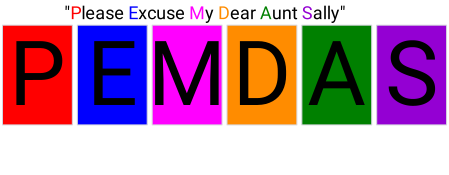
b The order of operations must be followed to evaluate the numerical expression from Part A. The steps of the order of operations can be remembered considering the acronym PEMDAS.
21⋅(2⋅200+95⋅8)+4⋅130−100
The P of PEMDAS refers to parentheses and other grouping symbols of the expression. The expression has two grouping symbols: a fraction line and a set of parentheses. The first thing to calculate from left to right is the fraction. It can be calculated directly.
21⋅(2⋅200+95⋅8)+4⋅130−100⇓0.5⋅(2⋅200+95⋅8)+4⋅130−100
Next, simplify the expression inside the set of parentheses.
2⋅200+95⋅8
This expression does not have any grouping symbols or exponents. However, it does have two multiplications. Evaluate these multiplications moving from left to right.
The resulting expression is a single addition. 400+760=1160
This result can be substituted for the expression inside the parentheses. 0.5⋅(2⋅200+95⋅8)+4⋅130−100⇓0.5⋅1160+4⋅130−100
Now the expression has two multiplications.
Finally, perform the addition and the subtraction from left to right.
Zain's team needs $1000 to buy the equipment they need!
Extra
Using the Distributive PropertyThe Distributive Property was discussed in previews lessons. The expression can be solved differently by using this property.
The Distributive Property allows to remove the parentheses before simplifying the expression inside. The rest of the expression can be simplified regularly.
The result is the same as the previous one following the order of operations. But remember that the property only holds true when a number is multiplying the result of an addition. It is not always possible to use the Distributive Property, but it can be useful in some cases.
Example
Zain at the Bat
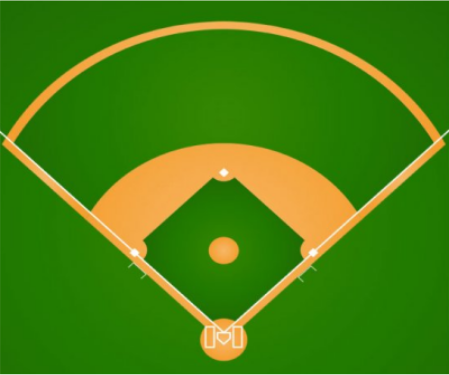
Zain is having a great time at bat in today's baseball game. He is hitting every single ball!
a The height of the ball 2.75 seconds after Zain hit it is given by a numerical expression.
21(88⋅2.75−32⋅2.752)
What is the height of the ball? Round to the nearest integer. {"type":"text","form":{"type":"math","options":{"comparison":"1","nofractofloat":false,"keypad":{"simple":true,"useShortLog":false,"variables":["x"],"constants":["PI"]},"rendered":false},"text":"<span class=\"katex\"><span class=\"katex-html\" aria-hidden=\"true\"><\/span><\/span>"},"formTextBefore":null,"formTextAfter":"feet","answer":{"text":["0"]}}
b The distance that the ball traveled after the same 2.75 seconds can be found by using another numerical expression.
0.87⋅147⋅2.75
How far did the ball travel? Round to the nearest integer. {"type":"text","form":{"type":"math","options":{"comparison":"1","nofractofloat":false,"keypad":{"simple":true,"useShortLog":false,"variables":["x"],"constants":["PI"]},"rendered":false},"text":"<span class=\"katex\"><span class=\"katex-html\" aria-hidden=\"true\"><\/span><\/span>"},"formTextBefore":null,"formTextAfter":"feet","answer":{"text":["352"]}}
Hint
a Follow the order of operations.
b Note that the only operation in the numerical expression is multiplication.
Solution
a To evaluate the expression, every operation must be done following the order of operations. The acronym PEMDAS is useful to remember each step.
21(88⋅2.75−32⋅2.752)
The numerical expression has two grouping symbols: a fraction line and a set of parentheses. The decimal value of the fraction can be calculated directly.
21(88⋅2.75−32⋅2.752)⇓0.5(88⋅2.75−32⋅2.752)
The second grouping symbol is the set of parentheses. To remove the parentheses, the expression inside must be evaluated. Again, the first thing to evaluate this expression is to identify the operations.
88⋅2.75−32⋅2.752
The expression does not have any more grouping symbols, but it has an exponent. Evaluate it first.
There are two multiplications in this expression, so calculate them moving from left to right.
Now there is only a single subtraction left. 242−242=0
The expression between parentheses equals 0. Substitute this result into the original expression in place of the expression inside the parentheses. The parentheses can be replaced with a multiplication symbol as well.
0.5(88⋅2.75−32⋅2.752)⇓0.5⋅0
Finally, there is a single multiplication left. It is important to remember that the result of multiplying any number by zero is zero.
0.5⋅0=0
Therefore, the height of the ball is of 0 feet. This means that the ball hit the ground 2.75 seconds after Zain hit the ball.
b Looking at the given numerical expression, it can be noted the only operation present is multiplication.
0.87⋅147⋅2.75
These calculations will be done one at a time, from left to right.
0.87⋅147⋅2.75
MultII
Multiply 0.87 by 147
127.89⋅2.75
MultII
Multiply 127.89 by 2.75
351.6975
RoundInt
Round to nearest integer
352
Pop Quiz
Evaluating Numerical Expressions
Write the value of each given numerical expression. Remember the order of operations!
Closure
Finding the Correct Result
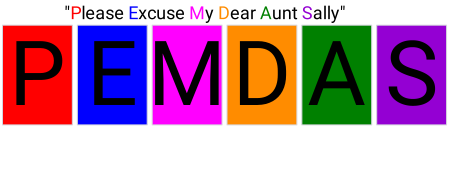
Two different numerical expressions were presented at the beginning of this lesson. The second expression has more operations than the first one. The good thing is that any numerical expression can be solved following the order of operations. The acronym PEMDAS is helpful for remembering the order!
 The first numerical expression has both addition and multiplication.
3+2⋅5
When evaluating this expression, Izabella and Kriz found different results.
Izabella:Kriz:2513
But the correct result is the one obtained following the order of operations. This means that the multiplication needs to be done first, then the addition.
The answer is 13. This means that Kriz was correct. The second numerical expression is more complex, but the procedure to evaluate it is the same. The first step is always to determine which operations are in the expression.
42−448÷8+18
A fraction line works as a grouping symbol, like a set of parentheses. This means that the expressions of the denominator and the numerator have to be evaluated before dividing. Note that the denominator has an exponent, so this is the first operation to be performed.
42−448÷8+18⇓16−448÷8+18
Next, evaluate the division in the numerator.
16−448÷8+18⇓16−46+18
Next, calculate the addition and the subtraction, then divide the obtained values.
The value of the numeric expression is 2. Remember that it does not matter how simple or complex a numerical expression is — any numerical expression can be solved following the order of operations. That is the beauty of it!
Loading content