{{ tocSubheader }}
{{ 'ml-label-loading-course' | message }}
An error ocurred, try again later!
Chapter {{ article.chapter.number }}
{{ article.number }}.
{{ article.displayTitle }}
{{ article.intro.summary }}
Show less Show more expand_more Lesson Settings & Tools
| | {{ 'ml-lesson-number-slides' | message : article.intro.bblockCount }} |
| | {{ 'ml-lesson-number-exercises' | message : article.intro.exerciseCount }} |
| | {{ 'ml-lesson-time-estimation' | message }} |
As investigated in the lesson exploring modeling with geometric shapes, trigonometric ratios can be used to solve various real-life problems. This lesson will expand the applications of trigonometric ratios to situations that involve density based on area and volume.
Challenge
Using Trigonometry to Determine Volume and Density
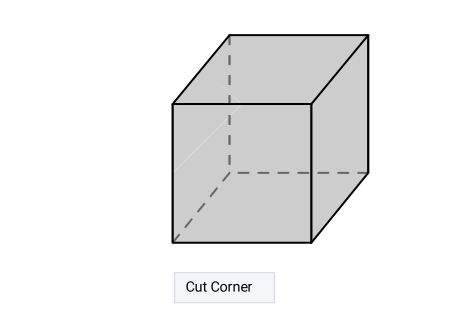
Last weekend Ali visited an aviation festival near his neighborhood. In an experiment at the festival, an engineer introduced the element rhenium, which is used to make jet engine parts. The engineer showed the onlookers a small pyramid-shaped part of the element. The part was obtained by cutting one corner of a cube with edges of length 6 centimeters as shown.
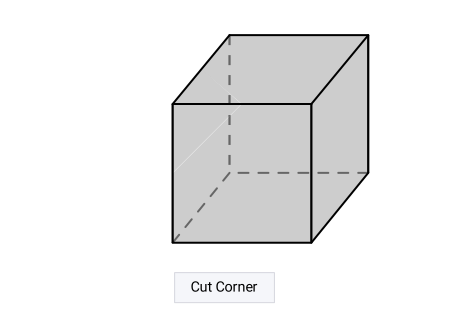
What is the density of rhenium?Ali wonders.
Example
Investigating Population Density
The concept of density can be considered in different contexts. Density is essentially a derived unit that compares a quantity per unit of area or volume.
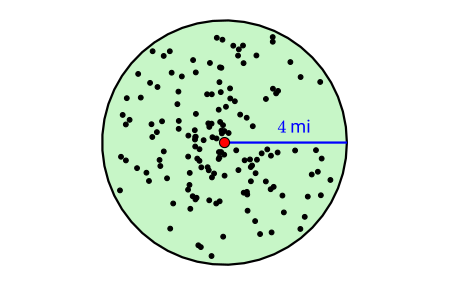
Maya is running a population census for her home city. She estimates the number of people in a region with a 4-mile radius to be around 220000.
Answer
Population Density: About 4376 people per square mile
Explanation: See solution.
Hint
The population density is the ratio of the number of people living in a region to region's area.
Solution
To find the density in people per square mile, the ratio of the number of people to the area of the region should be found.
The population density in this region is about 4376 people per square mile. Assuming that the total population is evenly distributed across the region, the number found, 4376, represents the number of people per square mile living in the region of Maya's home city.
Population Density=Area of regionNumber of people
The area of the region, which is a circle with a radius of 4 miles, can be calculated using the formula for the area of a circle.
A=πr2
The radius' value of 4 can be substituted for r in the formula to determine the area of the region under study.
The area of the region is about 50.27 square miles. Now that the area is known, the population density of this region can be determined.
Population Density=Area of a regionNumber of people
SubstituteValues
Substitute values
Population Density=50.27220000
Population Density≈4376
Example
Investigating Density of Liquids
In physics, density refers to the ratio of the mass of a substance to its volume. The next few examples are about the density based on volume.
Izabella is planning a to make a nice lunch, she buys a bottle of water and a bottle of cooking oil. She knows that both bottles have a volume of 5 liters. st1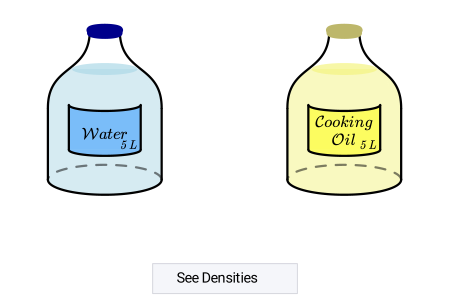
a Explain why her walking gait has changed.
b Use the given densities to find the difference between the masses of the substances.
Answer
a See solution.
b 400 grams
Hint
a Compare the densities of the substances.
b Use the fact that 1 liter is 1000 cubic centimeters.
Solution
a Although the volumes of both bottles are the same, one can weigh more than the other. This phenomena can be explained by the density of the substances. Denser substances weigh more because they have a bigger mass to volume ratio.
Water Density1g/cm3>Cooking Oil Density0.92g/cm3
Since water has a greater density than cooking oil and the volumes of the bottles are the same, the bottle of water is heavier than the bottle of oil. The heavier bottle of water is being held in her right hand. Therefore, Izabella has found herself leaning to the right. b Since 1 liter is equivalent to 1000 cubic centimeters, 5 liters is equal to 5 times 1000 cubic centimeters.
One bottle of cooking oil weighs 4600 grams. Therefore, the difference between the bottles' weights is 400 grams.
5⋅1000=5000cm3
The density of a substance is defined as its mass divided by its volume. Equivalently, the mass of a substance is its density times its volume. d=Vm⇔m=d⋅V
With this in mind, the mass of the water can be found by substituting cm31g for d and 5000cm3 for V.
It has been derived that 5 liters of water weigh 5000 grams. Similarly, the weight of a 5-liter bottle of cooking oil can be found.
m=d⋅V
SubstituteII
d=cm30.92g, V=5000cm3
m=cm30.92g⋅5000cm3
▼
Evaluate right-hand side
MoveRightFacToNum
ca⋅b=ca⋅b
m=cm30.92g⋅5000cm3
CancelCommonFac
Cancel out common factors
m=cm30.92g⋅5000cm3
SimpQuot
Simplify quotient
m=0.92g⋅5000
Multiply
Multiply
m=4600g
5000−4600=400 g
Example
Solving Problems Involving Hexagonals
Bees build their honeycombs in such a way that each cell is a prism with a regular hexagonal base. In these small hexagonal cells, bees are born and raised, and honey and pollen are stored.

Diego, a bee-loving biology student, discovers that the depth of a hexagonal cell is 0.5 centimeters, and its base has a side length of 0.3 centimeters. Help Diego answer his following research questions.
{"type":"text","form":{"type":"math","options":{"comparison":"1","nofractofloat":false,"keypad":{"simple":true,"useShortLog":false,"variables":["x"],"constants":["PI"]},"rendered":false},"text":"<span class=\"katex\"><span class=\"katex-html\" aria-hidden=\"true\"><\/span><\/span>"},"formTextBefore":null,"formTextAfter":"<span class=\"katex\"><span class=\"katex-html\" aria-hidden=\"true\"><span class=\"base\"><span class=\"strut\" style=\"height:0.8238736249999999em;vertical-align:-0.009765625em;\"><\/span><span class=\"mord\"><span class=\"mord text\"><span class=\"mord Roboto-Regular\">cm<\/span><\/span><span class=\"msupsub\"><span class=\"vlist-t\"><span class=\"vlist-r\"><span class=\"vlist\" style=\"height:0.8141079999999999em;\"><span style=\"top:-3.063em;margin-right:0.05em;\"><span class=\"pstrut\" style=\"height:2.7em;\"><\/span><span class=\"sizing reset-size6 size3 mtight\"><span class=\"mord mtight\">2<\/span><\/span><\/span><\/span><\/span><\/span><\/span><\/span><\/span><\/span><\/span>","answer":{"text":["0.23"]}}
b What is the volume of a cell? Round the answer to two decimal places.
{"type":"text","form":{"type":"math","options":{"comparison":"1","nofractofloat":false,"keypad":{"simple":true,"useShortLog":false,"variables":["x"],"constants":["PI"]},"rendered":false},"text":"<span class=\"katex\"><span class=\"katex-html\" aria-hidden=\"true\"><\/span><\/span>"},"formTextBefore":null,"formTextAfter":"<span class=\"katex\"><span class=\"katex-html\" aria-hidden=\"true\"><span class=\"base\"><span class=\"strut\" style=\"height:0.8238736249999999em;vertical-align:-0.009765625em;\"><\/span><span class=\"mord\"><span class=\"mord text\"><span class=\"mord Roboto-Regular\">cm<\/span><\/span><span class=\"msupsub\"><span class=\"vlist-t\"><span class=\"vlist-r\"><span class=\"vlist\" style=\"height:0.8141079999999999em;\"><span style=\"top:-3.063em;margin-right:0.05em;\"><span class=\"pstrut\" style=\"height:2.7em;\"><\/span><span class=\"sizing reset-size6 size3 mtight\"><span class=\"mord mtight\">3<\/span><\/span><\/span><\/span><\/span><\/span><\/span><\/span><\/span><\/span><\/span>","answer":{"text":["0.12"]}}
c Diego assumes that the honeycomb consist of 2000 cells. Given the density of honey 1.43 grams per cubic centimeter, find the mass of the honeycomb.
{"type":"text","form":{"type":"math","options":{"comparison":"1","nofractofloat":false,"keypad":{"simple":true,"useShortLog":false,"variables":["x"],"constants":["PI"]},"rendered":false},"text":"<span class=\"katex\"><span class=\"katex-html\" aria-hidden=\"true\"><\/span><\/span>"},"formTextBefore":null,"formTextAfter":"g","answer":{"text":["343.2"]}}
Hint
a A regular hexagon can be decomposed into 6 equilateral triangles that are congruent.
b The volume of a three-dimensional figure is equal to its base area times its height.
c The density of a substance is defined as its mass per unit volume.
Solution
a Consider a regular hexagon with a side length s. It can be divided into six congruent equilateral triangles. 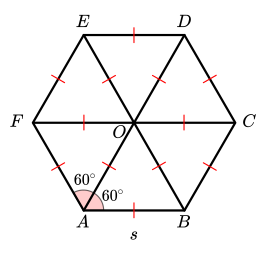 Therefore, the area AH of the hexagon is 6 times the area A of the equilateral triangle with side length s.
 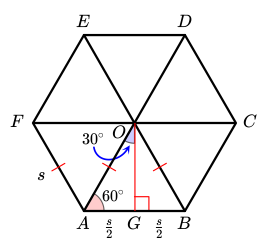 Now, the height OG can be found using the sine ratio of ∠GAO, which measures 60∘.
Now the area of an equilateral triangle with a side length of s can be calculated.
Since 6 of these triangles form the regular hexagon, the area AH of the hexagon is 6 times 4s23.
Now, the height OG can be found using the sine ratio of ∠GAO, which measures 60∘.
Now the area of an equilateral triangle with a side length of s can be calculated.
Since 6 of these triangles form the regular hexagon, the area AH of the hexagon is 6 times 4s23.
AH=6⋅A
Since the area of a triangle is half the product of its base and its height, the height of the equilateral triangle should be determined first. Draw the height of the triangle, which will bisect the base. sinm∠GAO=OAOG
Substitute the values and solve for OG.
sinm∠GAO=OAOG
SubstituteValues
Substitute values
sin60∘=sOG
▼
Solve for OG
23=sOG
MultEqn
LHS⋅s=RHS⋅s
s⋅23=OG
MoveLeftFacToNum
a⋅cb=ca⋅b
2s3=OG
RearrangeEqn
Rearrange equation
OG=2s3
AH=6⋅4s23⇔AH=23s23
By substituting 0.3 for s into the above equation, a cell's base area can be calculated. The base area of a cell is about 0.23 square centimeters. b It is a given that a cell in honeycomb is a hexagonal prism with a height of 0.5 centimeters. 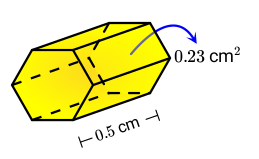 In Part A, its base area was found to be 0.23 square centimeters. Recall that the volume of a three-dimensional figure is equal to its base area times its height.
The volume of a cell is about 0.12 cubic centimeters.
In Part A, its base area was found to be 0.23 square centimeters. Recall that the volume of a three-dimensional figure is equal to its base area times its height.
The volume of a cell is about 0.12 cubic centimeters.
V=Bh
SubstituteII
B=0.23, h=0.5
V=(0.23)(0.5)
Multiply
Multiply
V=0.115
RoundDec
Round to 2 decimal place(s)
V≈0.12
c Recall that the density of a substance is defined as its mass per unit volume.
d=Vm
With the use of this definition, the mass of the honeycomb that consists of 2000 cells can be calculated. The total volume of the honeycomb is the product of one cell’s volume and 2000. The density of honey is 1.43 grams per cubic centimeter.
The mass of the honeycomb is 343.2 grams. Example
Mixing Substances With Different Densities
When two substances are mixed, the density of the mixture will still be the ratio of total mass to total volume. A carpenter uses four identical prisms with right triangle bases to create a cube-shaped mold as shown in the applet. 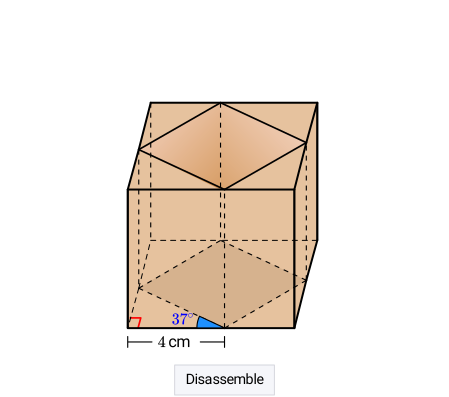
a Calculate the volume of the hollow part.
{"type":"text","form":{"type":"math","options":{"comparison":"1","nofractofloat":false,"keypad":{"simple":true,"useShortLog":false,"variables":["x"],"constants":["PI"]},"rendered":false},"text":"<span class=\"katex\"><span class=\"katex-html\" aria-hidden=\"true\"><\/span><\/span>"},"formTextBefore":null,"formTextAfter":"<span class=\"katex\"><span class=\"katex-html\" aria-hidden=\"true\"><span class=\"base\"><span class=\"strut\" style=\"height:0.8238736249999999em;vertical-align:-0.009765625em;\"><\/span><span class=\"mord\"><span class=\"mord text\"><span class=\"mord Roboto-Regular\">cm<\/span><\/span><span class=\"msupsub\"><span class=\"vlist-t\"><span class=\"vlist-r\"><span class=\"vlist\" style=\"height:0.8141079999999999em;\"><span style=\"top:-3.063em;margin-right:0.05em;\"><span class=\"pstrut\" style=\"height:2.7em;\"><\/span><span class=\"sizing reset-size6 size3 mtight\"><span class=\"mord mtight\">3<\/span><\/span><\/span><\/span><\/span><\/span><\/span><\/span><\/span><\/span><\/span>","answer":{"text":["175"]}}
b The carpenter mixes 52.5 grams of glue and 27.5 grams of sawdust, and pours it into the mold. What is the density of the mixture? If necessary, round the answer to two decimal places.
{"type":"text","form":{"type":"math","options":{"comparison":"1","nofractofloat":false,"keypad":{"simple":true,"useShortLog":false,"variables":["x"],"constants":["PI"]},"rendered":false},"text":"<span class=\"katex\"><span class=\"katex-html\" aria-hidden=\"true\"><\/span><\/span>"},"formTextBefore":null,"formTextAfter":"<span class=\"katex\"><span class=\"katex-html\" aria-hidden=\"true\"><span class=\"base\"><span class=\"strut\" style=\"height:1.064108em;vertical-align:-0.25em;\"><\/span><span class=\"mord text\"><span class=\"mord Roboto-Regular\">g<\/span><\/span><span class=\"mord\">\/<\/span><span class=\"mord\"><span class=\"mord text\"><span class=\"mord Roboto-Regular\">cm<\/span><\/span><span class=\"msupsub\"><span class=\"vlist-t\"><span class=\"vlist-r\"><span class=\"vlist\" style=\"height:0.8141079999999999em;\"><span style=\"top:-3.063em;margin-right:0.05em;\"><span class=\"pstrut\" style=\"height:2.7em;\"><\/span><span class=\"sizing reset-size6 size3 mtight\"><span class=\"mord mtight\">3<\/span><\/span><\/span><\/span><\/span><\/span><\/span><\/span><\/span><\/span><\/span>","answer":{"text":["0.46"]}}
Hint
a Use trigonometric ratios to find the dimensions of the mold.
b Use the volume of the hollow and the mass of the mixture.
Solution
a Consider the top view of the mold. 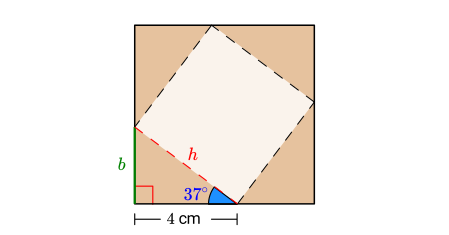 Using the cosine ratio of 37∘, the hypotenuse h can be found.
Now, the sine ratio of 37∘ can be used to calculate the length b of the opposite side.
Since identical triangular prisms are used, the other prisms' bases have the same side lengths.
Using the cosine ratio of 37∘, the hypotenuse h can be found.
Now, the sine ratio of 37∘ can be used to calculate the length b of the opposite side.
Since identical triangular prisms are used, the other prisms' bases have the same side lengths. 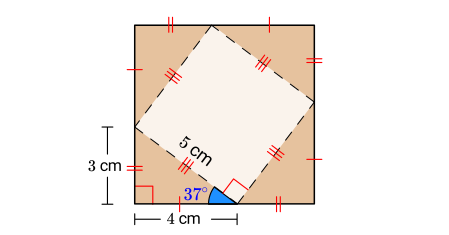
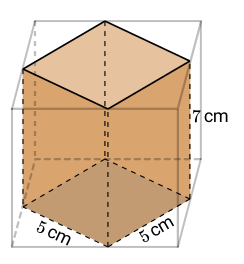 The volume of this square prism can be calculated as the product of its base area and its height. Since the base of the prism is a square with a side length of 5 centimeters, the base area is 52 square centimeters.
The volume of the hollow is 175cm3.
The volume of this square prism can be calculated as the product of its base area and its height. Since the base of the prism is a square with a side length of 5 centimeters, the base area is 52 square centimeters.
The volume of the hollow is 175cm3.
sin37∘=HypotenuseOpposite side
SubstituteValues
Substitute values
sin37∘=5b
▼
Solve for b
MultEqn
LHS⋅5=RHS⋅5
5⋅sin37∘=b
RearrangeEqn
Rearrange equation
b=5⋅sin37∘
UseCalc
Use a calculator
b=3.009075…
RoundInt
Round to nearest integer
b≈3
As the diagram indicates, the base of the hollow part is a square with a side length of 5 centimeters. Additionally, the mold is a cube with an edge length of 7 centimeters. Therefore, the hollow is a square prism with a base edge length of 5 centimeters and height of 7 centimeters.
b Start by finding the mass of the mixture that the carpenter prepared.
Glue52.5+Sawdust27.5=Total80
This amount of mixture occupies a volume of 175 cubed centimeters. Since density is a measure of mass per volume, the density of the mixture is equal to the quotient of the mass and volume. The density of the mixture is about 0.46g/cm3. Example
Investigating the Volume of a Cylinder in Different Orientations
The diagram shows a water tank that is positioned horizontally with some water inside. The water level height is 10 inches, and the distance between two bases is 50 inches.
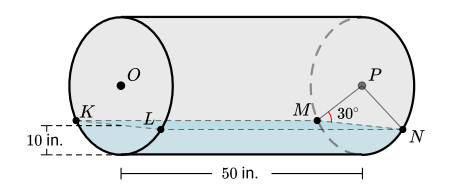
Kevin wonders how high the water level will rise when the tank is positioned vertically. Help Kevin to find it by answering the following questions.
{"type":"text","form":{"type":"math","options":{"comparison":"1","nofractofloat":false,"keypad":{"simple":true,"useShortLog":false,"variables":["x"],"constants":["PI"]},"rendered":false},"text":"<span class=\"katex\"><span class=\"katex-html\" aria-hidden=\"true\"><\/span><\/span>"},"formTextBefore":null,"formTextAfter":"<span class=\"katex\"><span class=\"katex-html\" aria-hidden=\"true\"><span class=\"base\"><span class=\"strut\" style=\"height:0.720703125em;vertical-align:0em;\"><\/span><span class=\"mord text\"><span class=\"mord Roboto-Regular\">in<\/span><span class=\"mord\">.<\/span><\/span><\/span><\/span><\/span>","answer":{"text":["20"]}}
{"type":"text","form":{"type":"math","options":{"comparison":"1","nofractofloat":false,"keypad":{"simple":true,"useShortLog":false,"variables":["x"],"constants":["PI"]},"rendered":false},"text":"<span class=\"katex\"><span class=\"katex-html\" aria-hidden=\"true\"><\/span><\/span>"},"formTextBefore":null,"formTextAfter":"<span class=\"katex\"><span class=\"katex-html\" aria-hidden=\"true\"><span class=\"base\"><span class=\"strut\" style=\"height:0.924711125em;vertical-align:0em;\"><\/span><span class=\"mord\"><span class=\"mord text\"><span class=\"mord Roboto-Regular\">in<\/span><span class=\"mord\">.<\/span><\/span><span class=\"msupsub\"><span class=\"vlist-t\"><span class=\"vlist-r\"><span class=\"vlist\" style=\"height:0.924711125em;\"><span style=\"top:-3.173603125em;margin-right:0.05em;\"><span class=\"pstrut\" style=\"height:2.7em;\"><\/span><span class=\"sizing reset-size6 size3 mtight\"><span class=\"mord mtight\">3<\/span><\/span><\/span><\/span><\/span><\/span><\/span><\/span><\/span><\/span><\/span>","answer":{"text":["20944"]}}
c What is the volume of the prism whose bases are the triangles KOL and MPN?
{"type":"text","form":{"type":"math","options":{"comparison":"1","nofractofloat":false,"keypad":{"simple":true,"useShortLog":false,"variables":["x"],"constants":["PI"]},"rendered":false},"text":"<span class=\"katex\"><span class=\"katex-html\" aria-hidden=\"true\"><\/span><\/span>"},"formTextBefore":null,"formTextAfter":"<span class=\"katex\"><span class=\"katex-html\" aria-hidden=\"true\"><span class=\"base\"><span class=\"strut\" style=\"height:0.924711125em;vertical-align:0em;\"><\/span><span class=\"mord\"><span class=\"mord text\"><span class=\"mord Roboto-Regular\">in<\/span><span class=\"mord\">.<\/span><\/span><span class=\"msupsub\"><span class=\"vlist-t\"><span class=\"vlist-r\"><span class=\"vlist\" style=\"height:0.924711125em;\"><span style=\"top:-3.173603125em;margin-right:0.05em;\"><span class=\"pstrut\" style=\"height:2.7em;\"><\/span><span class=\"sizing reset-size6 size3 mtight\"><span class=\"mord mtight\">3<\/span><\/span><\/span><\/span><\/span><\/span><\/span><\/span><\/span><\/span><\/span>","answer":{"text":["8660"]}}
d Find the height of water level when the tank is positioned vertically.
{"type":"text","form":{"type":"math","options":{"comparison":"1","nofractofloat":false,"keypad":{"simple":true,"useShortLog":false,"variables":["x"],"constants":["PI"]},"rendered":false},"text":"<span class=\"katex\"><span class=\"katex-html\" aria-hidden=\"true\"><\/span><\/span>"},"formTextBefore":null,"formTextAfter":"<span class=\"katex\"><span class=\"katex-html\" aria-hidden=\"true\"><span class=\"base\"><span class=\"strut\" style=\"height:0.720703125em;vertical-align:0em;\"><\/span><span class=\"mord text\"><span class=\"mord Roboto-Regular\">in<\/span><span class=\"mord\">.<\/span><\/span><\/span><\/span><\/span>","answer":{"text":["10"]}}
Hint
a Determine if △MPN is an isosceles triangle. Then, draw a segment from P to the ground and use one of trigonometric ratios.
b How much of the circle is represented by the region enclosed by MP, PN, and MN? Use the measure of ∠MPN.
c Determine the length of MN. Use the formula for the area of a triangle.
d Use the calculated volumes to find the volume of the water. How can the volume of the water be determined when the water tank is positioned vertically?
Solution
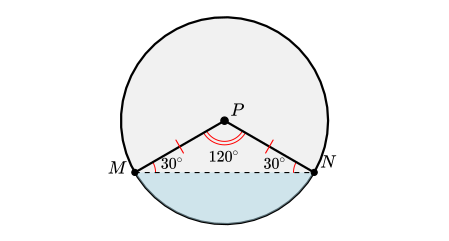
a Consider the circular base with center P. 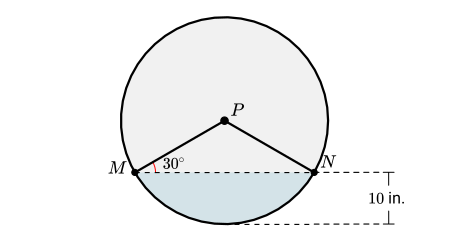 Since PM and PN are radii of the circle, they have the same length. From here, it can be concluded that the triangle △MPN is an isosceles triangle with base angles 30∘. By the Interior Angles Theorem, ∠MPN can be concluded to measure 120∘.
 Now, draw a segment from P to the ground. This segment will be perpendicular to the ground and MN. Since the height of an isosceles triangle is also the median of the triangle's base, this segment is also the perpendicular bisector of MN.
 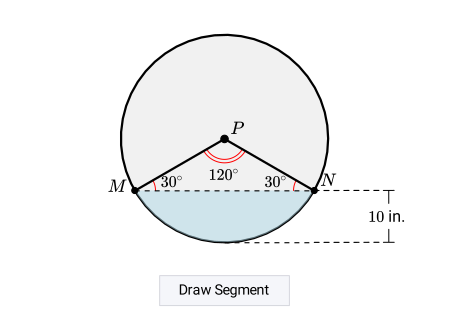 Additionally, the height of an isosceles triangle, which is drawn from its vertex angle to its base, is the bisector of the vertex angle. Therefore, ∠MPA and ∠NPA are congruent angles each measuring 60∘. Using the sine of ∠AMP, which measures 30∘, PM can be written in terms of PA.
Notice that PB is also a radius. This implies that PB and PM are equal.
Additionally, the height of an isosceles triangle, which is drawn from its vertex angle to its base, is the bisector of the vertex angle. Therefore, ∠MPA and ∠NPA are congruent angles each measuring 60∘. Using the sine of ∠AMP, which measures 30∘, PM can be written in terms of PA.
Notice that PB is also a radius. This implies that PB and PM are equal.
sin30∘=PMPA
▼
Solve for PM
PM=2PA
PB=PMPM=2PA⇒PB=2PA
Moreover, by the Segment Addition Postulate, the sum of PA and AB gives PB. Knowing AB=10 and PB=2PA, PA can be calculated.
Finally, by substituting PA with 10, the radius of the circular bases PM can be calculated. PMPM=2PA⇓=2(10)=20
b In Part A, the radius of the base and the measures of the central angles were found. 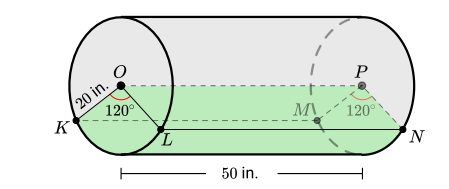 With this information, the volume of the shaded portion of the cylinder can now be calculated. Recall that the volume of a three-dimensional figure equals its base area times its height. The base area of the shaded portion As is 360∘120∘, or 31, of the whole base area Ab.
As=31Ab
Substitute
Ab=π(20)2
As=31π(20)2
CalcPow
Calculate power
As=31π(400)
MoveRightFacToNumOne
b1⋅a=ba
As=3400π
Since the height of a solid is the distance between its bases, multiplying Ab by 50 will give the volume of the portion of the cylinder.
Vs=As⋅h
SubstituteII
As=3400π, h=50
Vs=3400π(50)
▼
Evaluate right-hand side
MoveRightFacToNum
ca⋅b=ca⋅b
Vs=320000π
UseCalc
Use a calculator
Vs=20943.951023…
RoundInt
Round to nearest integer
Vs≈20944
c In Part A, the height of △MPN was found to be 10 inches. 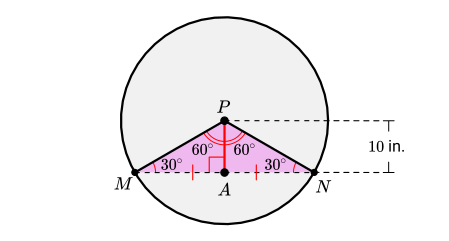 The tangent ratio of ∠AMP can be used to find MA. Note that ∠AMP measures 30∘.
Since MA and AN are congruent segments, AN is also 103 inches. Therefore, by the Segment Addition Postulate, the length of MN is 203 inches. Now that PA and MN are known, the area At of △MPN can be calculated.
The height of the triangular prism is 50 inches.
The tangent ratio of ∠AMP can be used to find MA. Note that ∠AMP measures 30∘.
Since MA and AN are congruent segments, AN is also 103 inches. Therefore, by the Segment Addition Postulate, the length of MN is 203 inches. Now that PA and MN are known, the area At of △MPN can be calculated.
The height of the triangular prism is 50 inches. 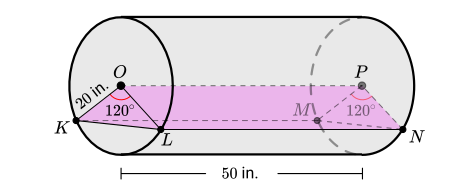 The volume of this triangular prism is At times 50.
Vt=At⋅h
SubstituteII
At=1003, h=50
Vt=(1003)(50)
UseCalc
Use a calculator
Vt=8660.254037…
RoundInt
Round to nearest integer
Vt≈8660
d Up to this point, the radius of the cylinder, the volume of the portion, and the volume of the triangular prism have been found. 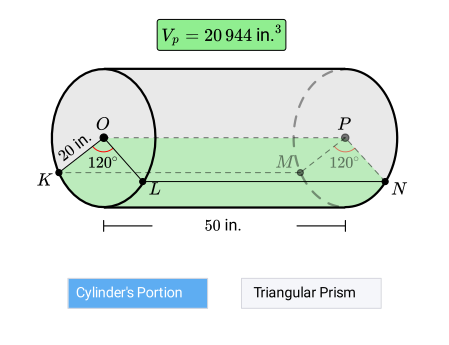 The difference between these volumes gives the volume of the water in the tank.
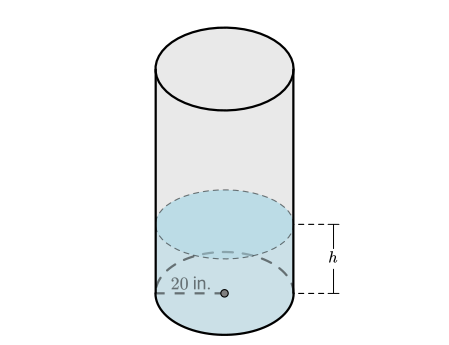 Since there is no change in the amount of water, the volume of the water in the cylinder remains the same. Using the formula for volume of a cylinder, the height h can be found.
The water will reach the height of about 10 inches when placed vertically.
Since there is no change in the amount of water, the volume of the water in the cylinder remains the same. Using the formula for volume of a cylinder, the height h can be found.
The water will reach the height of about 10 inches when placed vertically.
Vp20944−−Vt8660==Vw 12284
Now suppose the tank is positioned vertically. The water level in the tank can be shown as follows. Vw=Ab⋅h
SubstituteII
Vw=12284, Ab=π(20)2
12284=π(20)2⋅h
▼
Solve for h
CalcPow
Calculate power
12284=π(400)⋅h
CommutativePropMult
Commutative Property of Multiplication
12284=400π⋅h
DivEqn
LHS/400π=RHS/400π
400π12284=h
RearrangeEqn
Rearrange equation
h=400π12284
UseCalc
Use a calculator
h=9.775296…
RoundInt
Round to nearest integer
h≈10
Example
Approximating Volumes
After discussing hexagonal cells of beehives, Diego thinks he can approximate the number of cells in his body. His teacher recommends for Diego to treat a cell like a sphere with a diameter of 2×10⁻³ centimeters.
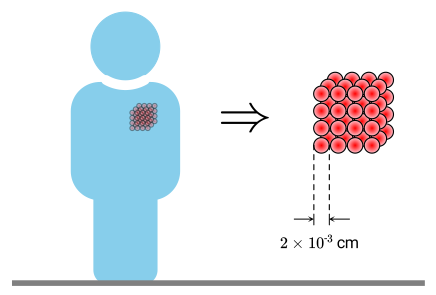
If Diego's weight is 60 kilograms and the density of a cell is approximately the density of water, which is 1 gram per cubic centimeter, help Diego approximate the number of cells in his body. Write the answer in scientific notation.
Answer
About 1.4×10¹³ cells
Hint
The formula for the volume of a sphere is V=34πr3, where r is the radius of the sphere.
Solution
To find the number of cells N, Diego's weight M should be divided by the mass of a cell m.
The volume of a cell is about 4.2×10⁻⁹ cubic centimeters.
The number of cells is approximately 1.4×10¹³.
N=mM
Recall that the density of a substance is equal to its mass divided by its volume. In other words, the mass of a substance is its density times its volume. d=Vm⇔m=d⋅V
Since the density of a cell is given, the volume of a cell can be calculated first. Finding the Volume of a Cell
With knowledge of the diameter of a cell, its radius can be calculated by dividing the diameter by 2.22×10-3=10-3cm
Now, use the formula for the volume of a sphere.
V=34πr3
Substitute
r=10-3
V=34π(10-3)3
▼
Evaluate right-hand side
PowPow
(am)n=am⋅n
V=34π(10-9)
MoveRightFacToNum
ca⋅b=ca⋅b
V=34π(10-9)
UseCalc
Use a calculator
V=(4.188790…)(10-9)
RoundDec
Round to 1 decimal place(s)
V≈(4.2)(10-9)
Rewrite
Rewrite (4.2)(10-9) as 4.2×10⁻⁹
V≈4.2×10⁻⁹
Finding the Mass of a Cell
The density of a cell is 1g/cm3 and its volume is 4.2×10⁻⁹cm3. By multiplying these values, the mass of a cell can be found.1cm3g⋅4.2×10-9cm3=4.2×10⁻⁹g
Finding the Number of Cells
The mass of a cell was found in grams. Therefore, Diego's weight should also be written in grams. To do so, use the conversion factor of 1000kgg.60kg⋅1000kgg=60000g
Finally, substitute the values into the formula mentioned at the beginning to calculate the number of cells.
N=mM
SubstituteII
M=60000g, m=4.2×10⁻⁹g
N=4.2×10⁻⁹g60000g
▼
Evaluate right-hand side
CrossCommonFac
Cross out common factors
N=4.2×10⁻⁹g60000g
SimpQuot
Simplify quotient
N=4.2×10-960000
WriteProdFrac
Write as a product of fractions
N=4.260000(10-91)
FracToNegExponent
am1=a-m
N=4.260000(109)
CalcQuot
Calculate quotient
N=(14285.714285714…)(109)
Multiply
Multiply
N=14285714285714
RoundSigDig
Round to 2 significant digit(s)
N≈14000000000000
Write in scientific notation
N≈1.4×10¹³
Closure
Determining the Density of a Cube
Throughout the lesson, different cases involving concepts of density based on area and volume have been discussed. Considering these situations, the challenge presented at the beginning of the lesson can be solved.
Ali knows that the small pyramid-shaped part of the element was obtained by cutting one corner of a cube with edges of length 6 centimeters.
{"type":"text","form":{"type":"math","options":{"comparison":"1","nofractofloat":false,"keypad":{"simple":true,"useShortLog":false,"variables":["x"],"constants":["PI"]},"rendered":false},"text":"<span class=\"katex\"><span class=\"katex-html\" aria-hidden=\"true\"><\/span><\/span>"},"formTextBefore":null,"formTextAfter":"<span class=\"katex\"><span class=\"katex-html\" aria-hidden=\"true\"><span class=\"base\"><span class=\"strut\" style=\"height:1.064108em;vertical-align:-0.25em;\"><\/span><span class=\"mord text\"><span class=\"mord Roboto-Regular\">g<\/span><\/span><span class=\"mord\">\/<\/span><span class=\"mord\"><span class=\"mord text\"><span class=\"mord Roboto-Regular\">cm<\/span><\/span><span class=\"msupsub\"><span class=\"vlist-t\"><span class=\"vlist-r\"><span class=\"vlist\" style=\"height:0.8141079999999999em;\"><span style=\"top:-3.063em;margin-right:0.05em;\"><span class=\"pstrut\" style=\"height:2.7em;\"><\/span><span class=\"sizing reset-size6 size3 mtight\"><span class=\"mord mtight\">3<\/span><\/span><\/span><\/span><\/span><\/span><\/span><\/span><\/span><\/span><\/span>","answer":{"text":["21"]}}
Hint
The volume of a pyramid is one-third of the product of its base area and height.
Solution
From the diagram, it can be seen that the pyramid has three congruent edges, each is 3 centimeters in length.
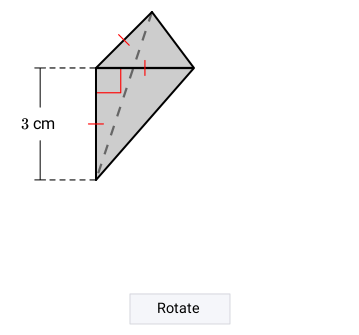 Additionally, the pyramid's base is an isosceles right triangle. Therefore, its area is half the product of its legs.
B=21bh⇓B=21(3)(3)=4.5
Recall that the volume of a pyramid is one-third of the product of its base area and height. Using the fact that the height of the pyramid is 3 centimeters, its volume can be determined.
Therefore, 94.5 grams of rhenium has a volume of 4.5 cubic centimeters. Now, using the definition of density, the volume of rhenium can be calculated.
The density of rhenium is 21 grams per cubic centimeter.
Loading content