Sign In
An error ocurred, try again later!
Scientific Notation
Slide 1 of 0
Concept
Scientific Notation
a×10b
In this form, the first factor is greater than or equal to 1 and less than 10. In other words, it needs to be in the interval [1,10). The second factor is a power of 10 where b is an integer. For example, the number 4 million can be rewritten as the product of 4 and a multiple of 10. Then, the multiple of 10 is rewritten as a base 10 power.
4000000=4×1000000=4×10⁶
Very small decimal numbers can also be written in scientific notation. Consider a number where there are many zeros before the significant figures. Take as 0.000342 as an example.
0.000342=3.42÷10000=3.42×10⁻⁴
In such cases, numbers are expressed as a division by a multiple of 10. Division by a multiple of 10 is equivalent to multiplication by a base 10 power with a negative exponent. Consider a few more examples of numbers written in scientific notation. | Decimal Form | Written as a Product or Division Expression | Scientific Notation |
|---|---|---|
| 4505 | 4.505×1000 | 4.505×10³ |
| 8320000 | 8.32×1000000 | 8.32×10⁶ |
| 0.0005 | 5÷10000 | 5×10⁻⁴ |
| 0.0521 | 5.21÷100 | 5.21×10⁻² |
Intuitive Method: Rewriting a Number in Scientific Notation
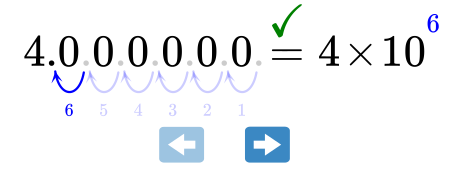
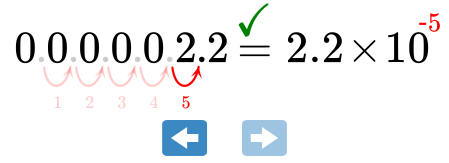
An intuitive method to rewrite a number into scientific notation is to count the number of places the decimal needs tomove. Consider a number greater than 10. The decimal would move from right to left to make the number less than 10 but still greater than 1. The number of places the decimal moved indicates the positive exponent to be used for the base 10 power.
Exercises
Recommended exercises
To get personalized recommended exercises, please login first.
Loading content
Loading content