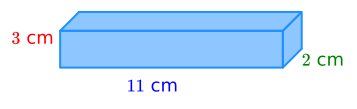
The given solid is a rectangular prism. It has a length of 11 centimeters, a height of 3 centimeters, and a width of 2 centimeters. Let's first calculate the lateral area and then the surface area.
Lateral Area
To calculate the lateral area, we can use the known formula where h is the height of the prism and P is the perimeter of the base.
L=Ph
We are given the length of the sides of the base. Let's calculate the perimeter of the base.
P&= 11+ 2+ 11+ 2
P&= 26
The perimeter of the base is 26 centimeters. We can substitute P= 26 and h= 3 in the formula to calculate L.
To calculate the surface area of a prism, we can use the known formula where P is the perimeter of the base, h is the height, and B is the area of the base.
S=Ph+2B
Note the base is a rectangle, so we can calculate its area using the formula for area of a rectangle.
The area of the base is 22 square centimeters. Earlier, we found that Ph= 78 square centimeters. Let's substitute these values into the formula for the surface area of a prism.