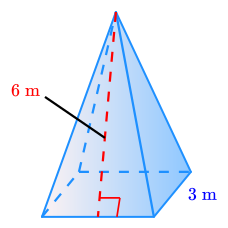
The given solid is a pyramid. It has a slant height of 6 meters. The base is a square with a side length of 3 meters.
Let's first calculate the lateral area and then the surface area.
Lateral Area
To calculate the lateral area of a pyramid, we can use the known formula where P is the perimeter of the base and l is the slant height.
L=1/2Pl
In a square, all of its sides are congruent. So we can calculate its perimeter by multiplying 3 by 4.
P=4s ⇒ P=4( 3)= 12
Therefore, the perimeter of the base is 12 centimeters. We are given that l is 6. Let's substitute these values into the formula for the lateral area to calculate L.
The lateral area of the pyramid is 36 square meters.
Surface Area
To calculate the surface area of a pyramid, we can use the known formula where P is the perimeter of the base, l is the slant height, and B is the area of the base.
S=1/2Pl+B
The area of the square equals the squared length of the side.
B=s^2 ⇒ B= 3^2= 9
We found that the area of the base B is 9 square centimeters. Also, we found that 12Pl is 36. Let's substitute these values into the formula of the surface area and calculate S.