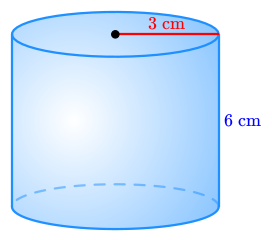
The given solid is a cylinder. It has a radius of 3 centimeters and a height of 6 centimeters. Let's first calculate the lateral area and then the surface area.
Lateral Area
To calculate the lateral area, we can use the known formula where h is the height of the cylinder and r is the radius of the base.
L=2π rh
We are given both the height and the radius. Let's calculate the lateral area.
The lateral area is about 113.1 square centimeters.
Surface Area
To calculate the surface area of a cylinder, we can use the known formula where h is the height of the cylinder and r is the radius of the base.
S=2π rh+2π r^2
Earlier, we found that 2π rh is about 113.1. Moreover, we have that r is 3. Let's substitute these values into the formula and calculate S.