8. Geometric Sequences
Sign In
An error ocurred, try again later!
Chapter 6
8.
Geometric Sequences
Geometric sequences are sequences where the ratio between consecutive terms remains constant. This unique characteristic allows them to model various phenomena in the real world, such as interest rates, population growth, and more. The essence of a geometric sequence is its common ratio, which dictates how each term relates to the previous one. For instance, if a bacterium divides every 20 minutes, the number of bacteria can be represented as a geometric sequence with a common ratio of 2. Similarly, when a sheet of paper is folded, its thickness doubles, making it another example of a geometric sequence. By understanding these sequences, one can predict outcomes, model growth or decay, and gain insights into various mathematical and real-world scenarios. They serve as a powerful tool in mathematics, offering both theoretical knowledge and practical applications.
Show less Show more expand_more 


Lesson Settings & Tools
| | 15 Theory slides |
| | 10 Exercises - Grade E - A |
| | Each lesson is meant to take 1-2 classroom sessions |
Geometric Sequences
Slide of 15
There are many situations where a quantity increases or decreases by a constant factor, like interest rates, population growth, etc. These situations can be modeled with a special type of sequence called a geometric sequence. This lesson will introduce geometric sequences for specific everyday life applications and will show how they can be described using explicit rules and recursive rules.
Catch-Up and Review
Here are a few recommended readings before getting started with this lesson.
Explore
Share
Report error
How Does the Thickness of a Sheet of Paper Increase as It Is Folded in Half?
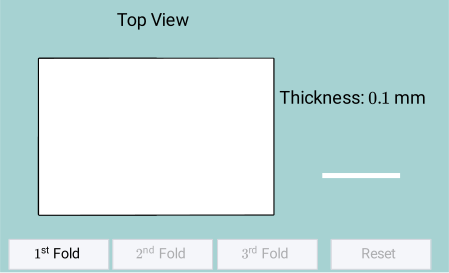
A regular sheet of paper has a thickness of about 0.1 millimeter. Every time the paper is folded in half, its thickness doubles. Try the applet below to explore how the thickness increases as the sheet keeps getting folded in half.
Challenge
Share
Report error
Predicting the Height of a Paper Sheet Folded Multiple Times
Using the same applet, now try to predict values according to the pattern.
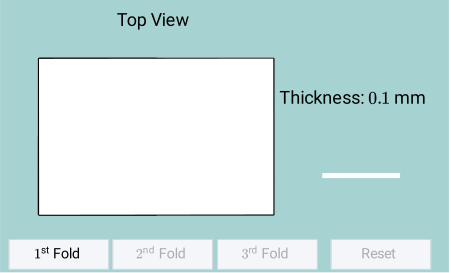
- If a regular sheet of paper with a thickness of 0.1 millimeters could be folded in half 15 times, how tall would it be? Would it be taller than an average person? For reference, the height of an average person is 1.7 meters.
- If it could be folded in half 20 times, how tall would it be? Would it be taller than a 10 story building? For reference, a 10 story building is about 45 meters tall.
Discussion
Share
Report error
Introducing Geometric Sequences
As can be seen in the previous applet, each time the sheet of paper was folded in half, its thickness doubled. The values for the paper thickness after each fold can be represented by terms of a specific type of sequence called a geometric sequence.
Concept
Share
Report error
Geometric Sequence
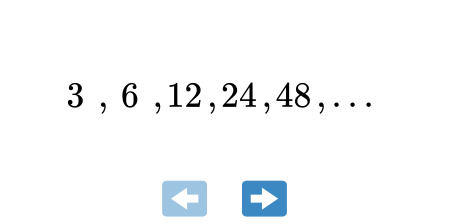
A geometric sequence is a sequence in which the ratio r between consecutive terms is a nonzero constant. This ratio is called the common ratio. The following is an example geometric sequence with first term 3 and common ratio 2.
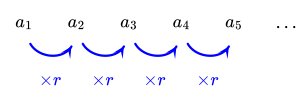
 The behavior of geometric sequences generally depends on the values of the first term a_1 and the common ratio r. The following table shows the effects of these parameters.
| a_1> 0 | a_1< 0 | |
|---|---|---|
| r>1 | Increasing 3 * 2 → 6 * 2 → 12 * 2 → 24 * 2 → 48 ... |
Decreasing - 3 * 2 → - 6 * 2 → - 12 * 2 → - 24 * 2 → - 48 ... |
| r=1 | Constant
3 * 1 → 3 * 1 → 3 * 1 → 3 * 1 → 3 ... |
Constant
- 3 * 1 → - 3 * 1 → - 3 * 1 → - 3 * 1 → - 3 ... |
| 0 < r < 1 | Decreasing 48 * 12 → 24 * 12 → 12 * 12 → 6 * 12 → 3 ... |
Increasing - 48 * 12 → - 24 * 12 → - 12 * 12 → - 6 * 12 → - 3 ... |
| r < 0 | Alternating
3 * (- 2) → - 6 * (- 2) → 12 * (- 2) → - 24 * (- 2) → 48 ... |
Alternating
- 3 * (- 2) → 6 * (- 2) → - 12 * (- 2) → 24 * (- 2) → - 48 ... |
Like for any other sequence, the first term of a geometric sequence is denoted by a_1, the second by a_2, and so on. Since geometric sequences have a common ratio r, once one term is known, the next term can always be found by multiplying the known term by r.
In fact, the sequence can be found using only a_1 and r, since all the subsequent terms can be found by multiplying a_1 by r a specific number of times. Because of this, geometric sequences have the following general form.
a_1, a_1r, a_1r^2, a_1r^3, a_1r^4, ...
Pop Quiz
Share
Report error
Identifying Geometric Sequences
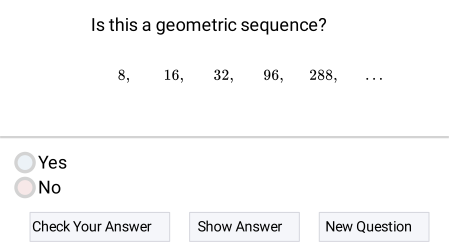
Discussion
Share
Report error
Describing Geometric Sequences Using an Explicit Rule
Geometric sequences can be described by using a formula that uses the positions of the terms to calculate their values. This formula is called an explicit rule of the geometric sequence.
Rule
Share
Report error
Explicit Rule of Geometric Sequences
Every geometric sequence can be described by a function known as the explicit rule, whose input is the position of a term n and whose output is the term's value a_n. An explicit rule for a geometric sequence has the following general form.
a_n = a_1 * r^(n - 1)
Here, a_1 is the first term of the sequence and r is the common ratio.
Proof
Proof by InductionRecall that every geometric sequence has a common ratio r. Therefore, it is possible to find every term of the sequence by multiplying the first term a_1 by this common ratio a particular number of times. Therefore, knowing a_1 and r is enough to describe the whole geometric sequence.
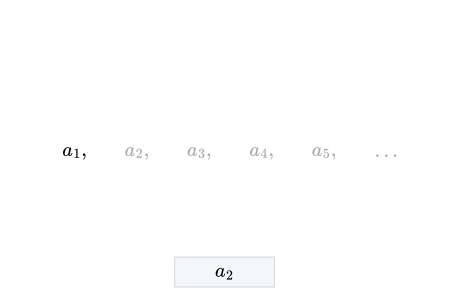 It is easier to identify a pattern that can be used to write a general expression for the explicit rule by making a table. Note that by the Zero Exponent Property, r^0 is equal to 1. Furthermore, r can be written as r^1.
| n | a_n | Using a_1 and r |
|---|---|---|
| 1 | a_1 | a_1 * r^0 |
| 2 | a_2 | a_1 * r^1 |
| 3 | a_3 | a_1 * r^2 |
| 4 | a_4 | a_1 * r^3 |
It can be seen that the exponent of the common ratio is always 1 less than the value of the position n. With this pattern, it is possible to write the explicit rule in the same form as the formula given at the beginning.
a_n = a_1 * r^(n - 1)
Example
Share
Report error
Modeling Multiplication of Bacteria Using Geometric Sequences
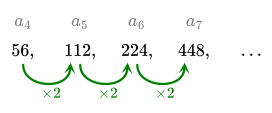
Jordan is studying her biology notes. She finds out that a bacterium can divide into two bacteria in a period of time of about 20 minutes. These two bacteria can then divide into two bacteria each, and so on.

Having read her notes, she is now ready for the lab practice. In a glass slide she has prepared a sample with 7 isolated bacteria.

For her practice, Jordan had to check every 20 minutes and count the number of bacteria. The results can be written as a sequence.
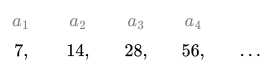
a Show that this situation can be modeled by using a geometric sequence.
b Find the next three terms of the sequence.
Answer
a Demonstration: See solution.
b Terms: a_5= 112, a_6=224, a_7=448
Hint
a Recall that a sequence is geometric if it has a common ratio.
b In a geometric sequence, any term can be found by multiplying the preceding term by the common ratio.
Solution
a Recall that a sequence is geometric if it has a common ratio. Since the the number of bacteria is doubling after every 20 minutes, the common ratio for this sequence is r= 2.
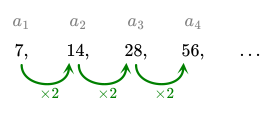
Since this sequence has a common ratio, it is, by definition, a geometric sequence.
b Once one term is known, the next term can be found by multiplying the known term by the common ratio r. For example, knowing that a_4=56, the next term a_5 can be obtained by multiplying 56 by the value of r.
a_5 = a_4r
▼
Substitute values and evaluate
a_5 = 112
Example
Share
Report error
An Ecology Project that Follows a Geometric Sequence
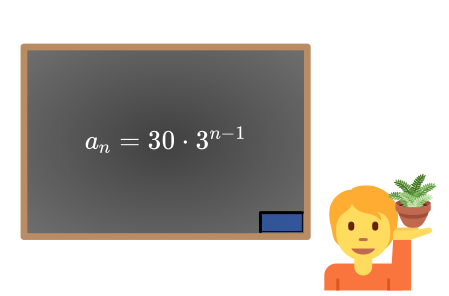
Ramsha's ecology teacher asks each of the 30 students in her class to plant a seed. Then, they explain that if each student asked 3 people to do the same by tomorrow, and these 3 people did the same by the next day, the amount of planted seeds could modeled by a geometric sequence with the explicit rule a_n = 30* 3^(n-1).
{"type":"text","form":{"type":"math","options":{"comparison":"1","nofractofloat":false,"keypad":{"simple":true,"useShortLog":false,"variables":["x"],"constants":["PI"]},"rendered":false},"text":" "},"formTextBefore":null,"formTextAfter":"planted seeds","answer":{"text":["2430"]}}
b On the 10^\text{th} day, how many seeds would be planted?
{"type":"text","form":{"type":"math","options":{"comparison":"1","nofractofloat":false,"keypad":{"simple":true,"useShortLog":false,"variables":["x"],"constants":["PI"]},"rendered":false},"text":" "},"formTextBefore":null,"formTextAfter":"planted seeds","answer":{"text":["590490"]}}
Hint
a The explicit rule must be evaluated for n=5 since the number of seeds planted on the 5^(th) day is to be calculated.
b The explicit rule must be evaluated for n=10 since the number of seeds planted on the 10^(th) day is to be calculated.
Solution
a To find the number of seeds planted on a specific day, the day number should be used as the n-value in the explicit rule. Therefore, to find the number of seeds planted on the 5^\text{th} day, the rule will be evaluated for n=5.
a_n = 30* 3^(n-1)
▼
Substitute 5 for n and evaluate
Substitute
n= 5
a_5 = 30* 3^(5-1)
SubTerm
Subtract term
a_5 = 30* 3^4
CalcPow
Calculate power
a_5 = 30* 81
Multiply
Multiply
a_5 = 2430
b Just as in the previous part, the explicit rule will be evaluated for the n-value that represents the desired day — in this case, n=10.
a_n = 30* 3^(n-1)
▼
Substitute 10 for n and evaluate
Substitute
n= 10
a_(10) = 30* 3^(10-1)
SubTerm
Subtract term
a_(10) = 30* 3^9
CalcPow
Calculate power
a_(10) = 30* 19 683
Multiply
Multiply
a_(10) = 590 490
Example
Share
Report error
The Geometric Sequence Behind the Story of Chess
There is a famous story about the invention of chess. When the game was presented to the king, he was so happy about it that he told the inventor to choose any payment. The inventor asked the king to put a single grain of rice on the first square, two grains on the second, four on the third and so on. The amount on the final square was the desired payment.
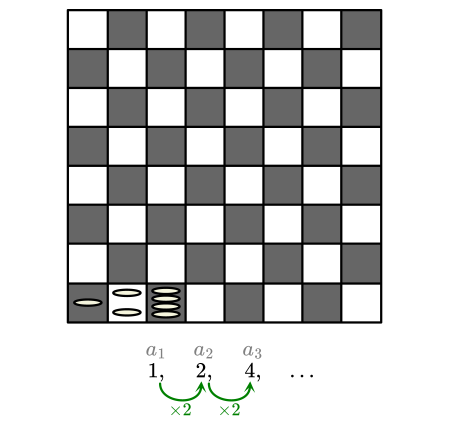
The king was surprised and believed that this was such a bad decision for the inventor, as the king thought this debt could be paid with no more than a bag of rice. However, when he ordered his treasurer to pay the agreed amount, it turned out that this wealthy king was not rich enough as to pay the debt. In fact, it is impossible for anyone to pay it!
a To explore this in detail, first find an explicit rule to model this situation.
{"type":"text","form":{"type":"math","options":{"comparison":"1","nofractofloat":false,"keypad":{"simple":false,"useShortLog":false,"variables":["n"],"constants":[]},"rendered":false},"text":" "},"formTextBefore":"a_n=","formTextAfter":null,"answer":{"text":["1 \\t 2^{n-1}","2^{n-1}","(2)^{n-1}","1 (2)^{n-1}"]}}
b Find the how many of grains of rice are needed to pay this debt if a board of chess has 64 squares. Give the answer, rounded to 3 significant figures.
{"type":"text","form":{"type":"math","options":{"comparison":"1","nofractofloat":false,"keypad":{"simple":false,"useShortLog":false,"variables":["x"],"constants":["PI"]},"rendered":false},"text":" "},"formTextBefore":null,"formTextAfter":"grains of rice","answer":{"text":["9.22 \\times 10^{18}"]}}
c A single grain of rice weighs about 4.4* 10^(-6) kilograms. The amount of rice produced in the entire world annually is about 480 million metric tons, or 4.8 * 10^(11) kilograms. If the global annual rice production were used, how many years would be needed to pay this debt? Round the answer to the nearest year.
{"type":"text","form":{"type":"math","options":{"comparison":"1","nofractofloat":false,"keypad":{"simple":true,"useShortLog":false,"variables":["x"],"constants":["PI"]},"rendered":false},"text":" "},"formTextBefore":null,"formTextAfter":"years","answer":{"text":["85"]}}
Hint
a The general form for the explicit rule of a geometric sequence is a_n = a_1 * r^(n-1).
b Evaluate the rule found in Part A for n=64.
c First calculate the weight of the total amount of grains of the debt, then find the years needed to produce that amount.
Solution
a This situation can be modeled by a sequence with the first term a_1 = 1, since a single grain is used on the first square, and a common ratio r=2, since the terms double every time. First, the general form for the explicit rule of a geometric sequence will be recalled.
a_n= a_1* r^(n-1) Now, the values a_1= 1 and r= 2 will be substituted to find the explicit rule of the presented sequence. a_n= a_1* r^(n-1) ⇓ a_n= 1* 2^(n-1)
b To find the total number of grains of rice of the king's debt, the explicit formula will be evaluated for n=64, since the chessboard has 64 squares.
a_n= 1* 2^(n-1)
▼
Substitute 64 for n and evaluate
Substitute
n= 64
a_(64)= 1* 2^(64-1)
SubTerm
Subtract term
a_(64)= 1* 2^(63)
CalcPow
Calculate power
a_(64)= 1* 9.223372...* 10^(18)
OneMult
1* a=a
a_(64)= 9.223372...* 10^(18)
RoundSigDig
Round to 3 significant digit(s)
a_(64)= 9.22* 10^(18)
c First the total weight of the debt will be found. To do this, the number of grains will be multiplied by the weight of each individual grain: 4.4* 10^(- 6) kilograms.
(9.22* 10^(18))(4.4* 10^(- 6))
▼
Simplify
CommutativePropMult
Commutative Property of Multiplication
(9.22)(4.4)(10^(18))(10^(- 6))
Multiply
Multiply
40.568(10^(18))(10^(- 6))
MultPow
a^m*a^n=a^(m+n)
40.568(10^(12))
Write in scientific notation
4.0568 * 10^(13)
Example
Share
Report error
Investigating a Police Case Using Geometric Sequences
A criminal mastermind started a big scam. They emailed some number of people and convinced them to send money by providing suspicious information for an investment plan. The criminal told each victim that all they needed to do was to contact 5 people and ask them to send the same amount of money, and the mastermind's company would take care of the rest.

The scammer gave each victim one week to find 5 people. Then, they gave one week to the new people to repeat the process. However, because of a blunder, the police caught the criminal.
a Which of the following options represents an explicit rule that can be used to find the number of new victims of this pyramid scheme at a given week?
{"type":"choice","form":{"alts":["a_n=a_15^(n-1)","a_1, a_15, a_125, ...","5, 25, 125, ...","a_n=5r^(n-1)"],"noSort":false},"formTextBefore":"","formTextAfter":"","answer":0}
b The criminal refuses to talk, but the police have gathered enough evidence to conclude that the operation has been going on for 4 weeks, and that on the fourth week, the criminal received $200 000 from the victims. Moreover, from some victim statements, the police also know that each victim was asked to send $80. What was the starting number of victims?
{"type":"text","form":{"type":"math","options":{"comparison":"1","nofractofloat":false,"keypad":{"simple":true,"useShortLog":false,"variables":["x"],"constants":["PI"]},"rendered":false},"text":" "},"formTextBefore":null,"formTextAfter":"victims","answer":{"text":["20"]}}
Hint
a The general form for the explicit rule of a geometric sequence is a_n = a_1* r^(n-1).
b Since the total amount of money received together with the amount that each victim sent is known, the number of victims at the fourth week can be found. Use this information and the result from Part A to calculate the initial number of victims.
Solution
a The formula of an explicit rule for a geometric sequence with common ratio r and initial term a_1 has the following form.
a_n = a_1* r^(n-1) Here, n is the position of the n^\text{th} term and a_n is the n^\text{th} term's value. Since each victim had to contact 5 people, who would then contact 5 more people, and so on, it can be concluded that each week the number of victims increased 5 times. Thus, the common ratio is r= 5. This value will be substituted into the above formula. a_n = a_1* r^(n-1) ⇓ a_n = a_1* 5^(n-1)
In this explicit rule, a_n represents the total number of victims on the n^(th) week. So far, the initial number of victims a_1 is unknown. b It is known that on the 4^\text{th} week, the scammer received a total amount of $200 000 from the victims. Because a_4 represents the number of victims on the 4^\text{th} week, and since each victim sent $80, 80a_4 should equal the total amount received.
a_n = a_1* 5^(n-1)
Substitute
n= 4
a_4 = a_1* 5^(4-1)
Substitute
a_4= 2500
2500 = a_1* 5^(4-1)
▼
Solve for a_1
SubTerm
Subtract term
2500 = a_1* 5^3
CalcPow
Calculate power
2500 = a_1* 125
DivEqn
.LHS /125.=.RHS /125.
20= a_1
RearrangeEqn
Rearrange equation
a_1 = 20
Discussion
Share
Report error
Defining Geometric Sequences Recursively
It has been shown how an explicit rule can describe a geometric sequence with a function that receives the term position as input and returns the term's value as output. However, a geometric sequence can also be described with a recursive relation.
Concept
Share
Report error
Recursive Rule of a Geometric Sequence
A recursive rule of a geometric sequence is a pair made of a recursive equation telling how the term a_n is related to its preceding term a_(n-1), and the first term of the sequence a_1.
a_1, a_n = a_(n-1) * r
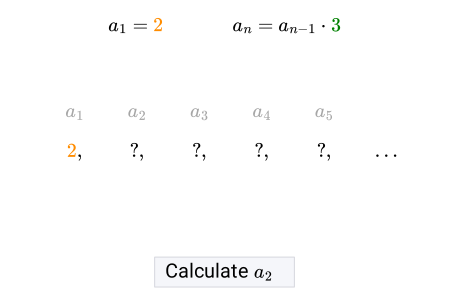
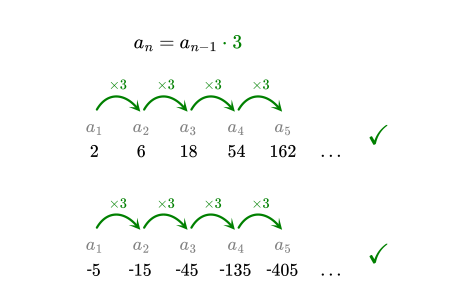
Now it will be explained, step by step, how to write the recursive rule for a geometric sequence.
Method
Share
Report error
Writing a Recursive Rule for a Geometric Sequence
The recursive rule of a geometric sequence includes the first term of the sequence and a recursive equation.
a_1, a_n = a_(n-1)* r
1
Find the Common Ratio
expand_more To find the common ratio r, identify any two consecutive terms and divide the latter term by the former one. cc a_1 & a_2 & a_3 & a_4 & 2, & 6, & 18, & 54, & ... 18/6 = 3 ⇒ r = 3
What to Do When No Consecutive Terms Are Known
The common ratio can still be found even if the sequence is known to be geometric but no consecutive terms are known. In general, it is enough to know any two terms of a geometric sequence and their positions. For example, suppose that it is known that r is positive and only a_2 and a_4 are known. cc a_1 & a_2 & a_3 & a_4 & ?, & 6, & ?, & 54, & ... Recall the general form of a geometric sequence.
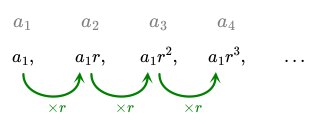
54/6 = a_1r^3/a_1r
▼
Simplify
CalcQuot
Calculate quotient
9 = a_1r^3/a_1r
CancelCommonFac
Cancel out common factors
9 = a_1 r^3/a_1 r
SimpQuot
Simplify quotient
9 = r^3/r
a^m/a=a^(m-1)
9 = r^2
▼
Solve for r
r = 3
2
Identify the First Term of the Sequence
expand_more To completely define the geometric sequence, the first term should also be determined. Without it, the recursive equation would describe any geometric sequence with common ratio r= 3. From the sequence, it can be seen that a_1= 2. cc a_1 & a_2 & a_3 & a_4 & 2, & 6, & 18, & 54, & ...
What to Do If a_1 Is Not Known
Reconsider the case where only a_2 and a_4 are known. Two equations were obtained. 54 &= a_1 r^3 6 &= a_1 r Since it was determined that r= 3, this value can be substituted into either equation to find a_1. This will be illustrated using the latter equation. 6 = a_1 3 ⇒ a_1 = 2
3
Write the Equation Rule
expand_more Finally, the recursive rule for the sequence can be written by putting together the previous results and substituting the common ratio and the value of the first term into the general formula. a_1, a_n = a_(n-1) * r ⇓ a_1 = 2, a_n = a_(n-1) * 3
Example
Share
Report error
Using a Recursive Rule for Carbon Dating a Sample
The study of the elements present in the atmosphere makes carbon dating possible. In particular, the ratio R of carbon-14 to carbon-12 is of main importance. carbon-14/carbon-12 = R Since carbon-14 is radioactive, R reduces by half after a specific period of time called a half life. Because organisms take carbon from the atmosphere while breathing, the same carbon ratio of the atmosphere is present in their bodies while they are alive. However, when they die, they stop inhaling carbon from the atmosphere and the ratio starts to decrease as the carbon-14 decays over time.
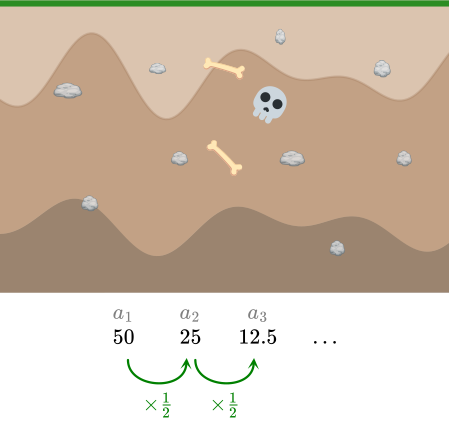
The diagram above shows a sequence representing the percentage of the original ratio of carbon R present in the organism. The term's value a_n is the percentage left of the original ratio R in the sample after n half life periods.
a Prove that this sequence is geometric and find a recursive rule for it.
b Use the recursive rule to find the next two terms of the sequence.
c An examined sample has only 6.25 % of the original carbon ratio from the atmosphere. Use the terms found in the Part B to estimate the age of the sample, considering that the half life period of carbon-14 is about 5730 years.
Answer
a Proof: See solution.
Recursive Rule: a_1=50, a_n = a_(n-1) * 12
Recursive Rule: a_1=50, a_n = a_(n-1) * 12
b Terms: a_4= 6.25, a_5 = 3.125
c Estimated Age: 22 920 years
Hint
a The general form for the recursive rule of a geometric sequence is a_1, a_n= a_(n-1)* r
b Use the recursive rule found in Part A. To find a specific term, the previous term needs to be known.
c Note that the positions of the terms represent the number of half life periods that have passed.
Solution
a It is known that the percentage decreases by half from one term to the next. Therefore, the sequence has a common ratio of r= 12. Because it has a common ratio, it is, by definition, a geometric sequence. Recall the form of a general recursive rule for a geometric sequence.
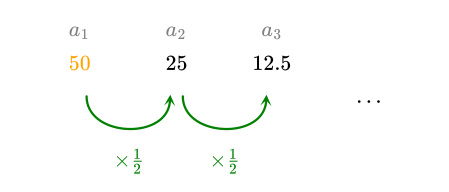
a_1, a_n= a_(n-1)* r Since the common ratio is already known, the first term a_1 must be identified. This can be found in the sequence.
Now the values of the first term and the common ratio will be substituted in the general form to obtain the desired recursive rule.
a_1, a_n = a_(n-1)* r ⇓ a_1= 50, a_n = a_(n-1)* 1/2 b The next two terms can be found by using the recursive formula consecutively. First a_4 will be found by substituting n=4 and a_3 = 12.5.
a_n= a_(n-1)* 1/2
▼
Substitute values and evaluate
Substitute
n= 4
a_4= a_(4-1)* 1/2
SubTerm
Subtract term
a_4= a_3* 1/2
Substitute
a_3= 12.5
a_4= 12.5 * 1/2
MoveLeftFacToNumOne
a* 1/b= a/b
a_4=12.5/2
CalcQuot
Calculate quotient
a_4=6.25
| a_1=50, a_n = a_(n-1) * 1/2 | ||
|---|---|---|
| n | Substitution | a_n |
| n = 4 | a_4 = a_3 * 12 ⇓ a_4 = 12.5 * 12 | a_4 = 6.25 |
| n = 5 | a_5 = a_4 * 12 ⇓ a_5 = 6.25 * 12 | a_5 = 3.125 |
Now, the next two terms can be added to the sequence.
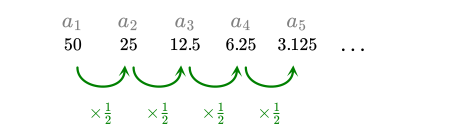
c The first thing to do is to identify the position of the term 6.25 in the sequence.

As can be seen, the position of the corresponding term is n=4. This means that in order for the sample to have only 6.25 % of the original ratio R left, 4 half life periods must have passed. The age of the sample will be found by multiplying 4 and the length of the half life period, which is given to be 5730 years. Age of the Sample 4 * 5730 = 22 920 The estimated age of the sample is 22 920 years.
Example
Share
Report error
Modeling a Bouncing Ball Using Geometric Sequences
Ali is curious about what would happen if he dropped a ball from the top of the building he lives in, which is about 81 meters tall. He has noticed that when the ball bounces, it reaches one third the height it was dropped from, so the ball would reach first 813=27 meters high on the first bounce. To calculate the height for the next bounces, he writes a recursive rule.
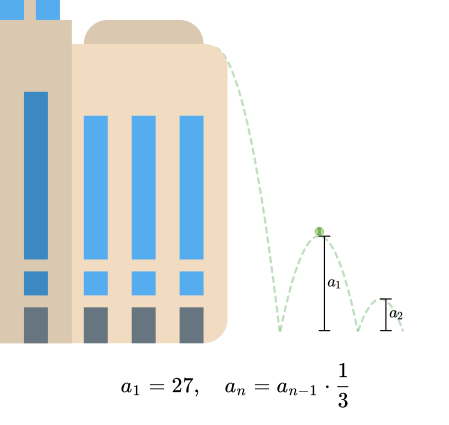
a Use the recursive rule to calculate the values of the first three terms.
b Find the corresponding explicit rule and calculate the height of the 5^(th) bounce. Give the answer rounded to two decimal places.
c Ali did some research online and found a bouncing ball of a special material that, when dropped from the same height of 81 meters, its bouncing height can be modeled according to the following explicit rule.
Answer
a Terms: a_1= 27, a_2 = 9, a_3 = 3
b Explicit Rule: a_n = 27 * ( 13 ) ^(n-1)
Height of the Fifth Bounce: 0.33 meters.
Height of the Fifth Bounce: 0.33 meters.
c Recursive Rule: a_1=72.9, a_n = a_(n-1) * 0.9
Hint
a Use the given recursive rule repeatedly. Note that to find a specific term, the previous term should be known.
b Recall that the general form for the explicit rule of a geometric sequence is a_n = a_1 * r^(n-1).
c Use the formula for the recursive rule of a geometric sequence.
Solution
a The first three terms can be found by using the recursive rule repeatedly. It is already known that a_1=27. Therefore, the next term a_2 will be found by substituting n=2 and a_1 = 27.
a_n= a_(n-1)* 1/3
▼
Substitute values and evaluate
Substitute
n= 2
a_2= a_(2-1)* 1/3
SubTerm
Subtract term
a_2= a_1* 1/3
Substitute
a_1= 27
a_2= 27 * 1/3
MoveLeftFacToNumOne
a* 1/b= a/b
a_2=27/3
CalcQuot
Calculate quotient
a_2=9
| a_n = a_(n-1) * 1/3 | ||
|---|---|---|
| n | Substitution | a_n |
| n = 1 | a_1 = 27 | a_1 = 27 |
| n = 2 | a_2 = a_1 * 13 ⇓ a_2 = 27 * 13 | a_2 = 9 |
| n = 3 | a_3 = a_2 * 13 ⇓ a_3 = 9 * 13 | a_3 = 3 |
b To find the explicit rule of the sequence, first identify the first term and the common ratio from the known recursive rule. In order to do this, start by reviewing the general form of a recursive rule.
a_n = 27 * ( 1/3 ) ^(n-1)
▼
Substitute 5 for n and evaluate
Substitute
n= 5
a_5 = 27 * ( 1/3 ) ^(5-1)
SubTerm
Subtract term
a_5 = 27 * ( 1/3 )^4
CalcPow
Calculate power
a_5 = 27 * 1/81
MoveLeftFacToNumOne
a* 1/b= a/b
a_5 = 27/81
CalcQuot
Calculate quotient
a_5 = 0.333333...
RoundDec
Round to 2 decimal place(s)
a_5 = 0.33
c Similar to the previous part, in order to write a recursive rule, the first term and the common ratio should be identified. To do this, the general form of an explicit rule will be reviewed.
a_n = a_1 * r^(n-1) Here, a_1 represents the first term of the sequence and r is the common ratio. Now, the general equation will be compared to the specific explicit rule provided. General Explicit Rule a_n = a_1 * r^(n-1) Particular Explicit Rule a_n = 72.9 * 0.9^(n-1) It can be concluded that a_1 = 72.9 and r= 0.9. Finally, the general form of a recursive rule will be written and these values will be substituted to find the recursive rule corresponding to the given explicit rule. General Explicit Rule a_1, a_n = a_(n-1) * r Particular Explicit Rule a_1= 72.9, a_n = a_(n-1) * 0.9
Discussion
Share
Report error
Geometric Sequences and Exponential Functions
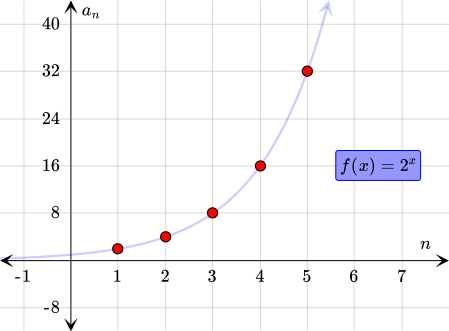
Because the values of the terms of a geometric sequence increase by a constant factor, every geometric sequence shows an exponential relation, where the common ratio can be considered as the constant multiplier of the associated exponential function. Consider the following geometric sequence.
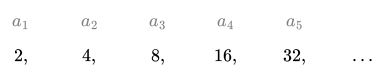
The sequence can be represented by a table of values, where the independent variable n represents the term's position and the dependent variable a_n represents the term's value.
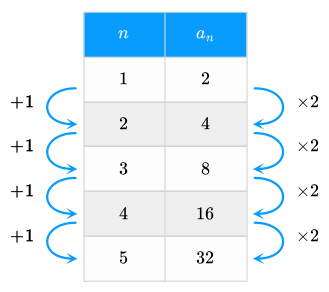
In this case, the common ratio is 2. Therefore, all the terms of the sequence lie on the graph of an exponential curve with a constant multiplier of 2.
Closure
Share
Report error
Modeling the Thickness of a Sheet of Paper using Geometric sequences
Now that geometric sequences have been introduced and it has been shown how to describe them by using explicit rules, the challenge at the beginning of the lesson will be solved. 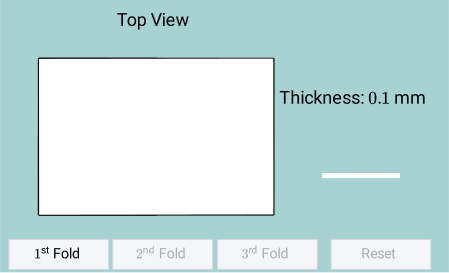
a If a regular sheet of paper, with a thickness of 0.1 millimeter, could be folded in half 15 times, how tall would it be? Write the answer in meters rounded to one decimal place. Would it be taller than an average person? For reference, the height of an average person is 1.7 meters.
b If it could be folded in half 20 times, how tall would it be? Write the answer in meters rounded to one decimal place. Would it be taller than a 10 story building? For reference, a 10 story building is about 45 meters tall.
Answer
a Height: 3.3 meters
Taller Than a Person? Yes
Taller Than a Person? Yes
b Height: 104.9 meters
Taller Than a 10 Story Building? Yes
Taller Than a 10 Story Building? Yes
Solution
a If the height of the paper is represented by the term value and the term's position represents the number of folds, the situation can be written as a sequence. Moreover, since the terms of this sequence double their value each time, this is a geometric sequence with a common ratio r= 2.
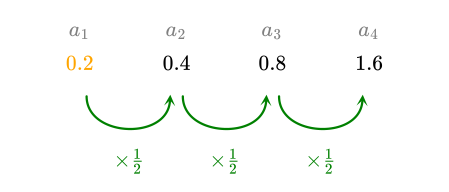 From the sequence, it can be seen that the first term is a_1= 0.2. Since both the common ratio and the initial term are already known, they can be substituted into the formula of the explicit rule of a geometric sequence.
a_n = a_1 * r^(n-1) ⇓ a_n = 0.2 * 2^(n-1)
Now, to find how tall the folded paper sheet would be after being folded 15 times, the explicit rule will be evaluated for n=15.
The folded sheet of paper would be 3276.8 millimeters tall. Since a meter has 1000 millimeters, the height in meters will be obtained by dividing it by 1000. 3276.8/1000 = 3.2768 This rounds to about 3.3 meters. Therefore, the folded paper would be definitely taller than an average person.
From the sequence, it can be seen that the first term is a_1= 0.2. Since both the common ratio and the initial term are already known, they can be substituted into the formula of the explicit rule of a geometric sequence.
a_n = a_1 * r^(n-1) ⇓ a_n = 0.2 * 2^(n-1)
Now, to find how tall the folded paper sheet would be after being folded 15 times, the explicit rule will be evaluated for n=15.
The folded sheet of paper would be 3276.8 millimeters tall. Since a meter has 1000 millimeters, the height in meters will be obtained by dividing it by 1000. 3276.8/1000 = 3.2768 This rounds to about 3.3 meters. Therefore, the folded paper would be definitely taller than an average person.
a_n = 0.2 * 2^(n-1)
▼
Substitute 15 for n and evaluate
Substitute
n= 15
a_(15) = 0.2 * 2^(15-1)
SubTerm
Subtract term
a_(15) = 0.2 * 2^(14)
CalcPow
Calculate power
a_(15) = 0.2 * 16 384
Multiply
Multiply
a_(15) = 3276.8
b To find the how tall the folded paper sheet would be after being folded 20 times, the explicit rule will now be evaluate for n=20.
The folded sheet of paper would be 104 857.6 millimeters tall. Now this quantity will be divided by 1000 to convert it to meters.
104 857.6/1000 = 104.8576 This rounds to about 104.9 meters. Therefore, it would be definitely taller than a 10 story building.
a_n = 0.2 * 2^(n-1)
▼
Substitute 20 for n and evaluate
Substitute
n= 20
a_(15) = 0.2 * 2^(20-1)
SubTerm
Subtract term
a_(15) = 0.2 * 2^(19)
CalcPow
Calculate power
a_(15) = 0.2 * 524 288
Multiply
Multiply
a_(15) = 104 857.6
Geometric Sequences
Exercise 3.1
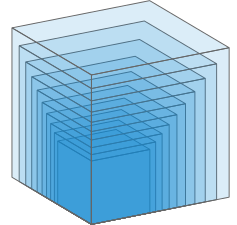
Nine hollow cubes are placed inside a big cube with a volume of 1000 cubic centimeters.
{"type":"text","form":{"type":"math","options":{"comparison":"1","nofractofloat":false,"keypad":{"simple":true,"useShortLog":false,"variables":["x"],"constants":["PI"]},"rendered":false},"text":" "},"formTextBefore":null,"formTextAfter":"cm^3","answer":{"text":["76"]}}
security
report
code
security
report
code
We have 10 cubes. Starting from the smallest cube, let's label their volumes as V_1, ... , V_(10). Let the side length of the smallest cube be x centimeters. With this information, we can write an equation for the volume of the smallest cube. V_1=x^3 The second smallest cube has a side that is 10 % larger than the smallest cube's side. V_2=(1.1x)^3 Let's simplify this equation, using the fact that V_1=x^3.
From here we can deduce that when the side length increases by a factor of 1.1, the volume increases by a factor of 1.331. This factor will repeat itself as we move between consecutive cubes. Therefore, we have a geometric sequence. V_1, 1.331V_1, 1.331^2V_1, ... , 1.331^9V_1 As we can see, to obtain the volume of the biggest cube, we have to multiply V_1 by 1.331 nine times, or equivalently by 1.331 raised to the power of 9. V_(10) = 1.331^9V_1 Since we know the value of V_(10), we can solve for V_1.
The volume of the smallest cube is about 76 cubic centimeters.
security
report
code
Geometric Sequences
Recommended exercises
To get personalized recommended exercises, please login first.
Loading content
≤
>
■2
■▢
e▢
7
8
9
×
÷■1
=
=
√▢
▢√
∫▢▢
4
5
6
+
−
≤
<
log
ln
log▢
1
2
3
()
∣
sin
cos
tan
0
.
π
x
y
Loading content