1. Fractions
Sign In
An error ocurred, try again later!
Chapter 2
1.
Fractions
This lesson provides a thorough exploration of fractions, breaking down the roles of the numerator and denominator. It explains how these two components work together to form fractions that represent parts of a whole. Additionally, the concept of equivalent fractions is discussed, which are fractions that may look different but represent the same value. Understanding these fundamentals has real-world applications. For example, fractions are used in cooking recipes, calculating test scores, and even in determining discounts during shopping. The information is presented in a way that's easy to grasp, making it beneficial for both academic and everyday scenarios.
Show less Show more expand_more 


Lesson Settings & Tools
| | 11 Theory slides |
| | 8 Exercises - Grade E - A |
| | Each lesson is meant to take 1-2 classroom sessions |
Fractions
Slide of 11
People deal with numbers in countless daily situations. Many of these involve numbers that are not whole numbers but are some part, or fraction, of them. This lesson will define fractions, present some facts about them, and show different real-life applications.
Catch-Up and Review
Here are a few recommended readings before getting started with this lesson.
Explore
Share
Report error
Splitting a Pizza
Jordan invited her friends over for a pizza party. They wonder how to split a pizza so that everyone gets the same number of slices. Try different ways to split the pizza, then click on the slices to decide how much pizza each person will eat. 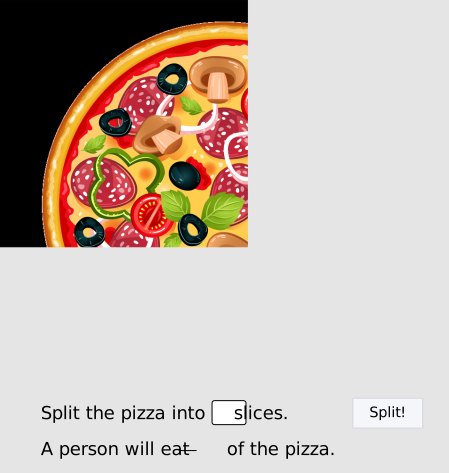 Note that Jordan can only split the pizza into a minimum of 2 and a maximum of 20 slices.
External credits: @macrovector
Discussion
Share
Report error
Presenting Rational Numbers
In order to state what part of the pizza each person will eat, a certain type of numbers should be used.
Concept
Share
Report error
Rational Numbers
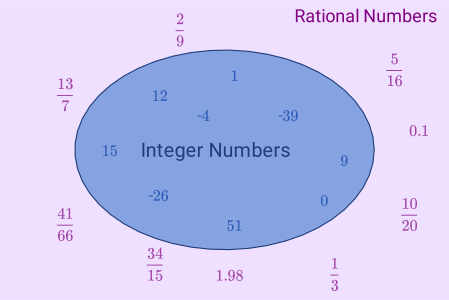
The set of rational numbers, represented by the symbol Q, is formed by all numbers that can be expressed as the ratio between two integers, ab, where b≠ 0. - 3, 13, 5, 3145 All four of these examples are rational numbers. Note that integers are also rational because they can always be written as fractions with a denominator of 1. -3 = -31, 5= 51 In other words, integer numbers is a subset of rational numbers.
Discussion
Share
Report error
Definition of a Fraction
In the definition of rational numbers, the word fraction
showed up but was not explained in detail. To clarify any doubts, its definition will now be presented.
Concept
Share
Report error
Fraction
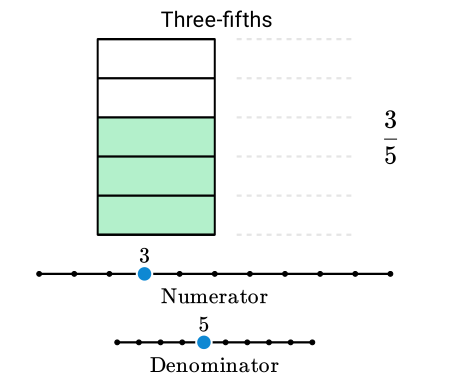
Fractions are a specific type of ratio that compares a part to a whole. Fractions are rational numbers written in the form ab, where the numerator a is the part and the denominator b is the whole.
l part→ whole→ a/b l←numerator ←denominator
a over b.Fractions where a is less than b are called proper fractions. Fractions where a is greater than or equal to b are called improper fractions.
Example
Share
Report error
Determining Fractions
Jordan's friends know how much she loves chocolate, so three people brought her chocolate bars as a gift when they came for her pizza party. Each chocolate bar was divided into a different number of pieces. 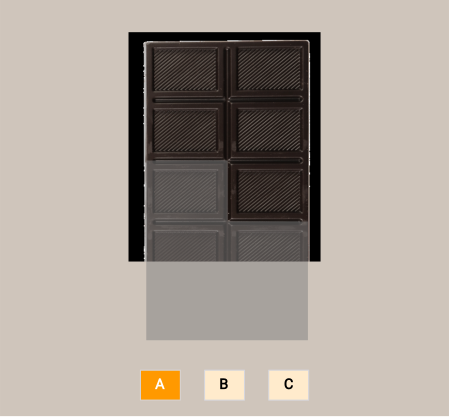 Jordan decides to share the chocolate with her friends. The shaded pieces in the diagrams above show how much of each bar the kids ate.
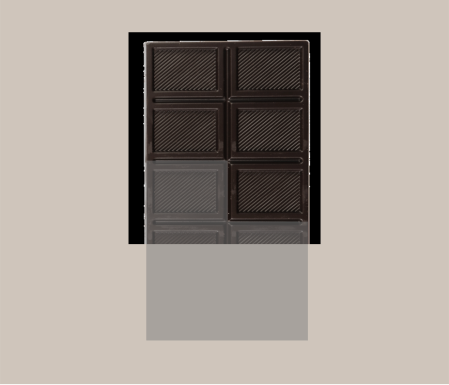 First, count the total number of pieces and the number of shaded pieces.
Total:& 10 Shaded:& 5
To find what part of the chocolate bar the shaded pieces represent, divide the number of shaded pieces by the total number of pieces.
Shaded/Total=5/10
Therefore, the shaded pieces represent 510 (five-tenths) of the chocolate bar. Notice that both the numerator and denominator are divisible by 5. This means that the fraction can be simplified by dividing its numerator and denominator by 5.
5÷ 5/10÷ 5=1/2
This means that the shaded pieces represent one-half of the chocolate bar.
First, count the total number of pieces and the number of shaded pieces.
Total:& 10 Shaded:& 5
To find what part of the chocolate bar the shaded pieces represent, divide the number of shaded pieces by the total number of pieces.
Shaded/Total=5/10
Therefore, the shaded pieces represent 510 (five-tenths) of the chocolate bar. Notice that both the numerator and denominator are divisible by 5. This means that the fraction can be simplified by dividing its numerator and denominator by 5.
5÷ 5/10÷ 5=1/2
This means that the shaded pieces represent one-half of the chocolate bar.
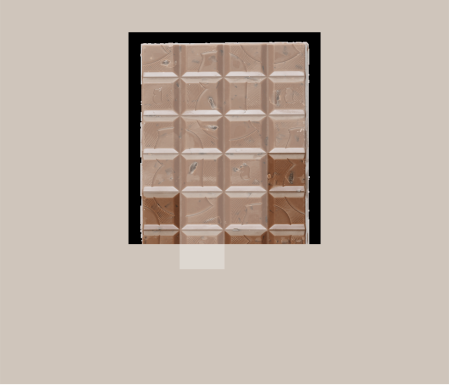 Like in Part A, start by counting the total number of pieces of chocolate and the number of shaded pieces.
Total:& 32 Shaded:& 18
The part of the chocolate bar represented by the shaded pieces can be written as a fraction. The numerator of the fraction is the number of shaded pieces and the denominator is the total number of pieces.
Shaded/Total=18/32
This fraction can also be simplified. Since 18 and 32 are even numbers, they both can be divided by 2.
Therefore, the shaded pieces represent 1832, or 916, of the chocolate bar.
Like in Part A, start by counting the total number of pieces of chocolate and the number of shaded pieces.
Total:& 32 Shaded:& 18
The part of the chocolate bar represented by the shaded pieces can be written as a fraction. The numerator of the fraction is the number of shaded pieces and the denominator is the total number of pieces.
Shaded/Total=18/32
This fraction can also be simplified. Since 18 and 32 are even numbers, they both can be divided by 2.
Therefore, the shaded pieces represent 1832, or 916, of the chocolate bar.
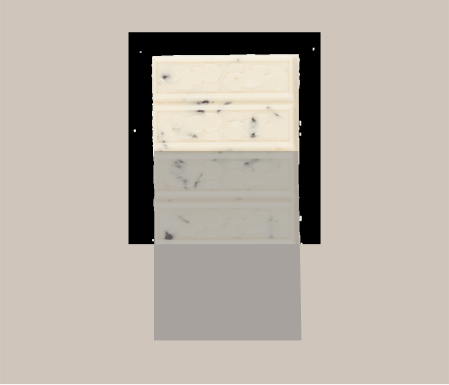 Again, count the total number of pieces of chocolate and the number of shaded pieces.
Total:& 6 Shaded:& 4
Next, divide the number of shaded pieces by the total number of pieces to find what part of the chocolate bar the kids ate.
Shaded/Total=4/6
Since both the numerator and denominator are divisible by 2, the fraction can be simplified.
4÷ 2/6÷ 2=2/3
The shaded pieces make up 46, or 23, of the chocolate bar.
Again, count the total number of pieces of chocolate and the number of shaded pieces.
Total:& 6 Shaded:& 4
Next, divide the number of shaded pieces by the total number of pieces to find what part of the chocolate bar the kids ate.
Shaded/Total=4/6
Since both the numerator and denominator are divisible by 2, the fraction can be simplified.
4÷ 2/6÷ 2=2/3
The shaded pieces make up 46, or 23, of the chocolate bar.
External credits: @freepik
a What part of the dark chocolate bar A do the shaded pieces represent?
{"type":"text","form":{"type":"math","options":{"comparison":"1","nofractofloat":false,"keypad":{"simple":true,"useShortLog":false,"variables":[],"constants":[]},"rendered":false},"text":" "},"formTextBefore":null,"formTextAfter":null,"answer":{"text":["\\dfrac{1}{2}","\\dfrac{5}{10}"]}}
b What part of the milk chocolate bar B do the shaded pieces represent?
{"type":"text","form":{"type":"math","options":{"comparison":"1","nofractofloat":false,"keypad":{"simple":true,"useShortLog":false,"variables":[],"constants":[]},"rendered":false},"text":" "},"formTextBefore":null,"formTextAfter":null,"answer":{"text":["\\dfrac{18}{32}","\\dfrac{9}{16}"]}}
c What part of the white chocolate bar C do the shaded pieces represent?
{"type":"text","form":{"type":"math","options":{"comparison":"1","nofractofloat":false,"keypad":{"simple":true,"useShortLog":false,"variables":[],"constants":[]},"rendered":false},"text":" "},"formTextBefore":null,"formTextAfter":null,"answer":{"text":["\\dfrac{4}{6}","\\dfrac{2}{3}"]}}
Hint
a Find the total number of pieces the chocolate bar is divided into. Then count the number of shaded pieces.
b Divide the number of shaded pieces by the total number of pieces.
c Form a fraction and check whether it can be simplified by dividing its numerator and denominator by their greatest common factor.
Solution
a Start by analyzing the dark chocolate bar A.
External credits: @freepik
b Now consider the milk chocolate bar B.
External credits: @freepik
18/32
SplitIntoFactors
Split into factors
9* 2/16* 2
CrossCommonFac
Cross out common factors
9* 2/16* 2
CancelCommonFac
Cancel out common factors
9/16
c Finally, examine the last chocolate bar, the white chocolate bar C.
External credits: @freepik
Pop Quiz
Share
Report error
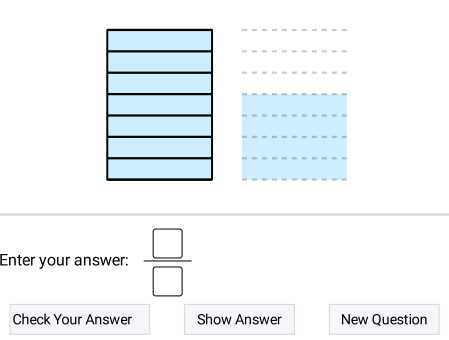
Identifying Fractions Describing the Graph
Consider a bar that is split into different parts. Find the fraction that describes the relationship between the shaded parts and the bar as a whole. Any shaded parts on the right-hand side indicate that the fraction is an improper fraction. Do not simplify the fractions.
Discussion
Share
Report error
Equivalent Fractions
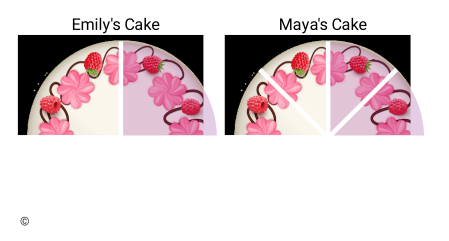
Fractions that have different numerators and denominators but represent the same value are called equivalent fractions. For example, the following fractions are equivalent because they are all equal to the same value, even though they look different. 1/2=3/6=5/10 Imagine two friends, Emily and Maya, who have two identical cakes. Emily divided her cake into four parts and ate one. Maya divided her cake into eight slices and ate two.
External credits: @macrovector
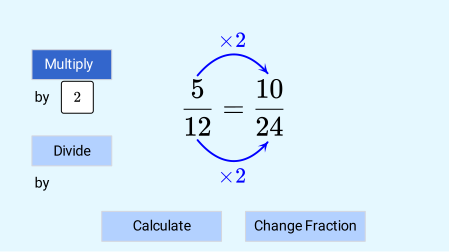
Emily and Maya ate the same amount of cake. Therefore, 14 and 28 are equivalent fractions. 1/4=2/8 Equivalent fractions can be formed by multiplying or dividing the numerator and denominator by the same number.
Discussion
Share
Report error
How to Simplify a Fraction
When a fraction has a large numerator and denominator, it can be hard to estimate its value. Simplifying such a fraction and finding an equivalent fraction with a smaller numerator and denominator can be helpful.
Method
Share
Report error
Simplifying a Fraction
Fractions of the same value can be written using different pairs of numerators and denominators. This is why some fractions can be simplified to equivalent fractions with a smaller numerator and denominator. Consider the following example.
18/66
In order to simplify this fraction, there are three steps to follow.
1
Determine Whether the Fraction Can Be Simplified
expand_more To determine whether the given fraction can be simplified, split the numerator and denominator into prime factors and see if there are any common factors other than 1. 18 &= 2* 3* 3 66 &= 2* 3* 11 The numerator and denominator share factors 2 and 3. Therefore, the fraction can be simplified. If the numerator and denominator did not have common factors other than 1, the fraction would be said to be simplified or written in its simplest form.
2
Find the Greatest Common Factor
expand_more The greatest common factor (GCF) of the numbers 18 and 66 can be found by multiplying all their common factors. GCF(18,66) = 2* 3= 6 If the numerator and denominator share only one common factor, then that factor is their GCF.
3
Reduce the Fraction
expand_more Finally, to reduce the fraction, divide its numerator and denominator by their GCF. 18/66=18/ 6/66/ 6=3/11 As a result, an equivalent fraction of 311 was obtained. It is the simplest form of the given fraction 1866.
Extra
Simplification of Different FractionsThe applet below illustrates how different fractions are simplified. 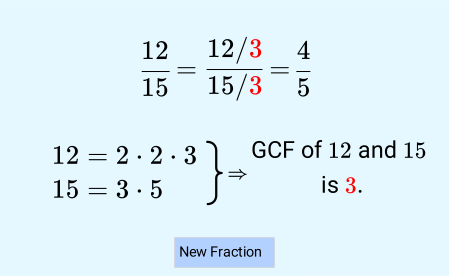
Example
Share
Report error
Pairing Equivalent Fractions
After having a lot of fun with her friends on Saturday, Jordan woke up rested and energized the next day and decided to do her math homework. When she finished, she texted her answers to her friend Emily and asked if she got the same results.

{"type":"pair","form":{"alts":[[{"id":0,"text":"6\/12"},{"id":1,"text":"16\/56"},{"id":2,"text":"14\/32"},{"id":3,"text":"20\/15"}],[{"id":0,"text":"1\/2"},{"id":1,"text":"2\/7"},{"id":2,"text":"7\/16"},{"id":3,"text":"4\/3"}]],"lockLeft":true,"lockRight":false},"formTextBefore":"","formTextAfter":"","answer":[[0,1,2,3],[0,1,2,3]]}
Hint
Find the greatest common factor (GCF) of the numerator and denominator of a fraction, then use it to simplify the fraction.
Solution
Notice that Emily's fractions are written in their simplest form, but Jordan's fractions are not simplified. Therefore, to find the equivalent fractions, each of Jordan's fractions will be analyzed and simplified, one at a time.
First Fraction
Begin by considering the first fraction from Jordan's list. 6/12 To simplify this fraction, its numerator and denominator should be divided by their greatest common factor (GCF). To find it, split 6 and 12 into prime factors. 6&= 2* 3 12&=2* 2* 3 As shown, 6 and 12 share two common factors. Their product is the GCF of these numbers. GCF(6,12)=2* 3=6 Finally, divide both the numerator and denominator by 6 to simplify the fraction. Therefore, 12 is an equivalent fraction to 612.Second Fraction
Now, consider the second fraction from Jordan's list. 16/56 Again, find the GCF of the numerator 16 and the denominator 56. To do so, write each number as the product of prime numbers. 16&= 2* 2* 2* 2 56&= 2* 2* 2* 7 There are three common factors between 16 and 56. Multiply them to calculate the GCF of 16 and 56. 2* 2* 2 = 8 Next, simplify the fraction by dividing its numerator and denominator by 8. Therefore, 1656 and 27 are equivalent fractions.Third Fraction
Similarly, examine the third fraction that Jordan wrote. 14/32 Just as before, determine the GCF of 14 and 32 by factoring the numbers into prime factors. 14&= 2* 7 32&= 2* 2* 2* 2 * 2 The numbers share only one common factor, 2. This means that the GCF of 14 and 32 is 2. Next, simplify the fraction by dividing the numerator and denominator by 2. It can be concluded that 716 is an equivalent fraction to 1432.Fourth Fraction
Finally, consider the last fraction from Jordan's list. 20/15 Start by rewriting the numerator and denominator as the product of prime factors. 20 & =2* 2* 5 15 & =3* 5 The common factor between 20 and 15 is 5. This is their GCF. Divide both the numerator and denominator by 5 to simplify the fraction. It can be concluded that 43 is an equivalent fraction to 2015.Pop Quiz
Share
Report error
Simplifying Fractions
Consider the given fraction. Can it be simplified? If yes, write the given fraction in its simplest form. If the fraction is already simplified, write it as it is.

Closure
Share
Report error
Real Life Applications of Fractions
On top of the topics mentioned in this lesson, there are many other real-life applications of fractions. Here are some of them.
- Recipes: Cooking is full of fractions. For example, a recipe for four servings might suggest using 12 teaspoon of vanilla extract and 34 tablespoon of sugar. If someone wants to cook for only two people, they would need to use fractions to adjust the ingredients accordingly.
- Sports: Fractions are frequently used to analyze the performance of a particular player and team or determine statistics like shooting percentages. Note that although percentages often appear in such statistics, they are calculated with the usage of fractions.
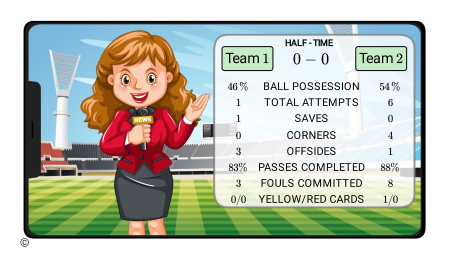
External credits: Image by brgfx
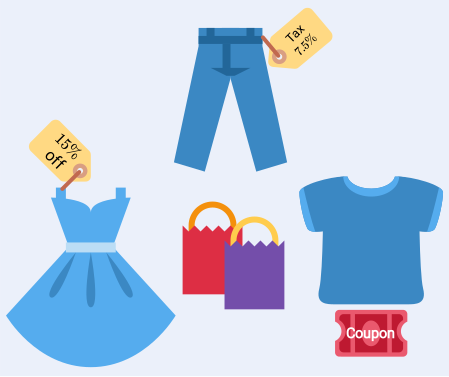
- Shopping: When there is a sale, fractions can be used to calculate the reduced price of a product. Sales tax and coupons also use fractions.
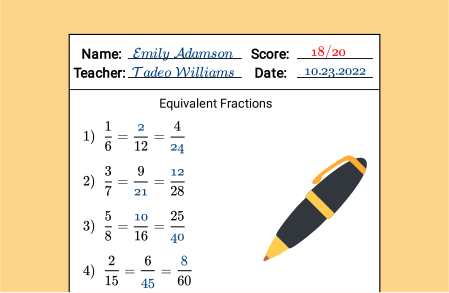
- Tests and exams: Scores of tests, exams, and homework assignments are generally expressed as fractions, like 27/30.
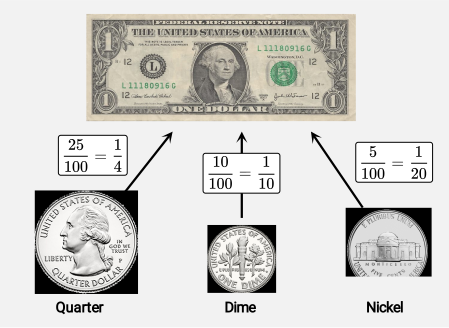
- Money: A dime is 110 of a dollar. A quarter is a 14 of a dollar. Understanding fractions makes adding money quick and easy.
Fractions
Exercise 1.1
Write the fraction corresponding to the given diagram. Do not simplify the fraction.
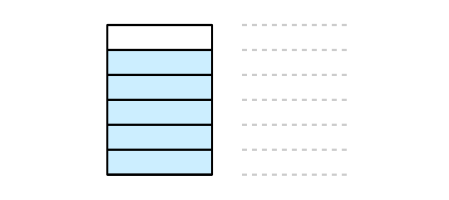
{"type":"text","form":{"type":"math","options":{"comparison":"1","nofractofloat":false,"keypad":{"simple":true,"useShortLog":false,"variables":[],"constants":[]},"rendered":false},"text":" "},"formTextBefore":null,"formTextAfter":null,"answer":{"text":["5\/6"]}}
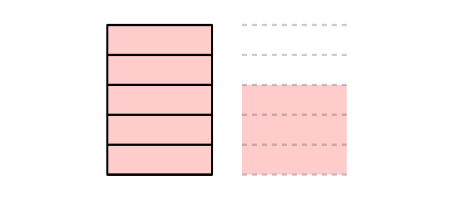
{"type":"text","form":{"type":"math","options":{"comparison":"1","nofractofloat":false,"keypad":{"simple":true,"useShortLog":false,"variables":[],"constants":[]},"rendered":false},"text":" "},"formTextBefore":null,"formTextAfter":null,"answer":{"text":["8\/5"]}}
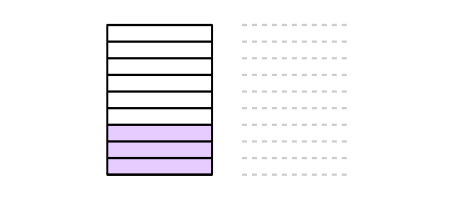
{"type":"text","form":{"type":"math","options":{"comparison":"1","nofractofloat":false,"keypad":{"simple":true,"useShortLog":false,"variables":[],"constants":[]},"rendered":false},"text":" "},"formTextBefore":null,"formTextAfter":null,"answer":{"text":["3\/9"]}}
security
report
code
security
report
code
Let's start by recalling the definition of a fraction. l part→ whole→ a/b l←numerator ←denominator We can see that a fraction is a ratio that compares a part to a whole. Now, let's analyze the given diagram and try to identify the part and the whole.
There are 6 bars in total on the left-hand side of the diagram, which is the whole. Only 5 of the bars are colored, which represents the part. We can substitute these numbers into the ratio to write the desired fraction. 5/6 Therefore, 56 is the fraction that corresponds to the given diagram.
Let's now examine the second given diagram in a similar fashion.
This time there are also colored bars on the right-hand side of the diagram. Since the lines are dashed and there is no rectangle, these bars are additional, so to speak. The rectangle on the left-hand side, consisting of 5 colored bars, represents the whole. If we add the 3 extra colored bars from the right side, we get a part of 8. 8/5 This is an improper fraction. This result makes sense because there are more colored bars than just the ones in the rectangle representing the whole.
Let's now analyze the final diagram.
First, we need to count how many bars there are in the rectangle. We can see that there are 9 bars in the rectangle. This is the number of the whole. Also, there are 3 colored bars, so 3 is the part. Now we have enough information to write the fraction. 3/9
security
report
code
Tearrik's parents bought 14 tangerines. Tearrik ate 3 of them. What fraction describes the amount of tangerines that Tearrik ate?

{"type":"text","form":{"type":"math","options":{"comparison":"1","nofractofloat":false,"keypad":{"simple":true,"useShortLog":false,"variables":[],"constants":[]},"rendered":false},"text":" "},"formTextBefore":null,"formTextAfter":null,"answer":{"text":["\\dfrac{3}{14}"]}}
security
report
code
security
report
code
Let's start by recalling the definition of a fraction. l part→ whole→ a/b l←numerator ←denominator To write a fraction representing the situation, we need to identify the part and the whole. We know that Tearrik's parents bought 14 tangerines, so this is the whole. Of these, Tearrik ate 3 tangerines, which represents the part. Let's substitute these values into the fraction. 3/14 Therefore, 314 describes the part of the tangerines that Tearrik ate.
security
report
code
Simplify the given fractions.
{"type":"text","form":{"type":"math","options":{"comparison":"1","nofractofloat":false,"keypad":{"simple":true,"useShortLog":false,"variables":[],"constants":[]},"rendered":false},"text":" "},"formTextBefore":null,"formTextAfter":null,"answer":{"text":["\\dfrac{5}{12}"]}}
{"type":"text","form":{"type":"math","options":{"comparison":"1","nofractofloat":false,"keypad":{"simple":true,"useShortLog":false,"variables":[],"constants":[]},"rendered":false},"text":" "},"formTextBefore":null,"formTextAfter":null,"answer":{"text":["\\dfrac{3}{8}"]}}
{"type":"text","form":{"type":"math","options":{"comparison":"1","nofractofloat":false,"keypad":{"simple":true,"useShortLog":false,"variables":[],"constants":[]},"rendered":false},"text":" "},"formTextBefore":null,"formTextAfter":null,"answer":{"text":["\\dfrac{9}{7}"]}}
security
report
code
security
report
code
Let's start by analyzing the first given fraction. 10/24 We can simplify it by dividing both the numerator and denominator by their greatest common factor (GCF). To find the GCF, we first need to split the numbers into their prime factors. 10 & = 2* 5 24 & = 2* 2* 2* 3 We can see that 10 and 24 share only one common factor, 2. This is their GCF. GCF(10,24)=2 Let's divide the numerator and denominator of the fraction by 2 to simplify it.
The simplified fraction is 512.
We will begin by considering the second given fraction. 15/40 To simplify it, we need to divide both the numerator and denominator by their GCF. First, we need to split the numbers into their prime factors. 15 & =3* 5 40 & =2* 2* 2* 5 We can see that 15 and 40 share only one common factor, 5. This is their GCF. GCF(15,40)=5 Let's divide the numerator and denominator of the fraction by 5 to simplify it.
The simplified fraction is 38.
Let's analyze the last given fraction. 36/28 We will simplify it by dividing both the numerator and denominator by their GCF. First, we will split the numbers into their prime factors. 36 & = 2* 2* 3* 3 28 & = 2* 2* 7 We see that 36 and 28 share two common factors, 2 and 2. The product of these factors is the GCF of 36 and 28. GCF(36,28)=2* 2=4 Let's divide the numerator and denominator of the fraction by 4 to simplify it.
The simplified fraction is 97.
security
report
code
Pair equivalent fractions.
{"type":"pair","form":{"alts":[[{"id":0,"text":"16\/12"},{"id":1,"text":"19\/76"},{"id":2,"text":"35\/77"},{"id":3,"text":"84\/48"}],[{"id":0,"text":"4\/3"},{"id":1,"text":"1\/4"},{"id":2,"text":"5\/11"},{"id":3,"text":"7\/4"}]],"lockLeft":true,"lockRight":false},"formTextBefore":"","formTextAfter":"","answer":[[0,1,2,3],[0,1,2,3]]}
security
report
code
security
report
code
To find the equivalent fraction pairs, let's analyze each fraction in the left column one at a time.
First Fraction
The first fraction is 1612. To find an equivalent fraction, let's simplify 1612 by dividing the numerator and denominator by their greatest common factor (GCF). First, let's split 16 and 12 into their prime factors. 16&= 2* 2* 2* 2 12&= 2* 2* 3 The GCF of two numbers is the product of their common factors. Since 16 and 12 share two common factors, their GCF is 2* 2=4. GCF(16,12)=4 Next, we will divide the numerator and denominator by the GCF.
Therefore, the equivalent fraction is 43.
Second Fraction
We can find an equivalent fraction of the second fraction 1976 by simplifying it. First, let's split the numerator of 19 and the denominator of 76 into their prime factors. 19&= 19* 1 76&= 19* 4 Since 19 and 76 share only one common factor, their GCF is 19. GCF(19,76)=19 Now, let's divide the numerator and denominator by the GCF.
Therefore, the equivalent fraction is 14.
Third Fraction
The third fraction is 3577. Let's simplify it! First, we can split the numerator of 35 and the denominator of 77 into their prime factors. 35&=5* 7 77&= 7* 11 Since 35 and 77 share only one common factor, their GCF is 7. GCF(35,77)=7 Now, let's divide the numerator and denominator by the GCF.
Therefore, the equivalent fraction is 511.
Fourth Fraction
The fourth and final fraction is 8448. We can find an equivalent fraction by simplifying it. Let's start by splitting the numerator and denominator into prime factors. 84&= 2* 2* 3* 7 48&= 2* 2* 2* 2* 3 We can see that 84 and 48 share three common factors. We can find the GCF of the numbers by multiplying these factors. GCF(84,48)=2* 2* 3=12 Now, let's divide the numerator and denominator by 12.
Therefore, the equivalent fraction is 74.
security
report
code
Fractions
Recommended exercises
To get personalized recommended exercises, please login first.
Loading content
≤
>
■2
■▢
e▢
7
8
9
×
÷■1
=
=
√▢
▢√
∫▢▢
4
5
6
+
−
≤
<
log
ln
log▢
1
2
3
()
∣
sin
cos
tan
0
.
π
x
y
Loading content