Talia wants to pack a -framed poster into a -shaped box.
Side Length of the Poster
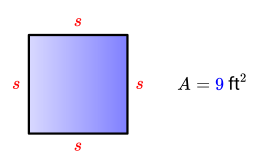
We know the square-framed poster has an of 9 square feet. We will begin by finding the length of each side of the poster. Recall that a square has four equal sides. Let's call the side length s.
When we find the , we its side measurements two times.
A = s * s ⇒ A= s^2We know that the area A is equal to 9 square feet. Therefore, we can this value into the equation for the area.
We need to find a number that, when , is equal to 9.
s^2 = 9
sqrt(s^2) = sqrt(9)
sqrt(s^2) = sqrt(3 * 3)
sqrt(s^2) = sqrt(3^2)
s= 3
We know that the length of the side of the poster is 3 feet.
Side Length of the Box
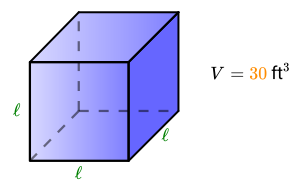
We also know that the of the box is 30 cubic feet. We want to calculate also the length of each side of the box.
Three side measurements of a cube — the length, the width, and the height — all happen to be the same and we called the side length l. We can find the volume of a cube by multiplying its side length three times.
V= l* l* l
Recall that multiplying a number by itself three times is equal to raising the number to the of 3.
V= l* l* l ⇒ V= l^3
We know that the -shaped box is 30 cubic foot. Therefore, we can substitute it into the equation for the volume.
V=l^3
30=l^3
l^3 = 30
sqrt(l^3)=sqrt(30)
l = sqrt(30)
Comparison
Now, we need to compare the length side of the poster with the box side length. If the side length of the poster appears to be smaller than side of the box, then the poster will lie flat. Therefore, we need to compare the hole edge length with the block edge length.
c|c
Poster Side Length& Box Side Length
3 & sqrt(30)
We want to find out whether 3 is greater than, less than, or equal to sqrt(30). To do it, we will estimate sqrt(30) to the . Let's narrow down our estimate by looking at nearby . The two nearest perfect cubes are 27 and 64.
27<30<64
sqrt(27)< sqrt(30)
sqrt(3 * 3 * 3)< sqrt(30)
sqrt(3^3)< sqrt(30)
3< sqrt(30)<4
Therefore, we see that the side length of the poster of 3 feet is smaller than side of the box sqrt(30). The poster will lie flat in the box.