5. Divide Decimals
Sign In
An error ocurred, try again later!
Chapter 3
5.
Divide Decimals
This lesson focuses on teaching the methods for dividing decimals, a crucial skill in mathematics. It introduces the concept of compatible numbers, which are numbers that make mental calculations easier. For instance, if you're trying to divide 612 by 9, rounding 612 to 600 makes the math simpler. The lesson also delves into the traditional method of long division for more complex calculations. These techniques are particularly useful in everyday scenarios where quick mental math is needed, such as calculating discounts or splitting bills. Whether you're a student looking to improve your math skills or an adult wanting to make everyday calculations easier, this lesson offers valuable insights.
Show less Show more expand_more 


Lesson Settings & Tools
| | 9 Theory slides |
| | 10 Exercises - Grade E - A |
| | Each lesson is meant to take 1-2 classroom sessions |
Divide Decimals
Slide of 9
Dividing decimals is similar to dividing whole numbers. The difference is that a decimal point is in play. It is crucial to understand where to place it within the quotient. The methods for dividing decimals will be developed in this lesson.
Catch-Up and Review
Here are a few recommended readings before getting started with this lesson.
Challenge
Share
Report error
LaShay's Piggy Bank
LaShay is fascinated by numbers and how she can buy her favorite things. She is currently saving money to buy a used 4K drone.

Help LaShay answer the following questions to support her math skills. Doing so will help her improve her saving plan.
a How many one-hundred dollar bills does she need to make $3000?
{"type":"text","form":{"type":"math","options":{"comparison":"1","nofractofloat":false,"keypad":{"simple":true,"useShortLog":false,"variables":["x"],"constants":["PI"]},"rendered":false},"text":" "},"formTextBefore":null,"formTextAfter":null,"answer":{"text":["30"]}}
b How many ten dollar bills does she need to make $300?
{"type":"text","form":{"type":"math","options":{"comparison":"1","nofractofloat":false,"keypad":{"simple":true,"useShortLog":false,"variables":["x"],"constants":["PI"]},"rendered":false},"text":" "},"formTextBefore":null,"formTextAfter":null,"answer":{"text":["30"]}}
c How many dimes does she need to make $3?
{"type":"text","form":{"type":"math","options":{"comparison":"1","nofractofloat":false,"keypad":{"simple":true,"useShortLog":false,"variables":["x"],"constants":["PI"]},"rendered":false},"text":" "},"formTextBefore":null,"formTextAfter":null,"answer":{"text":["30"]}}
d How many pennies does she need to make $0.3?
{"type":"text","form":{"type":"math","options":{"comparison":"1","nofractofloat":false,"keypad":{"simple":true,"useShortLog":false,"variables":["x"],"constants":["PI"]},"rendered":false},"text":" "},"formTextBefore":null,"formTextAfter":null,"answer":{"text":["30"]}}
Discussion
Share
Report error
Compatible Numbers
Compatible numbers are numbers that help make doing mental math more manageable. They are typically used to estimate quotients. Consider finding the estimation of the following quotient.
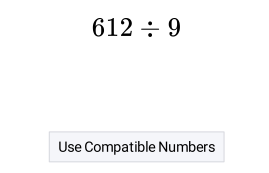
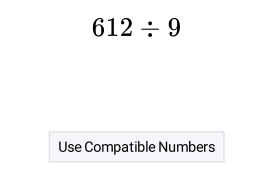
612 ÷ 9
It might seem difficult to divide these numbers using mental math. However, both numbers can be rounded to compatible numbers — 612 to 600 and 9 to 10. An estimate for 612 ÷ 9 is then found by mentally dividing 600 by 10, which is equal to 60. That means the given quotient is estimated to be about 60.
 The compatible numbers previously chosen are not the only options. Any numbers easily divisible and close to the original numbers are worth exploring. For example, rather than rounding 612 to 600, try 630. Notice that 63 is a multiple of 9. This makes 630 evenly divisible by 9. The estimate for the quotient is then 630÷ 9 = 70.
 Compatible numbers are not used to get precise answers. They are used to get quick and rough approximations. The pairs of numbers in the multiplication table are also compatible numbers. This is why it is a good habit to choose a pair from the multiplication table when calculating a quotient. The following table shows some compatible numbers for different quotients.
Keep in mind that the estimates hold value as they are close to the exact values of the quotients.
| Quotients | Exact Value | Use Compatible Numbers | Estimate |
|---|---|---|---|
| 615 ÷ 8 | 76.875 | 640 ÷ 8 | 80 |
| 36 ÷ 11.25 | 3.2 | 36 ÷ 12 | 3 |
| 52.82 ÷ 4.75 | 11.12 | 50 ÷ 5 | 10 |
Example
Share
Report error
Estimating the Number of Dimes in Piggy Bank
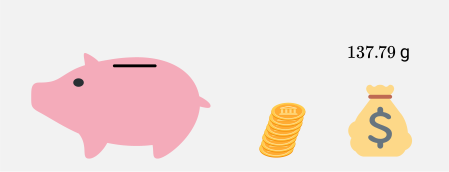
LaShay decides to use one of the all-time classic methods of saving money — a piggy bank! She then weighs it. All of the coins in the bank add up to 137.79 grams.
{"type":"text","form":{"type":"math","options":{"comparison":"1","nofractofloat":false,"keypad":{"simple":true,"useShortLog":false,"variables":["x"],"constants":["PI"]},"rendered":false},"text":" "},"formTextBefore":"About","formTextAfter":null,"answer":{"text":["70"]}}
Hint
Divide the total weight of all the money in the piggy bank by the weight of a dime. Then, round the weight of a dime to a whole number.
Solution
The total weight of all the money in the piggy bank should be divided by the weight of one dime to find the exact number of the dimes. 137.79 ÷ 2.27 This quotient can be estimated using compatible numbers. First, round the divisor to a whole number. The digit in the tenths place is 2, which is less than 5. This is why the divisor is rounded to 2. 137.79 & ÷& 2. 27 & & ↓ & & 2 Recall that compatible numbers are numbers that make doing mental math more straightforward. One way to know that the numbers will be compatible is to round the dividend to a number that is a multiple of 2. In this case, it can be 140 because it is close to 137.79 and it is a multiple of 2. 137.79 & ÷& 2.27 ↓ & & ↓ 140 & ÷ & 2 The quotient of 140 and 2 is 70. LaShay's now knows that her piggy bank contains about 70.
Discussion
Share
Report error
Dividing Decimals
The process of dividing decimals is similar to the process of dividing whole numbers using long division. What differentiates these processes is how the decimal point is placed when dividing decimals. Consider dividing the following decimal numbers.
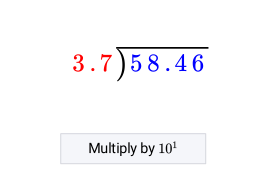
58.46 ÷ 3.7
The following steps can be followed to divide the decimals.
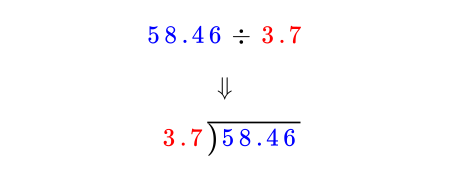 In this case, the divisor must be multiplied by 10^1 so that the decimal point moves to the right and the divisor becomes a whole number. The dividend is also multiplied by the same power of 10.
1
Multiply the Divisor and the Dividend by the Same Power of 10
expand_more When dividing decimals, the divisor is changed to a whole number. This requires multiplying the divisor and the dividend by the same power of 10. First, write the division using long division notation. The dividend is 58.46 and the divisor is 3.7.
2
Divide in the Same Way as Dividing Whole Numbers
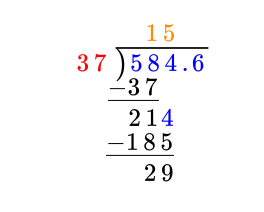
expand_more Start by dividing the whole number part of the dividend by the divisor.
3
Place the Decimal Point and Continue the Division
expand_more Now place the decimal point in the quotient above the decimal point in the dividend. Then bring down the digit in the tenths place and continue dividing as usual.
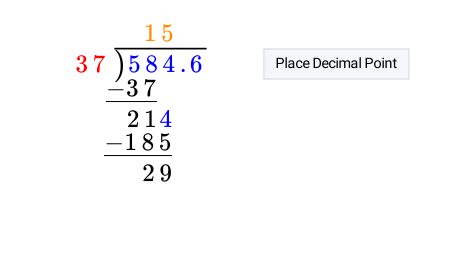 The quotient of 58.46 and 3.7 is 15.8.
Example
Share
Report error
How Many Hours Should LaShay Work?
LaShay needs $279.99 to buy the drone. She has already saved $125.75 up to this point. She then decided to mow her neighbor's lawn to make the rest of money she needs. Her neighbor agrees to pay her $9.25 per hour.

a Estimate the number of hours LaShay needs to work to earn enough to buy the drone.
{"type":"text","form":{"type":"math","options":{"comparison":"1","nofractofloat":false,"keypad":{"simple":true,"useShortLog":false,"variables":["x"],"constants":["PI"]},"rendered":false},"text":" "},"formTextBefore":"About ","formTextAfter":"hours","answer":{"text":["20","15"]}}
b Find the exact number of hours. Round the answer to one decimal place.
{"type":"text","form":{"type":"math","options":{"comparison":"1","nofractofloat":false,"keypad":{"simple":true,"useShortLog":false,"variables":["x"],"constants":["PI"]},"rendered":false},"text":" "},"formTextBefore":"About ","formTextAfter":"hours","answer":{"text":["16.7"]}}
Hint
a Subtract the amount that LaShay saved from the price of the drone. Use compatible numbers to estimate the quotient of the difference and 9.25.
b Start by converting the divisor into a whole number.
Use the standard division algorithm to divide the decimals.
Solution
a Start by finding the amount LaShay needs. It is the difference between the price of the drone, $279.99, and the amount LaShay has saved, $125.75.
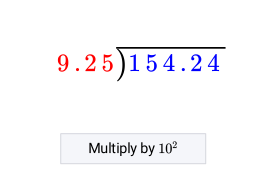
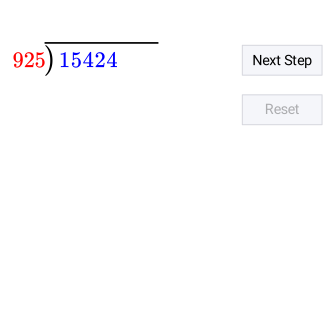
cr & 2 7 9 . 9 9 - & 1 2 5 . 7 5 & 1 5 4 . 2 4 The number of hours LaShay needs to work to earn this difference can be found by dividing it by the hourly wage, 9.25. 154.24 ÷ 9.25 Compatible numbers will be used to estimate the quotient. First, round the divisor to a whole number. For 9.25, the digit in the tenths place is 2, which is less than 5. This is why 9.25 is rounded to 9. 154.24 & ÷ & 9.25 & & ↓ & & 9 Find a number that is compatible with 9. This means that the number should be a multiple of 9 and close to 154.24. It can be either 90 or 180. Since 180 is closer, the dividend can be replaced with 180. 154.24 & ÷ & 9.25 & ↓ & & ↓ & 180 & ÷ & 9 & = 20 The quotient of 180 and 9 is 20. Therefore, LaShay needs to work about 20 hours to earn $154.24. Note that the goal here is to find an answer quickly, which leads to finding imprecise answers. The exact value will probably be different from this estimation.
b Recall the quotient from Part A that represents the number of hours LaShay needs to work.
Example
Share
Report error
How Far Does the Drone Go?
a LaShay managed to save enough money to buy the drone.

External credits: macrovector
{"type":"text","form":{"type":"math","options":{"comparison":"1","nofractofloat":false,"keypad":{"simple":true,"useShortLog":false,"variables":["x"],"constants":["PI"]},"rendered":false},"text":" "},"formTextBefore":null,"formTextAfter":"meters","answer":{"text":["23.09"]}}
b LaShay notices a bee nest on a tree branch while flying the drone in the backyard of the house.

Her grandfather, who used to be a beekeeper, tells LaShay the following.
|
So you want to approximate the number of bees in that hive huh? Well, count the number of bees that leave the hive in one minute. Then multiply it by 3 and divide by 0.014. |
{"type":"text","form":{"type":"math","options":{"comparison":"1","nofractofloat":false,"keypad":{"simple":true,"useShortLog":false,"variables":["x"],"constants":["PI"]},"rendered":false},"text":" "},"formTextBefore":null,"formTextAfter":"hours","answer":{"text":["24.6784"]}}
Hint
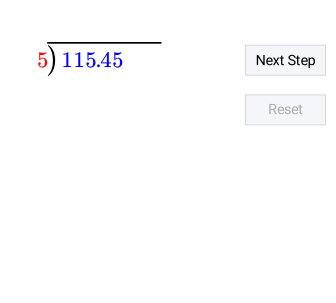
a Decide if the divisor is a whole number. Then, use long division to divide the decimals.
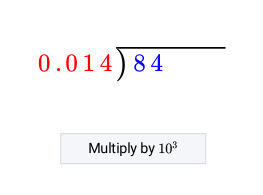
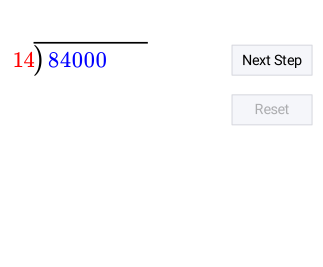
b What can be done when the divisor is not a whole number? Multiply it by a power of 10.
Solution
a Divide 115.45 by 5 to find how far the drone can travel.
b Now, it is time to find the number of bees in the nest. The number of bees that leave the hive in one minute is multiplied by 3, and then divided by 0.014.
Pop Quiz
Share
Report error
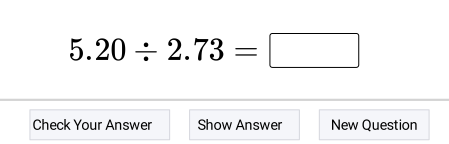
Finding the Quotient of Two Decimal Numbers
Divide the decimal numbers. Make sure that the decimal point is placed correctly. Round the answer to two decimal places, if necessary.
Closure
Share
Report error
Money in the Piggy Bank
When dividing decimals, the divisor is converted into a whole number by multiplying it by a power of 10. However, the dividend must also be multiplied by the same power of 10 to keep the value of the quotient the same. Now take a look at LaShay's piggy bank problem.

a How many one-hundred dollar bills does she need to make $3000?
{"type":"text","form":{"type":"math","options":{"comparison":"1","nofractofloat":false,"keypad":{"simple":true,"useShortLog":false,"variables":["x"],"constants":["PI"]},"rendered":false},"text":" "},"formTextBefore":null,"formTextAfter":null,"answer":{"text":["30"]}}
b How many ten dollar bills does she need to make $300?
{"type":"text","form":{"type":"math","options":{"comparison":"1","nofractofloat":false,"keypad":{"simple":true,"useShortLog":false,"variables":["x"],"constants":["PI"]},"rendered":false},"text":" "},"formTextBefore":null,"formTextAfter":null,"answer":{"text":["30"]}}
c How many dimes does she need to make $3?
{"type":"text","form":{"type":"math","options":{"comparison":"1","nofractofloat":false,"keypad":{"simple":true,"useShortLog":false,"variables":["x"],"constants":["PI"]},"rendered":false},"text":" "},"formTextBefore":null,"formTextAfter":null,"answer":{"text":["30"]}}
d How many pennies does she need to make $0.3?
{"type":"text","form":{"type":"math","options":{"comparison":"1","nofractofloat":false,"keypad":{"simple":true,"useShortLog":false,"variables":["x"],"constants":["PI"]},"rendered":false},"text":" "},"formTextBefore":null,"formTextAfter":null,"answer":{"text":["30"]}}
Hint
a Use long division to divide 3000 by 100.
b Use long division to divide 300 by 10.
c A dime is worth $0.1. Divide the decimal 3 by 0.1. Rewrite it so that the divisor is 1.
d A penny is worth $0.01. Divide the decimal 0.3 by 0.01.
Solution
a The number of one-hundred dollar bills is found by dividing 3000 by 100.
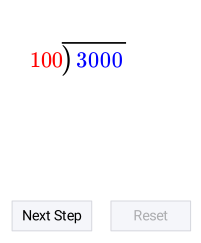
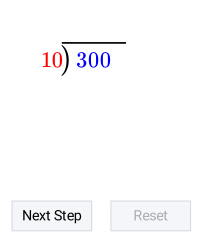
b Use the same reasoning as in Part A. Divide 300 by 10 to find the number of ten dollar bills.
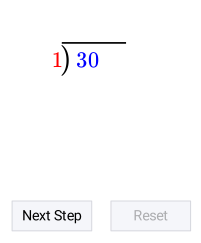
c Recall that a dime is worth $0.1. To find the number of dimes needed to make $3, divide 3 by 0.1.
d A penny is worth $0.01 and LaShay wants to make $0.3 with pennies. Then, 0.3 must be divided by 0.01 to find the number of pennies she needs.
0.3 ÷ 0.01 Like in the previous part, the divisor is a decimal number. Multiply the divisor and the dividend by 100 to make the divisor a whole number. Quotient 0.3 ÷ 0.01 ⇓ Multiplied by100 30 ÷ 1 After multiplication, the quotient becomes the same quotient as in the previous part. Since 30 divided by 1 is 30, the quotient, 0.3 ÷ 0.01, is also 30. 0.3 ÷ 0.01 = 30 This means that LaShay can make $0.3 using 30 pennies. On a final note, examine the table created using the quotients mentioned in these examples.
| Dividend | Divisor | Quotient |
|---|---|---|
| 3000 | 100 | 30 |
| 300 | 10 | 30 |
| 30 | 1 | 30 |
| 3 | 0.1 | 30 |
| 0.3 | 0.01 | 30 |
The numbers in the first columns get smaller downwards by a factor of 10. The same is true for the numbers in the second column. However, the quotient always stays the same. Therefore, when the dividend and divisor both increase by the same factor of 10, the quotient remains the same.
Divide Decimals
Exercises
Estimate each quotient.
{"type":"text","form":{"type":"math","options":{"comparison":"1","nofractofloat":false,"keypad":{"simple":true,"useShortLog":false,"variables":["x"],"constants":["PI"]},"rendered":false},"text":" "},"formTextBefore":"\u2248","formTextAfter":null,"answer":{"text":["5"]}}
{"type":"text","form":{"type":"math","options":{"comparison":"1","nofractofloat":false,"keypad":{"simple":true,"useShortLog":false,"variables":["x"],"constants":["PI"]},"rendered":false},"text":" "},"formTextBefore":"\u2248","formTextAfter":null,"answer":{"text":["4"]}}
security
report
code
security
report
code
Let's take a look at the given quotient. 37 ÷ 7.3 We want to estimate the quotient of a whole number and a decimal number. We will do two things to estimate it.
- Round the divisor to the nearest whole number.
- Round the dividend so that the divisor and the dividend are compatible numbers.
We use compatible numbers because they are numbers that are more manageable when dividing using mental math. Let's round the divisor. We look at the digit in the tenths place to round it to the nearest whole number.
Now we will look for a number that is around 37 and compatible with 7. The best way to do so is to round 37 to a number that is a multiple of 7. Let's list some multiples of 7. Some Multiples of7 21,28, 35,42,49 The closest multiple of 7 to 37 is 35. Let's round 37 to 35 and then divide 35 by 7.
The given quotient is about 5 by our estimation.
We want to estimate the quotient of two decimal numbers.
11.76 ) 52.9
In this case, the divisor is 11.76 and the dividend is 52.9. We will first round 11.76 to the nearest whole number. Then, we will round 52.9 so that the numbers are compatible. Let's round the divisor. We can round the digit in the tenths place to the nearest whole number.
Now we will look for a number that is around 52.9 and compatible with 12. A good way to do this is by rounding 52.9 to a number that is a multiple of 12. Let's list some multiples of 12. Some Multiples of12 24,36, 48,60,72 The closest multiple of 12 to 52.9 is 48. Let's round 52.9 to 48 and then divide 48 by 12.
The given quotient is about 4 by our estimation.
security
report
code
Find each quotient.
{"type":"text","form":{"type":"math","options":{"comparison":"1","nofractofloat":false,"keypad":{"simple":true,"useShortLog":false,"variables":["x"],"constants":["PI"]},"rendered":false},"text":" "},"formTextBefore":null,"formTextAfter":null,"answer":{"text":["0.596"]}}
{"type":"text","form":{"type":"math","options":{"comparison":"1","nofractofloat":false,"keypad":{"simple":true,"useShortLog":false,"variables":["x"],"constants":["PI"]},"rendered":false},"text":" "},"formTextBefore":null,"formTextAfter":null,"answer":{"text":["2.464"]}}
security
report
code
security
report
code
We want to calculate the given quotient. 8.94 ÷ 15 Here, we need to divide a decimal number by a whole number. We will use long division to calculate it.
Since 8 ones divided by 15 is 0, we write a 0 in the ones place of the quotient. Then we place the decimal point in the quotient directly above its place in the dividend.
We can now continue the division process as usual. We will not stop until the remainder becomes 0.
Therefore, the quotient is 0.596.
We will use long division to calculate the given quotient.
The first digit of the quotient will be in the ones place because 64 contains two groups of 26. After that we can place the decimal point in the quotient directly above its place in the dividend.
We can now continue the division process as usual.
Therefore, the quotient is 2.464.
security
report
code
Find each quotient.
{"type":"text","form":{"type":"math","options":{"comparison":"1","nofractofloat":false,"keypad":{"simple":true,"useShortLog":false,"variables":["x"],"constants":["PI"]},"rendered":false},"text":" "},"formTextBefore":null,"formTextAfter":null,"answer":{"text":["50"]}}
{"type":"text","form":{"type":"math","options":{"comparison":"1","nofractofloat":false,"keypad":{"simple":true,"useShortLog":false,"variables":["x"],"constants":["PI"]},"rendered":false},"text":" "},"formTextBefore":null,"formTextAfter":null,"answer":{"text":["8"]}}
security
report
code
security
report
code
We are asked to find the value of the following quotient. 7 ÷ 0.14 We will use long division to find it. Notice that the divisor is a decimal number. We will first make it a whole number by multiplying it by a power of 10. Since 0.14 has two decimal places, we multiply it by 10 to the power of 2. We also have to multiply the dividend by the number. Given 7 ÷ 0.14 ⇓ Use Long Division 0.14 ) 7 ⇓ Multiply by 10^2 14 ) 700 Now both numbers are whole numbers. We can perform the division as usual.
The quotient is 50.
We will use long division to calculate the given quotient.
34 ÷ 4.25
Again, we need to multiply the dividend and the divisor by 10^2. This is because the divisor has two decimal places and multiplying by 10^2 moves the decimal point two places to the right.
Given
34 ÷ 4.25
⇓
Use Long Division
4.25 ) 34
⇓
Multiply by 10^2
425 ) 3400
There are eight groups of 425 in 3400. Therefore, the quotient is 8.
security
report
code
Evaluate each quotient.
{"type":"text","form":{"type":"math","options":{"comparison":"1","nofractofloat":false,"keypad":{"simple":true,"useShortLog":false,"variables":["x"],"constants":["PI"]},"rendered":false},"text":" "},"formTextBefore":null,"formTextAfter":null,"answer":{"text":["1.64"]}}
{"type":"text","form":{"type":"math","options":{"comparison":"1","nofractofloat":false,"keypad":{"simple":true,"useShortLog":false,"variables":["x"],"constants":["PI"]},"rendered":false},"text":" "},"formTextBefore":null,"formTextAfter":null,"answer":{"text":["2.8"]}}
security
report
code
security
report
code
We see that the divisor is a decimal number with one decimal place. 1.476 ÷ 0.9 We will make the divisor a whole number by multiplying it by 10. We also have to multiply the dividend by the number. Given 1.476 ÷ 0.9 ⇓ Use Long Division 0.9 ) 1.476 ⇓ Multiply by 10 9 ) 14.76 We can divide 14.76 by 9 as we would with whole numbers. We will place the first digit of the quotient in the ones places because 14 contains one group of 9. After that we place the decimal point in the quotient directly above its place in the dividend.
The given quotient is 1.64.
This time we are given a quotient whose divisor is a decimal with three decimal places.
0.0364 ÷ 0.013
We multiply the dividend and the divisor by 10^3. This is because the divisor has three decimal places and multiplying by 10^3 moves the decimal point three places to the right.
Given
0.0364 ÷ 0.013
⇓
Use Long Division
0.013 ) 0.0364
⇓
Multiply by 10^3
13 ) 36.4
Since 2 * 13 is 26 and 3* 13 is greater than 36, the number in the ones place will be 2. Let's start with writing it!
security
report
code
Evaluate the expressions.
{"type":"text","form":{"type":"math","options":{"comparison":"1","nofractofloat":false,"keypad":{"simple":true,"useShortLog":false,"variables":["x"],"constants":["PI"]},"rendered":false},"text":" "},"formTextBefore":null,"formTextAfter":null,"answer":{"text":["9.92"]}}
{"type":"text","form":{"type":"math","options":{"comparison":"1","nofractofloat":false,"keypad":{"simple":true,"useShortLog":false,"variables":["x"],"constants":["PI"]},"rendered":false},"text":" "},"formTextBefore":null,"formTextAfter":null,"answer":{"text":["1.0375"]}}
security
report
code
security
report
code
Let's recall the order of operations. We use the acronym PEMDAS to remember the correct order!
Expressions inside parentheses are evaluated first, followed by exponents, then multiplication and division, and finally addition and subtraction are evaluated last. For the given expression, this means multiplying 6.2 and 10.32 first and then dividing it by 6.45. 6.2 * 10.32 ÷ 6.45 When we multiply two decimals, we ignore any decimal points and multiply as we would with whole numbers. Then we count the number of decimal places in each factor. cr & 1 0 3 2 * & 6 2 & 2 0 6 4 + & 6 1 9 2 0 & 6 3 9 8 4 Since 6.2 has one decimal place and 10.32 has two decimal places, their product will have three decimal places. Then the product of the numbers is 63.984. 6.2 * 10.32 ÷ 6.45 ⇓ 63.984 ÷ 6.45 Our goal is to find this quotient now. But first, we need to convert the divisor into a whole number. We can do it by multiplying the divisor by 10^2. We must multiply the dividend by the same power of 10 so that the value of the quotient remains the same. Given 63.984 ÷ 6.45 ⇓ Use Long Division 6.45 ) 63.984 ⇓ Multiply by 10 645 ) 6398.4 Let's find it!
The expression is equal to 9.92.
We need to follow the order of operations. For the given expression, this means evaluating the expression inside the parentheses completely before dividing.
(2^2-2.34) ÷ 1.6
Even within the expression inside the parentheses, we must follow the order of operations. We will first evaluate the exponent. It is equal to 4.
(4-2.34) ÷ 1.6
To subtract 2.34 from 4, we rewrite 4 as 4.00 and subtract by regrouping.
cr
& 3 9 10
& 4 . 0 0
- & 2 . 3 4
& 1 . 6 6
Now that we found the value of the expression inside the parentheses, we can divide it by 1.6.
(2^2-2.34) ÷ 1.6
⇓
1.66 ÷ 1.6
The divisor is a decimal number. We need to make it a whole number. We multiply the dividend and the divisor by 10 because the divisor has one decimal place.
Given
1.66 ÷ 1.6
⇓
Use Long Division
1.6 ) 1.66
⇓
Multiply by 10
16 ) 16.6
The first digit of the quotient will be 1 since 16 times 1 is 16.
The value of the expression is 1.0375.
security
report
code
Divide Decimals
Recommended exercises
To get personalized recommended exercises, please login first.
Loading content
≤
>
■2
■▢
e▢
7
8
9
×
÷■1
=
=
√▢
▢√
∫▢▢
4
5
6
+
−
≤
<
log
ln
log▢
1
2
3
()
∣
sin
cos
tan
0
.
π
x
y
Loading content