5. Divide Decimals
+ Customize lesson
0
0
Sign In
This lesson focuses on teaching the methods for dividing decimals, a crucial skill in mathematics. It introduces the concept of compatible numbers, which are numbers that make mental calculations easier. For instance, if you're trying to divide 612 by 9, rounding 612 to 600 makes the math simpler. The lesson also delves into the traditional method of long division for more complex calculations. These techniques are particularly useful in everyday scenarios where quick mental math is needed, such as calculating discounts or splitting bills. Whether you're a student looking to improve your math skills or an adult wanting to make everyday calculations easier, this lesson offers valuable insights.
| Student Learning Objectives: |
|---|
|
| | 9 Theory slides |
| | 10 Exercises - Grade E - A |
| | Each lesson is meant to take 1-2 classroom sessions |
LaShay is saving money to buy a used 4K drone.

Help her answer the following questions to improve her saving plan.
How many $100 bills does she need to make $3000?
How many $10 bills does she need to make $300?
How many dimes does she need to make $3?
How many pennies does she need to make $0.30?
Compatible numbers are numbers that help make doing mental math more manageable. Compatible numbers are used to get quick and rough approximations, not precise answers. Consider finding the estimation of the following quotient. 612 ÷ 9 It might seem difficult to divide these numbers using mental math. However, both numbers can be rounded to compatible numbers — 612 to 600 and 9 to 10. An estimate for 612 ÷ 9 can then be found mentally by dividing 600 by 10, which is equal to 60. That means the given quotient is about 60.


A pile of identical coins weighs 137.79 grams.

Each coin weighs 2.27 grams. Use compatible numbers to estimate the number of coins in the pile.
The process of dividing decimals is similar to the process of dividing whole numbers using long division. The main difference between the processes is how the decimal point is placed when dividing decimals. Consider dividing the following decimal numbers. 58.46 ÷ 3.7 Follow these steps to divide the decimals.

In this case, the divisor must be multiplied by 10^1 so that the decimal point moves to the right and the divisor becomes a whole number. We also multiply the dividend by the same power of 10.


The quotient of 58.46 and 3.7 is 15.8.
LaShay needs $279.99 to buy a drone. She has already saved $125.75. She decided to mow lawns to make the rest of money she needs. She charges $9.25 per hour.

Estimate the number of hours LaShay needs to mow lawns to earn enough to buy the drone.
Find the exact number of hours. Round the answer to one decimal place.
Subtract the amount that LaShay saved from the price of the drone. Use compatible numbers to estimate the quotient of the difference and 9.25.
Start by converting the divisor into a whole number. Use long division to divide the decimals.
We start by finding the amount of money LaShay still needs. This is the difference between the price of the drone, $279.99, and the amount LaShay has saved, $125.75.
cr & 2 7 9 . 9 9 - & 1 2 5 . 7 5 & 1 5 4 . 2 4 Next, we can find the number of hours LaShay needs to work by dividing the amount she still needs by her hourly wage of 9.25 dollars per hour. 154.24 ÷ 9.25 To estimate the quotient, we can use compatible numbers. First, we round the divisor to a whole number. The digit in the tenths place of 9.25 is 2. Since 2 is less than 5, we round 9.25 to 9. ccc 154.24 & ÷ & 9.25 & & ↓ & & 9 To find a number that is compatible with 9, we need a number that is a multiple of 9 and close to 154.24. For example, we can use either 90 or 180. Since 180 is closer to our number, let's replace 154.24 with 180. ccc 154.24 & ÷ & 9.25 & ↓ & & ↓ & 180 & ÷ & 9 & = 20 The quotient of 180 and 9 is 20, so LaShay needs to work about 20 hours to earn $154.24. Remember that this is only an estimate. It gives us a quick answer, but it is not an exact answer.
Let's now calculate the quotient from Part A exactly.
154.24 ÷ 9.25 ⇒ 9.25 ) 154.24 We are dividing two decimal numbers. First, we convert the divisor into a whole number. Since the divisor has two decimal places, we multiply both the divisor and the dividend by 10^2 to keep the expression balanced.

Now we have a division of two whole numbers, which we can calculate using long division.

Lastly, we round the answer to one decimal place. The hundredths digit is 7, which is greater than 5, so we round 16.674... to 16.7. 16.674... ≈ 16.7 LaShay has to mow lawns for about 16.7 hours.
LaShay bought a drone.

The drone can go 115.45 meters in 5 minutes. How far can the drone go in one minute?
LaShay notices a beehive on a tree branch while flying the drone in the backyard of the house.

Her grandfather, who used to be a beekeeper, tells LaShay the following.
|
So you want to approximate the number of bees in that hive, huh? Well, count the number of bees that leave the hive in one minute. Then, multiply it by 3 and divide by 0.014. |
LaShay counts 28 bees that leave the hive in one minute. Find the number of bees in the hive.
Is the divisor a whole number? Use long division to divide the decimals.
Multiply the divisor and the dividend by a power of 10.
To find how far the drone can travel in one minute, we divide 115.45 by 5.
115.45 ÷ 5 ⇒ 5 ) 115.45 The steps for dividing a decimal by a whole number are the same as the steps for dividing whole numbers. Remember to place the decimal point in the quotient above the decimal point in the dividend.

We found that the drone can travel 23.09 meters in one minute.
We want to find the number of bees in the hive. The number of bees that leave the hive in one minute is multiplied by 3, then divided by 0.014.
(Number of Bees * 3 ) ÷ 0.014 LaShay counted 28 bees leaving the hive in one minute. Let's multiply this number by 3. cr & 2 0.265cm & 2 8 * & 3 & 8 4 Now we divide the result by 0.014 using long division. 84 ÷ 0.014 ⇒ 0.014 ) 84 In this case, the divisor is a decimal number. Let's convert it into a whole number. Since the divisor has 3 decimal places, we will multiply it by 10^3. We should also multiply the dividend by the same number as the divisor to keep the expression equivalent.

Now we have a division of two whole numbers, so we can divide as usual.

This means that there are about 6000 bees in the hive.
Divide the decimal numbers. Make sure that the decimal point is placed correctly. Round the answer to two decimal places, if necessary.

When dividing decimals, the divisor is converted into a whole number by multiplying it by a power of 10. However, the dividend must also be multiplied by the same power of 10 to keep the value of the quotient the same. Let's reconsider LaShay's piggy bank.

How many $100 bills does she need to make $3000?
How many $10 dollar bills does she need to make $300?
How many dimes does she need to make $3?
How many pennies does she need to make $0.3?
Use long division to divide 3000 by 100.
Use long division to divide 300 by 10.
A dime is worth $0.10. Divide the decimal 3 by 0.1. Rewrite the expression so that the divisor is 1.
A penny is worth $0.01. Divide the decimal 0.3 by 0.01.
The number of $100 bills is found by dividing 3000 by 100. Let's use long division to find this quotient.

The quotient is 30, so LaShay needs 30 bills worth $100 each to make $3000.
We will use the same reasoning as in Part A. Let's divide 300 by 10 to find the number of $10 bills needed to make $300.
300 ÷ 10 = 30 The result is again 30, so LaShay needs 30 bills worth $10 each to make $300.
A dime is worth $0.10. To find the number of dimes needed to make $3, divide 3 by 0.1.
3 ÷ 0.1 Since the divisor is a decimal number, we multiply both the divisor and the dividend by 10 to rewrite the division with a whole-number divisor. 3 ÷ 0.1 ⇒ 30 ÷ 1 When a number is divided by 1, the result is the number itself. This means that 30 dimes are needed to make $3.
A penny is worth $0.01, and LaShay wants to make $0.30 with pennies. To find the number of pennies she needs, we divide 0.30 by 0.01.
0.3 ÷ 0.01 Like in the previous part, the divisor is a decimal number. Let's multiply the divisor and the dividend by 100 to make the divisor a whole number. 0.3 ÷ 0.01 ⇒ 30 ÷ 1 After multiplying, the quotient is the same as in the previous part. Since 30 divided by 1 is 30, 0.3 ÷ 0.01 is also 30. This means that LaShay can make $0.30 using 30 pennies.
| Dividend | Divisor | Quotient |
|---|---|---|
| 3000 | 100 | 30 |
| 300 | 10 | 30 |
| 30 | 1 | 30 |
| 3 | 0.1 | 30 |
| 0.3 | 0.01 | 30 |
The numbers in the first two columns decrease by a factor of 10, but the quotient always stays the same. When the dividend and divisor both increase or decrease by the same factor, the quotient remains the same.
Tiffaniqua spends most of her time on the weekends helping at a farm. Tiffaniqua asks the head farmer a question.
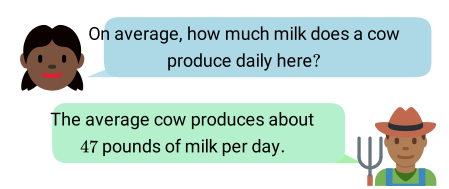
If one gallon of milk weighs about 8.6 pounds, estimate the number of gallons of milk a cow produces each day.
We know that the average cow produces about 47 pounds of milk per day. We also know that one gallon of milk weighs about 8.5 pounds. Let's divide the weight of milk produced by one cow by the number of pounds in one gallon. 47 ÷ 8.6 This quotient is equal to the number of gallons that one cow produces in one day. Let's round the divisor and the dividend so that they are compatible numbers. Start by rounding 8.6 to the closest whole number. 8.6 ≈ 9 Now, we are looking for a number that is close to 47 and is divisible by 9. 47 ≈ 45 Since 45 is close to 47 and it is a multiple of 9, we round 47 to 45. Now, we can estimate the quotient.
We found that one cow produces about 5 gallons of milk in one day.
Dylan has 4.6 gigabytes of storage available on his phone. The average size of a song is 0.005 gigabyte.

How many songs can Dylan's phone store?
We need to divide the available space on Dylan's phone by the average size of a song to find the number of songs the phone can store. 4.6 ÷ 0.005 Dividing decimal numbers is easier if we multiply the divisor and the dividend by the same power of 10 so that the divisor is a whole number. In this case, we will multiply by 10^3, or 1000. 4.6 * 1000 & = 4600 0.005 * 1000& = 5 This means that 4.6 ÷ 0.005 is the same as 4600÷ 5. Let's now calculate it. We will place the first digit of the quotient in the hundreds place because 46 contains nine groups of 5.
This means that Dylan's phone can store 920 songs.
Zosia rewrites 137.28 divided by 0.64 as follows.
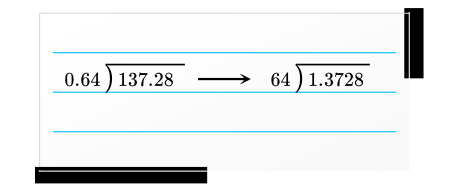
Is Zosia correct?
We are told that Zosia wants to find the quotient of 137.28 and 0.64 with the given procedure.
We want to find if she is correct. Dividing decimal numbers is easier if we multiply the divisor and the dividend by the same power of 10 so that the divisor is a whole number. In this case, we need to multiply by 100 because the divisor 0.64 has two decimal places. 137.28* 100 &= 13728 0.64* 100 &=64 This means that 137.28÷ 0.64 is the same as 13728÷ 64. We obtained a different answer than our friend. Our friend is not correct because she multiplied the divisor by 100 but divided the dividend by 100. Remember that we must multiply both the divisor and the dividend by the same number when using this method. The answer is then B.
The diagram shows how Ignacio divides two decimal numbers.
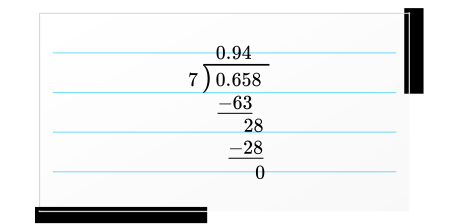
Is Ignacio correct?
Let's examine the steps Ignacio followed.
The operations seem correct at first glance. Let's find the quotient ourselves to find out if it really is. In this case, we divide a decimal number by a whole number. This is why we divide as we would with whole numbers. We also place the decimal point in the quotient directly above its place in the dividend. Let's do it!
We put a zero in the tenths place because there is no group of 7 in 6. Then, we continue as usual. As a result, we obtained a different answer than our friend. The answer is A.