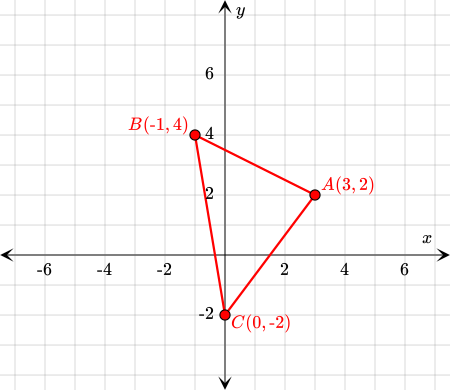
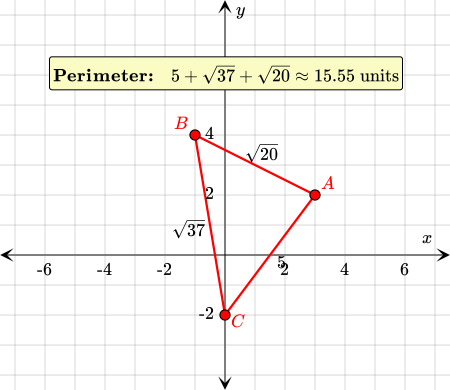
For the length of the remaining sides we will calculate using a table.
Segment
Points
sqrt((x_2-x_1)^2+(y_2-y_1)^2)
d
AB
( 3,2), ( - 1,4)
sqrt(( 3-( - 1))^2+( 2- 4)^2)
sqrt(20)
BC
( 0,- 2), ( - 1,4)
sqrt(( 0-( - 1))^2+( - 2- 4)^2)
sqrt(37)
When we have all of the sides we can calculate the perimeter by adding them.
b
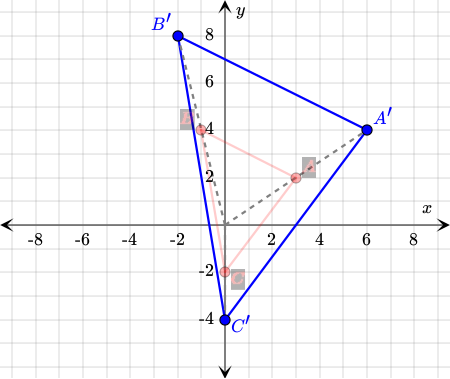
To enlarge the triangle by a factor of 2, we have to double the distance of each vertice from the origin in the same direction. We can do this by multiplying each point's coordinates by 2.
Point
(x,y)
( 2x, 2y)
A
(3,2)
(6,4)
B
(- 1,4)
(- 2,8)
C
(0,- 2)
(0,- 4)
When we know the coordinates of A', B' and C', we can draw △ A'B'C'.
We can find the length of the enlarged sides in the same way as in Part A. However, when you dilate a polygon by a certain factor you increase all of the side's lengths by that factor. Since this factor is 2, the perimeter of the enlarged triangle is twice the perimeter of the original.
Perimeter: 15.55(2)=31.1 units
c
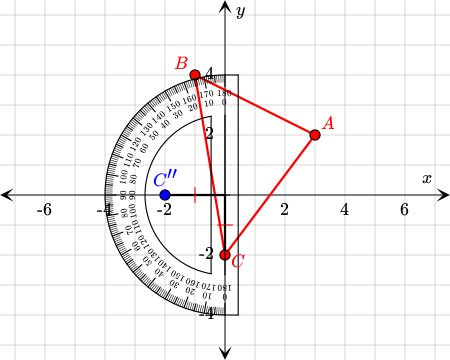
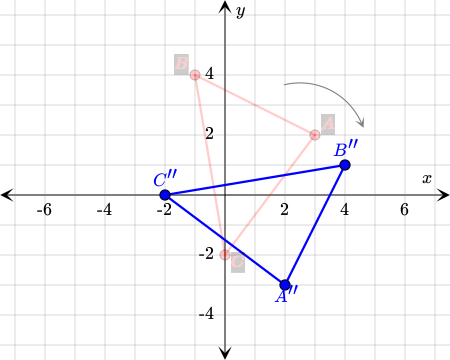
To rotate a vertice by 90^(∘) counterclockwise about the origin, we draw segments from it to the origin. Next, we use a protractor to draw a second segment that is at a 90^(∘) angle counterclockwise to the first segment. To find the coordinates of the rotated vertice we have to make the second segment the same length as the first.
If we repeat the procedure for the remaining two points, we can draw the rotated triangle.