This form is most often seen in real-world examples.
See solution.
Practice makes perfect
The standard form of an equation
Ax+By=C,
is most often seen in real-world examples of math problems. It describes the relationship between two variables when there is a restriction on how many things you can have in total.
Real-life problem
Suppose you are at the supermarket and want to buy one piece of fruit for your snack each day of the week. You need 7 pieces of fruit and you need to buy a combination of apples and oranges that gets you to 7. We can write this in an equation format:
Number of Apples+Number of Oranges=7.
With this we can have 6 apples and 1 orange, or 2 apples and 5 oranges, or any combination of the two fruits that adds to be a total of 7.
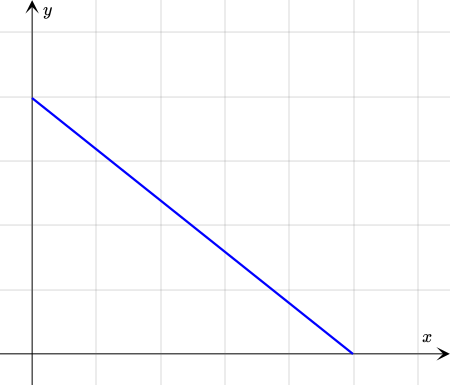
The graph of this type of equation, because it shows a restriction and a combination of variables, is always a variation of the following format.
The x- and y-intercepts show the possible combinations where you have all of one kind of object and none of the other. In the example from before, the x- and y-intercepts would be the case when you had either 7 oranges and 0 apples or 7 apples and 0 oranges.