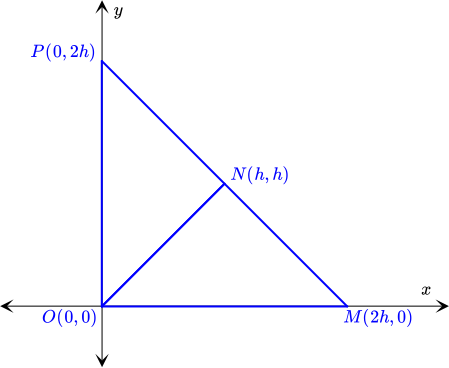
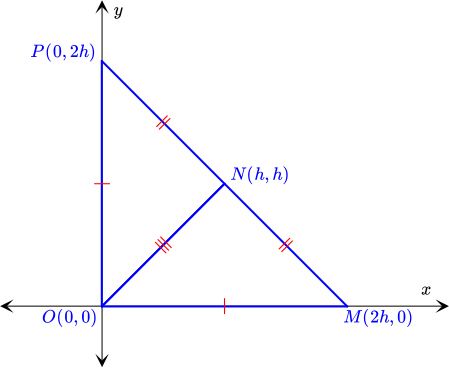
If three sides of one triangle are congruent to three sides of a second triangle, then the two triangles are congruent.
We have to show that three sides of △ NPO are congruent to three sides of △ NMO. We know that the triangles share the side ON. By the Reflexive Property of Congruence, this side is congruent to itself. Therefore, we can say that △ NPO and △ NMO have one pair of congruent sides. Let's find the other side lengths using the Distance Formula.
d = sqrt((x_2-x_1)^2 + (y_2-y_1)^2)
Triangle
Side
Points
Substitute
Simplify
△ NPO
NP
N( h, h) and P( 0, 2h)
NP=sqrt(( 0- h)^2+( 2h- h)^2)
NP=sqrt(2)h
△ NPO
PO
P( 0, 2h) and O( 0, 0)
PO=sqrt(( 0- 0)^2+( 0- 2h)^2)
PO=2h
△ NMO
NM
N( h, h) and M(2h, )
NM=sqrt((2h- h)^2+( - h)^2)
NM=sqrt(2)h
△ NMO
MO
M(2h, ) and O( 0, 0)
MO=sqrt(( 0-2h)^2+( 0- )^2)
MO=2h
We can see that NP=NM and PO=MO, so we have identified two more pairs of congruent sides.
Since three sides of △ NPO are congruent to three sides of △ NMO, the triangles are congruent.
△ NPO≅△ NMO