a The vertices are points that mark the angles of the triangle.
B
b Notice that the triangles are isosceles so the legs will have the same length.
A
a See solution
B
b See solution
Practice makes perfect
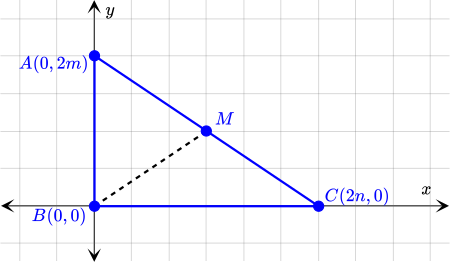
a Let's place an arbitrary right triangle in a coordinate plane. To make things easy, we will let the right angle vertex be at the origin and have it's legs run along the x- and y-axis. The non-right angle vertices we label (0,2m) and (2n,0). These coordinates will make it easy to find an expression for the midpoints, M, coordinates.
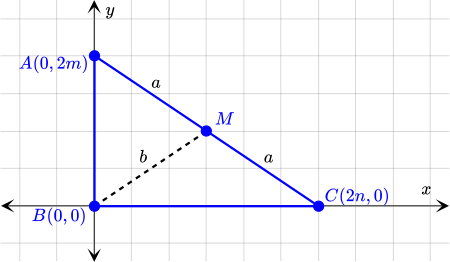
We want to prove that the distance from the midpoint M to each vertex is the same. Let's label these lengths a and b. Note that since M is the midpoint of AC, the length of AM and CM will by definition be the same.
To prove that AM≅ CM≅ BM, we have to find the lengths of these segments. This requires us to know the coordinates of the midpoint. Using the Midpoint Formula, we can find the coordinates of the midpoint.
The midpoint M has the coordinates (n,m). Now we can use the Distance Formula to determine the length of each segment. Again, since we by definition know that AM≅ CM, we only have to calculate one of these lengths.
Distance
Points
sqrt((x_2-x_1)^2+(y_2-y_1)^2)
d
AM
( n,m), ( 0,2m)
sqrt(( n- 0)^2+( m- 2m)^2)
sqrt(n^2+m^2)
BM
( n,m), ( 0,0)
sqrt(( n- 0)^2+( m- 0)^2)
sqrt(n^2+m^2)
As we can see, BM has the same length as AM which means we have proven that
AM ≅ BM ≅ CM.
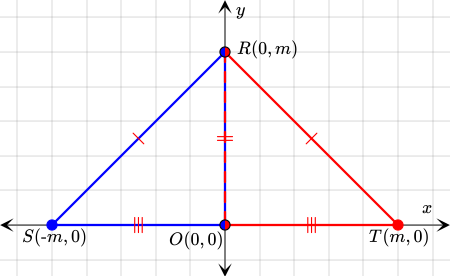
b When two right isosceles triangles are congruent, their hypotenuses will necessarily be corresponding sides. By placing the triangles back to back, such that their legs run along the x- and y-axis, we can show that any two congruent right isosceles triangles can be combined to form a single isosceles triangle.
Using the Distance Formula, we can show that SR≅ RT
Distance
Points
sqrt((x_2-x_1)^2+(y_2-y_1)^2)
d
RS
( 0,m), ( - m,0)
sqrt(( 0-( - m))^2+( m- 0)^2)
sqrt(2m^2)
RT
( m,0), ( 0,m)
sqrt(( m- 0)^2+( 0- m)^2)
sqrt(2m^2)
Since SR and TR have the same length, △ SRT is an isosceles triangle.