Sign In
The shortest distance from a point to a line is the length of the segment perpendicular to the given line.
3sqrt(10) units
The shortest distance from a point to a line is the length of the segment perpendicular to the given line. We will need to find the perpendicular line and then we can find the intersection point. Finally, we can calculate the distance from the given point to the point of intersection.
Perpendicular lines have opposite reciprocal slopes. This means the product of their slopes is equal to -1.
m_1 * m_2=- 1
The given line has a slope of 13.
y= 1/3x-2
Now, to find the equation of the perpendicular line, we can substitute the known point in the slope-intercept form, using that the slope is - 3.
We can add this value of b, along with the known slope, into the slope-intercept form to have a complete equation for the perpendicular line. y= - 3x+( - 2) ⇔ y=- 3x-2
To find the distance, we also need to know where the given line and the perpendicular line intersect. By setting up a system of equations, we can find the point of intersection. y= 13x-2 y=- 3x-2 Since both equations have y isolated, it is most convenient to use the Substitution Method.
Having solved the first equation for x, we can substitute this value into the second equation to find the value of y.
(II): x= 0
(II): Zero Property of Multiplication
(I): Subtract term
The lines intersect at (0,- 2).
Now that we know the two endpoints of the segment, we can use the Distance Formula to calculate the length of the segment.
Substitute ( - 3,7) & ( 0,- 2)
a-(- b)=a+b
Add and subtract terms
Calculate power
Add terms
Split into factors
sqrt(a* b)=sqrt(a)*sqrt(b)
Calculate root
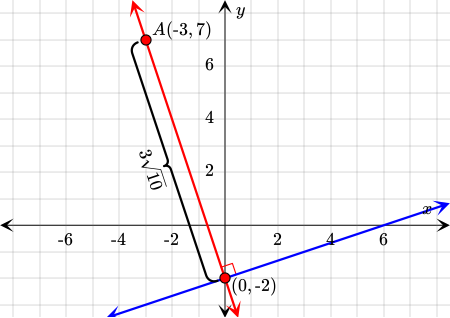
The distance from the point A(- 3,7) to the line y= 13x-2 is 3sqrt(10) units.