2. Slope of Parallel and Perpendicular Lines
Sign In
An error ocurred, try again later!
Chapter 4
2.
Slope of Parallel and Perpendicular Lines
The relationship between the slopes of lines plays a pivotal role in determining their orientation. When two lines are parallel, they run alongside each other without ever meeting, and they share the same slope. On the other hand, perpendicular lines intersect at a right angle, and their slopes are negative reciprocals of each other. This distinction is crucial for various geometric applications and proofs. For instance, understanding these concepts can aid in identifying specific quadrilaterals or determining the properties of certain shapes based on their lines and angles. Moreover, the ability to find equations of lines that are parallel or perpendicular to a given line is a valuable skill in coordinate geometry.
Show less Show more expand_more 


Lesson Settings & Tools
| | 14 Theory slides |
| | 12 Exercises - Grade E - A |
| | Each lesson is meant to take 1-2 classroom sessions |
Slope of Parallel and Perpendicular Lines
Slide of 14
In this lesson, the relationship between the slopes of parallel and perpendicular lines will be explored.
Catch-Up and Review
Here are a few recommended readings before getting started with this lesson.
Explore
Share
Report error
Investigating the Slopes of Parallel Lines
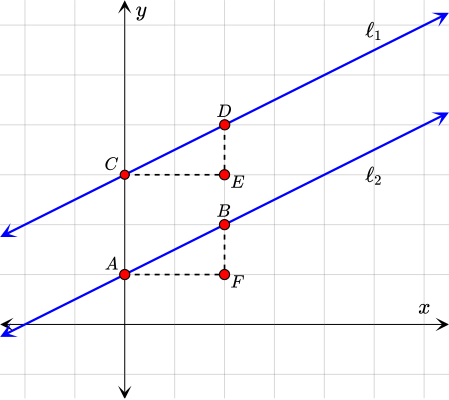
The lines l_1 and l_2 are positioned as shown in the graph. Move the point C vertically.
Discussion
Share
Report error
Slopes of Parallel Lines Theorem
In the previous graph, the slope triangles △ ABF and △ CDE can be mapped onto each other by a translation. Since translations are rigid motions, it can be concluded that △ ABF and △ CDE are congruent triangles. Because the slope triangles are congruent, the slopes of the lines are equal. This means that the lines are parallel.
In a coordinate plane, two distinct non-vertical lines are parallel if and only if their slopes are equal.
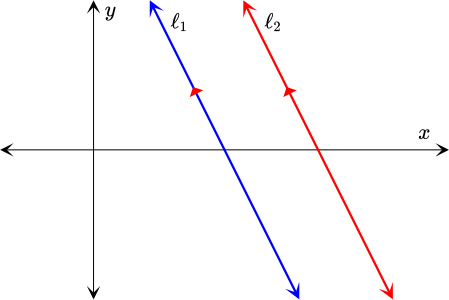
If l_1 and l_2 are two parallel lines and m_1 and m_2 their respective slopes, then the following statement is true.
l_1 ∥ l_2 ⇔ m_1 = m_2
The slope of a vertical line is not defined. Therefore, this theorem only applies to non-vertical lines. However, any two distinct vertical lines are parallel.
Proof
Since the theorem consists of a biconditional statement, the proof consists of two parts.
- If two distinct non-vertical lines are parallel, then their slopes are equal.
- If the slopes of two distinct non-vertical lines are equal, then the lines are parallel.
Part 1
Consider two distinct non-vertical parallel lines in a coordinate plane. Their equations can be written in slope-intercept form. l_1: y=m_1x+b_1 l_2: y=m_2x+b_2 Suppose that the slopes of the lines are not the same. The system of equations formed by the equations above can be solved by using the Substitution Method.y=m_1x+b_1 & (I) y=m_2x+b_2 & (II)
Substitute
(I): y= m_2x+b_2
m_2x+b_2=m_1x+b_1 y=m_2x+b_2
x= b_1-b_2m_2-m_1 y=m_2x+b_2
x= b_1-b_2m_2-m_1 y=m_2x+b_2
Substitute
(II): x= b_1-b_2/m_2-m_1
x= b_1-b_2m_2-m_1 y=m_2( b_1-b_2m_2-m_1)+b_2
l_1 ∥ l_2 ⇒ m_1 = m_2
Part 2
Now, consider two distinct non-vertical lines l_1 and l_2 that have the same slope m. Their equations can be written in slope-intercept form. l_1: y=mx+b_1 l_2: y=mx+b_2 Since these lies are distinct, b_1 and b_2 are not equal. With this information in mind, suppose that the lines intersect. Solving the system of equations will give the point of intersection. The Substitution Method will be used again.y=mx+b_1 & (I) y=mx+b_2 & (II)
Substitute
(I): y= mx+b_2
mx+b_2=mx+b_1 y=mx+b_2
SubEqn
(I): LHS-mx=RHS-mx
b_2=b_1 y=mx+b_2
m_1 = m_2 ⇒ l_1 ∥ l_2
Both directions of the biconditional statement have been proved.
l_1 ∥ l_2 ⇔ m_1 = m_2
Pop Quiz
Share
Report error
Practice Finding the Slope of Parallel lines
If the equation of a linear function is written in slope-intercept form, its slope can be identified.
By rewriting the given equation in slope-intercept form, find the slope of a parallel line to the line whose equation is shown. If necessary, round your answer to 2 decimal places.

Example
Share
Report error
Identifying the Equation of a Parallel Line
Consider the equation of a line written in slope-intercept form.
y=- 2x-5
Which of the following is the equation of the line that passes through the point (2,- 3) and is parallel to the given line.
{"type":"choice","form":{"alts":["y=2x-7","y=- 2x-1","y= 12x-4","y=- 2x+1"],"noSort":true},"formTextBefore":"","formTextAfter":"","answer":3}
Hint
Start by identifying the slope of the given line. Then, use the Slopes of Parallel Lines Theorem.
Solution
Consider both the general form of the slope-intercept form of a line and the given line. Slope-Intercept Form: & y= m x + b Given Line: & y= - 2 x -5
In the slope-intercept form, m represents the slope and b the y-intercept. Since the given line is in this form, the slope of the line is - 2. By the Slopes of Parallel Lines Theorem, a parallel line to this line also has a slope of - 2. Given Line: & y= - 2x-5 Parallel Line: & y = - 2x+b
It is given that this parallel line passes through the point (2,- 3). By substituting this point into the equation of the parallel line, its y-intercept can be found.
The equation of the parallel line to y=- 2x-5 through the point (2,- 3) is y=- 2x+1.
Given Line: & y= - 2x-5 Parallel Line: & y = - 2x+1
Example
Share
Report error
Finding a Parallel Line When Given a Graph and a Point
Up to now, it has been discussed how to find the equation of a parallel line to a line whose equation is given. What about finding the equation of a parallel line to a line whose graph is given?
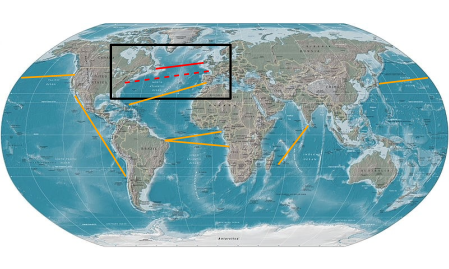
The first transatlantic telegraph cable was laid between Valentia in western Ireland and Trinity Bay Newfoundland in the 1850s. With the invention of fiber optic cables, the number of transatlantic cables has increased. The following map shows some of these cables.
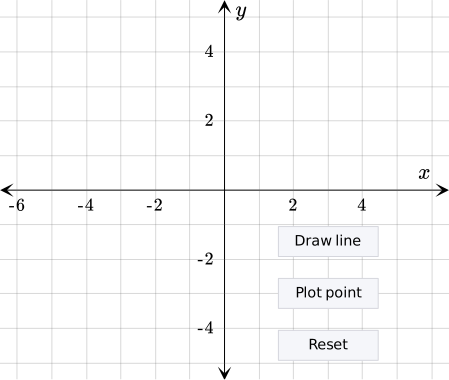
a If Kevin wants to use transformations to find the equation of the parallel line, what would be his next step? Use transformations to write the equation of the parallel line. Write the equation in slope-intercept form.
b Use the Slopes of Parallel Lines Theorem to find the equation of the line. Write the equation in slope-intercept form.
Answer
a Example Next Step: The next step would be determining the number of units needed to vertically translate the given line so that it passes through the given point.
y=1/4x-2
y=1/4x-2
b Equation: y=1/4x-2
Hint
a By which transformation can a line be mapped onto a parallel line?
b What is the slope of the given line?
Solution
a Parallel lines can be mapped onto each other by a translation. Therefore, the next step will be to determine the number of units needed to translate the line so that it passes through V.
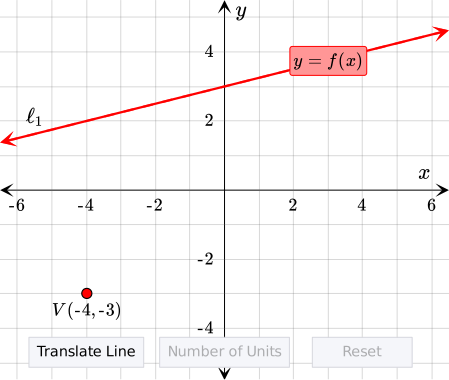 As can be seen in the graph, if the given line is translated 5 units down, a parallel line through V(- 4,- 3) is obtained. As a result, the y-values of the parallel line will be 5 less than the corresponding y-values of the given line. With this knowledge, the equation of the parallel line can be found by following two steps.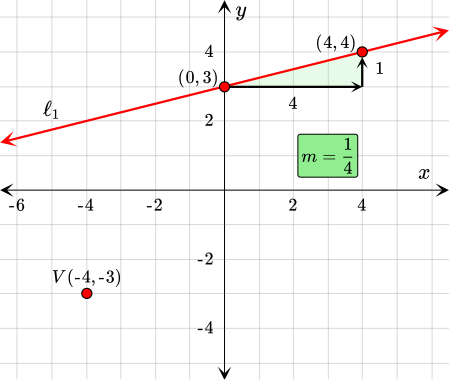
- Find the equation of the given line.
- Translate the given line 5 units down.
Step 1
By observing the graph, it can be seen that the line l_1 passes through the points (0,3) and (4,4). When a slope triangle is constructed between these points, the slope of the line is calculated as 14.
It can be seen that the line intercepts the y-axis at (0, 3). Therefore, the y-intercept is 3. Knowing the slope and the y-intercept of line is enough to write its equation in slope-intercept form. l_1: y= 1/4x+ 3
Step 2
Recall that the y-values of the parallel line are 5 less than the corresponding y-values of the given line. Therefore, to obtain the equation of the desired line, 5 units must be subtracted from the obtained equation. ccc Given Line & &Parallel Line [0.8em] y=f(x) & & y=f(x) - 5 [0.8em] ⇓ & & ⇓ [0.8em] y=1/4x+3 & & y=1/4x+3 - 5 [1em] & & y=1/4x-2
The equation of the parallel line to l_1 through V(- 4, - 3) is y= 14x-2. b Using the points (0,3) and (4,4), the slope of the line is calculated as 14.
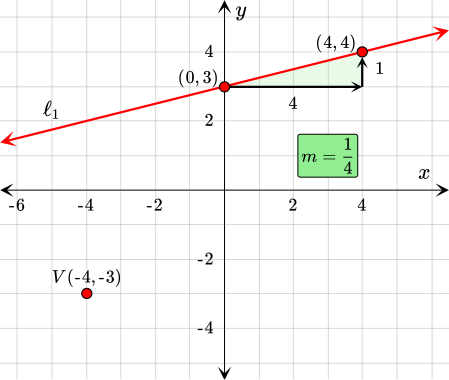 Therefore, by the Slopes of Parallel Lines Theorem, all parallel lines to l_1 have a slope of 14. Then, the equation of the parallel line passing through P can be written as follows, where b is the y-intercept. y= 1/4x+b
Since V(- 4,- 3) should lie on the line, the value of b can be found by substituting its coordinates into the above equation.
The equation of the parallel line to l_1 that passes through V(- 4,- 3) is y= 14x-2. The equation is the same as the equation obtained in Part A, as expected.
Therefore, by the Slopes of Parallel Lines Theorem, all parallel lines to l_1 have a slope of 14. Then, the equation of the parallel line passing through P can be written as follows, where b is the y-intercept. y= 1/4x+b
Since V(- 4,- 3) should lie on the line, the value of b can be found by substituting its coordinates into the above equation.
The equation of the parallel line to l_1 that passes through V(- 4,- 3) is y= 14x-2. The equation is the same as the equation obtained in Part A, as expected.
y=1/4x+b
SubstituteII
x= - 4, y= - 3
- 3=1/4( - 4)+b
▼
Solve for b
MoveRightFacToNumOne
1/b* a = a/b
- 3 = - 4/4+b
MoveNegNumToFrac
Put minus sign in front of fraction
- 3 = - 4/4+b
QuotOne
a/a=1
- 3 = - 1 + b
AddEqn
LHS+1=RHS+1
- 2 = b
RearrangeEqn
Rearrange equation
b=- 2
Example
Share
Report error
Systems of Equations With Parallel or Overlapping Lines
Recall that a system of linear equations can have infinitely many solutions, one solution or no solution. Under which conditions does a system of linear equations have infinitely many solutions or no solution?
Consider the following systems of equations. System I: & y=3x-3 & (I) 2y = 6x-6 & (II) [1.7em] System II: & y=- 5x-3 & (I) y = - 5x-1 & (II) Determine the number of solutions to each system without finding the actual solutions, if exist.Answer
System I: Infinitely many solutions
System II: No solution
Hint
Determine whether the equations in the system represent parallel lines. What does this say about the number of solutions?
Solution
Start by examining the first system of equations. System I: & y=3x-3 & (I) 2y = 6x-6 & (II) Dividing both sides of the second equation by 2 will result in the first equation. This result means that the equations in this system represent the same line. y=3x-3 2y = 6x-6 (II) ÷ 2 y=3x-3 y = 3x-3 Therefore, the lines are coincidental, and they have infinitely many points of intersection. Consequently, System (I) has infinitely many solutions. The equations in the System (II), however, differ in their y-intercepts. System II: & y=- 5x-3 & (I) y = - 5x-1 & (II) Since the equations are written in slope-intercept form, their slopes can be identified as - 5.
| Equation | Slope | y-Intercept |
|---|---|---|
| y= - 5x+ ( - 3) | - 5 | - 3 |
| y= - 5x+ ( - 1) | - 5 | - 1 |
By the Slopes of Parallel Lines Theorem, these lines are parallel and do not intersect. Therefore, System (II) has no solution.
Discussion
Share
Report error
Properties of Different Systems of Equations
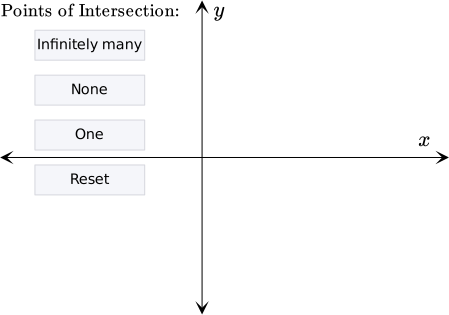
From the previous example, the following conclusions about systems of linear equations can be made.
| Condition | Conclusion | Example |
|---|---|---|
| The lines of the system have the same slope and the same y-intercept. | The lines are coincidental. This means that there are infinitely many points of intersection. Therefore, the system has infinitely many solutions. | y= 3x+ 1 y= 3x+ 1 |
| The lines of the system have the same slope but different y-intercept. | The lines are parallel. This means that there is not a point of intersection. Therefore, the system has no solution. | y= 3x+ 1 y= 3x+ 5 |
| The lines of the system have different slopes. | The lines are neither parallel nor coincidental. This means that there is one point of intersection. Therefore, the system has one solution. | y= 3x+1 y= - 2x+5 |
These conclusions can be seen in the following diagram.
Explore
Share
Report error
Investigating Lines Using Slope Triangles
In the graph below, the slope triangles seem to be congruent. The congruence of these triangles can be shown by a rotation. Move the slider to rotate line l_1 counterclockwise around point A. 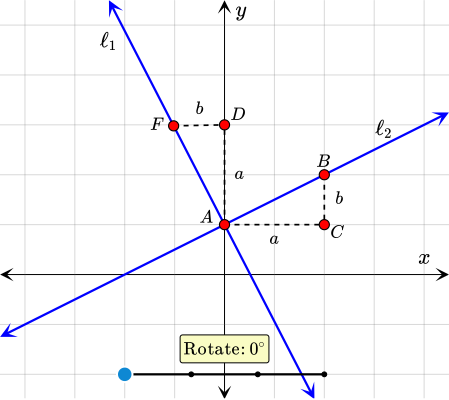 Think about these questions.
- Is it possible to find a relationship between the slopes of the lines before rotating l_1?
- How does the rotation change the slope of line l_1?
Discussion
Share
Report error
Properties of Perpendicular Lines
In the previous graph, it can be seen that the initial angle between the lines measures 90^(∘). Therefore, the lines are perpendicular.
Rule
Share
Report error
Slopes of Perpendicular Lines Theorem
In a coordinate plane, two non-vertical lines are perpendicular if and only if their slopes are negative reciprocals.
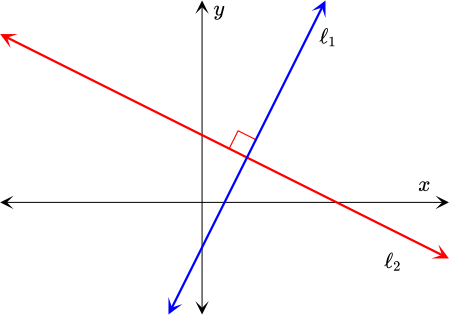
If l_1 and l_2 are two perpendicular lines and m_1 and m_2 their respective slopes, the following relation holds true.
l_1 ⊥ l_2 ⇔ m_1 * m_2=- 1
This theorem does not apply to vertical lines because their slope is undefined. However, vertical lines are always perpendicular to horizontal lines.
Proof
Since the theorem is a biconditional statement, the proof consists of two parts.
- If two non-vertical lines are perpendicular, then the product of their slopes is - 1.
- If the product of the slopes of two non-vertical lines is - 1, then the lines are perpendicular.
Part 1
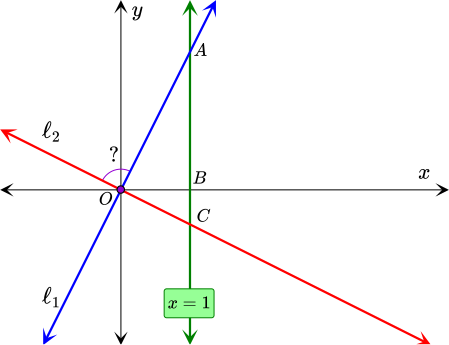
Let l_1 and l_2 be two perpendicular lines. Therefore, they intersect at one point. For simplicity, the lines will be translated so that the point of intersection is the origin.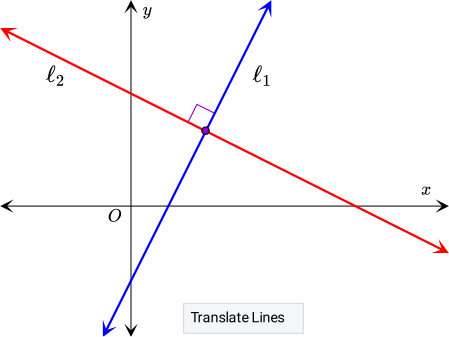
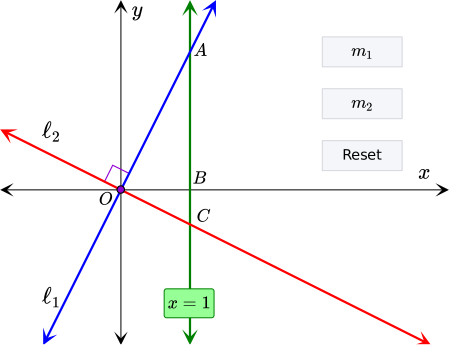
| Side | Points | Distance Formula sqrt((x_2-x_1)^2+(y_2-y_1)^2) | Length |
|---|---|---|---|
| AO | A( 1, m_1) & O( 0, 0) | sqrt(( 0- 1)^2+( 0- m_1)^2) | sqrt(1+m_1^2) |
| CO | C( 1, m_2) & O( 0, 0) | sqrt(( 0- 0)^2+( 0- m_2)^2) | sqrt(1+m_2^2) |
| CA | C( 1, m_2) & A( 1, m_1) | sqrt(( 1- 1)^2+( m_1- m_2)^2) | m_1-m_2 |
AO^2+ CO^2 = CA^2
SubstituteExpressions
Substitute expressions
( sqrt(1+m_1^2) )^2 + ( sqrt(1+m_2^2) )^2 = ( m_1-m_2)^2
▼
Simplify
PowSqrt
( sqrt(a) )^2 = a
1+m_1^2 + 1+m_2^2 = (m_1-m_2)^2
AddTerms
Add terms
2+m_1^2 +m_2^2 = (m_1-m_2)^2
ExpandNegPerfectSquare
(a-b)^2=a^2-2ab+b^2
2+m_1^2 +m_2^2 = m_1^2-2m_1m_2+m_2^2
SubEqn
LHS-m_1^2=RHS-m_1^2
2+m_2^2 = - 2m_1m_2+m_2^2
SubEqn
LHS-m_2^2=RHS-m_2^2
2 = - 2m_1m_2
DivEqn
.LHS /(- 2).=.RHS /(- 2).
2/- 2 = m_1m_2
MoveNegDenomToFrac
Put minus sign in front of fraction
- 2/2 = m_1m_2
QuotOne
a/a=1
- 1 = m_1m_2
RearrangeEqn
Rearrange equation
m_1* m_2 = - 1
l_1 ⊥ l_2 ⇒ m_1* m_2 = - 1
Part 2
Here it is assumed that the slopes of two lines l_1 and l_2 are opposite reciprocals. m_1* m_2 =- 1 Consider the steps taken in Part 1. This time, it should be found that △ AOC is a right triangle.
AO^2+ CO^2 ? = CA^2
SubstituteExpressions
Substitute expressions
(sqrt(1+m_1 ^2))^2+ (sqrt(1+m_2 ^2))^2 ? = (m_1-m_2)^2
▼
Simplify
PowSqrt
( sqrt(a) )^2 = a
1+m_1 ^2 +1+m_2 ^2 ? =(m_1-m_2)^2
AddTerms
Add terms
2+m_1 ^2 +m_2 ^2 ? =(m_1-m_2)^2
ExpandNegPerfectSquare
(a-b)^2=a^2-2ab+b^2
2+m_1 ^2 +m_2 ^2 ? =m_1^2-2m_1 m_2 +m_2 ^2
SubEqn
LHS-m_1^2=RHS-m_1^2
2+m_2 ^2 ? =- 2m_1 m_2 +m_2 ^2
SubEqn
LHS-m_2^2=RHS-m_2^2
2 ? =- 2m_1 m_2
Substitute
m_1 m_2= - 1
2 ? =- 2( - 1)
MultNegNegOnePar
- a(- b)=a* b
2=2 ✓
m_1* m_2 = - 1 ⇒ l_1 ⊥ l_2
The biconditional statement has been proven.
l_1 ⊥ l_2 ⇔ m_1* m_2 = - 1
Pop Quiz
Share
Report error
Practice Finding the Slope of Perpendicular Lines
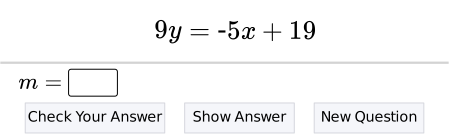
If the equation of a linear function is written in slope-intercept form, its slope can be easily identified. Find the slope of the line perpendicular to the given equation's line. This can be done by rewriting the given equation in slope-intercept form. If necessary, round the answer to two decimal places.
Example
Share
Report error
Identifying the Equation of a Perpendicular Line
Just like with parallel lines, there is an infinite number of perpendicular lines to a given line. Two pieces of information will help in writing the equation of a perpendicular line. These are the slope — which is calculated using the slope of the given line — and a point that lies on the line.
The equation of a line is given in standard form. 2x+y=- 3 Determine the equation of a perpendicular line to the given line that passes through the point (- 2,- 1).{"type":"choice","form":{"alts":["y=0.5x-1","y=2 x+3","y=0.5x","y=x+1"],"noSort":true},"formTextBefore":"","formTextAfter":"","answer":2}
Hint
Start by identifying the slope of the given line. Then, use the Slopes of Perpendicular Lines Theorem.
Solution
For any equation written in slope-intercept form y= mx+b, the value of m is its slope. Since the given equation is not written in this form, it will be rewritten so that the slope can be identified.
2x+y=- 3 ⇔ y= - 2x-3
The given equation's slope is - 2. Now, by the Slopes of Perpendicular Lines Theorem, the product of the slope of the given line and the slope of a line perpendicular must be - 1.
m_1 * m_2 = - 1
By substituting - 2 for m_1 in the above equation, the slope of a perpendicular line m_2 can be found.
This means that any perpendicular line to the given line will have a slope of 0.5. Therefore, a general equation in slope-intercept form for all the lines perpendicular to the given line can be written. y= 0.5x + b
It is given that this perpendicular line passes through the point (- 2,- 1). By substituting this point into the above equation, the value of b will be found.
Therefore, the equation of the perpendicular line to the line with equation 2x+y= - 3 through (2,- 3) is y=0.5x.
Given Line: & 2x+y= - 3 Perpendicular Line: & y = 0.5x
Example
Share
Report error
Finding a Perpendicular Line When Given a Graph and a Point
It has been discussed how to find the equation of a line that is perpendicular to a line whose equation is given. What about finding the equation of a line perpendicular to a line whose graph is given?
Mark and Paulina have been asked to write an equation of a line perpendicular to the line shown in the graph. Additionally, they are told that this perpendicular line should pass through the point (0, 83).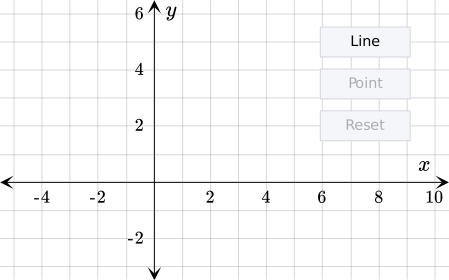
a Determine who is correct.
{"type":"choice","form":{"alts":["Paulina","Mark","None","Both"],"noSort":false},"formTextBefore":"","formTextAfter":"","answer":0}
b Which of the following is the equation of the perpendicular line through (0, 83)?
{"type":"choice","form":{"alts":["y=-2x+3","y=3x+2","y=- 3\/2x+8\/3","y=- 2\/3x+8\/3"],"noSort":false},"formTextBefore":"","formTextAfter":"","answer":3}
Hint
a What does the Slopes of Perpendicular Lines Theorem state?
b Find the slope of the given line.
Solution
a Recall that the Slopes of Perpendicular Lines Theorem states that two nonvertical lines are perpendicular if and only if they have opposite reciprocal slopes. From here, it can be concluded that Paulina is correct and Mark is not.
Paulina: & ✓ Mark: & *
b To find the equation of a perpendicular line, start by determining the slope of the given line.
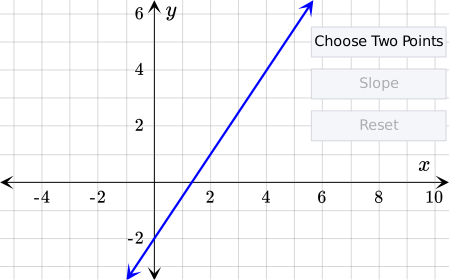 As it can be seen in the graph, the slope of the given line is 32. By the above theorem, the product of the slope of the given line and the slope of a perpendicular line must be - 1.
m_1 * m_2 = - 1
By substituting 32 for m_1 into the above equation, the value of m_2 can be found.
The slope of all perpendicular lines to the given line is - 23. Therefore, a general equation in slope-intercept form for all lines perpendicular to the given line can be written as follows. y= - 2/3x + b
Finally, the value of the y-intercept b needs to be found. It is known that the perpendicular line passes through the point (0, 83). Since the x-coordinate of this point is 0, then the value of b is equal to the y-coordinate of the point, which is 83. With this information, the desired line can be written. Equation of The Perpendicular Line [0.7em] y=- 2/3x+ 8/3
As it can be seen in the graph, the slope of the given line is 32. By the above theorem, the product of the slope of the given line and the slope of a perpendicular line must be - 1.
m_1 * m_2 = - 1
By substituting 32 for m_1 into the above equation, the value of m_2 can be found.
The slope of all perpendicular lines to the given line is - 23. Therefore, a general equation in slope-intercept form for all lines perpendicular to the given line can be written as follows. y= - 2/3x + b
Finally, the value of the y-intercept b needs to be found. It is known that the perpendicular line passes through the point (0, 83). Since the x-coordinate of this point is 0, then the value of b is equal to the y-coordinate of the point, which is 83. With this information, the desired line can be written. Equation of The Perpendicular Line [0.7em] y=- 2/3x+ 8/3
Closure
Share
Report error
Using Properties of Parallel Lines To Classify Parallelograms
The theorems seen in this lesson can be used to identify quadrilaterals and some of their properties.
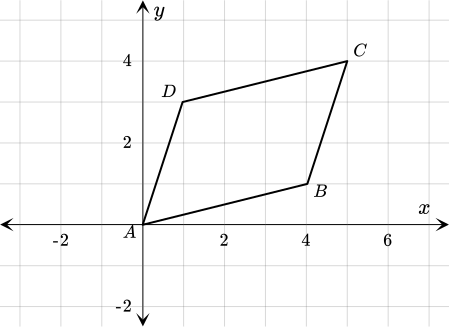
Determine whether quadrilateral ABCD is a parallelogram. Explain the reasoning.
Answer
Yes, see solution.
Hint
Recall that a parallelogram is a quadrilateral with two pairs of parallel sides.
Solution
From the graph, it appears that AB and CD are parallel and that BC and DA are parallel. To prove this claim, start by finding the slope of each side.
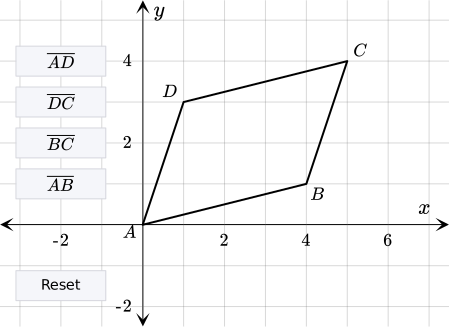 As it can be seen, the slopes of the sides AB and DC are the same, as well as the slopes of AB and DC. Therefore, by the Slopes of Parallel Lines Theorem, AB and DC are parallel and BC and AD are parallel. AB ∥ DC and BC ∥ AD
Since the given quadrilateral has two pairs of parallel sides, it is a parallelogram.
As it can be seen, the slopes of the sides AB and DC are the same, as well as the slopes of AB and DC. Therefore, by the Slopes of Parallel Lines Theorem, AB and DC are parallel and BC and AD are parallel. AB ∥ DC and BC ∥ AD
Since the given quadrilateral has two pairs of parallel sides, it is a parallelogram.
Answer
Yes, see solution.
Hint
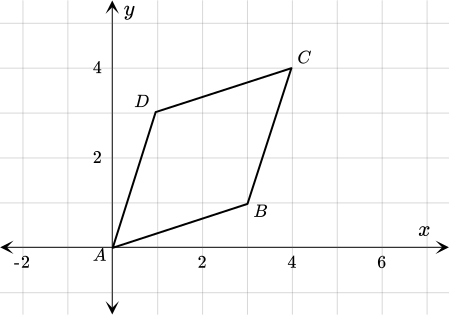
Start by drawing the diagonals of the rhombus. Then, find the slopes of the diagonals.
Solution
Start by drawing the diagonals of the rhombus. Then, find the slopes of the diagonals.
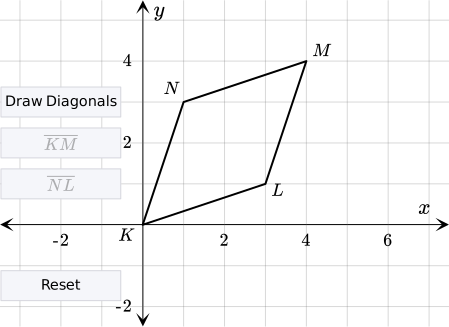 The slope m_1 of KL is 1 and the slope m_2 of NL is - 1. Notice that their product is - 1.
m_1 * m_2 = 1 ( - 1) = - 1
By the Slopes of Perpendicular Lines Theorem, it can be concluded that the diagonals are perpendicular to each other.
KM ⊥ LN
The slope m_1 of KL is 1 and the slope m_2 of NL is - 1. Notice that their product is - 1.
m_1 * m_2 = 1 ( - 1) = - 1
By the Slopes of Perpendicular Lines Theorem, it can be concluded that the diagonals are perpendicular to each other.
KM ⊥ LN
Slope of Parallel and Perpendicular Lines
Exercise 3.1
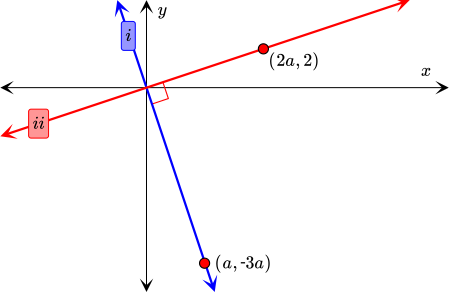
Determine the value of a.
{"type":"text","form":{"type":"math","options":{"comparison":"1","nofractofloat":false,"keypad":{"simple":true,"useShortLog":false,"variables":["x"],"constants":["PI"]},"rendered":false},"text":" "},"formTextBefore":"a=","formTextAfter":null,"answer":{"text":["3"]}}
security
report
code
security
report
code
Examining the coordinate plane, we notice that line i passes through (a,- 3 a) and the origin. By substituting these points in the Slope Formula, we can determine the slope of the line, m_i.
Since line ii forms a right angle with line i we know that they are perpendicular. Recall that the product of the slopes of perpendicular lines is - 1. m_1 * m_2=- 1 If we substitute -3 for m_i we can solve for m_(ii).
Let's substitute the point ( 2a, 2), the origin ( 0, 0), and m_(ii)= 13 into the Slope Formula.
The value of a is 3.
security
report
code
The following characteristics are known about the relationship of two lines.
- They are perpendicular.
- They have the same y-intercept.
- The first line passes through (a,b).
- The second line passes through (- a,b).
{"type":"text","form":{"type":"roots","options":{"comparison":"1","nofractofloat":false,"keypad":{"simple":true,"useShortLog":false,"variables":["x"],"constants":["PI"]},"rendered":false,"hideNoSolution":true,"variable":"m"},"text":" "},"formTextBefore":null,"formTextAfter":null,"answer":{"texts":["1","-1"]}}
security
report
code
security
report
code
Let's begin by illustrating in acoordinate plane a situation that matches the description. We know that the lines are perpendicular and have the same y-intercept.
We are also told that one line passes through (a,b) and the other passes through (- a, b). Let's mark two points in accordance with this description. Let's also mark the y-intercept which we will label (0,c).
We have two points on each line. By substituting these into the Slope Formula we can write expressions for their slopes.
Slope of L1
Slope of L2
Writing a System of Equations
Notice that the expressions we found for the slopes are very similar. Let's use this similarity to express their slopes in relation to each other.
We know that the lines are perpendicular. Therefore, their slopes are negative reciprocals. Let's use this to find a second way to express their slopes in relation to each other. m_1* m_2=- 1 ⇒ m_(L1)* m_(L2)=- 1 Together these expressions form a system of equations. - m_(L2)= m_(L1) & (I) m_(L1) * m_(L2)=- 1 & (II)
Solving for m_(L1)
We will now use Equation (I) to rewrite Equation (II) into having only one variable.
To find the slope of L1 we can solve Equation (II).
There are two possible values for the slope of L1. m_(L1)=1 and m_(L1)=-1
security
report
code
Slope of Parallel and Perpendicular Lines
Recommended exercises
To get personalized recommended exercises, please login first.
Loading content
≤
>
■2
■▢
e▢
7
8
9
×
÷■1
=
=
√▢
▢√
∫▢▢
4
5
6
+
−
≤
<
log
ln
log▢
1
2
3
()
∣
sin
cos
tan
0
.
π
x
y
Loading content