{{ tocSubheader }}
{{ 'ml-label-loading-course' | message }}
An error ocurred, try again later!
Chapter {{ article.chapter.number }}
{{ article.number }}.
{{ article.displayTitle }}
{{ article.intro.summary }}
Show less Show more expand_more Lesson Settings & Tools
| | {{ 'ml-lesson-number-slides' | message : article.intro.bblockCount }} |
| | {{ 'ml-lesson-number-exercises' | message : article.intro.exerciseCount }} |
| | {{ 'ml-lesson-time-estimation' | message }} |
In this lesson, strategies for adding, subtracting, and multiplying integers will be expanded to include decimal numbers. Although performing such operations on decimals is similar to performing them on integers, there are certain rules that need to be followed. These strategies will be developed in this lesson.
Catch-Up and Review
Here are a few recommended readings before getting started with this lesson.
Challenge
Zosia's Rectangular Model
Zosia draws a rectangle to represent the product of two whole numbers. The rectangle has a width of 2 units and a length of 3 units. Additionally, the area of the rectangle is the same as the product of the two numbers, which is 6.
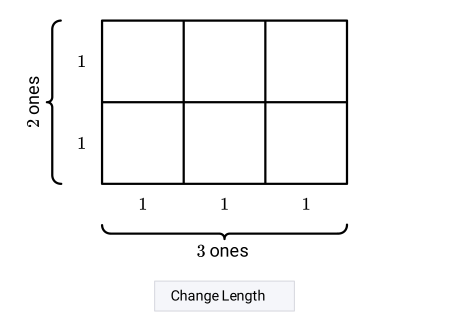 Zosia then wondered,
What would the product be if the side length of each square was 0.1 unit long?In that case, could the rectangle be used to represent 0.2×0.3? Help Zosia answer the following questions.
{"type":"text","form":{"type":"math","options":{"comparison":"1","nofractofloat":false,"keypad":{"simple":true,"useShortLog":false,"variables":["x"],"constants":["PI"]},"rendered":false},"text":"<span class=\"katex\"><span class=\"katex-html\" aria-hidden=\"true\"><\/span><\/span>"},"formTextBefore":null,"formTextAfter":"square units","answer":{"text":["0.01"]}}
b Use the small squares to find the product of 0.2 and 0.3.
{"type":"text","form":{"type":"math","options":{"comparison":"1","nofractofloat":false,"keypad":{"simple":true,"useShortLog":false,"variables":["x"],"constants":["PI"]},"rendered":false},"text":"<span class=\"katex\"><span class=\"katex-html\" aria-hidden=\"true\"><\/span><\/span>"},"formTextBefore":null,"formTextAfter":null,"answer":{"text":["0.06"]}}
Discussion
Place Value Chart
A place value chart is a table that displays the correct place of a digit in a number. Place value charts are useful for ensuring that digits are aligned correctly. For example, consider a decimal number.
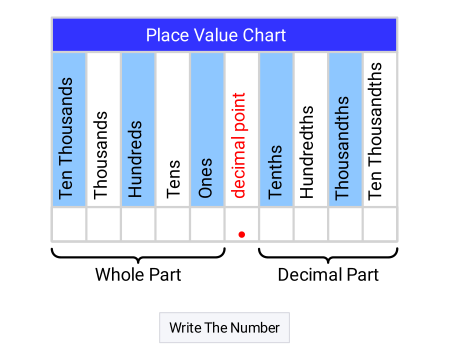 Place value charts can be used when adding and subtracting decimals.
Decimal Number673.452
The digits in this decimal number can be written in the place value chart to check their position. The aim here is to identify the positional values of different digits in the number accurately. It can be easier to start by writing the digits around the decimal point.
Discussion
Adding and Subtracting Decimals
The rules for adding and subtracting decimals are similar to the general rules for adding and subtracting integers. The most important point is to align the decimal points correctly. For example, consider adding the following decimal numbers.
Note that the subtraction of decimals is done in the same way.
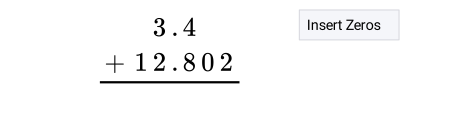
3.4+12.802
There are three steps to finding this sum. 1
Line up the Decimal Points
expand_more The first step is to line up the decimal points. The sum is written so that the decimal points are on top of each other.
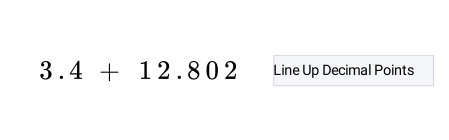 The numbers are now written vertically. A place value chart can also be used to align the decimal places.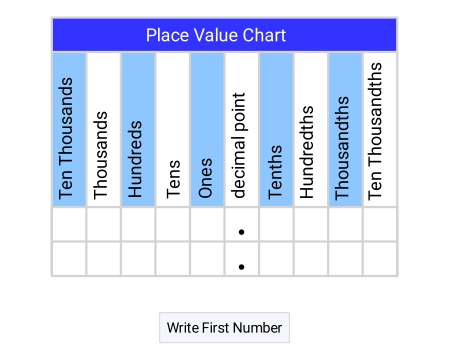
2
Place Zeros at the End of a Decimal If Needed
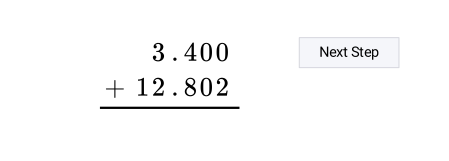
expand_more The first number does not have the same number of decimal places as the second number. Place zeros so that the numbers have the same number of decimal places.
 Now that the decimal digits in each of the numbers are equal, it will be easier to add or subtract these numbers.
3
Add Digits with the Same Place Value
expand_more Temporarily ignore the decimal point and add the digits that have the same place value. This is the same as adding two integers. After that, bring down the decimal point.
 The sum of the given numbers is 16.202.
Example
How Long Is Zosia's Video?
Zosia likes singing. She decides to record a video of herself singing.

She records two video clips. The first video clip is 4.56 minutes long and the second is 5.54 minutes long.
a Zosia merges these two video clips. What is the total length of the video?
{"type":"text","form":{"type":"math","options":{"comparison":"1","nofractofloat":false,"keypad":{"simple":true,"useShortLog":false,"variables":["x"],"constants":["PI"]},"rendered":false},"text":"<span class=\"katex\"><span class=\"katex-html\" aria-hidden=\"true\"><\/span><\/span>"},"formTextBefore":null,"formTextAfter":"minutes","answer":{"text":["10.1"]}}
b Zosia removes 1.27 minutes from the video after reviewing it. What is the final length of the video?
{"type":"text","form":{"type":"math","options":{"comparison":"1","nofractofloat":false,"keypad":{"simple":true,"useShortLog":false,"variables":["x"],"constants":["PI"]},"rendered":false},"text":"<span class=\"katex\"><span class=\"katex-html\" aria-hidden=\"true\"><\/span><\/span>"},"formTextBefore":null,"formTextAfter":"minutes","answer":{"text":["8.83"]}}
Hint
a Line up the decimal points so that place-value positions correspond to each other before adding any decimal numbers.
b Line up the decimal points so that place-value positions correspond to each other before doing the subtraction. If necessary, add zeros so that the numbers have the same number of decimal places.
Solution
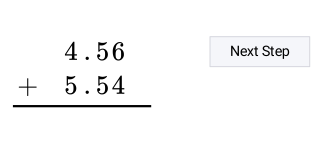
a The total length of the video is the sum of the lengths of the clips. The given numbers are decimals, so the first step is to line up the decimal points so that place-value positions correspond to each other.
+4.565.54
There is no need to add zeros to the end of either number here because they both have the same number of decimal places. Ignore the decimal point for the moment and continue adding as usual. Then, finally, add the decimal point to the sum.
b In the previous part it was found that the video is 10.1 minutes long. Now Zosia wants to remove some parts from the video. The final length of the video will be the difference between 10.1 and 1.27.
−10.1 1.27
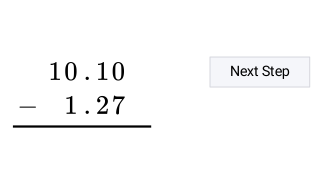
Notice that the numbers do not have the same number of decimal places. To make the subtraction easier, add one zero to the end of the first number so that both numbers have an equal number of decimal places.
−10.10 1.27
Now ignore the decimal points and continue subtracting as usual, then place the decimal point in the difference.
Pop Quiz
Finding the Sum and Difference of Decimals
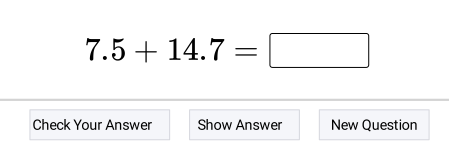
Recall the steps to follow to add and subtract decimals. First, align the decimal numbers by their place values, one below the other. Then, perform the operation just like as if the numbers were integers. Finally, place the decimal point to the answer. Follow these steps to find the sum or difference shown in the applet.
Discussion
Estimating Products by Rounding
Estimation is used to find a value that is close to the exact value of a product. This can be done by rounding the factors in the product to the greatest place value — the first non-zero digit on the left in a number. For example, consider the product of two decimal numbers.
35.92×0.014
Estimating this product can be done in two steps. 1
Round The Factors
expand_more The factors in the product will be rounded to the greatest place value to make it easier to compute mentally. In the first factor 35.92, the digit with the greatest place value is 3. In the other factor 0.014, the digit with the greatest place value is 1.
The first factor will be rounded to the nearest ten. Since 5 is greater than or equal to 5, add 1 to the number in the rounded place 3. All place values to the right of 3 are replaced with zeros.
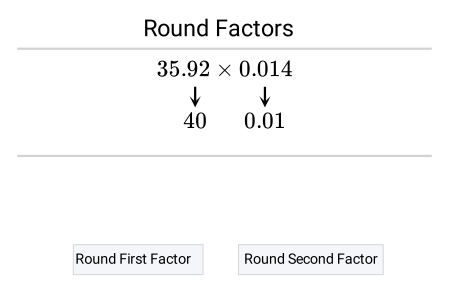
35.92×0.014
Next, look at the digit to the right of the greatest place. - If the digit is less than 5, the underlined number remains the same.
- If the digit is 5 or greater, add 1 to the underlined number.
Next, make all digits to the right of the greatest place value zero. For 35.92, the digit to the right of the greatest place value is 5. For 0.014, the digit to the right of the greatest place value is 4.
| Estimate 35.92×0.014 | ||
|---|---|---|
| Factor | Greatest Place Value | Digit to the Right |
| 35.92 | Tens | 5 |
| 0.014 | Hundredths | 4 |
35.92≈40.00(or 40)
Similarly, for 0.014, the digit to the right of the greatest place value is 4. This is less than 5, so 1 remains the same and all place values to the right of 1 have a value of zero.
0.014≈0.010(or 0.01)
The numbers have now been rounded to their greatest place values. The procedure is visualized in the following applet.
2
Multiply The Rounded Factors
expand_more Now multiply the rounded numbers. Since 0.01 is 10-2, it will move the decimal point in the other factor two places to the left.
×400.010.40
The given product is about 0.4. 35.92×0.014≈0.4
Discussion
Multiplying Decimals
Multiplying decimals has the same procedure as multiplying integers. The only difference is where the decimal point is placed in the product. The procedure will be demonstrated with an example.
1.69×3.7
The following steps can be followed to multiply decimals.
1
Multiply Ignoring the Decimal Point
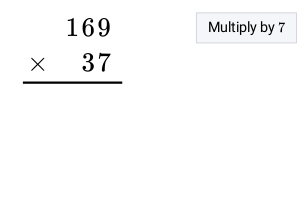
expand_more Ignore the decimal points for now and multiply the numbers as if multiplying integers.
2
Count the Number of Decimal Places in the Factors
expand_more After the numbers are multiplied, count the total number of decimal places in each factor.
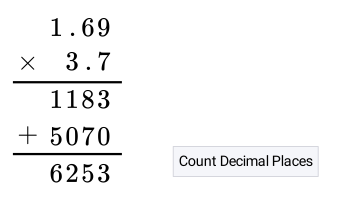 The sum of the decimal places is 3.
3
Locate the Decimal Point in the Product
expand_more The number of decimal places in the product is the sum of the decimal places in the factors. In the previous step, it was found that there were 3 decimal places in the example factors. This means that the product will have 3 decimal places as well.
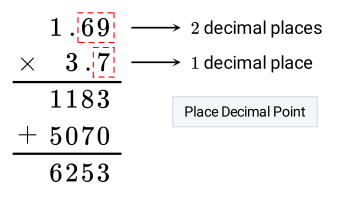 The product of 1.69 and 3.7 is 6.253.
Example
How Much Will Zosia's Brother Pay Her?
Zosia shares her video on a video sharing platform.

External credits: upklyak
Mark, Zosia's brother, promises to pay Zosia $1.75 for each view of her video. So far, 59 people have watched the video.
a Estimate the amount that Mark will pay.
{"type":"text","form":{"type":"math","options":{"comparison":"1","nofractofloat":false,"keypad":{"simple":true,"useShortLog":false,"variables":["x"],"constants":["PI"]},"rendered":false},"text":"<span class=\"katex\"><span class=\"katex-html\" aria-hidden=\"true\"><\/span><\/span>"},"formTextBefore":"About","formTextAfter":"dollars","answer":{"text":["120"]}}
b Find the exact amount that Mark will pay.
{"type":"text","form":{"type":"math","options":{"comparison":"1","nofractofloat":false,"keypad":{"simple":true,"useShortLog":false,"variables":["x"],"constants":["PI"]},"rendered":false},"text":"<span class=\"katex\"><span class=\"katex-html\" aria-hidden=\"true\"><\/span><\/span>"},"formTextBefore":null,"formTextAfter":"dollars","answer":{"text":["103.25"]}}
Hint
a Round the numbers to the greatest place value to make it easier to calculate mentally. Round 59 to the nearest ten and 1.75 to the nearest whole number.
b Multiply decimal numbers like multiplying whole numbers. Place the decimal point in the product by counting the number of decimal places in each factor.
Solution
a The product of the given numbers will be the amount that Mark will pay.
59×1.75
Each factor will be rounded to the greatest place value to estimate this product. In the number 59, the digit with the greatest place value is 5. In the other factor, the digit with the greatest place value is 1.
59×1.75
Now, take a look at the digit to the right of the greatest place value. - If the digit is less than 5, the underlined number remains the same.
- If the digit is 5 or greater, add 1 to the underlined number.
59↓60×1.75
For 1.75, the number in the tenths place is 7. Since 7 is greater than 5, the number in the rounded place 1 is increased by 1 and the other digits are converted to 0. In this case, the zeros can be ignored because they will not change the value of the product.
59↓60××1.75↓2
The product of 60 and 2 is 120. Mark will pay about 120 dollars.
b The whole number and the decimal number must be multiplied to find the exact amount that Mark will pay.
59×1.75
The steps for multiplying these numbers is the same as multiplying two decimal numbers. - Multiply the numbers as if the decimal factor were a whole number.
- Count the number of decimal places in the decimal factor.
- The number of decimal places in the product is the same as the number of decimal places in the decimal factor.
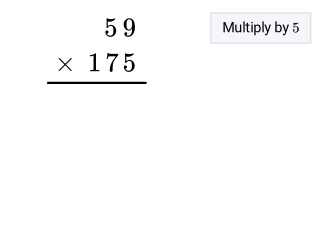
59× 1.75103.25→→←0 decimal places+2 decimal places2 decimal places
The product is 103.25. This means that Mark will pay Zosia 103.25 dollars.
Example
How Much Does The Platform Pay?
In addition to the amount that Mark gives her, Zosia also earns money per view from the video sharing platform.

The platform pays 0.113 times what Mark paid for 59 views.
a Recall that Mark paid $103.25. Estimate the amount that the platform pays by rounding the factors to their greatest place values.
{"type":"text","form":{"type":"math","options":{"comparison":"1","nofractofloat":false,"keypad":{"simple":true,"useShortLog":false,"variables":["x"],"constants":["PI"]},"rendered":false},"text":"<span class=\"katex\"><span class=\"katex-html\" aria-hidden=\"true\"><\/span><\/span>"},"formTextBefore":"About","formTextAfter":"dollars","answer":{"text":["10"]}}
b Find the exact amount that the platform pays.
{"type":"text","form":{"type":"math","options":{"comparison":"1","nofractofloat":false,"keypad":{"simple":true,"useShortLog":false,"variables":["x"],"constants":["PI"]},"rendered":false},"text":"<span class=\"katex\"><span class=\"katex-html\" aria-hidden=\"true\"><\/span><\/span>"},"formTextBefore":null,"formTextAfter":"dollars","answer":{"text":["11.67"]}}
Hint
a Round the numbers to the greatest place value to make it easier to calculate mentally. In this case, round 103.25 to the nearest hundred and 0.113 to the nearest tenth.
Solution
a The product of 103.25 and 0.113 is what the platform pays for 59 views. The factors in this product will be rounded to the greatest place value to find an estimate for the product.
103.25×0.113
The digit to the right of the greatest place value determines how the number is rounded. - If the digit is less than 5, the number in the rounded place remains the same.
- If the digit is 5 or greater, add 1 to the number in the rounded place.
103.25×0.113
In 103.25, the digit in the tens place is 0. Since 0 is less than 5, the digit in the hundreds place 1 remains the same and the other digits are replaced with 0. This results in the estimated number 100.
103.25↓100×0.113
In 0.113, the number in the hundredths place is 1. Since 1 is less than 5, the number in the tenth place 1 is kept unchanged. Then, the other digits are replaced with 0. Since these zeros do not change the value of the number, they can be omitted.
103.25↓100××0.113↓0.1
Multiplying a number by 0.1 means dividing the number by 10 because 0.1=101. This means that the product of 100 and 0.1 is 10.
100×0.1
▼
Evaluate
10
b Recall the steps when multiplying two decimal numbers.
- Multiply as if the factors were whole numbers.
- Count the number of decimal places in each factor.
- The number of decimal places in the product is the sum of the number of decimal places in each factor.
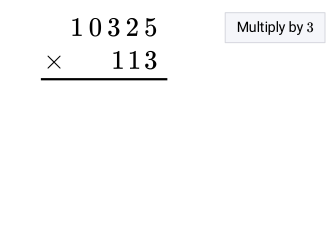
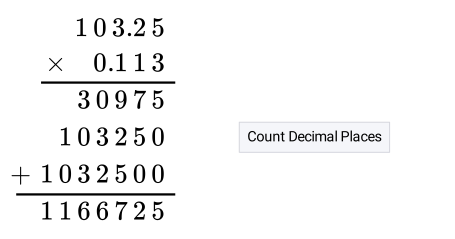
11.66275⟶Round11.67
The platform pays 11.67 dollars for 59 views. This is close the estimate found in Part A, so this answer is reasonable. Pop Quiz
Finding the Product of Decimals
Multiply the decimal numbers. Make sure that the decimal point is placed correctly!
Closure
Modeling the Product of Numbers
Mathematical operations such as addition, subtraction, and multiplication are performed on decimal numbers in a similar way that they are performed on integers. The most important point here is where to place the decimal point. Now consider Zosia's rectangle that can be used to represent the product of two numbers.
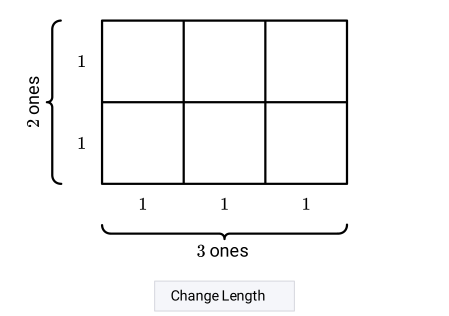 Zosia changes the side length of each square to 0.1. Answer the following questions according to the given model.
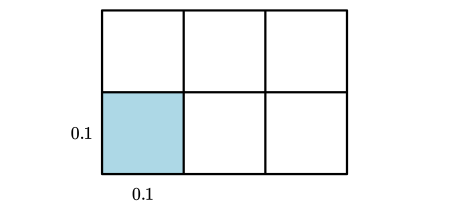 Since the area of a square is the product of its two sides, this square has an area of 0.1×0.1 square units.
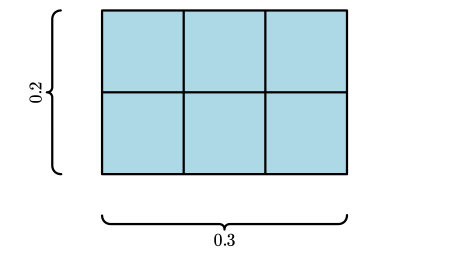
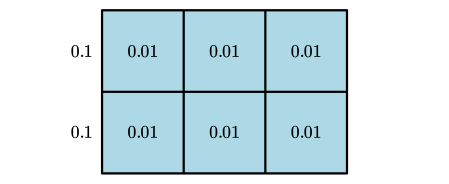 Since there are 6 small squares, the area of the rectangle can be found by multiplying 0.01 by 6. Multiply the numbers as if they were whole numbers.
Either way, the answer is the same!
Since there are 6 small squares, the area of the rectangle can be found by multiplying 0.01 by 6. Multiply the numbers as if they were whole numbers.
Either way, the answer is the same!
{"type":"text","form":{"type":"math","options":{"comparison":"1","nofractofloat":false,"keypad":{"simple":true,"useShortLog":false,"variables":["x"],"constants":["PI"]},"rendered":false},"text":"<span class=\"katex\"><span class=\"katex-html\" aria-hidden=\"true\"><\/span><\/span>"},"formTextBefore":null,"formTextAfter":"square units","answer":{"text":["0.01"]}}
b Use the small squares to find the product of 0.2 and 0.3.
{"type":"text","form":{"type":"math","options":{"comparison":"1","nofractofloat":false,"keypad":{"simple":true,"useShortLog":false,"variables":["x"],"constants":["PI"]},"rendered":false},"text":"<span class=\"katex\"><span class=\"katex-html\" aria-hidden=\"true\"><\/span><\/span>"},"formTextBefore":null,"formTextAfter":null,"answer":{"text":["0.06"]}}
Hint
a The area of a square is the product of its two sides.
b Use the area of the squares to find the area of the rectangle.
Solution
a The given rectangle consists of six squares. Each square has a side length of 0.1 unit.
0.1×0.1
Now multiply the decimals as if they were whole numbers.
1×1=1
Then, count the number of decimal places in each factor and add them.
0.1× 0.1 →→ 1 decimal place + 1 decimal place 2 decimal places
The number of decimal places in the product must be 2. Insert zeros to the left of 1 and move the decimal point two places to the left.
0.1× 0.10.01→→←1 decimal place + 1 decimal place 2 decimal places
The area of a single square is 0.01 square unit.
b Notice that the area of the rectangle is the product of 0.2 and 0.3. This means that finding the area of the rectangle is the same as finding 0.2×0.3.
In the previous part, it is found that the area of a each square is 0.01.
1×6=6
The sum of the number of decimal places in each factor is 2. This means that the number of decimal places in the product must be 2.
0.01× 60.06→→←+2 decimal places0 decimal places2 decimal places
The area of the rectangle is 0.06. This is also equal to the product of 0.2 and 0.3. Alternatively, the Commutative and Associative Properties of Multiplication can be used to find the product.
0.2×0.3
▼
Rewrite
Rewrite
Rewrite 0.2 as 2×0.1
(2×0.1)×0.3
Rewrite
Rewrite 0.3 as 3×0.1
(2×0.1)×(3×0.1)
AssociativePropMult
Associative Property of Multiplication
2×(0.1×3×0.1)
CommutativePropMult
Commutative Property of Multiplication
2×(3×0.1×0.1)
AssociativePropMult
Associative Property of Multiplication
(2×3)×(0.1×0.1)
Multiply
Multiply
6×0.01
Multiply
Multiply
0.06
Loading content