Table of contents
Sign In
An error ocurred, try again later!
Chapter 6
3.
Writing and Solving Two-Step Equations
This lesson is a comprehensive guide on solving two-step equations, a critical concept in algebra. It emphasizes the role of inverse operations and properties of equality in finding solutions. The lesson is particularly useful for real-world applications, such as planning a cycling trip or splitting meal costs. By understanding these mathematical principles, one can tackle a variety of challenges in daily life, from calculating travel distances to budgeting expenses. The teaching approach combines theoretical explanations with practical examples, offering a well-rounded understanding of the subject.
Show less Show more expand_more Lesson Settings & Tools
| | 10 Theory slides |
| | 12 Exercises - Grade E - A |
| | Each lesson is meant to take 1-2 classroom sessions |
Writing and Solving Two-Step Equations
Slide of 10
Real-life situations are modeled by equations. At times, two operations are applied to a variable. Sometimes, the variable is on both sides of the equation. Then, that variable can be isolated to one side by transferring the variable terms using inverse operations. This lesson covers how to write and solve such two-step equations.
Catch-Up and Review
Here are a few recommended readings before getting started with this lesson.
Challenge
Bike Trip
Zain and Jordan planned an adventure across a vast desert landscape. They will cycle for three days until they reach a huge music festival! The first two days, Zain and Jordan need to cycle the same distance each day. On the third day, they will have 10 miles remaining to be cycled.

The total distance Zain and Jordan cycle during the trip is 60 miles. If they miscalculate their trip, they will miss the festival!
a Write an equation that represents the situation. Use d as the variable.
{"type":"text","form":{"type":"math","options":{"comparison":"1","nofractofloat":false,"keypad":{"simple":false,"useShortLog":false,"variables":["d"],"constants":[]},"rendered":false},"text":"<span class=\"katex\"><span class=\"katex-html\" aria-hidden=\"true\"><\/span><\/span>"},"formTextBefore":null,"formTextAfter":null,"answer":{"text":["2d+10=60","60=2d+10","2d=60-10","60-10=2d","60-2d=10","10=60-2d"]}}
b Solve the equation to find the distance Zain and Jordan plan to cover on each of the first two days.
{"type":"text","form":{"type":"math","options":{"comparison":"1","nofractofloat":false,"keypad":{"simple":true,"useShortLog":false,"variables":[],"constants":[]},"rendered":false},"text":"<span class=\"katex\"><span class=\"katex-html\" aria-hidden=\"true\"><\/span><\/span>"},"formTextBefore":null,"formTextAfter":"miles","answer":{"text":["25"]}}
Discussion
One- and Two-Step Equations
Equations can be named according to the minimum number of inverse operations needed to solve them.
One-Step Equations
A one-step equation is an equation that needs only one inverse operation to be solved. Below is an example of a one-step equation.x+4=9
This equation can be solved by subtracting 4 from both sides.
Two-Step Equations
A two-step equation is an equation that needs two inverse operations to be solved. Below is an example of a two-step equation.2x−3=11
This equation can be solved by first adding 3 to both sides and then dividing both sides by 2. 2x−3=11
AddEqn
LHS+3=RHS+3
2x−3+3=11+3
AddTerms
Add terms
2x=14
DivEqn
LHS/2=RHS/2
22x=214
MovePartNumRight
ca⋅b=ca⋅b
22x=214
CalcQuot
Calculate quotient
1x=7
IdPropMult
Identity Property of Multiplication
x=7
Example
Unfortunate Accident
Zain and Jordan are cycling along. Already on their first day, they ran into a problem! Zain's tire got a terrible flat and they do not have a spare to replace it. They need to buy a new tire.
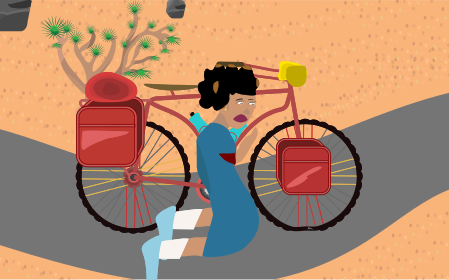
They head into town to buy extra tires to be better prepared.
a Zain and Jordan decide to buy 3 tires. They told the owner of the bike shop about their trip. He is so impressed that he gives them a $10 discount. Together, they will need to pay $41. This situation is modeled by the following equation, where t is the price of a single tire.
3t−10=41
Solve this equation to find the price of a single tire. Check the answer. {"type":"text","form":{"type":"math","options":{"comparison":"1","nofractofloat":false,"keypad":{"simple":true,"useShortLog":false,"variables":["x"],"constants":["PI"]},"rendered":false},"text":"<span class=\"katex\"><span class=\"katex-html\" aria-hidden=\"true\"><\/span><\/span>"},"formTextBefore":"<span class=\"katex\"><span class=\"katex-html\" aria-hidden=\"true\"><span class=\"base\"><span class=\"strut\" style=\"height:0.61508em;vertical-align:0em;\"><\/span><span class=\"mord mathdefault\">t<\/span><span class=\"mspace\" style=\"margin-right:0.2777777777777778em;\"><\/span><span class=\"mrel\">=<\/span><span class=\"mspace\" style=\"margin-right:0.2777777777777778em;\"><\/span><\/span><span class=\"base\"><span class=\"strut\" style=\"height:0.80556em;vertical-align:-0.05556em;\"><\/span><span class=\"mord\">$<\/span><\/span><\/span><\/span>","formTextAfter":null,"answer":{"text":["17"]}}
b While in town, they appease their appetites and order a ton of quesadillas.
 The two friends want to split the cost of the meal in half. Jordan decides to add $5 as a tip. In total, Jordan pays $20. This situation can be modeled by the following equation, where m is the cost of their meal.
2m+5=20
Solve this equation to find the total price of the meal. Then, check the answer. {"type":"text","form":{"type":"math","options":{"comparison":"1","nofractofloat":false,"keypad":{"simple":true,"useShortLog":false,"variables":["x"],"constants":["PI"]},"rendered":false},"text":"<span class=\"katex\"><span class=\"katex-html\" aria-hidden=\"true\"><\/span><\/span>"},"formTextBefore":"<span class=\"katex\"><span class=\"katex-html\" aria-hidden=\"true\"><span class=\"base\"><span class=\"strut\" style=\"height:0.43056em;vertical-align:0em;\"><\/span><span class=\"mord mathdefault\">m<\/span><span class=\"mspace\" style=\"margin-right:0.2777777777777778em;\"><\/span><span class=\"mrel\">=<\/span><span class=\"mspace\" style=\"margin-right:0.2777777777777778em;\"><\/span><\/span><span class=\"base\"><span class=\"strut\" style=\"height:0.80556em;vertical-align:-0.05556em;\"><\/span><span class=\"mord\">$<\/span><\/span><\/span><\/span>","formTextAfter":null,"answer":{"text":["30"]}}
Hint
a Use the Addition and Division Properties of Equality.
b Use the Subtraction and Multiplication Properties of Equality.
Solution
a When solving equations with one variable, the variable is isolated on one side of the equation. This can be done by using inverse operations because inverse operations undo each other. In the given equation, the variable t is multiplied by 3 and then 10 is subtracted from the product.
3t−10=41
These operations need to be undone in reverse order. The first operation to be undone is the subtraction. The inverse operation of subtraction is addition, so 10 is added to each side of the equation. The Addition Property of Equality ensures that both sides of the equation remain equal.
Now the multiplication can be undone. The inverse operation of multiplication is division, so both sides of the equation are divided by 3. This does not change the solution to the equation by the Division Property of Equality.
3t=51
DivEqn
LHS/3=RHS/3
33t=351
CrossCommonFac
Cross out common factors
33t=351
CancelCommonFac
Cancel out common factors
t=351
CalcQuot
Calculate quotient
t=17
b Recall that the variable is isolated on one side when solving equations in one variable. Inverse operations play a role in isolating the variable because they
undoeach other. Consider the given equation. Here, the variable m is divided by 2 and then 5 is added to the result.
2m+5=20
These operations need to be undone in reverse order. This means undoing the addition first. The inverse operation of addition is subtraction, so the Subtraction Property of Equality is used to subtract 5 from both sides of the equation.
Next, the division is undone. The inverse operation of division is multiplication, so the Multiplication Property of Equality is used and both sides of the equation are multiplied by 2.
The solution to the equation is m=30, which means that the cost of the meal is $30. The solution 30 can be substituted for m in the equation to check the answer.
Substituting 30 for m into the equation results in a true statement. This means that m=30 is the correct solution.
Discussion
Equations With Variables on Both Sides
An equation can have variable terms on both sides. When solving this type of equation, it is necessary to transfer all the variable terms to one side. Once all variable terms are on the same side, they can be combined. Consider an example equation with variable terms on both sides.
3x=x−2
There are three main steps to follow when solving this type of equation.
1
Transferring Variable Terms to One Side
expand_more Inverse operations and the Properties of Equality are used to move all the variable terms to one side of the equation. In this case, the Subtraction Property of Equality is used to subtract x from both sides of the equation.
3x3x−x=x−2⇓=x−2−x
2
Combining Like Terms
expand_more Then, the equation is simplified by combining like terms. This results in an equation with just one variable term.
3x−x2x=x−2−x⇓=-2
Example
Taking a Break
On the second day of this ride to the festival, Zain and Jordan begin to wonder about some of the data from their ride.
a Zain noticed that they covered one-fifth of the distance they planned for the day. Jordan said that they still have 20 miles to go. The distance they covered so far is the difference of the total distance planned for the day and 20 miles.
5t=t−20
This equation models the described situation. Here, t represents the total distance they planned for the day. Solve for their planned total distance t. Check the answer. {"type":"text","form":{"type":"math","options":{"comparison":"1","nofractofloat":false,"keypad":{"simple":true,"useShortLog":false,"variables":["x"],"constants":["PI"]},"rendered":false},"text":"<span class=\"katex\"><span class=\"katex-html\" aria-hidden=\"true\"><\/span><\/span>"},"formTextBefore":"<span class=\"katex\"><span class=\"katex-html\" aria-hidden=\"true\"><span class=\"base\"><span class=\"strut\" style=\"height:0.61508em;vertical-align:0em;\"><\/span><span class=\"mord mathdefault\">t<\/span><span class=\"mspace\" style=\"margin-right:0.2777777777777778em;\"><\/span><span class=\"mrel\">=<\/span><\/span><\/span><\/span>","formTextAfter":null,"answer":{"text":["25"]}}
b Zain — chilling after a day of cycling — wondered how fatigue affects their pace. Luckily, Jordan was tracking their journey. It took them two-thirds of the time to cycle the first mile as it did the last mile. Additionally, cycling the first mile took 10 minutes less than cycling the last mile.
32x=x−10
This equation models the situation. The time it took to travel the last mile is represented by x. Solve this equation to find the difference. Check the answer. {"type":"text","form":{"type":"math","options":{"comparison":"1","nofractofloat":false,"keypad":{"simple":true,"useShortLog":false,"variables":["x"],"constants":["PI"]},"rendered":false},"text":"<span class=\"katex\"><span class=\"katex-html\" aria-hidden=\"true\"><\/span><\/span>"},"formTextBefore":"<span class=\"katex\"><span class=\"katex-html\" aria-hidden=\"true\"><span class=\"base\"><span class=\"strut\" style=\"height:0.43056em;vertical-align:0em;\"><\/span><span class=\"mord mathdefault\">x<\/span><span class=\"mspace\" style=\"margin-right:0.2777777777777778em;\"><\/span><span class=\"mrel\">=<\/span><\/span><\/span><\/span>","formTextAfter":null,"answer":{"text":["30"]}}
Hint
a Use inverse operations to transfer all the variable terms to one side of the equation.
b Use the Properties of Equality to transfer all the variable terms to one side of the equation.
Solution
a In this equation, there are variable terms on both sides. All the variable terms should be transferred to one side using inverse operations. Then, they can be combined. In this case, the Subtraction Property of Equality can be used to subtract t from both sides of the equation.
5-4t=-20
It can then be solved by undoing the operations applied to the variable. In this case, this means using the Multiplication Property of Equality to multiply both sides of the equation by the reciprocal of the coefficient.
5-4t=-20
MultEqn
LHS⋅-45=RHS⋅-45
5-4t⋅-45=-20⋅-45
CommutativePropMult
Commutative Property of Multiplication
5-4⋅-45t=-20⋅-45
MultFracByInverse
ba⋅ab=1
t=-20⋅-45
MoveLeftFacToNum
a⋅cb=ca⋅b
t=-4-20⋅5
Multiply
Multiply
t=-4-100
DivNegNeg
-b-a=ba
t=4100
CalcQuot
Calculate quotient
t=25
b The variable is isolated on one side when solving equations in one variable. In the case where there are variable terms on both sides of the equation, this means using inverse operations to move all the variable terms to one side. Consider the given equation.
32x=x−10
The term x on the right hand side can be transferred to the left hand side using the Subtraction Property of Equality. Then, the equation is simplified.
32x=x−10
SubEqn
LHS−x=RHS−x
32x−x=x−10−x
SubTerms
Subtract terms
-31x=-10
MultEqn
LHS⋅(-1)=RHS⋅(-1)
-31x⋅(-1)=-10⋅(-1)
MultNegNegOnePar
-a(-b)=a⋅b
31x=10
MoveRightFacToNum
ca⋅b=ca⋅b
3x=10
32x=x−10
Substitute
x=30
32(30)=?30−10
MoveRightFacToNum
ca⋅b=ca⋅b
32⋅30=?30−10
Multiply
Multiply
360=?30−10
CalcQuot
Calculate quotient
20=?30−10
SubTerm
Subtract term
20=20 ✓
Pop Quiz
Solving Equations
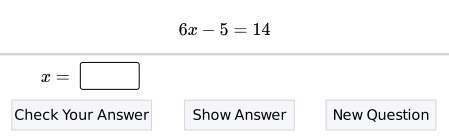
Solve the equations by using the Properties of Equality. If necessary, give answers as decimals rounded to two decimal places.
Example
Observing Nature
Zain and Jordan continued cruising along their cycling trip. The beauty of the ride became even more noticeable as they could hear songbirds! Some birds sang perched atop a power line.

A few more birds flew in and joined the flock. As a result, the number of birds doubled. Then, 4 birds flew away. In the end, 8 birds were left singing on the power line.
a Write an equation that models this situation. Use the variable b.
{"type":"text","form":{"type":"math","options":{"comparison":"1","nofractofloat":false,"keypad":{"simple":false,"useShortLog":false,"variables":["b"],"constants":[]},"rendered":false},"text":"<span class=\"katex\"><span class=\"katex-html\" aria-hidden=\"true\"><\/span><\/span>"},"formTextBefore":null,"formTextAfter":null,"answer":{"text":["2b-4=8","8 = 2b-4"]}}
b Solve the equation.
{"type":"text","form":{"type":"math","options":{"comparison":"1","nofractofloat":false,"keypad":{"simple":true,"useShortLog":false,"variables":["x"],"constants":["PI"]},"rendered":false},"text":"<span class=\"katex\"><span class=\"katex-html\" aria-hidden=\"true\"><\/span><\/span>"},"formTextBefore":"<span class=\"katex\"><span class=\"katex-html\" aria-hidden=\"true\"><span class=\"base\"><span class=\"strut\" style=\"height:0.69444em;vertical-align:0em;\"><\/span><span class=\"mord mathdefault\">b<\/span><span class=\"mspace\" style=\"margin-right:0.2777777777777778em;\"><\/span><span class=\"mrel\">=<\/span><\/span><\/span><\/span>","formTextAfter":null,"answer":{"text":["6"]}}
Hint
a Represent the unknown quantity with the variable.
b Use inverse operations to transfer all the variable terms to one side of the equation.
Solution
Original Number of Birds:b
The number of birds on the power line after more birds flew in is twice the original number of birds, or 2b. After 4 birds flew away, the number of birds on the power line becomes 2b−4. This expression is equal to 8. Using this information, an equation can be written.
2b−4=8
This equation models the given situation.
b When solving equations in one variable, the variable is isolated on one side of the equation. This can be done by using inverse operations because inverse operations undo each other. In this equation, the variable b is multiplied by 2 and then 4 is subtracted from the product.
2b−4=8
These operations need to be undone in reverse order. With that, the first operation to be undone is the subtraction. The inverse operation of subtraction is addition. Add 4 to each side of the equation. The Addition Property of Equality ensures that both sides of the equation remain equal.
Now the multiplication can be undone. The inverse operation of multiplication is division, so both sides of the equation are divided by 2. This does not change the solution to the equation by the Division Property of Equality.
2b=12
DivEqn
LHS/2=RHS/2
22b=212
CrossCommonFac
Cross out common factors
22b=212
CancelCommonFac
Cancel out common factors
b=212
CalcQuot
Calculate quotient
b=6
Example
Reaching the Target
Zain and Jordan successfully reached the music festival! The line to enter the festival is super long. Each came up with their own way to describe the difference between the time they expected to wait in line and the time they will actually have to wait.
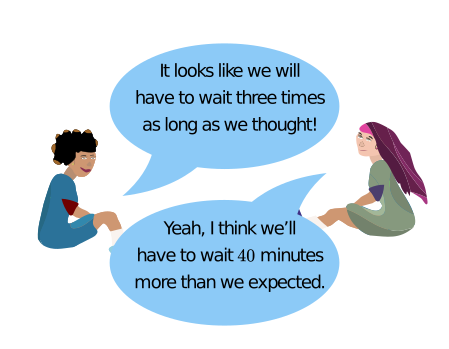
a Write an equation that models this situation. Use both descriptions provided by Zain and Jordan. Let variable t represent their original expected wait time.
{"type":"text","form":{"type":"math","options":{"comparison":"1","nofractofloat":false,"keypad":{"simple":false,"useShortLog":false,"variables":["t"],"constants":[]},"rendered":false},"text":"<span class=\"katex\"><span class=\"katex-html\" aria-hidden=\"true\"><\/span><\/span>"},"formTextBefore":null,"formTextAfter":null,"answer":{"text":["3t = t+40","t+40 = 3t"]}}
b Solve the equation.
{"type":"text","form":{"type":"math","options":{"comparison":"1","nofractofloat":false,"keypad":{"simple":true,"useShortLog":false,"variables":["x"],"constants":["PI"]},"rendered":false},"text":"<span class=\"katex\"><span class=\"katex-html\" aria-hidden=\"true\"><\/span><\/span>"},"formTextBefore":"<span class=\"katex\"><span class=\"katex-html\" aria-hidden=\"true\"><span class=\"base\"><span class=\"strut\" style=\"height:0.61508em;vertical-align:0em;\"><\/span><span class=\"mord mathdefault\">t<\/span><span class=\"mspace\" style=\"margin-right:0.2777777777777778em;\"><\/span><span class=\"mrel\">=<\/span><\/span><\/span><\/span>","formTextAfter":null,"answer":{"text":["20"]}}
c How long do Zain and Jordan have to wait in line? Give the time in minutes.
{"type":"text","form":{"type":"math","options":{"comparison":"1","nofractofloat":false,"keypad":{"simple":true,"useShortLog":false,"variables":["x"],"constants":["PI"]},"rendered":false},"text":"<span class=\"katex\"><span class=\"katex-html\" aria-hidden=\"true\"><\/span><\/span>"},"formTextBefore":null,"formTextAfter":"minutes","answer":{"text":["60"]}}
Hint
a Represent the unknown quantity with the variable. Zain and Jordan both described the same quantity.
b Use inverse operations to transfer all the variable terms to one side of the equation.
c Use Zain's or Jordan's description of the actual wait time.
Solution
Expected Wait Time:t
Zain's and Jordan's comments suggest two ways to write the actual wait time in terms of t. Zain said that the actual wait time was three times the expected wait time, or 3t. According to Jordan, the actual wait time was 40 minutes longer than expected, or t+40 minutes.
Actual Wait Time in Zain’s Words:Actual Wait Time in Jordan’s Words:3tt+40
In both cases, the value of the expression is the same. In other words, the actual wait time of Zain and Jordan is equal. This allows an equation to be written by setting both person's expressions equal to each other.
3t=t+40
b When solving equations with one variable, isolate that variable on one side of the equation. This can be done by using inverse operations to move all the variable terms to one side. In this equation, using the Subtraction Property of Equality to subtract t from both sides accomplishes that.
2t=40
DivEqn
LHS/2=RHS/2
22t=240
CrossCommonFac
Cross out common factors
22t=240
CancelCommonFac
Cancel out common factors
t=240
CalcQuot
Calculate quotient
t=20
c In Part A, the actual wait time was expressed in terms of the expected wait time t in two different ways.
Actual Wait Time in Zain’s Words:Actual Wait Time in Jordan’s Words:3tt+40
In Part B, the expected wait time t was found. The value of t, or 20 minutes, can be substituted for t in either expression for the actual wait time.
The actual time Zain and Jordan have to wait in line is 60 minutes. Closure
The Plan for the Trip
An equation that models the challenge presented at the beginning of this lesson can now be written and solved. Recall that Zain and Jordan planned to cycle the same distance for the first two days of their trip, and then cycle the remaining 10 miles on the last day.

Remember, the whole trip is 60 miles long. Making these calculations will ensure they make it to the festival on time!
a Write an equation in terms of d that represents the situation.
{"type":"text","form":{"type":"math","options":{"comparison":"1","nofractofloat":false,"keypad":{"simple":false,"useShortLog":false,"variables":["d"],"constants":[]},"rendered":false},"text":"<span class=\"katex\"><span class=\"katex-html\" aria-hidden=\"true\"><\/span><\/span>"},"formTextBefore":null,"formTextAfter":null,"answer":{"text":["2d+10=60","60=2d+10","2d=60-10","60-10=2d","60-2d=10","10=60-2d"]}}
b Solve the equation to find the distance Zain and Jordan planned to cover each of the first two days.
{"type":"text","form":{"type":"math","options":{"comparison":"1","nofractofloat":false,"keypad":{"simple":true,"useShortLog":false,"variables":[],"constants":[]},"rendered":false},"text":"<span class=\"katex\"><span class=\"katex-html\" aria-hidden=\"true\"><\/span><\/span>"},"formTextBefore":null,"formTextAfter":"miles","answer":{"text":["25"]}}
Hint
a Assign the variable to the number of miles Zain and Jordan planned to cycle on each of the first two days.
b Undo the operations applied to the variable in reverse order.
Solution
a Writing an equation that models a real-life situation requires using a variable to represent an unknown quantity. In this bicycle situation, the unknown quantity is the number of miles that Zain and Jordan planned to cycle on each of the first two days of their trip. This quantity can be represented by d.
Number of Miles:d
Next, the total number of miles can be expressed in terms of d. On each of the first two days, Zain and Jordan covered d miles. That means they cycled 2d miles the first two days. On the third day, they cycled 10 miles. The total number of miles cycled equals the first two days 2d plus the final 10 miles. Total Number of Miles:2d+10
Finally, this expression is set to equal the total length of the trip, or 60 miles.
2d+10=60
b The d-variable must be isolated to solve the equation. In this case, two operations are applied to the variable.
2d+10=60
First, d is multiplied by 2 and then 10 is added to the product. These operations are undone in reverse order using inverse operations. The first operation to be undone is the addition. This is done using the Subtraction Property of Inequality. 2d=50
DivEqn
LHS/2=RHS/2
22d=250
CrossCommonFac
Cross out common factors
22d=250
SimpQuot
Simplify quotient
d=250
CalcQuot
Calculate quotient
d=25

External credits: Freepik
Writing and Solving Two-Step Equations
Writing and Solving Two-Step Equations
Recommended exercises
To get personalized recommended exercises, please login first.
Loading content
Loading content