5. The Focus and Directrix of Parabolas
Sign In
An error ocurred, try again later!
Chapter 4
5.
The Focus and Directrix of Parabolas
Parabolas are unique curves that have a geometric definition based on a set of points equidistant from a fixed point, known as the focus, and a fixed line, termed the directrix. This relationship between the focus and directrix gives rise to the equation of the parabola. The lesson delves into the algebraic and geometric representations of parabolas, highlighting their reflective properties. These properties have practical applications, such as in satellite dish designs, where signals from space reflect off the dish and converge at the focus. The shape of a parabola and its equation can vary based on the position of the focus and directrix, leading to different forms of the equation. The exploration also touches upon transformations that can change the focus and directrix, providing insights into the versatile nature of parabolas in mathematics.
Show less Show more expand_more 


Lesson Settings & Tools
| | 9 Theory slides |
| | 9 Exercises - Grade E - A |
| | Each lesson is meant to take 1-2 classroom sessions |
The Focus and Directrix of Parabolas
Slide of 9
This lesson will explore the geometric and algebraic representations of a parabola.
Catch-Up and Review
Here are a few recommended readings before getting started with this lesson.
Try your knowledge on these topics.
a In the diagram, the distance between points A and B is the same as the distance between points A and C.
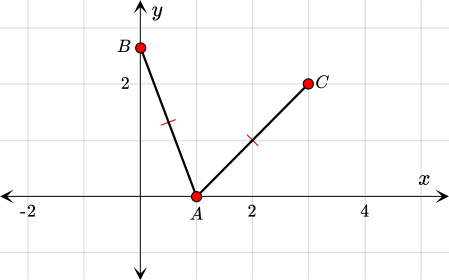
Use the Distance Formula to find the y-coordinate of B. If necessary, round your answer to 2 decimal places.
{"type":"text","form":{"type":"math","options":{"comparison":"1","nofractofloat":false,"keypad":{"simple":true,"useShortLog":false,"variables":[],"constants":[]},"rendered":false},"text":" "},"formTextBefore":"y=","formTextAfter":null,"answer":{"text":["2.65","\\sqrt{7}"]}}
b The graph of f(x) is translated 3 units to the right and 3 units up. Which of the following functions represent the equation of the resulting graph?
{"type":"choice","form":{"alts":["f(x+3)-3","f(x-3)+3","f(x+3)+3","f(x-3)\/3"],"noSort":false},"formTextBefore":"","formTextAfter":"","answer":1}
Explore
Share
Report error
Investigating Points that Are Equidistant from a Pair of Points
In the following applet, points A and B are plotted. By moving point C, all the points that are equidistant from A and B can be seen.
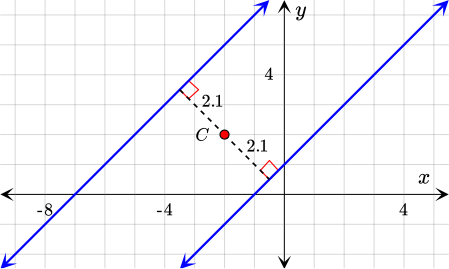
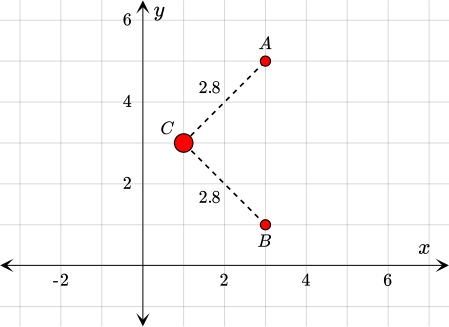 As it can be seen above, the locus of these points form a line. Similarly, the locus of all the points that are equidistant from two parallel lines also form a line. In fact, they form a line that is also parallel to the given lines.
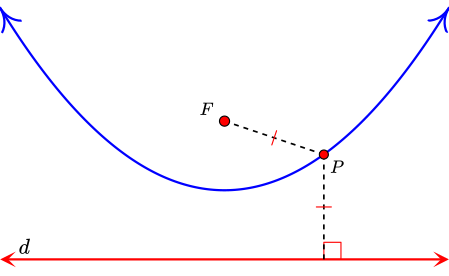
 Now, think about the locus of all points equidistant from a line and a point not on the line. What type of curve do you think the locus of these points forms?
Discussion
Share
Report error
Parabola
Example
Share
Report error
Properties of a Parabola
In the applet below, point P is equidistant from point F and line d.
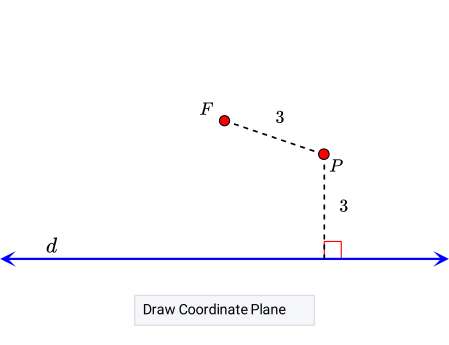 Zosia claims that the points equidistant from point F and line d form a parabola. Her friend Heichi, however, claims that the points form some kind of closed curve. Who is correct?
{"type":"choice","form":{"alts":["Zosia","Heichi","None"],"noSort":false},"formTextBefore":"","formTextAfter":"","answer":0}
Hint
Is it possible to find a point P directly above F so that the distance from P to F and the distance from P to d are the same?
Solution
It is not possible to find a point P directly above F so that the distance from F to P is the same as the distance from d to P. Therefore, the curve formed by the points that are equidistant from F and d cannot be a closed curve. 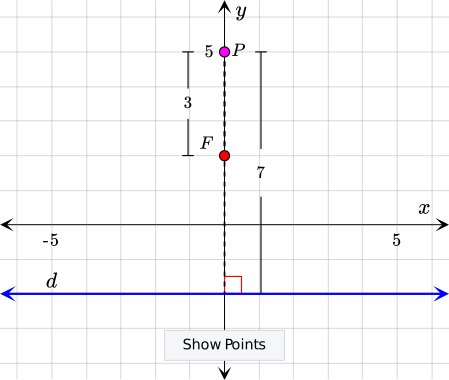 Considering point F and line d, there are infinitely many points are equidistant from F and d. These points extend infinitely to the left, right, and upward. Therefore, Heichi's claim is false. Furthermore, as defined earlier, all points on a plane equidistant from a point and a line form a parabola. This means that Zosia is correct.
Example
Share
Report error
Using the Distance Formula To Calculate Points on a Parabola
The equation of a parabola can be found using the Distance Formula.
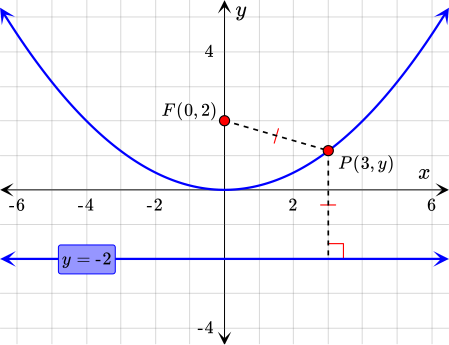
Consider the previous parabola, this time drawn on a coordinate plane. The focus of the parabola is F(0,2), and its directrix is the line with the equation y=- 2. Consider also a point P with an x-coordinate of 3, lying on the parabola.
{"type":"text","form":{"type":"math","options":{"comparison":"1","nofractofloat":false,"keypad":{"simple":true,"useShortLog":false,"variables":[],"constants":[]},"rendered":false},"text":" "},"formTextBefore":"y=","formTextAfter":null,"answer":{"text":["\\dfrac{9}{8}","1.125"]}}
{"type":"text","form":{"type":"math","options":{"comparison":"1","nofractofloat":false,"keypad":{"simple":false,"useShortLog":false,"variables":["x"],"constants":[]},"rendered":false},"text":" "},"formTextBefore":"y=","formTextAfter":null,"answer":{"text":["\\dfrac{x^2}{8}","\\dfrac{1}{8}x^2","0.125x^2"]}}
Hint
Use the Distance Formula to express the distance from the focus F(0,2) to the point P(3,y).
Solution
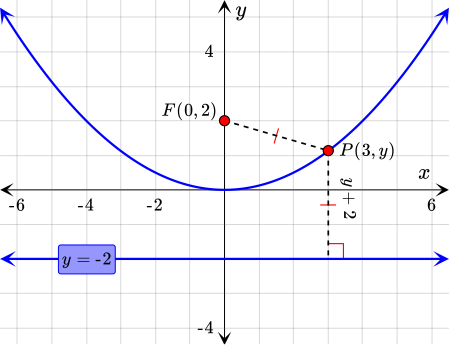
Note that the directrix of the parabola is a horizontal line. Therefore, the distance between P(3,y) and the directrix is given by the length of the vertical segment that connects P and the line. This length is the difference between the y-coordinate of P and - 2, which is the y-coordinate of every point on the line. d=y-(- 2) ⇔ d=y+2 Recall that a parabola is the set of all the points in a plane that are equidistant from a point called focus and a line called directrix. Since point P is on the parabola, it is equidistant from the directrix and the focus.
d = sqrt((x_2-x_1)^2+(y_2-y_1)^2)
SubstituteValues
Substitute values
y+2 = sqrt(( 3- 0)^2+( y- 2)^2)
▼
Solve for y
SubTerm
Subtract term
y+2 = sqrt(3^2+(y-2)^2)
CalcPow
Calculate power
y+2 = sqrt(9+(y-2)^2)
RaiseEqn
LHS^2=RHS^2
(y+2)^2 = 9+(y-2)^2
ExpandPosNegPerfectSquare
(a± b)^2=a^2± 2ab+b^2
y^2+4y+4 = 9+y^2-4y+4
SubEqn
LHS-y^2=RHS-y^2
4y+4 = 9-4y+4
SubEqn
LHS-4=RHS-4
4y=9-4y
AddEqn
LHS+4y=RHS+4y
8y=9
DivEqn
.LHS /8.=.RHS /8.
y=9/8
d = sqrt((x_2-x_1)^2+(y_2-y_1)^2)
SubstituteValues
Substitute values
y+2 = sqrt(( x- 0)^2+( y- 2)^2)
▼
Solve for y
SubTerm
Subtract term
y+2 = sqrt(x^2+(y-2)^2)
RaiseEqn
LHS^2=RHS^2
(y+2)^2 = x^2+(y-2)^2
ExpandPosNegPerfectSquare
(a± b)^2=a^2± 2ab+b^2
y^2+4y+4 = x^2+y^2-4y+4
SubEqn
LHS-y^2=RHS-y^2
4y+4 = x^2-4y+4
SubEqn
LHS-4=RHS-4
4y=x^2-4y
AddEqn
LHS+4y=RHS+4y
8y=x^2
DivEqn
.LHS /8.=.RHS /8.
y=x^2/8
MoveNumRight
a/b=1/b* a
y=1/8x^2
Discussion
Share
Report error
Equation of a Parabola From Focus and Directrix
Keeping the previous example in mind, consider a parabola with focus (0,p) and directrix y=- p. How can its equation be obtained?
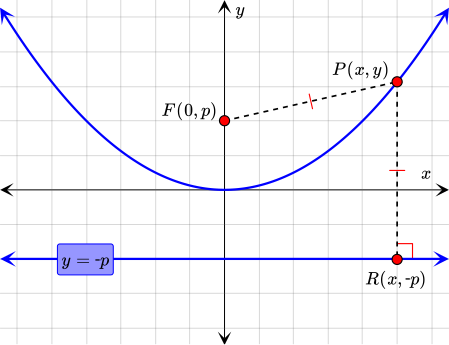
By definition, any point P(x,y) on the parabola must be equidistant from the focus and the directrix. This means that FP and RP are congruent segments. Therefore, they have the same length. The Distance Formula can be used to write an expression for each length.
| d = sqrt((x_2-x_1)^2 + (y_2-y_1)^2) | ||
|---|---|---|
| Points | Substitution | Simplififcation |
| F( 0, p) and P( x, y) | FP = sqrt(( x- 0)^2+( y- p)^2) | FP = sqrt(x^2+(y-p)^2) |
| R( x, - p) and P( x, y) | RP = sqrt(( x- x)^2+( y-( - p) )^2) | RP = sqrt((y+p)^2) |
sqrt(x^2+(y-p)^2)=sqrt((y+p)^2)
▼
Solve for y
RaiseEqn
LHS^2=RHS^2
x^2+(y-p)^2=(y+p)^2
ExpandPosNegPerfectSquare
(a± b)^2=a^2± 2ab+b^2
x^2+y^2-2yp+p^2=y^2+2yp+p^2
SubEqn
LHS-y^2=RHS-y^2
x^2-2yp+p^2=2yp+p^2
SubEqn
LHS-p^2=RHS-p^2
x^2-2yp=2yp
AddEqn
LHS+2yp=RHS+2yp
x^2= 4yp
DivEqn
.LHS /4p.=.RHS /4p.
x^2/4p=y
MoveNumRight
a/b=1/b* a
1/4px^2=y
RearrangeEqn
Rearrange equation
y=1/4px^2
Example
Share
Report error
Finding the Equation of a Parabola
In the graph, a parabola with the focus at (1,2) and directrix y=4 is shown.
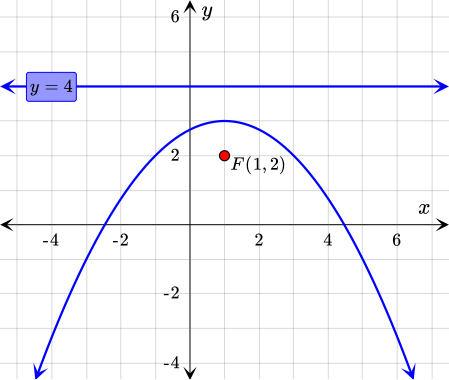
a Use the definition of a parabola to find its equation.
b Consider a parabola with focus at (0,- 1) and directrix y=1. Determine the transformations that could be applied to the graph of this parabola so that the given graph is obtained.
c Use the equation of the parabola in Part B and the transformations applied to write the equation of the given parabola. Is it the same equation as the equation from Part A?
Answer
a y=- 1/4x^2+1/2x+11/4
b The given graph is the graph of y=- 14x^2 translated 1 unit to the right and 3 units up.
c Equation: y=- 1/4(x-1)^2+3
Is It the Same Equation as in Part A? Yes, when the right-hand side of this equation is simplified, it results in the same equation as in Part A.
Is It the Same Equation as in Part A? Yes, when the right-hand side of this equation is simplified, it results in the same equation as in Part A.
Hint
a The distance between any point P(x,y) on the parabola and the directrix is 4-y.
b What is the transformation that maps the point (0,- 1) onto the point (1,2)?
c How does the equation of a quadratic function change when it is translated horizontally or vertically?
Solution
a Let P(x,y) be any point on the given parabola. Then, the distance form this point to the directrix y=4 is 4-y. 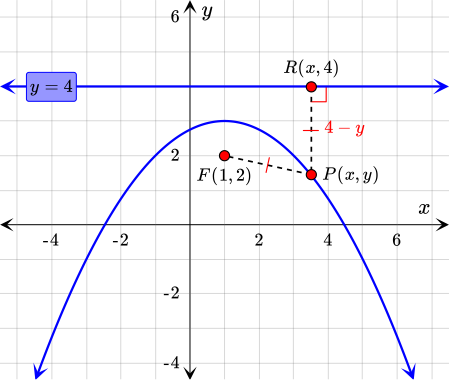
Since P(x,y) is equidistant from F(1,2) and the line y=4, it is known that FP and RP are equal. Therefore, FP is also 4-y. By substituting this information together with the points F( 1, 2) and P( x, y) into the Distance Formula, the equation of the parabola can be obtained.
d = sqrt((x_2-x_1)^2+(y_2-y_1)^2)
SubstituteValues
Substitute values
4-y = sqrt(( x- 1)^2+( y- 2)^2)
▼
Solve for y
RaiseEqn
LHS^2=RHS^2
(4-y)^2=(x-1)^2+(y-2)^2
ExpandNegPerfectSquare
(a-b)^2=a^2-2ab+b^2
16-8y+y^2=x^2-2x+1+y^2-4y+4
AddTerms
Add terms
16-8y+y^2=x^2-2x+y^2-4y+5
SubEqn
LHS-y^2=RHS-y^2
16-8y=x^2-2x-4y+5
SubEqn
LHS-16=RHS-16
- 8y=x^2-2x-4y-11
AddEqn
LHS+4y=RHS+4y
- 4y=x^2-2x-11
DivEqn
.LHS /(- 4).=.RHS /(- 4).
y=x^2-2x-11/- 4
WriteDiffFrac
Write as a difference of fractions
y=x^2/- 4-2x/- 4-11/- 4
MovePartNumRight
a* b/c=a/c* b
y=1/- 4x^2-2/- 4x-11/- 4
MoveNegDenomToFrac
Put minus sign in front of fraction
y=- 1/4x^2-(- 2/4)x-(- 11/4)
SubNeg
a-(- b)=a+b
y=- 1/4x^2+2/4x+11/4
ReduceFrac
a/b=.a /2./.b /2.
y=- 1/4x^2+1/2x+11/4
b Consider a parabola with focus at (0,- 1) and directrix y=1.
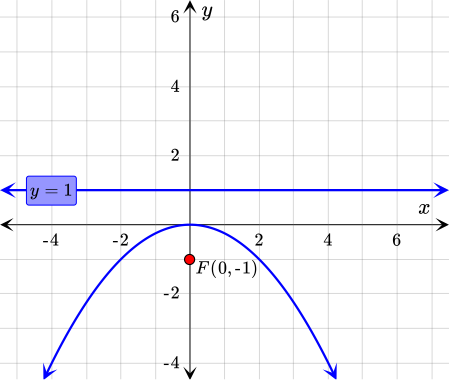
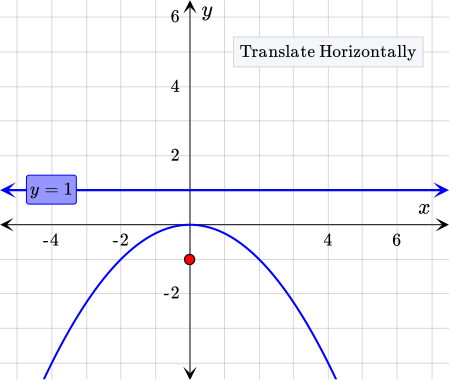
Notice that after a translation 1 unit to the right and 3 units up, the image of the focus of this parabola is the focus of the given parabola. The parabola can be obtained by translating the the above curve 1 unit to the right and 3 units up.
c In a previous example, the equation of a parabola with focus (0, p) and directrix y= - p was obtained. Using this information, the equation of a parabola with focus (0, - 1) and directrix y= 1 can be obtained.
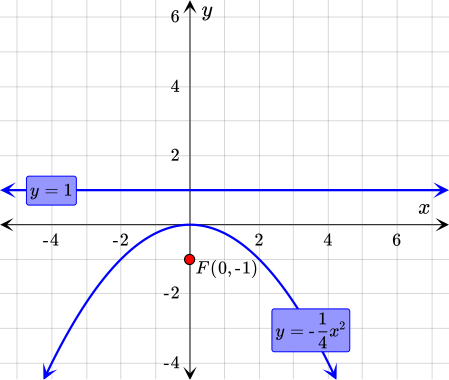
The given parabola is the image of the parabola with equation y=- 14x^2 after a translation 1 unit to the right and 3 units up. With that as a guide, the equation of the given parabola can be written.
y =- 1/4(x- 1)^2+ 3
Expanding the square of the binomial and simplifying will give the equation found in Part A.
It is noteworthy that the transformations can change the focus and the directrix.
| Focus | Directrix | Equation |
|---|---|---|
| (0, p) | y= - p | y=1/4 px^2 |
| (0, - 1) | y= - (- 1) ⇕ y=1 |
y=1/4( - 1)x^2 ⇕ y=- 1/4x^2 |
Therefore, the equation of the parabola with focus at (0,- 1) and directrix y=1 is y=- 14x^2.
Recall the general form for translations of functions.
| Transformations of f(x) | |
|---|---|
| Horizontal Translations | Translation right h units, h>0 y=f(x- h) |
| Translation left h units, h>0 y=f(x+ h) | |
| Vertical Translations | Translation up k units, k>0 y=f(x)+ k |
| Translation down k units, k>0 y=f(x)- k | |
y =- 1/4(x-1)^2+3
▼
Simplify right-hand side
ExpandNegPerfectSquare
(a-b)^2=a^2-2ab+b^2
y =- 1/4(x^2-2x+1)+3
Distr
Distribute - 1/4
y =- 1/4x^2+2x/4-1/4+3
MovePartNumRight
a* b/c=a/c* b
y =- 1/4x^2+2/4x-1/4+3
ReduceFrac
a/b=.a /2./.b /2.
y =- 1/4x^2+1/2x-1/4+3
NumberToFrac
a = 4* a/4
y =- 1/4x^2+1/2x-1/4+12/4
AddFrac
Add fractions
y =- 1/4x^2+1/2x+11/4 ✓
| Equation | Focus | Directrix |
|---|---|---|
| y=- 1/4x^2 | (0,- 1) | y=1 |
| y=- 1/4(x-1)^2 | (1,- 1) | y=1 |
| y =- 1/4(x-1)^2+3 | (1,2) | y=4 |
Example
Share
Report error
Investigating Horizontal Parabolas
Up to this point, parabolas whose directrices are parallel to the x-axis have been discussed. Next, parabolas whose directrices are parallel to the y-axis will be examined.
Izabella is making an original video game character. She wants a force field in the shape of a parabola. When the character is at F(- 4,- 2) and the opposing team's army is on vertical line x=2, the force field will appear as shown in the graph.
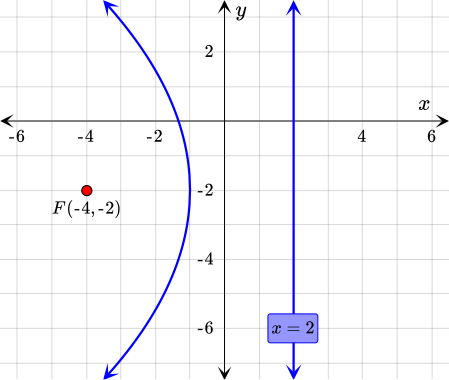
a Help Izabella to determine whether the parabola can be the graph of a function.
b Knowing the equation of the parabola will help Izabella in designing the force field shape. Use the definition of a parabola to find its equation.
Answer
a The parabola is not the graph of a function.
b x = - 1/12(y+2)^2-1
Hint
a Use the Vertical Line Test to check whether the curve can be the graph of a function.
b Use the definition of a parabola and the Distance Formula.
Solution
a The Vertical Line Test can be used to determine if the parabola can represent the graph of a function. 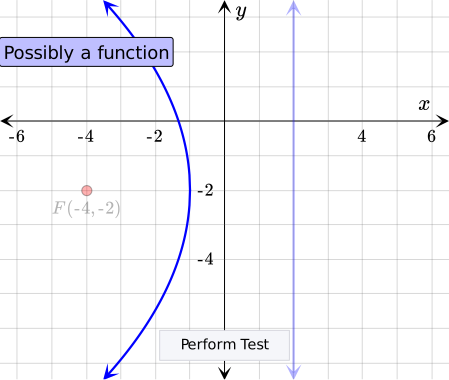 The vertical line intersects the graph more than once several times. Therefore, this parabola cannot be the graph of a function. Accordingly, the equation of this parabola is not a function. Furthermore, its equation does not have the same form as the equations of parabolas whose directrices are parallel to the x-axis.
b For any point P(x,y) on the parabola, the distance from the directrix x=4 must be the same as the distance from the focus F(- 4,- 2).
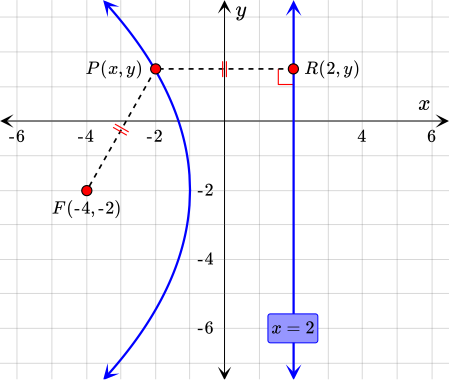 To be specific, FP and RP must be congruent. To write an expression for each length, the Distance Formula can be used.
Now, setting the expressions equal to each other makes it possible to write an equation.
It can be seen that the equation does not include any x^2-term. Therefore, it will be easier to solve for x.
Alas! Izabella has found the equation. It can be simplified if desired. However, since it is acceptable to write the equation as it is, further simplifications will not be performed. This quadratic equation corresponds to the given parabola, whose directrix is parallel to the y-axis.
| d = sqrt((x_2-x_1)^2 + (y_2-y_1)^2) | ||
|---|---|---|
| Points | Substitution | Simplififcation |
| F( - 4, - 2) and P( x, y) | FP = sqrt(( x-( - 4))^2+( y-( - 2))^2) | FP = sqrt((x+4)^2+(y+2)^2) |
| R( 2, y) and P( x, y) | RP = sqrt(( x- 2)^2+( y- y )^2) | RP = sqrt((x-2)^2) |
sqrt((x+4)^2+(y+2)^2) = sqrt((x-2)^2)
RaiseEqn
LHS^2=RHS^2
(x+4)^2+(y+2)^2 = (x-2)^2
ExpandPosNegPerfectSquare
(a± b)^2=a^2± 2ab+b^2
x^2+8x+16+(y+2)^2 = x^2-4x+4
SubEqn
LHS-x^2=RHS-x^2
8x+16+(y+2)^2 = - 4x+4
8x+16+(y+2)^2 = - 4x+4
▼
Solve for x
AddEqn
LHS+4x=RHS+4x
12x+16+(y+2)^2 =4
SubEqn
LHS-16=RHS-16
12x+(y+2)^2 =- 12
SubEqn
LHS-(y+2)^2=RHS-(y+2)^2
12x=- (y+2)^2-12
DivEqn
.LHS /12.=.RHS /12.
x=- (y+2)^2-12/12
WriteDiffFrac
Write as a difference of fractions
x=- (y+2)^2/12-12/12
MoveNegNumToFrac
Put minus sign in front of fraction
x=- (y+2)^2/12-12/12
MoveNumRight
a/b=1/b* a
x=- 1/12(y+2)^2-12/12
QuotOne
a/a=1
x=- 1/12(y+2)^2-1
Closure
Share
Report error
Parabolas in the Real World
What is the purpose of designing a satellite dish in the form of a paraboloid, or a three-dimensional parabola?
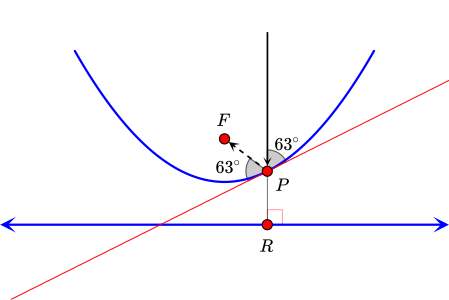
The shape of a parabola brings along an important reflective property. This property is used to collect or project light, sound, or radio waves. For this reason, satellite dishes are designed in the form of paraboloids — surfaces generated by the rotation of a parabola around its axis of symmetry.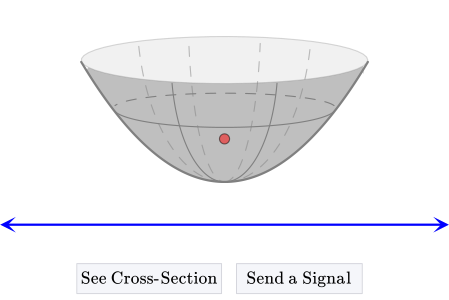
The Focus and Directrix of Parabolas
Exercise 2.1
Outside of New York, there is a lighthouse on a small island at a distance of 5 nautical miles from a straight shoreline. One day, Captain Conic has anchored his ship MS Parabola
between the lighthouse and the shoreline.
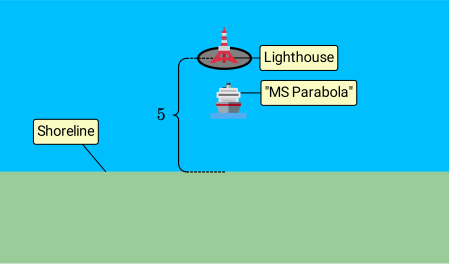
When anchored, the distance from the ship to the lighthouse SL is 2 nautical miles, and the distance from the ship to the shoreline SS is 3 nautical miles.
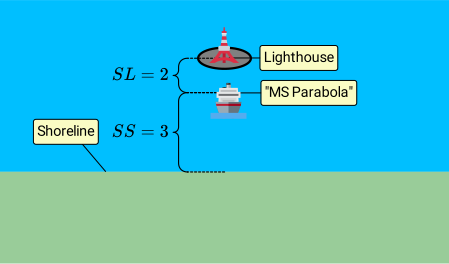
When the captain decided to weigh anchor, he gave his helmsman order to sail MS Parabola
so that the difference between SS and SL remained constant at 1 nautical mile. This made the route of the ship form a parabola.
{"type":"text","form":{"type":"math","options":{"comparison":"1","nofractofloat":false,"keypad":{"simple":false,"useShortLog":false,"variables":["y"],"constants":["PI"]},"rendered":false},"text":" "},"formTextBefore":"Directrix:","formTextAfter":null,"answer":{"text":["y=1","1=y"]}}
{"type":"text","form":{"type":"math","options":{"comparison":"1","nofractofloat":false,"keypad":{"simple":false,"useShortLog":false,"variables":["x"],"constants":["PI"]},"rendered":false},"text":" "},"formTextBefore":"y=","formTextAfter":null,"answer":{"text":["\\dfrac{1}{8}x^2+3","\\dfrac{x^2}{8}+3"]}}
security
report
code
security
report
code
We will place the lighthouse at (0,5) and we will let the x-axis represent the shoreline.
If the difference between SS and SL is always 1 nautical mile, we can describe the path of the parabola with a focus in (0,5) and a directrix of y=1.
To write the equation that represents the path of the ship, we will consider the standard equation of a vertical parabola with vertex (h,k).
VERTICAL PARABOLA
y=1/4 p(x- h)^2+ k [0.4em]
[-1em]
&Vertex: ( h, k)
&Focus: ( h, k+ p)
&Directrix: y= k- p
From the diagram in Part A we know that the vertex is in ( 0, 3). We also know that the directrix is the horizontal line y= 1. Let's add this information to the standard equation.
y=1/4 p(x- 0)^2+ 3 [0.4em]
[-1em]
&Vertex: ( 0, 3)
&Focus: ( 0, 3+ p)
&Directrix: 1= 3- p
To finalize the equation, we have to solve for p.
By substituting p=2 in the expression, we can write the final equation.
security
report
code
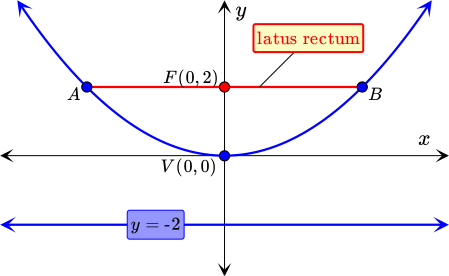
Every parabola has something called the latus rectum. This is the line segment that is parallel to the directrix, passes through the focus, and with endpoints on the parabola. Find the length of the latus rectum of the following parabola.
{"type":"text","form":{"type":"math","options":{"comparison":"1","nofractofloat":false,"keypad":{"simple":true,"useShortLog":false,"variables":["x"],"constants":["PI"]},"rendered":false},"text":" "},"formTextBefore":"Latus rectum:","formTextAfter":"units","answer":{"text":["8"]}}
security
report
code
security
report
code
Let's start by finding the equation of the parabola. From the diagram, we see that its vertex is in the origin. It also has a vertical axis of symmetry. This means we can describe the parabola with the following equation. y=1/4 px^2 In this equation, p is the y-coordinate of the focus.
In the diagram we can see that the focus is in the point (0, 2). This means that if we substitute p= 2 we can write the equation of the parabola.
Now we need to find the endpoints of latus rectum. Notice that these points will have the same y-coordinate as the focus.
To determine the x-coordinates, x_A and x_B, we will substitute 2 for y in the equation of the parabola and solve for x.
Notice that Point B lies in the first quadrant. Therefore, this point has the coordinates (4,2). Point A is in the second quadrant which means its coordinates are (- 4,2). The distance between these two points is the difference between the x-coordinates.
The length of latus rectum is 8 units.
security
report
code
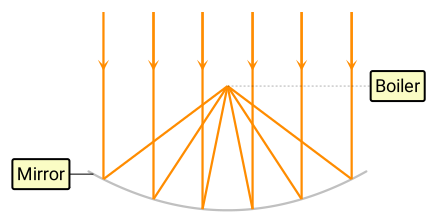
Solar energy can be harnessed using mirrors with a parabolic shaped cross section that have a boiler in the focus.
{"type":"text","form":{"type":"math","options":{"comparison":"1","nofractofloat":false,"keypad":{"simple":false,"useShortLog":false,"variables":["x"],"constants":["PI"]},"rendered":false},"text":" "},"formTextBefore":"y=","formTextAfter":null,"answer":{"text":["\\dfrac{1}{7.2}*x^2","\\dfrac{x^2}{7.2}"]}}
security
report
code
security
report
code
Notice that the equation should be on the form y=ax^2. This means the parabola is vertical and should have its vertex at the origin. The boiler is 1.8 kilometers from the mirror. This means the focus F of the parabola is located at (0, 1.8).
A parabola with its vertex at the origin can be written using the following formula. y=1/4 px^2 The variable p is the y-coordinate of the focus. Therefore, if we substitute p= 1.8 into the equation, we can determine the parabola.
Now we can draw the parabola.
security
report
code
The Focus and Directrix of Parabolas
Recommended exercises
To get personalized recommended exercises, please login first.
Loading content
≤
>
■2
■▢
e▢
7
8
9
×
÷■1
=
=
√▢
▢√
∫▢▢
4
5
6
+
−
≤
<
log
ln
log▢
1
2
3
()
∣
sin
cos
tan
0
.
π
x
y
Loading content